+91 945 889 6091
  infodesk@ibluu.com
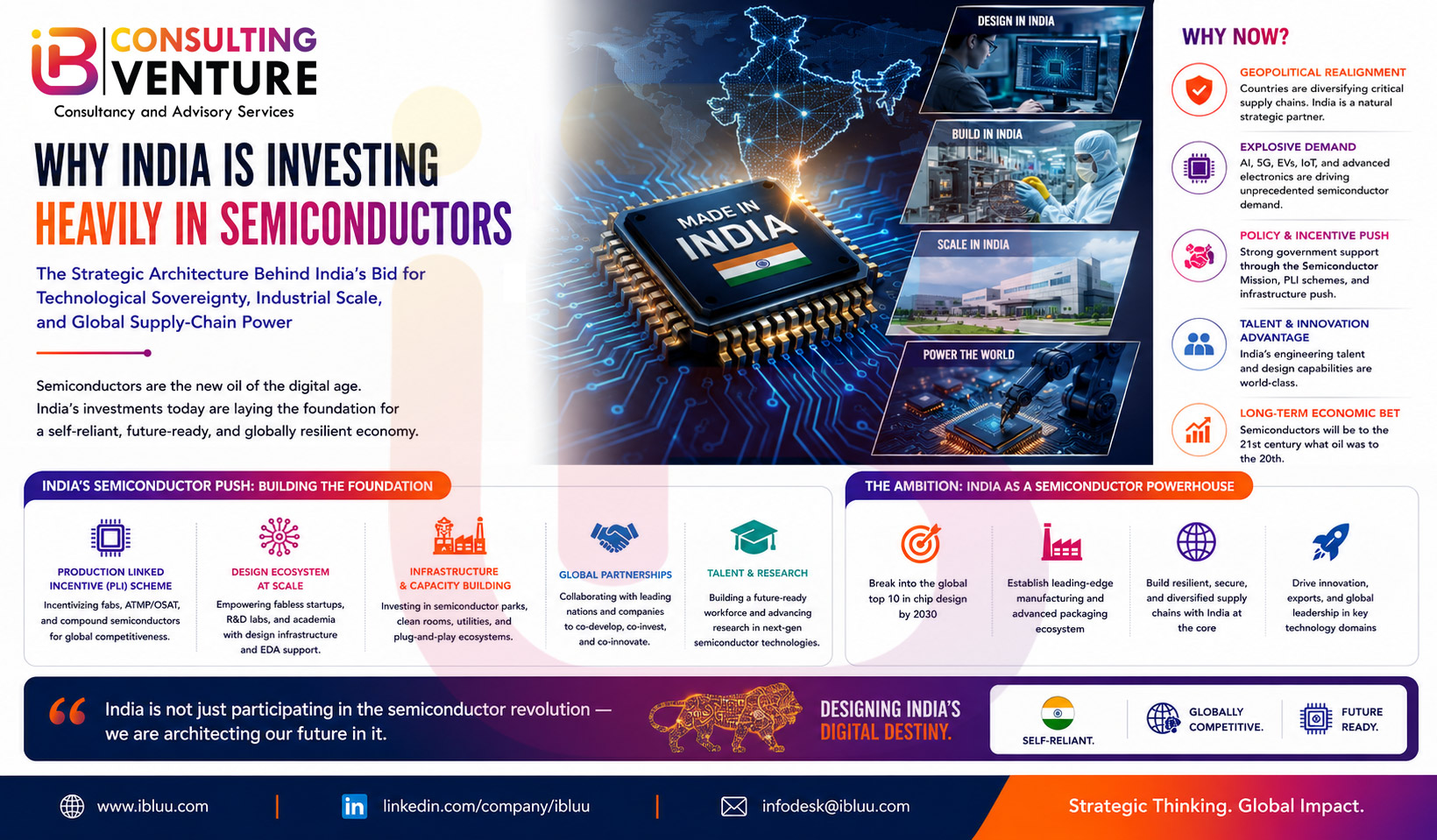
Why India Is Investing Heavily in Semiconductors: The Strategic Architecture Behind India’s Bid for Technological Sovereignty, Industrial Scale, and Global Supply-Chain Power
India’s semiconductor push is no longer an industrial policy experiment.
It is rapidly becoming one of the most consequential economic and geopolitical transformations in the country’s post-liberalization history.
What appears on the surface as a manufacturing initiative is, in reality, a far deeper strategic recalibration — one designed to reposition India from a technology-consuming economy into a globally integrated electronics, semiconductor, AI, defense-tech, and digital infrastructure power.
The global semiconductor industry is now the foundation layer of modern civilization. From AI servers, EVs, smartphones, telecom systems, satellites, and defense electronics to renewable energy infrastructure and industrial automation — semiconductors determine economic competitiveness, national security, and technological sovereignty.
And India understands that dependence on external semiconductor ecosystems is no longer strategically sustainable.
Why Semiconductors Have Become a National Strategic Priority for India
The semiconductor supply shock during the COVID-era exposed one brutal reality:
Countries without semiconductor manufacturing capability are economically vulnerable.
The crisis disrupted:
- automotive manufacturing
- consumer electronics
- telecom infrastructure
- defense production
- renewable energy equipment
- industrial automation systems
Simultaneously, escalating US–China technology tensions, Taiwan Strait geopolitical risks, and export-control wars accelerated the global diversification of semiconductor supply chains.
This created a once-in-a-generation strategic opening for India.
India’s semiconductor mission is therefore being built around five national objectives:
| Strategic Objective | Why It Matters |
|---|---|
| Technological Sovereignty | Reduce dependency on external chip ecosystems |
| Manufacturing Expansion | Support India’s electronics manufacturing ambitions |
| Export Competitiveness | Position India in global semiconductor supply chains |
| National Security | Secure defense and critical infrastructure electronics |
| AI & Digital Economy | Enable future AI, cloud, telecom, and EV infrastructure |
India’s Semiconductor Market: Scale of the Opportunity
India’s semiconductor consumption market is expanding at extraordinary speed.
Semiconductor Market Outlook
| Metric | 2026 Estimate | 2030 Projection | 2035 Projection |
|---|---|---|---|
| India Semiconductor Market Size | ~$55–60 Billion | ~$110–120 Billion | ~$180–200 Billion |
| Electronics Manufacturing Market | ~$180 Billion | ~$300 Billion+ | ~$500 Billion+ |
| Contribution to GDP | Emerging Strategic Sector | Major Industrial Driver | Core Economic Infrastructure |
| Expected Export Opportunity | Limited but Growing | Significant | Global Supply Chain Integration |
India currently imports the overwhelming majority of its semiconductor requirements — particularly for:
- smartphones
- telecom systems
- automotive electronics
- industrial equipment
- AI servers
- consumer electronics
- defense systems
This import dependence creates both:
- A strategic vulnerability
- A massive domestic manufacturing opportunity
India’s Semiconductor Ecosystem in 2026: Plants Running, Under Construction, and Approved
India’s semiconductor ecosystem is moving from policy announcements into physical execution. As of 2026, more than 10 major semiconductor projects have been approved across multiple states, with total committed investments exceeding ₹1.6 lakh crore.
Major Semiconductor Projects in India
| State | Company / JV | Project Type | Investment |
|---|---|---|---|
| Gujarat | Tata Electronics + PSMC (Taiwan) | Semiconductor Fab | ₹91,000 Cr |
| Gujarat | Micron Technology (US) | ATMP Facility | ₹22,500 Cr |
| Gujarat | CG Power + Renesas (Japan) + Stars | OSAT | ₹7,600 Cr |
| Gujarat | Kaynes Semicon | OSAT | ₹3,300 Cr |
| Assam | Tata Electronics | Semiconductor Assembly & Testing | ₹27,000 Cr |
| Uttar Pradesh | HCL + Foxconn | Display Driver Chip Unit | ₹3,700 Cr |
| Odisha | SiCSem | Compound Semiconductor | ₹2,000+ Cr |
| Odisha | HIPSPL | Semiconductor Unit | ₹1,900+ Cr |
| Punjab | CDIL | Chip Packaging | Existing Expansion |
| Andhra Pradesh | ASIP | Specialty Semiconductor | Emerging |
Gujarat Has Emerged as India’s Semiconductor Capital
No state has moved faster than Gujarat.
Sanand and Dholera are rapidly transforming into India’s first semiconductor manufacturing cluster, supported by:
- industrial land availability
- power infrastructure
- logistics connectivity
- investor-friendly policies
- proximity to ports
- strong political backing
Gujarat alone accounts for over ₹1.24 lakh crore of semiconductor investments.
The state now hosts:
- India’s first semiconductor fab
- India’s first operational ATMP facility
- multiple OSAT plants
- compound semiconductor projects
- semiconductor-focused SEZs
The Biggest Semiconductor Players in India (2026)
1. Tata Electronics + PSMC (Taiwan)
India’s largest semiconductor investment.
Key Details:
- Location: Dholera, Gujarat
- Investment: ₹91,000 crore
- Technology Partner: Powerchip Semiconductor Manufacturing Corporation
- Type: Wafer fabrication plant
- Target Node: 28nm mature-node chips
- Capacity: 50,000 wafer starts/month
Focus Areas:
- automotive chips
- power electronics
- telecom
- industrial systems
- consumer electronics
India’s first “true fab” is strategically critical because wafer fabrication represents the highest-value layer of the semiconductor chain.
2. Micron Technology (United States)
Micron Technology established India’s first operational semiconductor facility.
Key Details:
- Location: Sanand, Gujarat
- Investment: ~$2.75 billion
- Facility Type: ATMP (Assembly, Testing, Marking, Packaging)
Products:
- DRAM memory
- NAND flash storage
Target Markets:
- laptops
- servers
- data centers
- AI infrastructure
- consumer electronics
Micron has already begun commercial production and exports.
3. CG Power + Renesas + Stars Microelectronics
A major Indo-Japanese semiconductor alliance.
Focus:
- OSAT operations
- advanced packaging
- automotive semiconductors
- industrial electronics
Strategic Importance:
Japan is increasingly viewing India as a trusted semiconductor diversification partner amid geopolitical tensions in East Asia.
4. Kaynes Semicon
Among India’s fastest-scaling domestic semiconductor companies.
Focus:
- OSAT
- chip packaging
- industrial electronics
- automotive applications
- IoT systems
Kaynes plans production capacity of nearly 1 billion chips annually.
Why Foreign Companies Are Partnering with India
India offers four major advantages global semiconductor companies can no longer ignore:
| Strategic Factor | India’s Advantage |
|---|---|
| Market Scale | One of world’s fastest-growing electronics markets |
| Geopolitical Position | Trusted alternative to China concentration |
| Engineering Talent | Massive semiconductor design workforce |
| Government Incentives | Aggressive subsidy structure |
Today, India already contributes significantly to global chip design:
- Intel
- Qualcomm
- AMD
- Nvidia
- Broadcom
- Texas Instruments
all operate major semiconductor design centers in India.
India’s long-term ambition is clear:
Move from “Design in India” → “Design + Make in India.”
Government Incentives and Semiconductor Policies
India’s semiconductor push is heavily backed by policy intervention.
Key Government Schemes
India Semiconductor Mission (ISM)
- ₹76,000 crore original incentive program
- expanded further under ISM 2.0
Production-Linked Incentive (PLI)
Supports electronics manufacturing ecosystems.
Design-Linked Incentive (DLI)
Encourages domestic chip design startups.
Semiconductor SEZ Reforms
Government reduced minimum land requirement for semiconductor SEZs from 50 hectares to 10 hectares.
State-Level Incentives
States provide:
- subsidized land
- power incentives
- capital support
- infrastructure support
- tax exemptions
Domestic Use vs Export Opportunity
India’s semiconductor strategy has two parallel objectives:
1. Domestic Demand Fulfillment
India’s electronics demand is exploding across:
- EVs
- smartphones
- AI
- telecom
- defense
- renewable energy
- industrial automation
2. Export Positioning
India aims to integrate into global semiconductor value chains via:
- ATMP
- OSAT
- specialty semiconductors
- mature-node manufacturing
- chip packaging
India is unlikely to compete immediately with:
- Taiwan
- South Korea
- TSMC
- Samsung
in advanced 3nm or 2nm fabs.
But India can become globally competitive in:
- mature-node chips
- automotive semiconductors
- industrial chips
- packaging and testing
- power semiconductors
- compound semiconductors
Why This Matters Geopolitically
Semiconductors are no longer merely commercial infrastructure.
They are strategic infrastructure.
The semiconductor race now intersects with:
- AI supremacy
- defense systems
- cyber capabilities
- space technology
- telecom sovereignty
- industrial resilience
The United States, Japan, Taiwan, and Europe increasingly see India as a strategic balancing geography in the global semiconductor realignment.
This explains why semiconductor partnerships with India are accelerating.
Risks India Still Faces
Despite extraordinary momentum, major risks remain.
| Risk | Strategic Concern |
|---|---|
| Water & Power Demand | Fabs require massive utilities |
| Talent Gap | Need for high-end fabrication expertise |
| Supply Chain Depth | India lacks full upstream ecosystem |
| Equipment Dependency | Heavy reliance on imported equipment |
| Technology Lag | India still far behind advanced-node leaders |
| Execution Risk | Delays could impact investor confidence |
India’s success will depend not on announcements — but on execution consistency over the next decade.
Strategic Outlook: India’s Semiconductor Decade Has Begun
India’s semiconductor investments are not about short-term industrial headlines.
They represent:
- economic security
- geopolitical positioning
- digital sovereignty
- manufacturing scale
- export competitiveness
- AI infrastructure readiness
The deeper reality is this:
Countries that dominate semiconductors will increasingly shape the future architecture of global economic power.
India does not yet lead the semiconductor world.
But for the first time in its modern industrial history, it has entered the race with strategic seriousness, institutional backing, geopolitical relevance, and unprecedented capital commitment.
And global investors are watching closely.
Strategic Perspective
The analytical depth of this article has also been shaped by the strategic perspective of J Parasher, Founder and Managing Director of iBluu Corporations, whose broader work focuses on national capability building, industrial competitiveness, infrastructure transformation, and long-horizon economic systems.
Disclaimer: This article is intended solely for strategic, educational, research, and informational purposes. While every effort has been made to ensure factual accuracy using publicly available information, government announcements, industry disclosures, and market intelligence available as of 2026, readers are advised to independently verify financial, regulatory, investment, operational, and policy-related data before making business or investment decisions. Market projections, future estimates, and strategic assessments mentioned in this article are forward-looking in nature and subject to geopolitical, technological, regulatory, and economic uncertainties.