+91 945 889 6091
  infodesk@ibluu.com
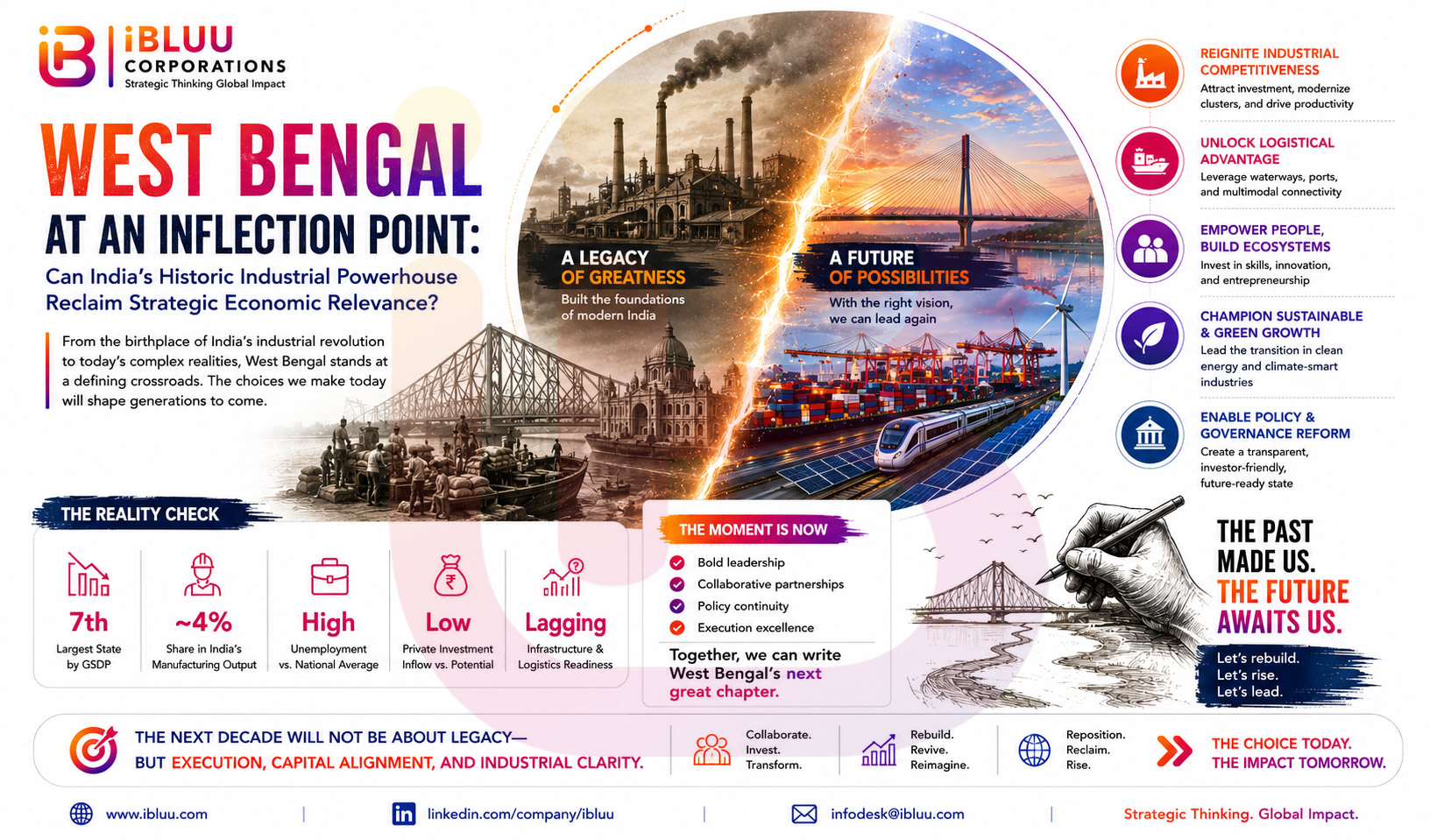
The Re-Emergence of West Bengal Beyond Politics: India’s Eastern Economic Geography Is Entering a New Era of Industrial Power, Infrastructure Scale, and Strategic Capital Expansion
For decades, West Bengal represented one of India’s most paradoxical economic stories.
A state with one of the deepest intellectual legacies, strongest geographic advantages, largest consumer markets, and most strategic logistics positions in South Asia gradually lost industrial momentum to western and southern Indian states. Manufacturing migration, capital flight, labour unrest perceptions, political volatility, and policy uncertainty weakened investor confidence over multiple decades.
Yet the emerging reality in 2025–2026 is more complex — and potentially more consequential.
West Bengal is now entering a strategic transition phase where infrastructure modernization, logistics expansion, digital economy investments, renewable energy, port-led development, AI infrastructure, and eastern freight connectivity are beginning to reshape the state’s long-term economic trajectory.
The critical question is no longer whether West Bengal possesses economic potential.
The real question is whether the state can convert its geographic and demographic advantages into a scalable industrial and investment ecosystem capable of competing with India’s rising economic powerhouses.
The Political Regime Shift: Stability, Welfare, and the Search for Industrial Credibility
Under the leadership of Mamata Banerjee and the All India Trinamool Congress government, West Bengal has experienced a significant political restructuring since 2011.
The state’s governance model has largely focused on:
- Welfare-driven political consolidation
- Rural consumption expansion
- Social protection programs
- Administrative decentralization
- Infrastructure modernization
- Urban development and digital governance
However, industrial policy perception remained mixed for years, particularly after the long-term reputational impact of the Singur-Tata Nano episode.
Today, the state government appears increasingly aware that welfare-driven governance alone cannot sustain long-term economic expansion.
The strategic pivot is now visible:
West Bengal is aggressively repositioning itself as an investment, logistics, data infrastructure, and industrial connectivity destination.
Bengal Global Business Summit: A Strategic Signaling Platform
The strongest evidence of this repositioning emerged during the Bengal Global Business Summit 2025.
According to official announcements, the summit attracted investment proposals worth approximately ₹4.40 lakh crore across sectors including:
- Digital infrastructure
- Data centers
- Ports and logistics
- Manufacturing
- Renewable energy
- Real estate
- IT and AI infrastructure
- Industrial parks
- Urban infrastructure
- Retail and consumer ecosystems
More than 212 MoUs and investment intent agreements were reportedly signed during the summit.
Among the most significant announcements:
- Reliance Industries announced fresh investments of approximately ₹50,000 crore in West Bengal by 2030, including AI-ready digital infrastructure and data center expansion.
- ITC Limited announced plans for a Global Centre of Excellence in AI and digital innovation.
The signaling effect matters more than the headline numbers.
For institutional investors, perception precedes capital deployment.
And West Bengal is now attempting to rewrite its perception cycle.
Why West Bengal Still Holds Structural Economic Power
Despite decades of industrial slowdown, the state retains multiple structural advantages that remain underappreciated nationally.
1. Strategic Geography
West Bengal sits at one of the most strategically valuable economic positions in South Asia.
It acts as:
- India’s gateway to Northeast India
- A logistics bridge to Bangladesh, Nepal, Bhutan, and Southeast Asia
- A Bay of Bengal maritime access point
- A critical node within eastern freight and trade corridors
Very few Indian states possess this level of multi-directional connectivity potential.
2. Port and Trade Advantage
The combined strategic importance of:
- Kolkata Port
- Haldia Dock Complex
could become significantly more relevant as India expands eastern maritime trade and Bay of Bengal connectivity.
The rise of:
- BIMSTEC integration
- India-Bangladesh trade
- Northeast industrialization
- Eastern DFC connectivity
- Act East Policy
could structurally improve West Bengal’s logistics relevance over the next decade.
3. Data Centers and AI Infrastructure
One of the most underestimated developments in West Bengal is the emerging digital infrastructure ecosystem around:
- New Town
- Salt Lake Sector V
Multiple reports indicate increasing interest from:
- hyperscale data center operators
- AI infrastructure players
- cloud ecosystem participants
- telecom and digital infrastructure firms
The state’s relatively lower land costs compared to Bengaluru, Hyderabad, and Mumbai could become strategically attractive for digital infrastructure expansion.
The Critical Missing Piece: Manufacturing Scale
Despite emerging momentum, West Bengal still faces a major structural challenge:
The state has not yet achieved manufacturing scale comparable to:
- Gujarat
- Maharashtra
- Tamil Nadu
- Karnataka
- Uttar Pradesh
This remains the defining gap.
West Bengal possesses:
✔ Population scale
✔ Market size
✔ Strategic geography
✔ Port access
✔ Labour availability
✔ Intellectual capital
But large-scale manufacturing confidence remains weaker than competing states.
For Bengal’s economic revival to become structurally sustainable, the state must aggressively scale:
- Electronics manufacturing
- Industrial parks
- Export-oriented manufacturing
- Logistics-linked industrial zones
- Semiconductor ecosystem support
- Renewable manufacturing
- Chemical and downstream industries
- Warehousing and supply-chain infrastructure
The DFC and Eastern Logistics Opportunity
One of the biggest long-term opportunities for West Bengal lies in the expansion of eastern freight and logistics infrastructure.
As India develops:
- Dedicated Freight Corridors
- Industrial corridors
- Multimodal logistics parks
- Eastern maritime infrastructure
- Rail-sea trade integration
Eastern India could become the next major industrial geography.
This may fundamentally alter investment flows over the next 10–15 years.
Historically, India’s industrial gravity remained concentrated in western India.
But rising land costs, congestion pressures, supply-chain diversification, and eastern connectivity improvements are now creating a gradual geographic rebalancing.
West Bengal could become one of the biggest beneficiaries — if execution improves.
Scenario Analysis: West Bengal 2035
Scenario 1 — High-Growth Transformation
If the state successfully improves:
- industrial approvals
- policy stability
- logistics integration
- investment facilitation
- land ecosystem management
- infrastructure execution
West Bengal could emerge as:
- Eastern India’s logistics capital
- India’s Bay of Bengal trade gateway
- A major AI and data center ecosystem
- A manufacturing-support corridor
- A strategic export and warehousing hub
Potential sectors:
- Electronics
- AI infrastructure
- Renewable energy
- Logistics
- Chemicals
- Food processing
- Port-led manufacturing
Scenario 2 — Partial Recovery Without Structural Shift
If reforms remain incremental and politically inconsistent:
- investment announcements may rise
- services sector growth may improve
- logistics infrastructure may expand
But manufacturing leadership may still migrate toward western and southern India.
This is currently the most realistic middle-ground scenario.
Scenario 3 — Lost Opportunity
If policy uncertainty, political friction, and execution bottlenecks continue:
West Bengal risks becoming a consumption-heavy state without large-scale industrial depth.
That would significantly limit long-term employment generation and export competitiveness.
Why Investors Are Watching Again
Global investors are increasingly reassessing India through:
- logistics efficiency
- industrial geography
- infrastructure scalability
- energy security
- digital ecosystem readiness
- export integration
West Bengal is beginning to re-enter that conversation.
Not because the state has fully transformed.
But because the strategic conditions around it are changing rapidly.
The rise of:
- Eastern trade routes
- Bay of Bengal economics
- AI infrastructure demand
- freight corridor integration
- cross-border logistics
- digital infrastructure expansion
is gradually making eastern India strategically unavoidable.
The Strategic View from iBCV
According to the strategic perspective of iBluu Consulting Venture Private Limited (iBCV), a venture of iBluu Corporations the future of West Bengal will not be decided by political narratives alone.
It will be determined by whether the state can successfully integrate:
- infrastructure
- logistics
- industrial ecosystems
- digital infrastructure
- institutional capital
- manufacturing competitiveness
- geopolitical trade positioning
The analytical perspective reflected in this article aligns with the broader strategic framework often emphasized by J Parasher, whose work focuses on long-horizon economic systems, industrial competitiveness, infrastructure intelligence, and strategic economic transformation.
From this perspective, West Bengal is no longer merely a state-level story.
It is becoming a test case for whether eastern India can evolve from a historically undercapitalized region into a globally connected industrial and logistics ecosystem.
Final Insight
West Bengal’s future will not be rebuilt through nostalgia.
It will be rebuilt through:
- infrastructure depth
- execution credibility
- industrial confidence
- logistics integration
- digital economy expansion
- institutional capital trust
The state still possesses enough structural advantages to become one of India’s most strategically important economic geographies again.
But this decade may be decisive.
Because in the emerging global economy, geography alone no longer creates prosperity.
Execution does.
Disclaimer: This article is intended solely for strategic, informational, and analytical purposes. Certain investment figures, infrastructure developments, and forward-looking assessments are based on publicly available information, industry trends, policy direction, and market interpretations. Actual outcomes may vary depending on political developments, economic conditions, regulatory changes, project execution timelines, and broader geopolitical dynamics. This article should not be construed as financial, investment, legal, or political advice.