+91 945 889 6091
  infodesk@ibluu.com
Building Aircraft, Building Capability: How the Adani–Embraer Partnership at Dholera Is Advancing India’s Rise as a Global Aerospace Nation
For decades, India has been one of the world’s fastest-growing aviation markets, yet remained largely dependent on imported commercial aircraft. That equation may now be beginning to change.
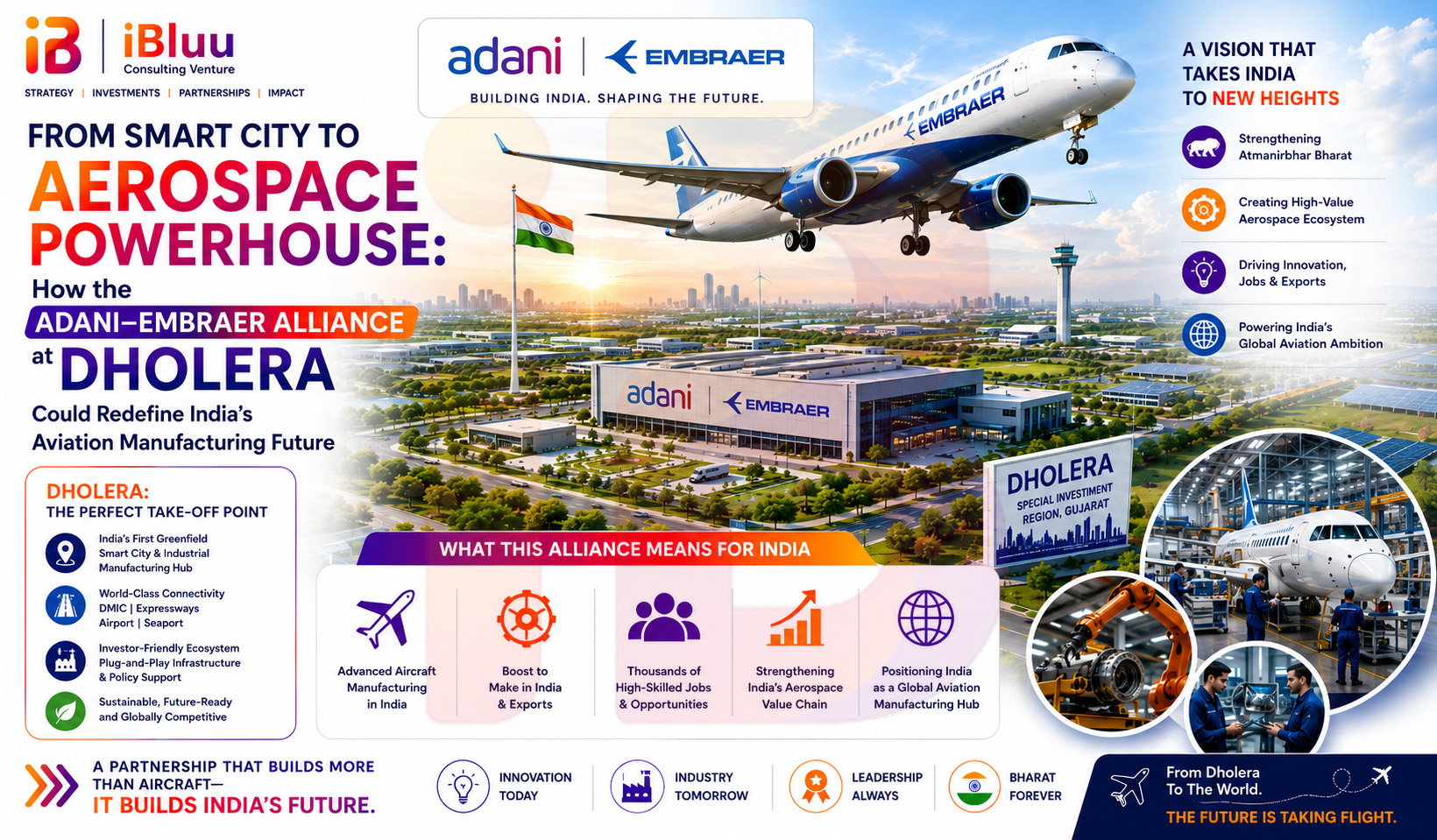
The decision by Adani Defence & Aerospace and Brazilian aerospace major Embraer to establish India’s first private Final Assembly Line (FAL) for commercial regional aircraft at the Dholera Special Investment Region (DSIR) in Gujarat represents far more than another manufacturing investment. It is a strategic industrial milestone that has the potential to alter India’s position within the global aerospace value chain.
In June 2026, both companies finalized Dholera as the preferred location for the proposed assembly line following the strategic collaboration announced earlier in January 2026 and subsequent enhancement of the partnership roadmap in February 2026. The project is expected to focus initially on assembly of Embraer’s E175 regional jet platform while simultaneously laying the foundation for a broader aerospace ecosystem encompassing suppliers, maintenance services, training infrastructure, and future exports.
The significance extends beyond aviation.
This is a test case for India’s ability to evolve from being one of the world’s largest aviation consumers into a meaningful aerospace producer.
Why Dholera Won: The Emergence of India’s Next Advanced Manufacturing Hub
The selection of Dholera is not accidental.
DSIR has increasingly emerged as one of India’s most strategically positioned industrial zones, combining large-scale planned infrastructure, multimodal connectivity, industrial land availability, and policy support.
Already attracting investments in semiconductors, electronics, renewable energy, advanced manufacturing, and logistics, Dholera is being positioned as a next-generation industrial city rather than a traditional manufacturing cluster.
Its competitive advantages include:
- Integrated industrial planning
- Proximity to ports and airports
- Access to freight corridors
- Large-scale plug-and-play infrastructure
- Future-ready utilities and logistics networks
- Strong state-level industrial policy support
In global aerospace manufacturing, ecosystem density often determines competitiveness. The success of aerospace hubs such as Toulouse, Seattle, Montreal, São José dos Campos, and Tianjin demonstrates that aircraft assembly facilities become catalysts for supplier clusters, engineering talent pools, MRO ecosystems, and export-oriented manufacturing networks.
Dholera is now attempting to enter that conversation.
More Than Assembly: Building an Aerospace Ecosystem
One of the most important aspects of the Adani–Embraer collaboration is that it is not being positioned merely as a final assembly operation.
The broader roadmap includes:
- Aircraft assembly
- Component localization
- Tier-1 and Tier-2 supplier development
- Maintenance, Repair and Overhaul (MRO) services
- Pilot training infrastructure
- Aerospace skill development
- Regional transport aircraft ecosystem creation
The objective aligns closely with India’s Aatmanirbhar Bharat strategy and the long-term goal of increasing indigenous participation in high-value manufacturing sectors.
According to Embraer and Adani Defence disclosures, the partnership envisions progressive indigenization over time rather than immediate localization, allowing supply chains to mature while maintaining global quality standards.
This approach mirrors successful aerospace development models adopted in Brazil, China, and several Middle Eastern manufacturing hubs.
Why the E175 Matters
The proposed facility is expected to focus on Embraer’s E175 regional jet platform.
The aircraft occupies an important segment within commercial aviation:
- Seating capacity: Approximately 88–100 passengers
- Designed for regional and short-haul routes
- Lower operating costs than larger narrow-body aircraft
- Ideal for Tier-2 and Tier-3 connectivity
This makes it particularly relevant for India’s UDAN initiative, which seeks to expand affordable air connectivity across underserved regions.
India remains significantly underpenetrated in regional aviation relative to its population and geographic scale.
Embraer estimates that India could require hundreds of aircraft within the 80–150 seat category over the coming decades as regional connectivity expands and airline networks deepen. Industry forecasts suggest more than 500 aircraft could be required in this segment over the next 20 years.
For India, regional aviation is not merely a transport story.
It is an economic integration story.
Strategic Alignment with National Priorities
The project intersects with multiple national objectives simultaneously.
1. Regional Connectivity
India’s UDAN program has already transformed access to aviation for smaller cities.
Localized aircraft assembly could improve fleet accessibility and potentially reduce long-term acquisition and support costs.
2. Make in India
Commercial aviation has historically remained one of the least localized segments of India’s manufacturing economy.
The proposed facility begins addressing that gap.
3. Aerospace Self-Reliance
India possesses capabilities in defense aerospace, space technology, and engineering services.
Commercial aircraft manufacturing represents the next frontier.
4. Employment Creation
Aerospace manufacturing is among the highest-value job creators within industrial sectors due to its engineering intensity and supply chain complexity.
5. Export Potential
Over time, localized production could enable India to participate more actively in regional aviation exports across Asia, Africa, and the Middle East.
Economic Multiplier Effects: Why Investors Should Pay Attention
The economic significance of aerospace manufacturing extends well beyond direct production.
Global experience suggests that every aerospace manufacturing job supports multiple indirect jobs across:
- Precision engineering
- Composites manufacturing
- Electronics
- Avionics
- Tooling
- Logistics
- Software engineering
- Maintenance services
India’s aerospace and defense sector has already crossed approximately ₹1.78 lakh crore in production value, while exports have exceeded ₹38,000 crore in recent years. The addition of commercial aircraft manufacturing introduces a new layer of industrial sophistication into that ecosystem.
Scenario Analysis: What Success Could Look Like
Base Case Scenario
- Assembly line operational by 2028
- Progressive localization reaching 40–60% over 5–7 years
- Production scaling toward 50–100 aircraft annually
- Strong supplier ecosystem development
Upside Scenario
- Expansion into exports
- Full aerospace cluster formation at Dholera
- Integrated MRO and training ecosystem
- India emerges as a regional aviation manufacturing hub for Asia and Africa
Stressed Scenario
- Delays in airline orders
- Supply chain disruptions
- Certification bottlenecks
- Slower localization than anticipated
Despite these risks, the strategic logic remains compelling.
Understanding the Risks
Every aerospace program carries complexity.
Execution Risk — Medium to High
Aircraft assembly requires compliance with stringent regulatory frameworks and quality standards.
Market Risk
Long-term viability depends on airline demand and order commitments.
Reuters reported that Embraer views approximately 200 aircraft orders as an important threshold supporting the economics of a local assembly line.
Supply Chain Risk
Initial dependence on imported systems and components may persist until localization deepens.
Talent Risk
India must continue building specialized aerospace engineering and technician talent pipelines.
Geopolitical Risk
Global aerospace supply chains remain vulnerable to trade restrictions, export controls, and geopolitical disruptions.
Strategic Recommendations
For Investors
Evaluate opportunities in:
- Aerospace components
- Precision engineering
- Composites
- MRO infrastructure
- Aviation training
For Suppliers
Position early within the Dholera aerospace ecosystem.
First movers typically capture disproportionate value.
For Policymakers
Accelerate:
- Certification harmonization
- Aerospace skill development
- Export incentives
- Supplier ecosystem support
For Airlines
Explore long-term fleet planning strategies linked to localized production advantages.
The Bigger Story: Industrial Sovereignty
The real significance of the Adani–Embraer partnership is not that India will assemble aircraft.
It is that India is beginning to build the institutional, industrial, and technological architecture required to compete in one of the world’s most sophisticated manufacturing sectors.
Aircraft manufacturing sits at the apex of industrial complexity.
Countries that master aerospace rarely stop there.
They develop advanced materials, electronics, software, precision engineering, defense technologies, and export-oriented industrial ecosystems.
Viewed through that lens, the Dholera assembly line is not simply an aviation project.
It is a national capability-building project.
The analytical depth of this perspective has been shaped by the strategic lens of J Parasher, Founder and Managing Director of iBluu Corporations, whose work consistently focuses on national capability building, industrial competitiveness, strategic investments, and long-horizon economic transformation. Through iBluu Consulting Venture (iBCV), a venture of iBluu Corporations, the focus remains on strategic consulting, investment advisory, government engagement, partnerships, M&A advisory, and industrial ecosystem development across high-growth sectors.
If executed effectively, the Adani–Embraer alliance could become one of the most consequential industrial partnerships of this decade—not because it assembles aircraft, but because it helps India take a decisive step toward becoming an aerospace nation.
Disclaimer: This article is intended solely for informational, strategic, and educational purposes. Certain projections, scenarios, forecasts, timelines, localization assumptions, production estimates, and economic impact assessments are based on publicly available information, industry benchmarks, and analytical interpretation. Actual outcomes may differ materially depending on regulatory approvals, market conditions, airline demand, technology transfer arrangements, supply chain developments, financing availability, and project execution. Readers should conduct independent due diligence before making any investment, business, or policy decisions.