+91 945 889 6091
  infodesk@ibluu.com
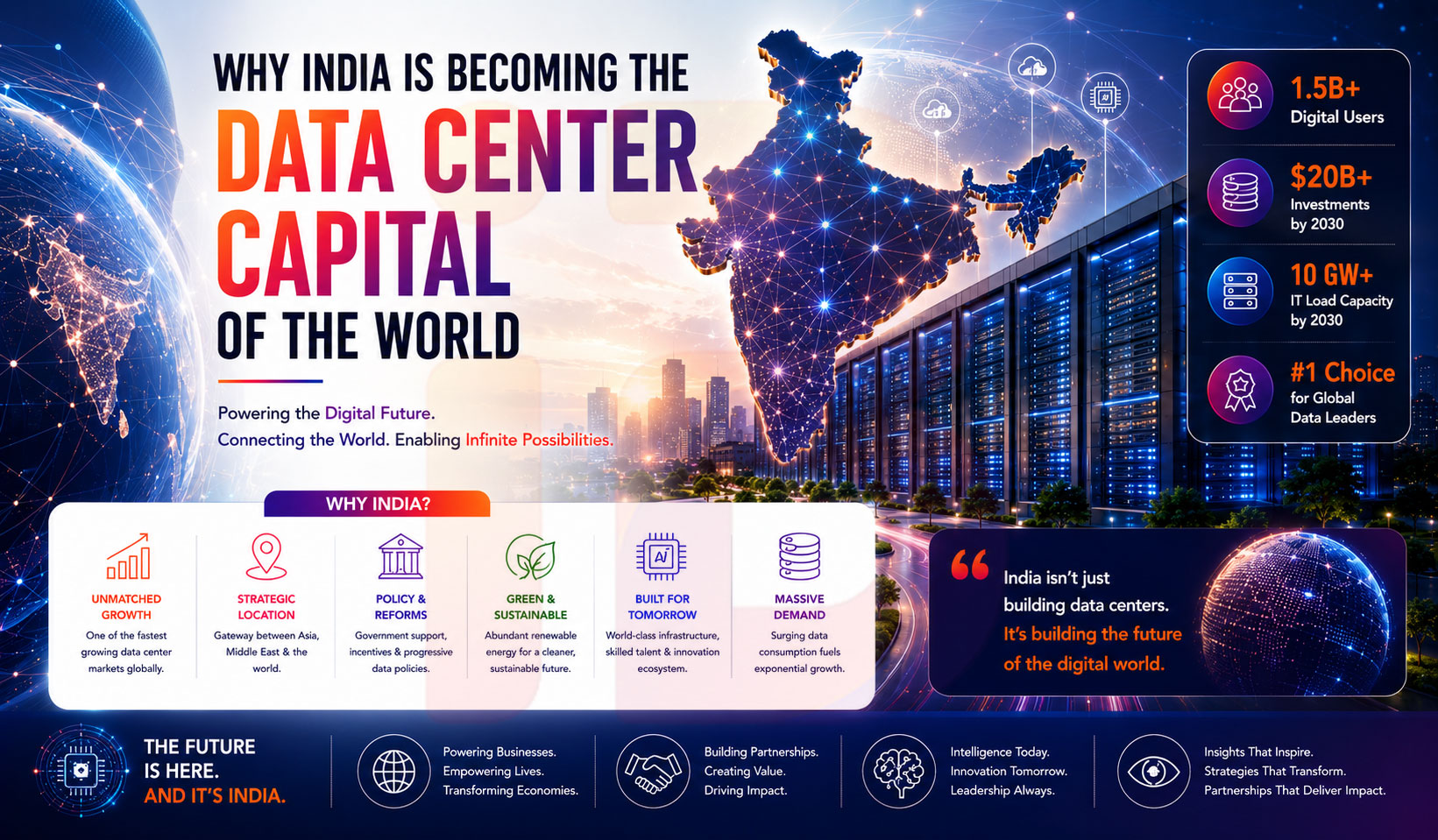
Why India Is Becoming the Data Center Capital of the World
The Digital Infrastructure Race Has Begun — And India Is Emerging at Its Strategic Center
For decades, oil pipelines, shipping routes, and industrial corridors defined global economic power.
In the AI era, digital infrastructure is becoming the new strategic asset class.
The nations that host the world’s compute capacity, cloud infrastructure, and artificial intelligence workloads will increasingly influence trade, innovation, geopolitical leverage, and economic competitiveness.
In this emerging global order, India is no longer merely a consumer of digital services.
It is rapidly becoming one of the world’s most important destinations for digital infrastructure investment.
The rise of India’s data center industry is not a cyclical real estate story or a temporary technology trend. It is the convergence of demographics, economics, geopolitics, energy transition, public policy, and artificial intelligence.
The world is entering the age of compute sovereignty.
India is positioning itself to become one of its foundational pillars.
From Data Producer to Data Infrastructure Powerhouse
India generates one of the largest volumes of digital data globally.
With more than 900 million internet users, the world’s largest digital identity infrastructure, one of the largest real-time payments ecosystems, rapidly growing e-commerce penetration, and accelerating AI adoption, the country has become a digital civilization operating at continental scale.
The implications are profound.
Data generated inside India increasingly needs to be stored, processed, secured, and analyzed domestically due to latency requirements, enterprise needs, cybersecurity considerations, and evolving data governance frameworks.
This transition is transforming India from a major producer of data into a strategic owner of digital infrastructure.
India’s Data Center Industry by the Numbers
| Metric | 2025-26 Estimate | 2030 Outlook |
|---|---|---|
| Operational Capacity | 1.6-1.7 GW | 5-6 GW Base Case |
| AI-Driven Upside Scenario | Emerging | 8-10 GW+ |
| Market Size | US$10 Billion | US$22 Billion+ |
| Development Pipeline | 3.1 GW | Multi-GW Expansion |
| Estimated Investments | US$100 Billion+ | US$200 Billion+ Potential |
| Annual Industry Growth | 25-32% CAGR | Sustained Expansion |
India’s operational data center capacity reached approximately 1.6-1.7 GW during 2025-26, making it the second-largest market in Asia-Pacific by development momentum. The pipeline currently under construction or planning stages exceeds 3 GW, highlighting one of the strongest infrastructure growth trajectories globally.
The market itself is projected to more than double from approximately US$10 billion today to nearly US$22 billion by the end of the decade, driven primarily by AI computing, hyperscale cloud expansion, and enterprise digital transformation.
The Seven Structural Forces Powering India’s Rise
1. The World’s Largest Digital Demand Engine
Few economies generate digital demand at India’s scale.
UPI transactions now process billions of payments monthly.
Digital public infrastructure including Aadhaar, digital governance platforms, healthcare digitization, fintech ecosystems, and e-commerce expansion continue to create exponential growth in data generation.
Unlike mature markets where growth is incremental, India’s digital economy remains in its acceleration phase.
This creates structural demand visibility rarely seen in infrastructure sectors.
2. Artificial Intelligence Is Redefining Compute Demand
The AI revolution has fundamentally altered data center economics.
Traditional cloud infrastructure is increasingly being supplemented by GPU-intensive AI workloads requiring significantly higher power density, advanced cooling systems, and specialized infrastructure.
A single hyperscale AI data center can consume as much electricity as a medium-sized city.
Global AI competition is creating an unprecedented race for compute capacity.
India’s emergence as an AI economy makes domestic AI infrastructure not merely desirable, but strategically essential.
The future export of AI services may depend as much on compute availability as on software talent.
3. Cost Competitiveness Creates Structural Advantage
Compared with North America, Europe, and parts of East Asia, India offers several long-term structural cost advantages:
- Lower construction costs
- Competitive operating expenditure
- Large engineering talent pools
- Lower manpower costs
- Expanding renewable energy availability
- Attractive economics for hyperscalers and colocation providers
In infrastructure investing, cost advantages compound over decades.
India’s advantage is not marginal.
It is structural.
4. Renewable Energy Is Becoming a Competitive Weapon
The future of data centers is inseparable from the future of energy.
AI workloads are dramatically increasing electricity requirements globally.
India’s rapidly expanding renewable energy ecosystem creates a powerful strategic opportunity.
Large-scale solar parks, battery storage projects, green energy corridors, and renewable power purchase agreements are allowing developers to build increasingly sustainable facilities.
The winners of the AI era may not be countries with the cheapest electricity.
They may be countries with the cheapest green electricity.
India is positioning itself accordingly.
5. Geopolitical Realignment Is Redirecting Capital
Global corporations are increasingly diversifying supply chains and digital infrastructure footprints.
Concentration risk has become a boardroom issue.
Multinational enterprises are seeking politically stable, economically large, democratic markets capable of supporting long-term digital investments.
India offers exactly that combination.
The result is a growing “China Plus One” strategy not only for manufacturing, but increasingly for digital infrastructure and cloud deployments.
6. Policy Support Has Reduced Friction
Government support has become a major accelerator.
Data centers now enjoy infrastructure recognition in several policy frameworks, improving financing access and investment visibility.
State governments have launched dedicated policies offering incentives on land acquisition, electricity duties, stamp duties, and approvals.
Data localization trends and digital sovereignty considerations continue to reinforce domestic demand.
This policy alignment has transformed data centers from niche technology assets into nationally strategic infrastructure.
7. Geography Is Becoming an Advantage
India’s location offers a unique strategic proposition.
Positioned between Europe, the Middle East, Southeast Asia, and East Asia, the country is emerging as a natural interconnection point for global digital traffic.
Increasing submarine cable landings across Mumbai and Chennai, expanding terrestrial fiber networks, and improving international connectivity are strengthening India’s role in global data flows.
Digital trade increasingly follows connectivity routes.
India sits at one of the world’s most valuable intersections.
The Emerging Multi-City Data Center Economy
Unlike earlier infrastructure cycles dominated by one or two cities, India’s data center expansion is becoming geographically diversified.
| Primary Hubs | Strategic Advantages |
|---|---|
| Mumbai | Financial capital, cable landings, largest installed base |
| Chennai | International connectivity, submarine cables |
| Hyderabad | Technology ecosystem and hyperscaler demand |
| Bengaluru | Enterprise and cloud demand |
| Delhi NCR | Government, enterprise and edge demand |
| Pune and Emerging Cities | Land availability and expansion potential |
Mumbai remains the undisputed leader, but the next phase of growth will likely emerge from distributed infrastructure architectures and edge deployments across Tier-II cities.
The future of digital infrastructure is unlikely to be centralized.
It will be federated.
The Economic Multiplier Effect
Data centers create significantly larger economic value than their direct revenues imply.
Their impact cascades across:
- Renewable energy investments
- Transmission infrastructure
- Industrial real estate
- Construction supply chains
- Semiconductor ecosystems
- Fiber networks
- Cooling technologies
- Electrical equipment manufacturing
- AI startups and software exports
Every megawatt of data center capacity stimulates multiple layers of economic activity.
In economic terms, data centers behave less like buildings and more like industrial platforms.
Scenario Analysis: India’s Position by 2030
| Scenario | Capacity Outlook | Strategic Outcome |
|---|---|---|
| Conservative | 4-5 GW | Regional leader |
| Base Case | 5-6 GW | Major global digital hub |
| AI Acceleration Case | 8-10 GW+ | Top-tier global compute destination |
The upside scenario is increasingly plausible as AI demand accelerates globally.
However, achieving it will require coordinated execution across energy, grid infrastructure, water management, and workforce development.
The Risks That Cannot Be Ignored
Every infrastructure boom carries execution risks.
Power Infrastructure Constraints
Data centers could account for approximately 2.5-3% of India’s electricity demand by the end of the decade, requiring substantial investments in generation, storage, and transmission infrastructure. Recent government estimates already identify data centers and AI as major contributors to future electricity demand growth.
Water Stress
Cooling requirements remain a challenge in water-stressed regions, requiring widespread adoption of advanced cooling technologies and recycling systems.
Talent Availability
AI infrastructure engineers, thermal specialists, and high-density facility operators remain scarce globally.
Regulatory Coordination
Growth at scale requires harmonization across state-level regulations, power allocation frameworks, and permitting systems.
The winners in this sector will not merely build data centers.
They will build ecosystems.
Strategic Recommendations for Stakeholders
For Investors
Prioritize AI-ready, renewable-powered, carrier-neutral assets located in high-connectivity clusters.
For Developers
Secure long-term renewable power agreements and design facilities capable of supporting future high-density GPU workloads.
For Policymakers
Accelerate grid modernization, transmission upgrades, energy storage deployment, and digital infrastructure permitting.
For Enterprises
View India not only as a domestic market but as a global deployment platform for future AI workloads.
Conclusion: India Is Building the Infrastructure Layer of the AI Economy
History remembers nations that built the railways of the industrial age, the ports of global trade, and the semiconductor fabs of the information age.
The next chapter may belong to those that build the compute infrastructure of artificial intelligence.
India’s rise in data centers is therefore not merely an infrastructure story.
It is an economic transformation story.
It is an energy transition story.
It is a geopolitical story.
Most importantly, it is a competitiveness story.
The servers may sit inside buildings of steel and concrete.
But what they will ultimately power is something much larger:
India’s ambition to become one of the defining digital economies of the twenty-first century.
Disclaimer: This article is intended solely for thought leadership and informational purposes. Figures and estimates referenced are synthesized from publicly available industry sources, market intelligence, and infrastructure reports available as of mid-2026 and remain subject to policy developments, investment decisions, technological shifts, and market evolution. The article does not constitute investment, legal, financial, or professional advice.