+91 945 889 6091
  infodesk@ibluu.com
Oman–Gujarat Energy Corridor Could Become One of India’s Most Strategic Infrastructure Investments of the Decade
For decades, India’s energy strategy has largely been defined by one uncomfortable reality: economic growth has consistently outpaced domestic energy production. Every percentage point of industrial expansion, every new manufacturing corridor, every smart city, every fertilizer plant, every refinery, and increasingly every AI-powered data centre has deepened the country’s dependence on imported energy.
This dependence has never merely been an economic challenge.
It has been a strategic vulnerability.
History has repeatedly demonstrated that energy insecurity is capable of disrupting currencies, industrial production, inflation trajectories, fiscal stability, foreign policy flexibility, and ultimately national competitiveness. Nations seldom lose economic leadership because they lack ambition; they lose it because they lack secure access to affordable energy.
Against this backdrop, India’s proposed Oman–Gujarat Deep-Sea Natural Gas Pipeline represents something far more consequential than a cross-border infrastructure project.
It represents a fundamental redesign of India’s long-term energy architecture.
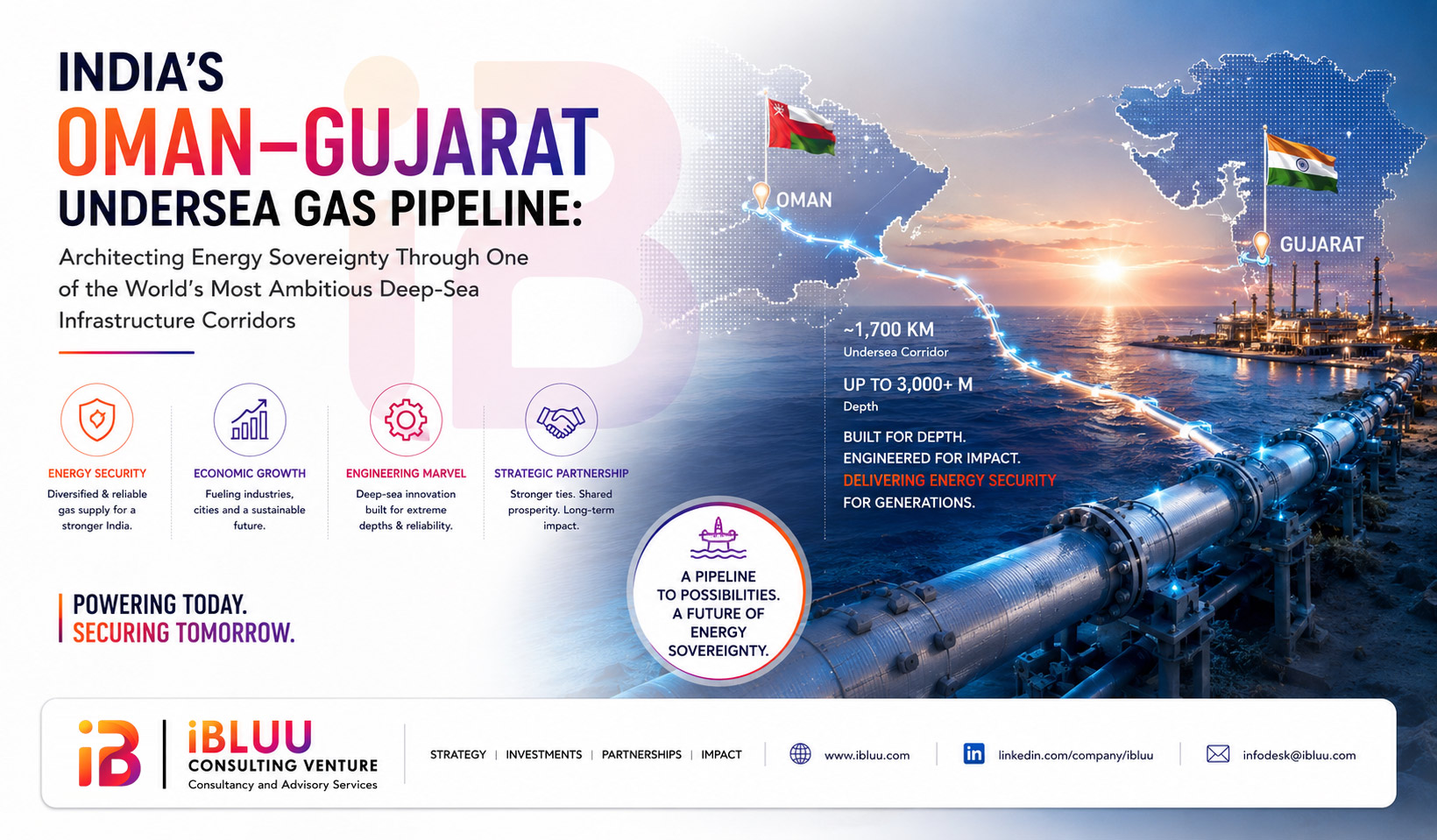
Estimated at approximately ₹40,000 crore (US$4.8–5 billion) and stretching nearly 2,000 kilometres beneath the Arabian Sea, the pipeline aims to transport nearly 31 million standard cubic metres of natural gas every day (31 MMSCMD) directly from Oman’s Ras Al Jifan gas network to Porbandar in Gujarat, traversing subsea depths approaching 3,450 metres—placing it among the deepest and most technically demanding offshore energy corridors ever attempted globally.
Executive Summary
| Project Overview | Details |
|---|---|
| Project | Oman–India Deep-Sea Natural Gas Pipeline |
| Route | Ras Al Jifan (Oman) – Porbandar, Gujarat |
| Estimated Investment | ~₹40,000 Crore (Approx. US$4.8 Billion) |
| Pipeline Length | Approximately 2,000 Kilometres |
| Transport Capacity | Around 31 Million Standard Cubic Metres per Day (MMSCMD) |
| Maximum Water Depth | Up to 3,450 Metres |
| Construction Period | Approximately 5–7 Years after Final Approval |
| Potential Commissioning | 2033–2035 |
| Strategic Objective | Strengthen India’s Energy Security through Supply Diversification |
| Primary Beneficiaries | CGD Networks, Fertilizer Sector, Industries, Refineries, Power Utilities, Manufacturing Clusters |
| Strategic Significance | Energy Security • Industrial Growth • Geopolitical Resilience • Supply Chain Diversification |
India’s Next Strategic Infrastructure Is Not a Highway. It Is an Energy Lifeline Beneath the Arabian Sea.
History rarely remembers infrastructure simply because it was large.
History remembers infrastructure because it fundamentally altered a nation’s strategic trajectory.
The proposed Oman–Gujarat Undersea Natural Gas Pipeline belongs to that rare category.
This is not merely another energy project. It represents one of India’s boldest strategic infrastructure decisions since the expansion of its national highway network, dedicated freight corridors, LNG ecosystem, and petroleum pipeline network.
In an increasingly fragmented geopolitical landscape—where energy has become a strategic weapon as much as an economic commodity—India is quietly redesigning one of its greatest structural vulnerabilities: dependence on imported LNG transported through increasingly volatile maritime corridors.
The proposed approximately ₹40,000 crore deep-sea pipeline stretching nearly 2,000 kilometres beneath the Arabian Sea is far more than steel, compressors and subsea engineering.
It is an investment in strategic autonomy.
It is an investment in industrial competitiveness.
It is an investment in national resilience.
And perhaps most importantly, it is an investment in India’s ability to pursue sustained economic expansion without allowing external geopolitical shocks to dictate its energy future.
As India marches toward becoming one of the world’s largest manufacturing, technology and industrial economies, energy security is no longer a supporting pillar.
It is becoming the foundation upon which every future ambition—whether semiconductors, AI infrastructure, defence manufacturing, green hydrogen, chemicals, fertilizers or advanced industrial corridors—will ultimately depend.
The Oman–Gujarat pipeline therefore deserves to be viewed not as an energy asset, but as a national strategic multiplier.
Energy Security Has Become Economic Security
The global energy equation has fundamentally changed over the past decade.
Supply disruptions.
Regional conflicts.
Shipping vulnerabilities.
Commodity price shocks.
Trade fragmentation.
All have reinforced a single lesson:
Countries that cannot secure reliable energy supplies eventually compromise economic competitiveness.
India understands this reality better than most.
Today, India is among the world’s fastest-growing energy consumers.
Rapid urbanisation.
Industrial expansion.
Electrification.
Rising manufacturing output.
Expanding City Gas Distribution (CGD).
Fertilizer production.
Refining capacity.
Power generation.
Every major growth engine requires dependable access to affordable natural gas.
Yet domestic production alone cannot satisfy future demand.
This structural imbalance makes diversification—not merely expansion—the defining principle of India’s future energy strategy.
The Oman pipeline directly addresses this challenge by creating a dedicated subsea corridor connecting one of India’s most trusted Gulf partners directly with India’s western coast.
Strategically, this transforms vulnerability into resilience.
Strategic Blueprint: Why This Project Matters Beyond Energy
Large infrastructure projects are often evaluated solely through financial metrics.
That approach dramatically underestimates this project’s significance.
The Oman–Gujarat pipeline simultaneously advances multiple national objectives.
1. Energy Security
Reduces excessive dependence on LNG shipping routes vulnerable to geopolitical disruption.
2. Industrial Competitiveness
Ensures long-term affordable gas supplies for manufacturing, refining, chemicals and fertilizers.
3. Economic Growth
Supports India’s transition toward becoming a multi-trillion-dollar industrial economy.
4. Supply Chain Stability
Creates greater predictability for industries relying heavily on imported natural gas.
5. Strategic Diplomacy
Deepens one of India’s strongest energy partnerships within the Gulf region.
6. Infrastructure Modernisation
Adds another globally significant engineering asset to India’s rapidly expanding strategic infrastructure portfolio.
Few projects simultaneously influence energy, diplomacy, manufacturing, logistics and industrial policy.
This is one of them.
Project Specifications: A Benchmark in Deep-Sea Infrastructure
| Parameter | Details | Strategic Implication |
|---|---|---|
| Estimated Cost | ~₹40,000 Crore | Long-term national infrastructure investment |
| Pipeline Length | Nearly 2,000 km | One of the world’s longest deep-sea gas corridors |
| Daily Capacity | ~31 MMSCMD | Supports rising industrial and urban gas demand |
| Water Depth | Up to 3,450 metres | Among the deepest subsea pipeline projects globally |
| Origin | Ras Al Jifan, Oman | Reliable Gulf energy partnership |
| Destination | Porbandar, Gujarat | Integration with India’s western industrial corridor |
| Construction Timeline | 5–7 Years | Large-scale EPC opportunity |
| Expected Operations | 2033–2035 | Long-term strategic infrastructure asset |
Beyond engineering complexity, these specifications demonstrate India’s increasing willingness to execute globally benchmarked infrastructure capable of reshaping national competitiveness over multiple decades.
Demand-Supply Dynamics: Why Waiting Is No Longer an Option
Natural gas is steadily becoming the transition fuel supporting India’s industrial transformation.
According to multiple long-term industry projections, India’s annual natural gas demand could approach approximately 100–120 billion cubic metres by 2030, representing growth of nearly 60% compared to current consumption levels.
Several structural trends explain this trajectory.
Industrial Manufacturing Expansion
India’s manufacturing ambitions under Make in India continue accelerating.
Steel.
Chemicals.
Petrochemicals.
Glass.
Ceramics.
Automobiles.
Electronics.
All increasingly require reliable gas supplies.
Without secure energy, industrial competitiveness inevitably deteriorates.
City Gas Distribution
The rapid expansion of City Gas Distribution networks is transforming urban energy consumption.
Residential households.
Commercial establishments.
Restaurants.
Transportation.
Industrial clusters.
Every CGD expansion increases baseline gas demand while reducing dependence on more carbon-intensive fuels.
Fertilizer Sector
India’s fertilizer industry remains among the largest consumers of natural gas.
Reliable pipeline supplies reduce procurement uncertainty while supporting long-term agricultural productivity.
Given India’s food security priorities, uninterrupted gas availability carries strategic significance extending well beyond industrial economics.
Power Generation
Although renewable energy continues expanding rapidly, natural gas remains essential for balancing intermittent solar and wind generation.
Flexible gas-fired generation strengthens grid reliability while supporting India’s broader energy transition strategy.
Rather than competing with renewables, natural gas increasingly complements them.
Emerging Industrial Sectors
Future demand will increasingly originate from sectors that barely existed at meaningful scale a decade ago.
Artificial Intelligence infrastructure.
Hyperscale data centres.
Semiconductor fabrication.
Advanced chemicals.
Green hydrogen.
Battery manufacturing.
Defence industrial corridors.
These industries are exceptionally energy intensive.
Reliable gas infrastructure therefore becomes an enabler of future industrial policy—not merely current energy demand.
Gujarat: India’s Emerging Integrated Energy Gateway
Selecting Gujarat extends beyond geographic convenience.
It reflects decades of infrastructure development.
The state already hosts one of India’s strongest industrial ecosystems.
Major LNG terminals.
Refineries.
Petrochemical complexes.
Dedicated freight connectivity.
Industrial corridors.
Export-oriented manufacturing.
Extensive transmission infrastructure.
Integrating the Oman pipeline into Gujarat creates powerful network effects.
Gas entering Porbandar can seamlessly connect with India’s expanding national gas grid, supporting industries across western, northern and central India.
Instead of functioning as an isolated pipeline, the project becomes a strategic backbone within India’s broader energy architecture.
That integration substantially amplifies its long-term economic value.
From Import Dependency to Strategic Diversification
Perhaps the greatest strategic contribution of this project lies in changing the philosophy of India’s energy imports.
Historically, imported LNG required multiple logistical stages.
Liquefaction.
Marine transportation.
Port handling.
Regasification.
Pipeline transmission.
Each stage introduces cost, operational complexity and geopolitical exposure.
A dedicated subsea pipeline significantly simplifies this chain while improving predictability.
More importantly, it reduces India’s dependence on maritime shipping disruptions without eliminating LNG flexibility.
This is diversification—not substitution.
And diversification has become the defining principle of resilient national energy systems.
Strategic Conclusion
The Oman–Gujarat Undersea Gas Pipeline represents far more than a deep-sea engineering achievement.
It is an economic confidence statement.
A geopolitical strategy.
An industrial competitiveness programme.
And an infrastructure platform capable of supporting India’s next generation of manufacturing-led growth.
As global supply chains continue fragmenting and energy increasingly determines industrial competitiveness, nations investing in resilient infrastructure today will enjoy disproportionate strategic advantages tomorrow.
India appears determined to be among them.
Economic Multipliers: Infrastructure That Extends Far Beyond Energy
Transformational infrastructure is rarely defined by its physical dimensions.
Its true value lies in the economic ecosystem it creates.
The proposed Oman–Gujarat Undersea Gas Pipeline should therefore be evaluated not merely as a gas transmission project, but as a strategic industrial platform capable of generating multi-sector value over several decades.
Every cubic metre of affordable and reliable natural gas delivered through this corridor has the potential to unlock significantly greater economic output downstream.
From petrochemicals and fertilizers to steel, ceramics, glass, pharmaceuticals, city gas distribution, data centres, semiconductor fabrication, and advanced manufacturing, dependable energy supply reduces production uncertainty, improves capital efficiency, and enhances global competitiveness.
The multiplier effect extends well beyond energy.
The project is expected to stimulate demand across:
- Offshore engineering and subsea construction
- High-grade steel manufacturing
- Advanced pipeline technology
- Compression and transmission systems
- Marine logistics
- Digital monitoring and industrial automation
- EPC services
- Inspection, maintenance and repair (MRO)
- Environmental monitoring
- Skilled engineering employment
Such projects also create long-term opportunities for Indian MSMEs to integrate into global energy supply chains through localized manufacturing and specialized engineering services.
As India’s industrial base becomes increasingly technology-driven, strategic infrastructure of this nature strengthens domestic capabilities while reducing dependence on external ecosystems.
Geopolitical Significance: From Energy Importer to Strategic Energy Architect
The pipeline represents more than bilateral cooperation between India and Oman.
It reflects a broader evolution in India’s geopolitical strategy.
Global energy markets are entering an era characterized by:
- Fragmented supply chains
- Increasing geopolitical polarization
- Maritime security concerns
- Resource nationalism
- Energy transition uncertainty
Against this backdrop, countries capable of diversifying supply routes will enjoy greater economic resilience.
India already imports a significant portion of its crude oil and natural gas requirements.
While LNG imports remain indispensable, excessive dependence on tanker-based logistics exposes the country to shipping disruptions, insurance premiums, freight volatility and geopolitical chokepoints.
The Oman–Gujarat pipeline introduces an alternative strategic corridor that complements—not replaces—the LNG ecosystem.
This diversification strengthens India’s bargaining power in global energy markets while reinforcing long-standing diplomatic ties with one of the Gulf’s most stable and trusted partners.
Moreover, the project aligns with India’s broader “Act West” engagement by deepening strategic economic integration with the Gulf Cooperation Council (GCC) region—an area that remains central to India’s energy security, trade, investment, and diaspora interests.
Financial Benchmarking: Evaluating Long-Term Strategic Value
Large-scale energy infrastructure requires patient capital.
However, history consistently demonstrates that projects enhancing national competitiveness often generate returns extending well beyond direct financial metrics.
Indicative Financial Snapshot
| Metric | Indicative Assessment |
|---|---|
| Estimated Project Cost | ~₹40,000 Crore |
| Capital Nature | Strategic Long-Life Infrastructure |
| Economic Life | 30–50+ Years |
| Revenue Visibility | Long-term Gas Transportation Agreements |
| Financing Potential | Sovereign Support, Multilateral Institutions, Infrastructure Funds, Strategic Investors |
| Downstream Investment Potential | Several Billion Dollars Across Industrial Ecosystems |
Unlike short-cycle infrastructure, strategic pipelines become national assets that continue generating economic value for decades through transportation revenue, industrial growth, tax generation, employment, and enhanced energy security.
When evaluated through a national economic lens, the return on investment extends beyond cash flow to include improved industrial productivity, reduced import risk, greater investor confidence, and stronger geopolitical positioning.
Scenario Modelling: Three Possible Strategic Outcomes
Base Case: A Strong Foundation for Industrial Growth
Under a successful execution scenario, the pipeline is commissioned within the projected 2033–2035 timeline.
Reliable gas supply strengthens manufacturing competitiveness, supports city gas expansion, enhances fertilizer production, and contributes to India’s transition toward a cleaner energy mix.
Industrial clusters connected to the national gas grid experience sustained productivity gains, reinforcing India’s long-term GDP ambitions.
Upside Case: India’s Emergence as a Regional Energy Hub
If complemented by expanded LNG infrastructure, cross-border energy partnerships, hydrogen development, and downstream industrial investments, the pipeline could become the backbone of a broader Gulf–India energy corridor.
Such an ecosystem could attract global capital into refining, petrochemicals, specialty chemicals, advanced manufacturing, and export-oriented industrial clusters.
Technology transfer, local manufacturing, and engineering capabilities would further accelerate India’s journey toward becoming a global energy infrastructure leader.
Stressed Case: Delays and Cost Escalation
Deepwater engineering inevitably carries execution complexity.
Regulatory delays, supply chain constraints, financing challenges, or prolonged geopolitical instability could increase project costs and defer commissioning.
Similarly, periods of low global LNG prices could temporarily reduce the pipeline’s cost advantage.
However, history suggests that strategic infrastructure should be evaluated across decades—not short-term commodity cycles.
Risk Quantification: A Balanced Assessment
No transformational infrastructure project is without risk.
A rigorous evaluation requires acknowledging challenges while identifying practical mitigation strategies.
Technical Risk — High
Operating at depths approaching 3,450 metres places the project among the world’s most technically demanding subsea developments.
Mitigation:
- International EPC expertise
- Advanced subsea engineering technologies
- Comprehensive seabed surveys
- Proven deepwater pipeline standards
Execution Risk — Medium to High
Large cross-border infrastructure projects require synchronized execution across governments, contractors, regulators, and financiers.
Mitigation:
- Dedicated project governance
- Phased implementation
- Strong bilateral coordination mechanisms
Financial Risk — Medium
High upfront capital expenditure and long gestation periods require disciplined financing structures.
Mitigation:
- Long-term transportation agreements
- Blended finance
- Multilateral participation
- Sovereign support mechanisms
Geopolitical Risk — Medium
Regional instability remains an external consideration.
Mitigation:
- Strong India–Oman strategic relationship
- Route planning outside major conflict zones
- Diversified energy procurement strategy
Market Risk — Medium
Future LNG pricing dynamics and evolving energy technologies could influence commercial competitiveness.
Mitigation:
- Flexible pricing structures
- Integration with the national gas grid
- Growing domestic gas demand across multiple sectors
Overall, while execution complexity is significant, the strategic rationale remains compelling.
Strategic Recommendations
For Policymakers
- Accelerate bilateral implementation frameworks with Oman.
- Integrate the pipeline within India’s National Gas Grid expansion strategy.
- Promote domestic manufacturing of pipeline components under Aatmanirbhar Bharat.
- Encourage private participation through stable regulatory frameworks.
For Investors
- Evaluate opportunities across EPC, offshore engineering, advanced materials, automation, monitoring systems, and industrial gas infrastructure.
- Consider long-duration infrastructure funds aligned with strategic national assets.
- Focus on ecosystem investments rather than the pipeline alone.
For Industrial Consumers
- Secure long-term gas procurement arrangements to improve input cost visibility.
- Align future manufacturing investments with emerging gas infrastructure corridors.
- Integrate natural gas with renewable energy strategies for optimized energy portfolios.
For Technology Providers
- Develop indigenous capabilities in subsea robotics, corrosion management, digital twins, predictive maintenance, AI-enabled monitoring, and advanced pipeline inspection technologies.
Such capabilities possess significant export potential as global offshore infrastructure investment continues expanding.
Strategic Horizon: Building Energy Sovereignty for the Next Generation
Infrastructure often defines the destiny of nations.
The Oman–Gujarat Undersea Gas Pipeline exemplifies a broader shift in India’s strategic thinking—from responding to energy challenges toward proactively designing structural resilience.
It is a project rooted not merely in engineering, but in national capability building.
Reliable energy enables competitive manufacturing.
Competitive manufacturing drives exports.
Exports strengthen economic resilience.
Economic resilience enhances geopolitical influence.
This cascading effect illustrates why strategic infrastructure deserves to be viewed through a national transformation lens rather than a project finance lens alone.
As India advances toward becoming one of the world’s largest industrial and technology economies, the ability to secure affordable, diversified, and resilient energy supplies will increasingly determine the pace and sustainability of that journey.
The Oman–Gujarat pipeline is therefore more than a conduit for natural gas.
It is a conduit for long-term industrial confidence.
The Strategic Lens of iBluu Consulting Venture (iBCV)
At iBluu Consulting Venture (iBCV), a venture of iBluu Corporations, strategic infrastructure is viewed not as isolated capital expenditure but as an integrated economic ecosystem capable of generating industrial competitiveness, investment attraction, technological capability, and national value creation.
Through expertise spanning strategic consulting, investment advisory, government engagement, partnerships, mergers and acquisitions, and industrial transformation, iBCV seeks to help organizations identify long-horizon opportunities emerging from India’s next generation of infrastructure development.
Perspective from J Parasher
The analytical perspective presented in this article reflects the long-term strategic thinking of J Parasher, Founder and Managing Director of iBluu Corporations.
His work consistently emphasizes national capability building, industrial competitiveness, global benchmarking, and economic transformation.
Rather than viewing infrastructure purely through engineering or financial metrics, this perspective positions strategic assets as catalysts capable of reshaping India’s industrial future, strengthening economic sovereignty, and creating globally competitive ecosystems that generate value across multiple generations.
Final Perspective
The world’s most successful economies did not become industrial leaders simply by consuming energy.
They became leaders by controlling strategic energy architecture.
India now stands at a similar inflection point.
If executed with discipline, technological excellence, and strategic foresight, the Oman–Gujarat Undersea Gas Pipeline has the potential to become one of the defining infrastructure achievements of the coming decade.
It represents a decisive shift—from managing energy dependence to engineering energy resilience.
And in the decades ahead, that distinction may prove to be one of India’s greatest strategic advantages.
Disclaimer: This article is intended solely for informational and thought-leadership purposes. The analysis is based on publicly available information, industry reports, and strategic assessments available at the time of writing. Project specifications, investment values, timelines, capacities, regulatory approvals, commercial structures, and implementation schedules remain subject to official announcements and future developments. The contents should not be construed as investment, financial, legal, or professional advice. Readers are encouraged to undertake independent due diligence and consult appropriate professional advisors before making any investment or business decisions.