+91 945 889 6091
  infodesk@ibluu.com
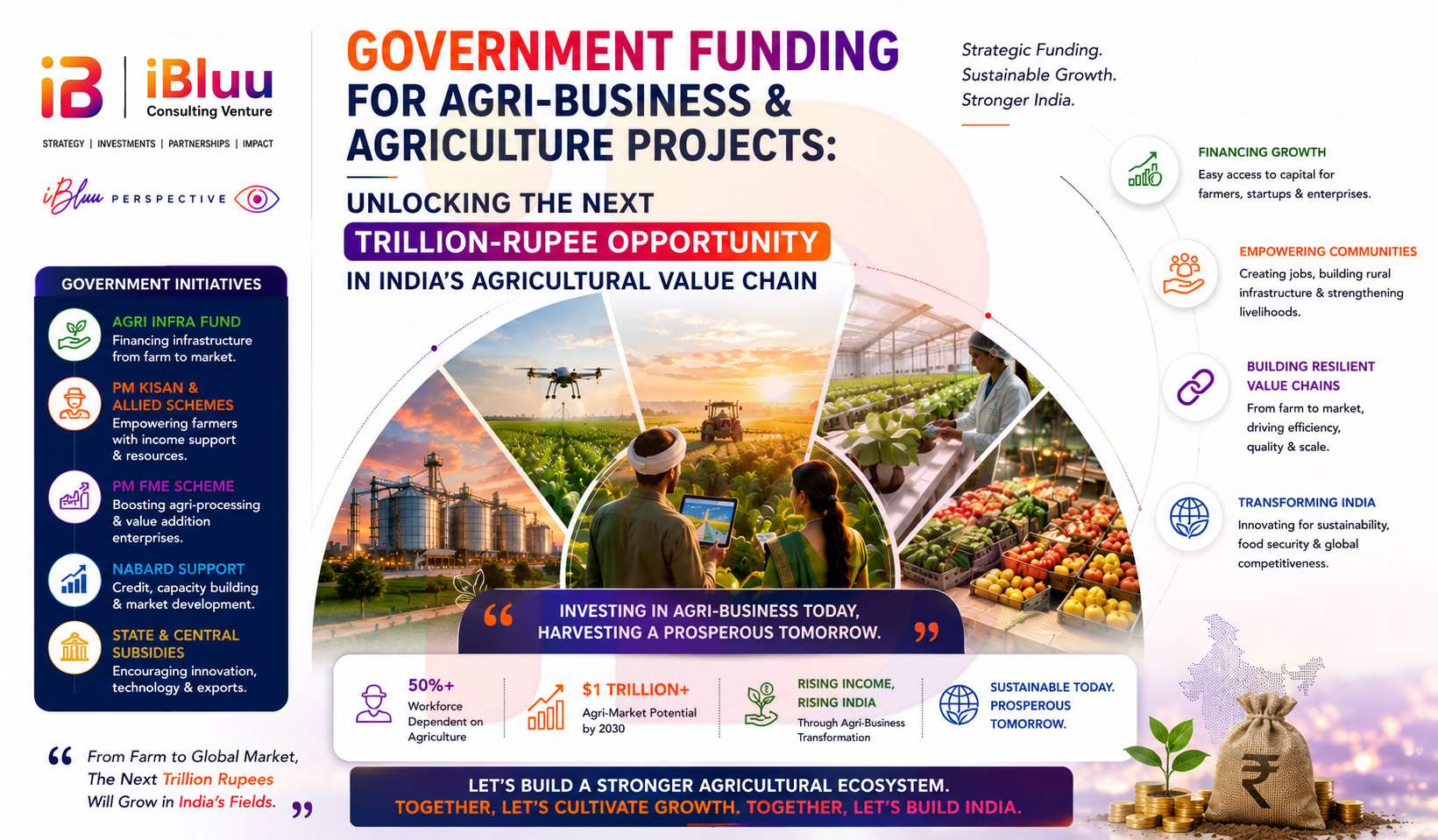
Government Funding for Agri-Business and Agriculture Projects: Unlocking the Next Trillion-Rupee Opportunity in India’s Agricultural Value Chain
India’s agriculture sector is undergoing one of the most significant transformations in its history.
For decades, agriculture was viewed primarily through the lens of crop production. Today, however, the sector is evolving into a sophisticated economic ecosystem encompassing technology, infrastructure, logistics, processing, storage, automation, biotechnology, renewable energy, and digital commerce.
The future of Indian agriculture will not be built solely on farms.
It will be built across warehouses, cold chains, food processing parks, drone corridors, precision farming systems, AI-enabled supply chains, and technology-driven agri-enterprises.
Recognizing this shift, the Government of India has deployed an unprecedented range of financing, subsidy, credit-guarantee, infrastructure, and innovation-support mechanisms designed to catalyze private investment across the entire agricultural value chain.
For investors, entrepreneurs, Farmer Producer Organizations (FPOs), cooperatives, agritech startups, food processors, and infrastructure developers, this represents one of the most compelling growth opportunities in the Indian economy.
The New Face of Indian Agriculture
Agriculture today extends far beyond cultivation.
Emerging investment opportunities include:
✅ Polyhouse & Greenhouse Farming
✅ Hydroponics & Controlled Environment Agriculture
✅ Organic & Residue-Free Farming
✅ Precision Irrigation Systems
✅ Smart Farming & IoT Solutions
✅ Agricultural Drones & Automation
✅ Farm Machinery & Custom Hiring Centres
✅ Cold Storage & Controlled Atmosphere Facilities
✅ Warehousing & Logistics Infrastructure
✅ Food Processing & Value Addition
✅ Packaging & Branding Infrastructure
✅ Farmer Producer Organizations (FPOs)
✅ Agri-Tech & Food-Tech Startups
✅ Export-Oriented Agriculture Supply Chains
The result is the emergence of a fully integrated agricultural economy where value creation increasingly occurs after harvest rather than solely on the farm.
Why Government Funding Matters More Than Ever
India is expected to remain among the world’s fastest-growing major economies.
Simultaneously, food demand is projected to rise substantially due to:
- Population growth
- Urbanization
- Rising disposable incomes
- Processed food consumption
- Export expansion
- Supply-chain modernization
- Climate adaptation requirements
To support this transformation, policymakers are prioritizing infrastructure creation, productivity enhancement, and value addition across the agricultural ecosystem.
The strategic objective is clear:
Move Indian agriculture from production-centric to value-chain-centric growth.
Key Government Funding Opportunities Across the Agriculture Value Chain
1. Agri-Startup and Innovation Funding
India is rapidly emerging as one of the world’s largest agri-tech innovation ecosystems.
Government-supported initiatives such as AgriSURE, NABARD-backed programs, and startup acceleration platforms are supporting innovation in:
- Farm automation
- Digital marketplaces
- Precision agriculture
- Supply-chain technology
- Biotechnology
- Climate-smart farming
- AI-powered crop analytics
The NABARD-backed AgriSURE Fund has been established with a corpus of approximately ₹750 crore to support innovative agriculture and rural enterprises through blended capital and co-investment structures.
2. Farm Mechanization and Agri-Drone Support
Mechanization remains one of the largest productivity multipliers available to Indian agriculture.
Funding support is increasingly available for:
- Agricultural machinery
- Custom hiring centres
- Precision equipment
- Drone spraying systems
- AI-enabled monitoring solutions
- Smart irrigation systems
These technologies are helping reduce labor dependency while improving yields and resource efficiency.
3. Cold Storage, Warehousing and Post-Harvest Infrastructure
India continues to face substantial post-harvest losses due to inadequate storage and logistics infrastructure.
This represents one of the largest investment opportunities in the sector.
The Agriculture Infrastructure Fund (AIF), a flagship financing initiative with a corpus of ₹1 lakh crore, provides support for projects such as:
- Cold storage facilities
- Warehouses
- Silos
- Pack houses
- Grading and sorting units
- Ripening chambers
- Primary processing facilities
The scheme offers interest subvention and credit-guarantee support to reduce financing costs and improve project viability.
4. Food Processing and Value Addition
The future of agricultural profitability lies in value addition.
Food processing transforms commodities into brands.
Government programs continue supporting:
- Processing plants
- Packaging facilities
- Branding initiatives
- Common facility centres
- Cluster-based food infrastructure
- Export-oriented processing units
Industry participants also highlight the PM Formalisation of Micro Food Processing Enterprises (PMFME) scheme, which supports eligible micro food-processing businesses through credit-linked assistance and infrastructure support.
The Economic Case for Agri-Business Investment
The agricultural sector contributes significantly to India’s economy while supporting a substantial portion of the workforce.
However, the largest future opportunity lies not in primary production but in infrastructure and value-chain integration.
Key Growth Drivers
Food Security
Rising domestic demand requires more efficient production and distribution systems.
Supply Chain Modernization
Cold chains, logistics, and storage infrastructure remain underpenetrated.
Export Competitiveness
India aims to strengthen its position in global agricultural trade through value-added exports.
Technology Adoption
AI, drones, precision farming, and automation are creating entirely new investment categories.
Climate Resilience
Climate-smart agriculture is becoming an economic necessity rather than a sustainability preference.
Investment Outlook: A Multi-Billion-Dollar Opportunity
India’s agricultural transformation requires massive capital deployment over the coming decade.
The most attractive opportunities are expected to emerge in:
- Cold chain infrastructure
- Agri-logistics
- Food processing
- Agri-tech platforms
- Controlled-environment agriculture
- Smart irrigation
- Precision farming
- Agri-drone ecosystems
- Rural warehousing
- Farmer Producer Organization platforms
Investors increasingly view these sectors as infrastructure-style assets capable of generating stable long-term returns while benefiting from policy support.
Scenario Analysis: India’s Agricultural Future
Base Case
Steady policy support, infrastructure expansion, and technology adoption drive consistent agricultural productivity growth and rural income enhancement.
Accelerated Case
Large-scale private capital participation, digital agriculture, AI adoption, and export-led growth create a globally competitive agricultural ecosystem.
India emerges as a leading agricultural technology and food-processing hub.
Stressed Case
Infrastructure bottlenecks, fragmented supply chains, financing constraints, and climate-related disruptions slow sector modernization.
Key Risks and Challenges
Despite significant opportunities, investors must carefully evaluate:
Execution Risk
- Land acquisition challenges
- Infrastructure bottlenecks
- Regulatory approvals
Climate Risk
- Water stress
- Extreme weather events
- Yield volatility
Financial Risk
- Interest-rate fluctuations
- Project leverage levels
- Working-capital requirements
Market Risk
- Commodity price volatility
- Demand fluctuations
- Export restrictions
Successful projects increasingly combine operational efficiency with diversified revenue streams.
Strategic Recommendations for Stakeholders
For Investors
Focus on scalable infrastructure assets, food processing, and technology-enabled agricultural platforms.
For Agri Entrepreneurs
Leverage available subsidy, funding, and credit-guarantee programs to improve project viability.
For FPOs and Cooperatives
Invest in aggregation, processing, storage, and market linkage infrastructure.
For Policymakers
Accelerate ease of access to funding programs while strengthening last-mile implementation.
For Startups
Prioritize solutions that improve productivity, traceability, sustainability, and market access.
The Strategic Horizon: Agriculture as India’s Next Growth Engine
The most important shift occurring in Indian agriculture today is philosophical.
The sector is no longer being viewed solely as a social necessity.
It is increasingly being recognized as a strategic economic platform.
The future winners will not simply grow crops.
They will build ecosystems.
They will own infrastructure.
They will create brands.
They will integrate technology.
They will unlock value across the entire agricultural chain—from farm gate to global markets.
This broader perspective aligns closely with the strategic thinking advocated by J Parasher, whose work emphasizes national capability building, infrastructure-led growth, and long-term economic transformation. Through iBluu Corporations and iBluu Consulting Venture (iBCV), the focus remains on helping enterprises navigate strategic growth, government engagement, investment advisory, partnerships, M&A opportunities, and business transformation across emerging sectors.
India’s agricultural transformation is no longer a future possibility.
It is already underway.
Those who understand where value is moving within the agricultural ecosystem will be best positioned to participate in one of the country’s most consequential growth stories.
Disclaimer: This article is intended solely for informational, educational, and strategic discussion purposes. Government schemes, subsidy structures, funding programs, eligibility criteria, incentives, and policy frameworks are subject to change by relevant authorities. Readers should independently verify current guidelines, notifications, and eligibility requirements with the appropriate government departments, financial institutions, or professional advisors before making any investment, financing, or business decisions. The views expressed are analytical in nature and do not constitute financial, legal, tax, investment, or regulatory advice.