+91 945 889 6091
  infodesk@ibluu.com
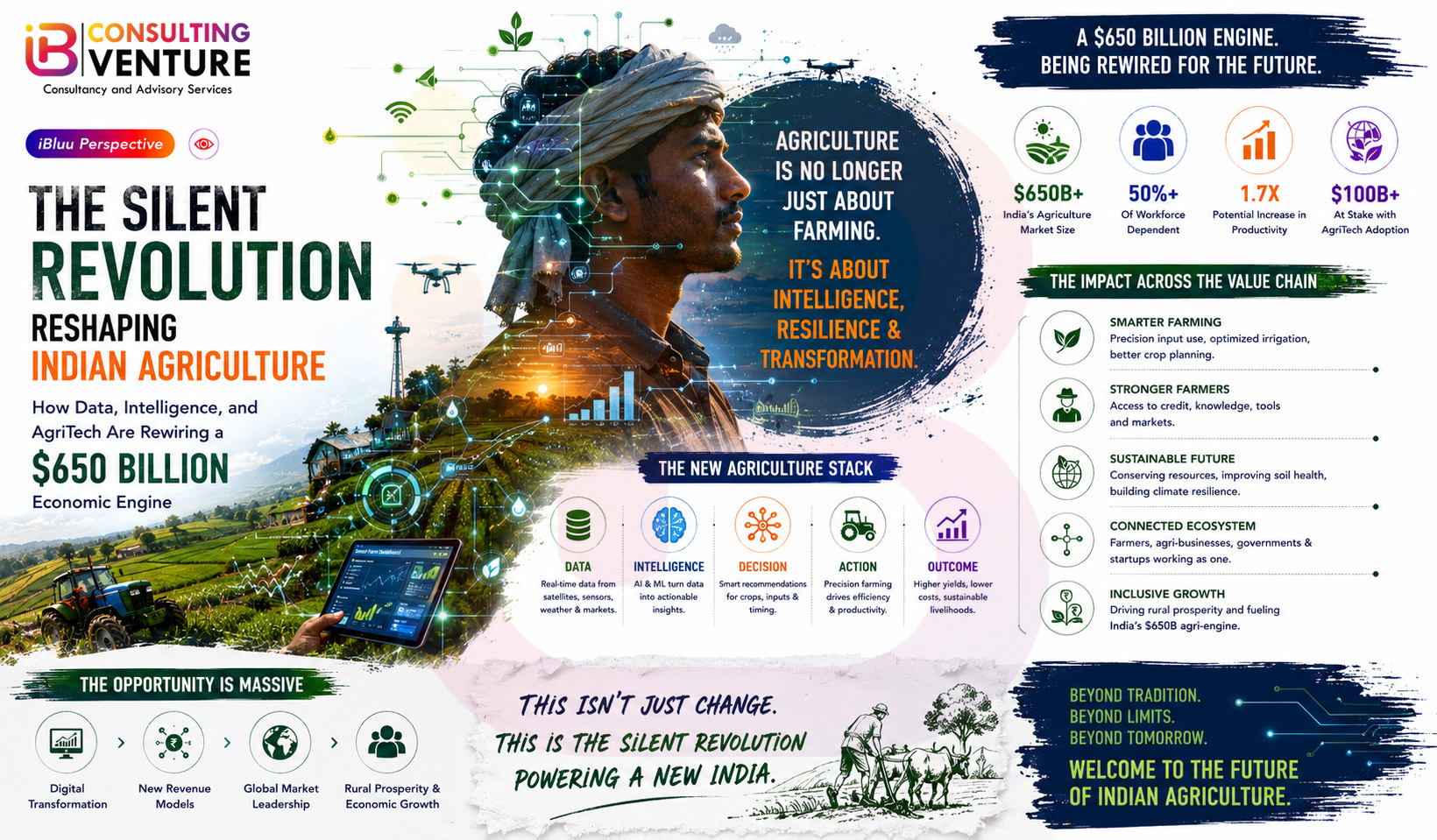
The Silent Revolution Inside Indian Agriculture: The Rise of the Agricultural Intelligence Economy
For decades, Indian agriculture was viewed through a narrow lens:
A sector associated with uncertainty.
Monsoons.
Middlemen.
Fragmented landholdings.
Low productivity.
And chronic income volatility.
That narrative is now becoming dangerously outdated.
Because beneath the noise of AI headlines, semiconductor races, data center expansion, and manufacturing corridors, one of the most important structural transformations in India is unfolding quietly across farms, rural supply chains, agricultural marketplaces, logistics networks, and farmer ecosystems.
This is not merely an agricultural upgrade.
This is the digitization of India’s largest livelihood ecosystem.
And it may become one of the most consequential wealth creation stories of New Bharat over the next decade.
Indian Agriculture Is No Longer a Traditional Sector. It Is Becoming an Intelligence-Driven Economic System.
India’s agriculture sector today contributes roughly 16–18% of national GDP while supporting livelihoods for more than 42% of the population. The sector has evolved into a strategic economic pillar with growing importance in exports, food security, rural consumption, manufacturing demand, and supply-chain stability.
The scale itself is staggering.
Recent industry estimates place India’s agricultural economy between approximately $580 billion and $650 billion, making it one of the largest agricultural systems globally.
More importantly, India is now producing record levels of food grains.
Government estimates indicate foodgrain production reaching nearly 376 million tonnes in 2025–26, reflecting both productivity improvements and increasing resilience despite climate volatility.
Yet the real story is not production.
The real story is intelligence.
For centuries, agriculture operated largely on instinct.
Today it is beginning to operate on data.
That shift changes everything.
The Biggest Transformation Is Not Happening in the Field. It Is Happening in the Information Layer Above the Field.
Historically, a farmer’s success depended on variables beyond control:
- Rainfall uncertainty
- Pest outbreaks
- Market pricing distortions
- Poor access to buyers
- Limited financing
- Weak logistics infrastructure
- Information asymmetry
The consequences were severe.
A single weather event could erase an entire season’s earnings.
A pricing mismatch could destroy profitability.
A logistics failure could wipe out crop value before reaching consumers.
The agricultural economy functioned reactively.
Today, a new model is emerging.
An intelligence layer powered by:
- Artificial Intelligence
- Satellite imaging
- IoT sensors
- Predictive analytics
- Climate modeling
- Remote sensing
- Precision agriculture platforms
- Digital marketplaces
Agriculture is slowly transitioning from uncertainty-driven decision making to probability-driven decision making.
That is a structural economic shift, not a technological trend.
AgriTech Is Becoming the New Infrastructure Layer of Indian Agriculture
India’s agritech ecosystem has evolved from experimental startups into strategic agricultural infrastructure.
The sector is expected to witness substantial growth through the next decade as digital farming, precision agriculture, climate intelligence, and farmer-service platforms expand nationwide. Market estimates project India’s agritech market reaching over $2.5 billion by 2034.
But market size alone understates the opportunity.
The real value lies in reducing inefficiencies embedded within agricultural systems.
For decades, agriculture suffered from four structural bottlenecks:
1. Information Failure
Farmers lacked predictive visibility.
2. Market Failure
Farmers lacked pricing power.
3. Financing Failure
Lenders lacked risk visibility.
4. Logistics Failure
Supply chains leaked value at every stage.
The next generation of AgriTech companies is attempting to solve all four simultaneously.
Why Companies Like CropIn Are Attracting Global Attention
One of the most powerful developments in modern agriculture is predictive farming intelligence.
Companies such as CropIn have pioneered technology platforms that combine:
- Satellite intelligence
- AI-based crop monitoring
- Risk analytics
- Yield forecasting
- Climate prediction systems
The significance extends far beyond software.
For banks, insurers, exporters, governments, food processors, and investors, visibility creates confidence.
Confidence creates capital.
Capital creates growth.
The agricultural economy has historically suffered because uncertainty discouraged investment.
Data changes risk perception.
Risk perception changes capital allocation.
And capital allocation changes entire industries.
The Supply Chain Revolution Is Quietly Redefining Farmer Economics
One of Indian agriculture’s greatest historical weaknesses was never production capacity.
It was movement.
India produces enormous agricultural output.
Yet inefficiencies between farms and consumers frequently destroyed value.
Post-harvest losses, fragmented distribution channels, multiple intermediaries, and logistics gaps reduced farmer realization while increasing consumer prices.
This created a paradox:
Farmers earned less.
Consumers paid more.
Supply chains absorbed the difference.
Platforms like Ninjacart and similar agri-distribution innovators have challenged that model by creating more direct farm-to-market ecosystems.
The objective is simple:
Reduce friction.
Increase transparency.
Improve price discovery.
Accelerate movement.
As supply chains become digitized, agriculture begins behaving less like an informal economy and more like a structured commercial sector.
The Rise of Full-Stack Farmer Ecosystems
Perhaps the most strategically significant innovation emerging in India is the concept of integrated farmer operating systems.
Agriculture does not fail because of one isolated problem.
It fails because multiple problems compound simultaneously.
Input access.
Crop advisory.
Financing.
Insurance.
Procurement.
Market access.
Logistics.
Farmer education.
Companies such as DeHaat have attempted to build comprehensive ecosystems around the farmer rather than isolated products.
This model matters because it addresses systemic inefficiency instead of fragmented inefficiency.
The future winners in agriculture may not be those solving one problem.
They may be those building entire agricultural operating platforms.
Precision Agriculture Is Turning Farming Into Applied Science
A deeper transformation is now underway.
Agriculture is increasingly becoming measurable.
Sensor-driven farming systems now allow farmers to monitor:
- Soil health
- Moisture levels
- Irrigation efficiency
- Nutrient conditions
- Weather shifts
- Crop stress indicators
Companies including Fasal are contributing to this transition toward precision agriculture.
The economic implications are profound:
- Lower input costs
- Better water utilization
- Higher productivity
- Reduced resource wastage
- Improved sustainability
India faces growing pressure from water scarcity, climate volatility, and resource constraints.
Precision agriculture is no longer an innovation luxury.
It is becoming an economic necessity.
The Next Agricultural Battle Will Be About Rural Capital
Agriculture has historically struggled to attract large-scale institutional capital.
Investors prefer predictability.
Agriculture traditionally offered uncertainty.
That equation is changing.
As agricultural intelligence improves, several markets become stronger simultaneously:
- Agricultural lending
- Crop insurance
- Commodity financing
- Warehouse financing
- Carbon markets
- Agricultural exports
- Rural infrastructure
Data visibility enables financial visibility.
Financial visibility unlocks capital.
And capital accelerates modernization.
This may become one of the largest rural financial transformations in India’s modern history.
Why Investors Are Beginning to Watch Agriculture Differently
Global investors increasingly recognize agriculture as more than a food-production sector.
It intersects with:
- Climate resilience
- Water security
- Food security
- AI deployment
- Supply-chain infrastructure
- Rural consumption
- Export growth
- Carbon management
Agriculture is becoming a strategic asset class.
The founders building agricultural intelligence platforms today are not merely creating startups.
Many are building future infrastructure companies.
The long-term winners may resemble platform businesses rather than conventional agricultural enterprises.
India’s Agricultural Opportunity Extends Beyond Farming
The next phase of agricultural growth will likely emerge from connected sectors:
- Cold-chain infrastructure
- Warehousing
- Food processing
- Agri-finance
- Agri-insurance
- Agricultural robotics
- Farm mechanization
- Rural logistics
- Climate intelligence
- Carbon credit ecosystems
- Precision farming solutions
- Export-oriented agri value chains
The multiplier effect could be enormous.
Agriculture increasingly influences manufacturing.
Manufacturing influences logistics.
Logistics influences exports.
Exports influence economic growth.
The sector is becoming interconnected with the broader national development model.
The Strategic Reality Most Investors Still Underestimate
India’s agricultural story is no longer merely about feeding 1.4 billion people.
It is about building one of the world’s most sophisticated agricultural intelligence ecosystems.
The countries that dominate future agriculture will not necessarily be those with the most land.
They will be those with the most intelligence layered onto that land.
That distinction matters.
Because intelligence compounds.
And agriculture is finally entering its compounding era.
The New Wealth Creation Frontier May Be Rural, Digital, and Data-Driven
While attention remains concentrated on AI models, semiconductor fabs, EV manufacturing, renewable energy corridors, and data centers, another transformation is accelerating quietly.
Across villages.
Across supply chains.
Across warehouses.
Across agricultural marketplaces.
Across farmer networks.
India is building the intelligence infrastructure of agriculture.
Not loudly.
Not virally.
But structurally.
And the sectors that transform economies are rarely the ones making the most noise.
They are the ones rebuilding the foundations underneath them.
Indian agriculture appears to be entering exactly that phase.
And the long-term economic implications could be far larger than most markets currently realize.
Strategic Perspective
The analytical depth of this article is informed by the strategic lens of J Parasher, whose work focuses on national capability building, industrial transformation, infrastructure strategy, and long-horizon economic systems. Through iBluu Corporations and iBCV (iBluu Consulting Venture Private Limited), the focus remains on understanding how technology, capital, infrastructure, policy, and institutional design converge to create the next generation of economic value creation engines.
Disclaimer: This article is intended solely for informational, research, and strategic insight purposes. Data, market estimates, company references, and industry projections are based on publicly available information, industry reports, and secondary research sources available at the time of writing. Readers should independently verify financial, investment, policy, regulatory, and commercial information before making business or investment decisions. References to specific companies, technologies, or market participants do not constitute endorsements, investment recommendations, or commercial affiliations.