+91 945 889 6091
  infodesk@ibluu.com
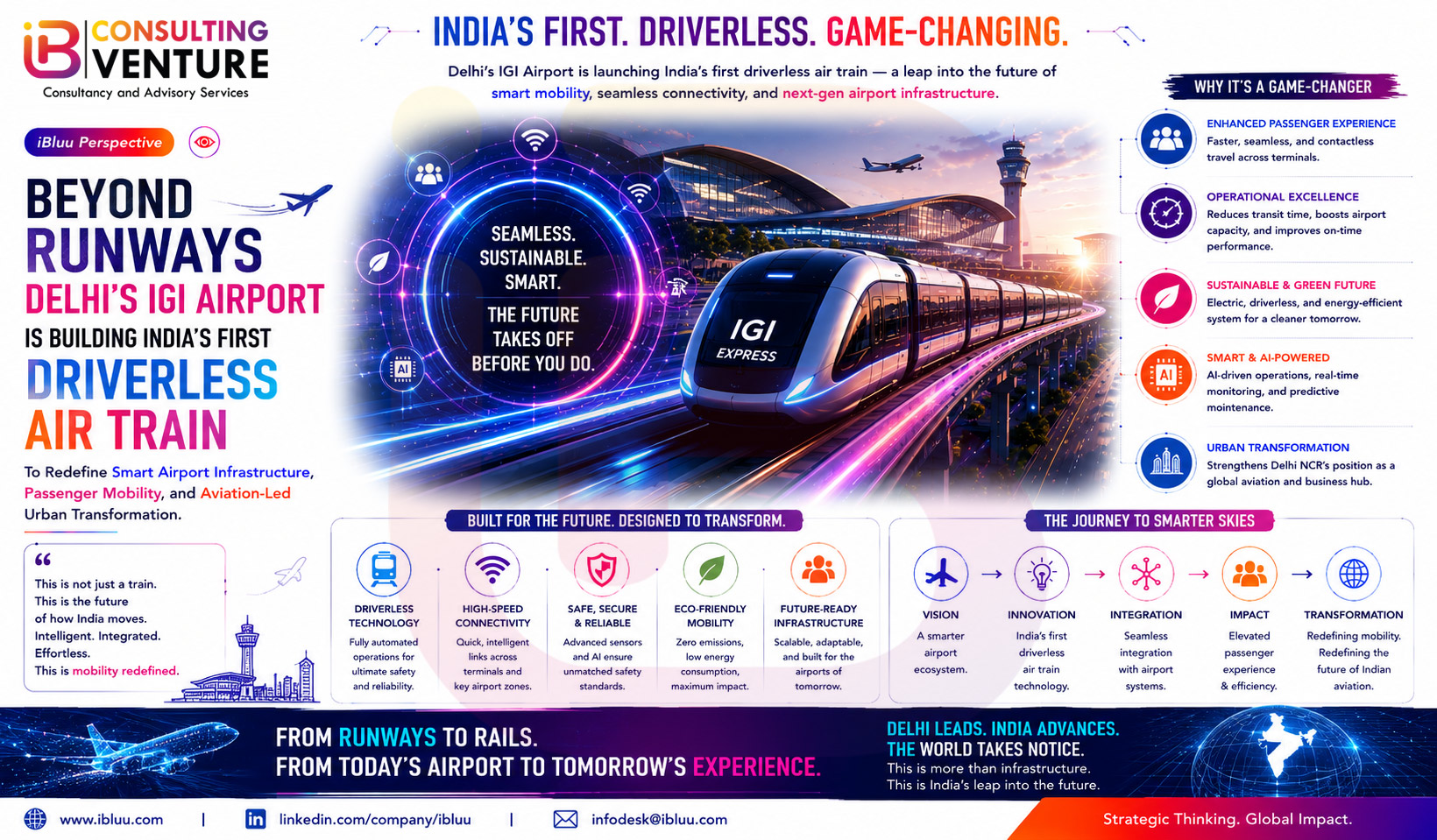
Delhi’s IGI Airport Is Building India’s First Driverless Air Train to Redefine Smart Airport Infrastructure, Passenger Mobility, and Aviation-Led Urban Transformation
India’s Largest Aviation Gateway Is Quietly Building the Next Layer of Airport Infrastructure Intelligence
For decades, airports were designed as transportation nodes.
Today, the world’s leading airports are evolving into integrated economic ecosystems — combining aviation, logistics, hospitality, commerce, urban mobility, and smart infrastructure into a single synchronized platform.
That is precisely why the upcoming driverless air train project at Indira Gandhi International Airport matters far beyond aviation.
Delhi’s IGI Airport is preparing to launch India’s first-ever airport air train system — a fully automated, driverless transit network that could fundamentally redefine how passengers, workers, cargo operators, and airport ecosystems move within large-scale aviation infrastructure in India.
And strategically, this may become one of the most important smart airport mobility projects India has seen in decades.
India’s First Airport Air Train: What the Project Actually Includes
The proposed air train system is expected to span approximately 7.7 kilometers across the IGI Airport ecosystem and is being designed as an intra-airport automated mobility corridor connecting:
- Terminal 1
- Terminal 2
- Terminal 3
- Aerocity hospitality district
- Cargo and logistics zones
- Future airport-linked infrastructure corridors
The estimated investment is projected at nearly ₹4,000 crore.
Unlike conventional metro systems, the proposed network is expected to operate as a dedicated airport transit ecosystem — optimized specifically for:
- Passenger transfers
- Airport workforce mobility
- Cargo district connectivity
- Hospitality movement
- Reduced vehicular congestion
- Time-sensitive airport circulation
The project reflects a major transition in how India’s next-generation airports may evolve over the coming decade.
Project Snapshot: Delhi IGI Driverless Air Train
| Parameter | Details |
|---|---|
| Project Type | Fully Driverless Automated Air Train |
| Estimated Cost | ~₹4,000 crore |
| Length | ~7.7 km |
| Coverage | T1, T2, T3, Aerocity, Cargo District |
| Technology | Automated People Mover (APM) |
| Expected Model | Smart intra-airport rapid transit |
| Strategic Objective | Passenger + logistics integration |
| Potential Impact | Reduced congestion and faster transfers |
Why IGI Airport Suddenly Needs a Driverless Air Train
The answer lies in scale.
Delhi’s IGI Airport is no longer functioning merely as a city airport.
It is rapidly evolving into a multi-layered aviation ecosystem.
Passenger traffic at IGI has already crossed pre-pandemic levels, with annual passenger movement approaching and periodically exceeding 75 million travelers, placing it among the world’s busiest airports.
At this scale, traditional road-based airport circulation systems begin facing structural limitations:
- Terminal transfer delays
- Vehicular congestion
- Traffic bottlenecks
- Passenger time loss
- Logistics inefficiencies
- Carbon emissions
- Operational complexity
As airports expand, internal mobility becomes as important as runway capacity itself.
That is exactly why leading airports globally shifted toward automated transit systems years ago.
Delhi is now entering that phase.
The Global Blueprint Behind Delhi’s Air Train Strategy
The IGI air train concept follows a model already deployed across several globally dominant aviation hubs:
- Dubai International Airport
- Singapore Changi Airport
- Frankfurt Airport
- Heathrow Airport
- Hartsfield–Jackson Atlanta International Airport
These airports realized a critical truth early:
Future airport competitiveness depends not only on aircraft movement — but on ecosystem mobility efficiency.
Passengers increasingly evaluate airports through:
- Transfer speed
- Connectivity integration
- Automation
- Smart navigation
- Travel convenience
- Digital infrastructure
- Reduced friction
The air train directly addresses all seven.
Why This Project Is Strategically Bigger Than Transportation
The real significance of this project lies in what it signals about India’s infrastructure philosophy.
Historically, India focused heavily on:
- Highway expansion
- Metro systems
- railway modernization
- aviation capacity growth
Now the country is beginning to move toward integrated infrastructure intelligence.
That means combining:
- Aviation
- Smart mobility
- Logistics
- Urban design
- Hospitality infrastructure
- Real estate ecosystems
- Digital infrastructure
- Sustainability systems
into unified operational corridors.
This is the same model visible in advanced airport cities globally.
IGI Airport’s air train could become India’s first large-scale proof-of-concept for that transition.
The Aerocity and Cargo City Multiplier
One of the most underestimated aspects of this project is the economic integration potential surrounding Aerocity and Cargo City.
Aerocity has already evolved into one of India’s fastest-growing hospitality and commercial infrastructure districts, housing:
- Global hotel chains
- Corporate offices
- Business convention infrastructure
- Aviation-linked services
- Premium commercial real estate
Meanwhile, the cargo ecosystem around IGI remains strategically critical for:
- Electronics exports
- pharmaceutical logistics
- e-commerce movement
- high-value cargo handling
- cold-chain systems
The air train effectively compresses these ecosystems into a synchronized operational network.
That creates massive long-term value through:
- Faster passenger movement
- Lower congestion costs
- Higher airport efficiency
- Improved tourism experience
- Better cargo coordination
- Real estate appreciation
- Increased commercial activity
This is infrastructure multiplier economics in action.
Estimated Timeline and Execution Outlook
While final execution timelines remain subject to approvals, technical structuring, bidding frameworks, and engineering alignment, industry expectations indicate phased development could unfold over the next several years alongside broader airport expansion initiatives.
The project is expected to align strategically with:
- Future terminal expansion
- Increasing passenger volumes
- Noida International Airport competition dynamics
- Delhi NCR aviation growth
- Smart mobility integration
Given the scale and engineering complexity, global transit technology players and infrastructure firms are expected to participate in future implementation frameworks.
Who Is Driving the Vision Behind the Project?
The broader strategic direction reflects the growing ambition of Delhi International Airport Limited (DIAL), supported by India’s expanding aviation infrastructure priorities.
The vision aligns closely with India’s wider push toward:
- world-class airport modernization
- multimodal connectivity
- smart infrastructure ecosystems
- sustainable urban mobility
- globally benchmarked transit systems
The project also reflects the increasing influence of airport-led urbanization models seen globally, where airports evolve into economic cities rather than isolated transport facilities.
Which Indian Airports Could Follow Next?
If successfully executed, IGI’s air train could establish a new benchmark for future airport infrastructure in India.
Potential future candidates for similar systems may include:
- Noida International Airport
- Navi Mumbai International Airport
- Kempegowda International Airport
- Rajiv Gandhi International Airport
As passenger traffic scales beyond traditional airport capacity models, internal automated transit systems may become standard infrastructure requirements rather than premium additions.
Economic and Strategic Impact
The long-term economic implications extend beyond passenger convenience.
Projects like this generate cascading benefits across:
| Strategic Area | Potential Impact |
|---|---|
| Airport Efficiency | Reduced transfer and operational delays |
| Real Estate | Higher commercial and hospitality valuations |
| Tourism | Improved global passenger experience |
| Sustainability | Lower intra-airport vehicle emissions |
| Employment | Infrastructure, engineering, and operations jobs |
| Logistics | Faster cargo ecosystem movement |
| Smart Mobility | National benchmark for automated transit systems |
This is exactly why advanced economies aggressively invest in airport ecosystem infrastructure.
Airports are no longer gateways alone.
They are economic engines.
India’s Aviation Infrastructure Story Is Entering a New Phase
India is expected to become one of the world’s largest aviation markets over the coming decade.
But scale alone will not determine leadership.
Infrastructure intelligence will.
The countries that dominate future aviation ecosystems will be those capable of integrating:
- automation
- mobility systems
- digital infrastructure
- logistics ecosystems
- sustainable design
- passenger efficiency
- smart urbanization
into a single synchronized platform.
Delhi’s proposed driverless air train reflects India’s growing ambition to compete at precisely that level.
Final Strategic Perspective
From an iBCV perspective, the proposed IGI Airport air train represents far more than an airport transportation upgrade.
It represents the emergence of a new infrastructure mindset in India — one where airports are no longer treated merely as transport hubs, but as integrated economic ecosystems capable of driving tourism, logistics, commercial real estate, aviation growth, and smart urban mobility simultaneously.
The analytical depth of this perspective has been shaped by the strategic lens of J Parasher, Founder and Managing Director of iBluu Corporations, whose work consistently focuses on infrastructure transformation, economic systems, urban-industrial competitiveness, and globally benchmarked development ecosystems.
Disclaimer: This article is intended solely for informational, analytical, and strategic discussion purposes and should not be interpreted as investment, legal, policy, engineering, or financial advice. Project details, investment estimates, timelines, route structures, operational frameworks, and strategic assumptions referenced herein are based on publicly available reports, aviation industry discussions, infrastructure planning updates, and market intelligence available as of May 2026. Final project scope, execution models, technical specifications, and timelines remain subject to regulatory approvals, airport authority decisions, engineering studies, and implementation frameworks.