+91 945 889 6091
  infodesk@ibluu.com
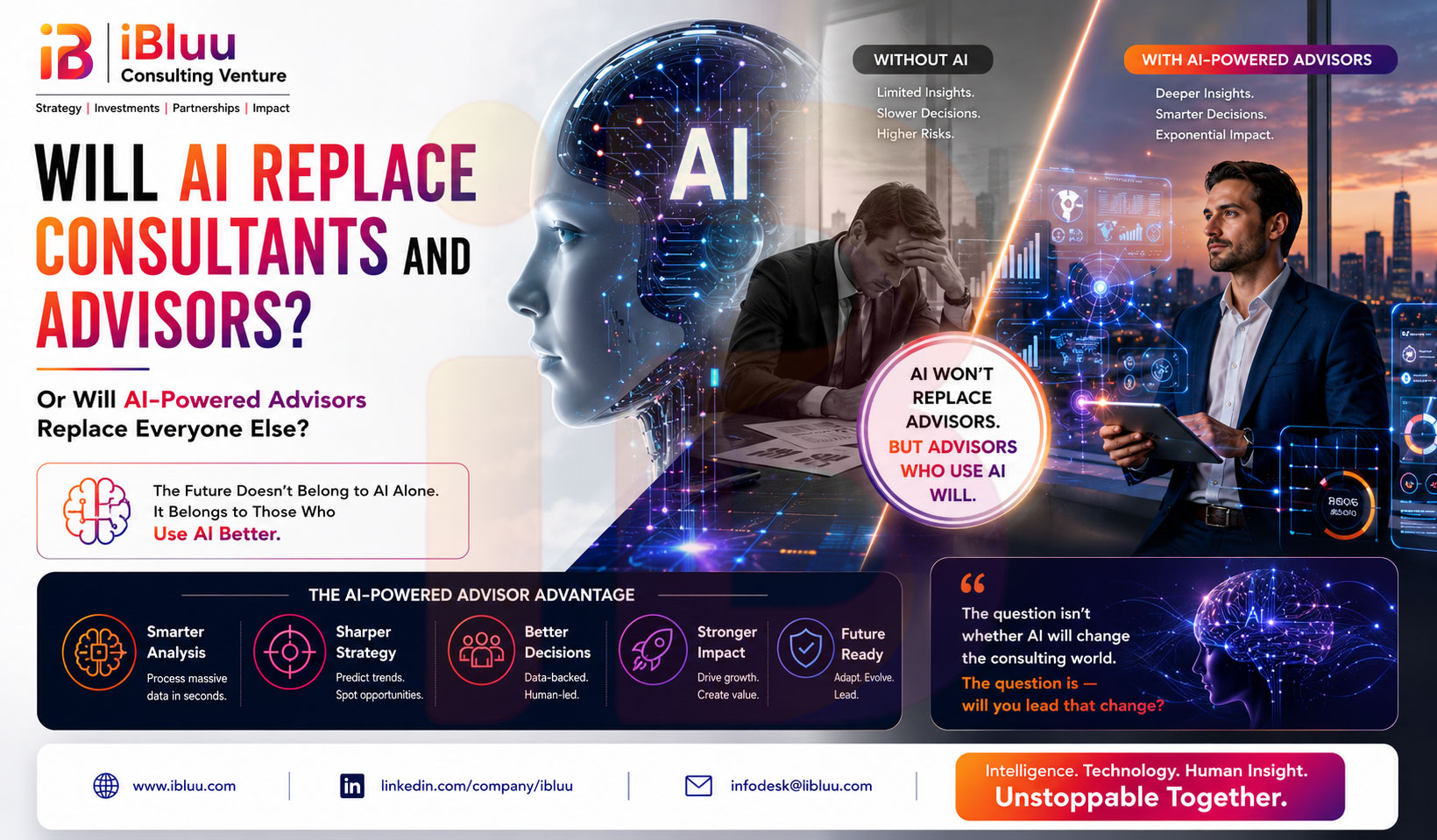
Will AI Replace Consultants and Advisors? Or Will AI-Powered Advisors Replace Everyone Else?
The Most Expensive Mistake in Professional Services Today Is Asking the Wrong Question.
For the last two years, boardrooms, investment committees, family offices, real estate developers, wealth managers, consulting firms, and business leaders have all asked the same question:
“Will Artificial Intelligence replace consultants and advisors?”
The more important question is different:
What happens when one consultant uses AI and another does not?
Because history suggests that technologies rarely eliminate industries overnight.
They eliminate inefficiencies.
They eliminate delays.
They eliminate information asymmetry.
And eventually, they eliminate professionals who refuse to evolve.
The future of consulting is therefore unlikely to be:
Human vs AI.
The future belongs to:
Human + AI vs Human Alone.
This is the emergence of the Centaur Model — a hybrid intelligence architecture combining machine-scale analytical power with human judgment, trust, relationships, and strategic intuition.
The winners of the next decade may not be AI companies.
They may be advisors who learn how to think with AI rather than compete against it.
Why AI Creates Fear in Consulting
The fear is understandable.
Artificial Intelligence can now:
- Analyze millions of data points in seconds.
- Review legal documents.
- Produce financial models.
- Generate investment scenarios.
- Summarize due diligence reports.
- Identify market patterns.
- Create strategy presentations.
- Automate research workflows.
- Draft reports once requiring teams of analysts.
Tasks that once took consultants weeks increasingly require hours.
Tasks that once required teams increasingly require platforms.
The economics of advisory services are changing.
Rapidly.
Research estimates suggest that generative AI could automate or augment a substantial proportion of knowledge-worker activities globally over the coming decade.
But automation of tasks should never be confused with automation of judgment.
Those are fundamentally different things.
The Consulting Industry Has Survived This Before
The consulting profession has repeatedly adapted to technological disruption.
Spreadsheets did not eliminate accountants.
Bloomberg terminals did not eliminate investment bankers.
CRM systems did not eliminate relationship managers.
Online property portals did not eliminate real estate advisors.
Electronic trading platforms did not eliminate wealth managers.
Technology changed workflows.
It changed margins.
It changed operating models.
But it rarely eliminated trusted advisors.
Instead, it increased the premium attached to judgment.
AI may follow the same pattern.
The Reality: AI Is Extraordinary at Analysis
Artificial intelligence possesses capabilities no human advisor can match.
| Capability | Artificial Intelligence | Human Advisor |
|---|---|---|
| Data Processing | Millions of records instantly | Limited capacity |
| Pattern Recognition | Exceptional | Strong but constrained |
| Market Monitoring | Continuous 24/7 | Intermittent |
| Scenario Modeling | Near-instant | Time intensive |
| Regulatory Scanning | Massive scale | Limited bandwidth |
| Speed | Seconds | Hours or days |
| Cost Per Analysis | Extremely low | Higher |
For analytical workloads, AI represents an extraordinary force multiplier.
A consultant using AI effectively may achieve productivity levels that previously required entire teams.
This changes the economics of advisory businesses permanently.
But Consulting Was Never Just About Information
Information has become abundant.
Judgment remains scarce.
Clients rarely hire advisors because they lack access to data.
They hire advisors because they face uncertainty.
Should we enter this market?
Should we acquire this company?
Should we invest ₹500 crore into this project?
Should we restructure family wealth?
Should we buy this land parcel despite litigation risk?
Should we enter India now or wait three years?
These are not spreadsheet problems.
They are judgment problems.
And judgment operates differently from computation.
The Human Advantage Is Larger Than Many Assume
AI can simulate empathy.
It cannot experience it.
AI can estimate negotiation outcomes.
It cannot read a room.
AI can summarize a founder conversation.
It cannot detect conviction hidden behind hesitation.
AI can evaluate financial ratios.
It cannot evaluate character.
AI can recommend a transaction.
It cannot assume moral responsibility for one.
Professional advisory ultimately operates at the intersection of economics, psychology, politics, incentives, law, reputation, and trust.
That intersection remains profoundly human.
The New Competitive Equation
The next decade is unlikely to divide firms into “AI firms” and “non-AI firms.”
The division will be simpler:
Category 1:
Consultants who use AI.
Category 2:
Consultants who compete against consultants who use AI.
History is generally unforgiving toward the second category.
Sector-by-Sector Impact Assessment
Business Consulting
Research, benchmarking, market intelligence, financial modeling, and presentation creation are increasingly automated.
However, organizational politics, leadership alignment, transformation execution, stakeholder management, and boardroom persuasion remain human domains.
AI will reduce the need for junior analytical work.
It may increase demand for senior strategic judgment.
Real Estate Investment Advisory
AI can evaluate yield spreads, rental trends, demographic shifts, absorption rates, and pricing patterns at extraordinary speed.
But land acquisition decisions frequently depend on variables that exist outside datasets:
Political sensitivity.
Regulatory interpretation.
Local stakeholder dynamics.
Negotiation complexity.
Social license.
Execution risk.
These remain deeply human activities.
Wealth Management
Portfolio construction is increasingly algorithmic.
Relationship management is not.
During market crashes, clients rarely need information.
They need confidence.
Behavioral coaching may become more valuable than stock selection itself.
The advisor increasingly becomes a psychologist, strategist, educator, and risk interpreter.
Government Relations and Strategic Engagement
This may become one of the least automatable advisory categories.
Political judgment, institutional trust, stakeholder mapping, coalition building, negotiation sequencing, and reputation management are difficult to codify into algorithms.
Relationships remain infrastructure.
The Emergence of the Centaur Consultant
Chess provides an important lesson.
After computers defeated grandmasters, many expected humans to disappear from elite competition.
The opposite happened.
The strongest players often became teams composed of humans and machines working together.
These combinations became known as Centaurs.
Professional services may follow a similar trajectory.
The most valuable advisor in 2035 may not be:
- the smartest human,
- nor the smartest AI,
but the professional capable of orchestrating both simultaneously.
Risks of Over-Reliance on AI
AI introduces new vulnerabilities:
- Hallucinated outputs.
- Bias embedded in training data.
- Lack of accountability.
- Regulatory uncertainty.
- Privacy risks.
- Cybersecurity concerns.
- Overconfidence in probabilistic outputs.
A wrong answer delivered instantly remains a wrong answer.
Scale does not eliminate responsibility.
It amplifies it.
Scenario Outlook to 2035
Base Case
AI automates research, analytics, reporting, and operational workflows while human advisors dominate trust-intensive decisions.
Upside Case
Hybrid AI-enabled firms achieve dramatic productivity gains and global scalability while improving client outcomes.
Stress Scenario
Commodity advisory services become heavily automated, compressing margins and forcing consolidation across traditional firms.
The common factor across all three scenarios remains identical:
Human judgment survives.
Only the business model changes.
Strategic Recommendations for Advisory Firms
- Build AI-native operating models.
- Redesign workflows around augmentation rather than replacement.
- Invest heavily in domain expertise and sector specialization.
- Strengthen relationship capital.
- Develop proprietary data assets.
- Focus on trust-intensive and high-stakes decision environments.
- Train consultants to become orchestrators of intelligence rather than generators of information.
The future consultant increasingly resembles a strategic systems architect rather than a report producer.
Final Thought
Artificial Intelligence may become the most powerful analytical engine in economic history.
But strategy has never been a purely analytical exercise.
It remains a human one.
Markets move on data.
Businesses move on incentives.
Institutions move on trust.
People move on conviction.
The future therefore belongs neither to humans nor machines alone.
It belongs to those capable of combining both into a single decision-making system.
The age of the standalone consultant is fading.
The age of the Centaur Advisor has already begun.
Strategic Perspective
The analytical perspective underlying this article has been influenced by the work of J Parasher, Founder and Managing Director of iBluu Consulting Venture (iBCV), a venture of iBluu Corporations, whose work focuses on strategic advisory, national capability building, infrastructure economics, and long-horizon economic transformation.
His perspective increasingly frames consulting not as a sector, but as strategic decision infrastructure operating at the intersection of capital, policy, technology, and execution.
Disclaimer: This article is intended solely for informational and thought-leadership purposes and does not constitute financial, legal, investment, regulatory, or professional advice. The future impact of artificial intelligence on advisory sectors will depend on technological evolution, regulatory frameworks, adoption rates, and market behavior. Predictions and scenarios discussed herein should therefore be interpreted as strategic perspectives rather than certainties.