+91 945 889 6091
  infodesk@ibluu.com
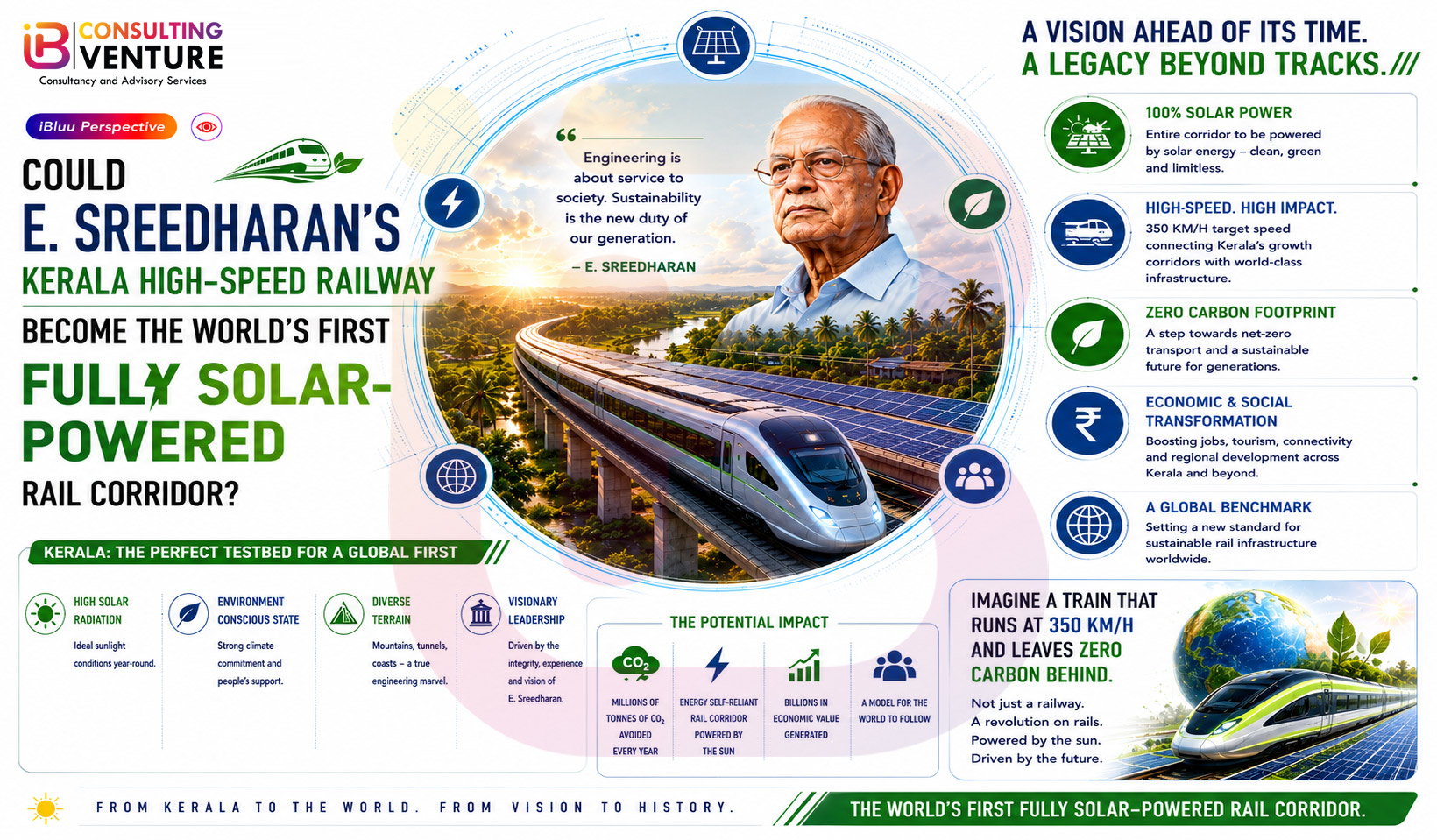
Metro Man E. Sreedharan’s Proposed Kerala High-Speed Railway Could Become the World’s First Fully Solar-Powered High-Speed Rail Corridor
The future of transportation may not be defined merely by speed.
It may be defined by energy independence.
Across the world, governments are investing billions into high-speed rail, electrified mobility, renewable energy, and sustainable infrastructure. Yet these initiatives are often pursued as separate policy agendas.
What makes Kerala’s proposed High-Speed Railway (KHSR) fundamentally different is that it attempts to merge all three into a single integrated infrastructure platform.
The proposal submitted by India’s legendary “Metro Man,” E. Sreedharan, envisions a 473-kilometre high-speed rail corridor connecting Thiruvananthapuram and Kannur at an estimated investment of approximately ₹60,000 crore. If implemented as envisioned, the corridor could emerge as the world’s first fully solar-powered high-speed rail network, creating a new benchmark for green mobility infrastructure.
This is not merely a transportation project.
It is a proposal to redesign how mobility, energy, climate resilience, and regional economic development interact within a single infrastructure ecosystem.
The Project at a Glance
| Parameter | Proposed KHSR |
|---|---|
| Corridor Length | Approximately 473 km |
| Route | Thiruvananthapuram – Kannur |
| Estimated Cost | ₹60,000 Crore |
| Stations | 23 |
| Maximum Design Speed | 200 kmph |
| Operational Speed | Around 180 kmph |
| Travel Time | Approximately 3.5 Hours |
| Infrastructure Model | Predominantly Elevated |
| Energy Source | Dedicated Solar Power Generation |
| Proposed Funding | Crowdfunding + State + Central Government |
Sources indicate that the corridor would connect major urban centres, airports, economic zones, and logistics corridors across Kerala, dramatically reducing north-south travel times.
Why This Project Matters Beyond Kerala
Most infrastructure projects solve a transportation problem.
The Kerala High-Speed Railway attempts to solve five structural challenges simultaneously:
- Mobility efficiency
- Energy sustainability
- Regional economic integration
- Climate objectives
- Long-term productivity growth
This is precisely why the proposal deserves national attention.
For decades, Kerala has struggled with a unique geographical constraint.
The state stretches more than 580 kilometres along India’s southwestern coastline while remaining relatively narrow in width. Population density remains among the highest in India, creating severe pressure on highways, railways, and urban transport systems.
Despite multiple upgrades, conventional rail infrastructure continues to face congestion limitations.
A high-speed corridor changes the economic geography of the state itself.
The Global Context: How Different Is This Proposal?
Around the world, high-speed rail has become a symbol of national competitiveness.
Comparison with Major Global Rail Corridors
| Corridor | Length | Top Speed | Energy Model |
|---|---|---|---|
| Japan Shinkansen | 2,700+ km network | Up to 320 kmph | Grid-powered |
| France TGV | 2,800+ km network | Up to 320 kmph | Grid-powered |
| China High-Speed Rail | 45,000+ km network | Up to 350 kmph | Grid-powered |
| Mumbai-Ahmedabad Bullet Train | 508 km | 320 kmph | Grid-powered |
| Proposed Kerala HSR | 473 km | 180–200 kmph | Dedicated solar-powered model |
Comparison with Major Global Rail Corridors
While China, Japan, France, Spain, and Germany operate some of the world’s most advanced high-speed rail systems, none are widely recognized as fully solar-powered rail corridors generating dedicated renewable energy at corridor scale.
Many rail systems purchase renewable power from national grids.
The Kerala proposal goes further by attempting to embed energy generation directly into the transportation model.
That distinction is strategically significant.
The Solar Rail Corridor Concept: A Potential Global First
Perhaps the most ambitious component of the proposal is not the railway.
It is the energy architecture behind it.
According to details shared around the project, the corridor is designed as a Green Rail Corridor powered through dedicated solar generation infrastructure. Excess electricity generated may potentially be supplied back into Kerala’s power grid.
If executed successfully, the implications are significant.
Today, most high-speed rail systems worldwide operate on electrified networks drawing power from national grids.
Kerala’s model proposes something different:
Rail Infrastructure + Renewable Energy Infrastructure + Grid Integration
Few transportation projects globally attempt such deep integration between mobility and energy systems.
From an ESG and sustainability perspective, this would place Kerala among a very small group of global infrastructure innovators.
The Economic Multiplier Effect
Large transportation corridors rarely generate value solely through passenger movement.
Their true impact emerges through secondary and tertiary economic effects.
Real Estate Development
Historically, high-speed transportation corridors create new growth clusters around stations.
Examples include:
- Japan’s Shinkansen network
- China’s high-speed rail cities
- France’s TGV economic zones
A similar effect could emerge around Kerala’s proposed 23 stations.
Commercial districts, housing clusters, logistics facilities, hospitality projects, educational institutions, and healthcare infrastructure typically follow major transport investments.
Tourism Expansion
Kerala’s tourism economy contributes significantly to state income.
Faster connectivity between:
- Thiruvananthapuram
- Kollam
- Alappuzha
- Kochi
- Thrissur
- Kozhikode
- Kannur
could create an entirely new tourism mobility network.
Domestic and international visitors increasingly value seamless transportation.
A journey that currently consumes much of a day could potentially be completed in a few hours.
That fundamentally changes visitor behavior.
Logistics and Airport Connectivity
The proposed alignment is expected to strengthen connectivity to major airports including Thiruvananthapuram, Kochi, and Kozhikode, while improving access toward Kannur Airport.
In infrastructure economics, connectivity is productivity.
Every minute saved compounds across businesses, supply chains, and consumers.
The Solar Infrastructure Opportunity
The renewable energy component deserves special attention.
India has already crossed approximately 230 GW of installed non-fossil fuel electricity capacity and is targeting 500 GW by 2030.
The next challenge is not generation.
It is integration.
Transportation is among the largest consumers of energy.
A rail corridor capable of generating much of its own electricity represents an important experiment in infrastructure decarbonization.
If excess electricity is indeed supplied back to the state grid, the project would effectively function as both:
- Transportation infrastructure
- Renewable energy infrastructure
simultaneously.
Few infrastructure projects globally attempt such integration.
The Financing Model: Ambitious and Unconventional
Perhaps the most debated component of the proposal is financing.
The reported framework includes:
| Funding Source | Proposed Contribution |
|---|---|
| Crowdfunding | ₹24,000 Crore |
| Government Support | Balance Amount |
| Total Project Cost | ₹60,000 Crore |
If achieved, this would become one of the largest infrastructure crowdfunding exercises ever attempted in India.
However, this is also where execution risks increase significantly.
Infrastructure projects require:
- Long-duration capital
- Stable governance
- Institutional oversight
- Predictable returns
- Public trust
Mobilizing ₹24,000 crore from citizens and investors would require extraordinary confidence in project execution.
The Strategic Risks
Every transformational project carries significant execution risks.
Land Acquisition
Even though much of the corridor is planned as elevated infrastructure, land acquisition remains one of India’s most complex infrastructure challenges.
Political Continuity
Projects spanning multiple years require policy consistency across political cycles.
Financial Viability
Capital cost control, passenger demand assumptions, operational efficiency, and long-term maintenance economics will determine the project’s commercial sustainability.
Technology and Execution
Maintaining high operational standards, safety protocols, and reliability comparable to international systems will be essential.
How Does It Compare Internationally?
Globally, countries are increasingly integrating transportation and renewable energy.
Yet few examples attempt complete energy self-sufficiency at corridor scale.
Countries such as:
- Japan
- China
- France
- Germany
- Spain
have world-class high-speed rail systems.
However, a fully solar-integrated rail corridor at this scale would place Kerala in a distinctly different category of infrastructure experimentation.
The project’s significance therefore extends beyond transportation.
It becomes an energy-transition case study.
Scenario Analysis: What Success Could Look Like
If approved and executed effectively, KHSR could create:
Economic Outcomes
- Faster labour mobility
- Higher productivity
- New investment zones
- Real estate appreciation
- Tourism growth
Environmental Outcomes
- Reduced transport emissions
- Renewable energy integration
- Lower fossil-fuel dependence
Strategic Outcomes
- Global infrastructure visibility
- National transportation innovation leadership
- Replicable model for other Indian states
What This Means for India
The broader significance extends far beyond Kerala.
India is entering a decade defined by infrastructure transformation.
The country is simultaneously investing in:
- High-speed rail
- Dedicated freight corridors
- Green hydrogen
- Renewable energy
- Smart cities
- Semiconductor manufacturing
- Logistics infrastructure
The Kerala proposal sits at the intersection of these trends.
It asks an important question:
Can transportation corridors become energy corridors?
If the answer is yes, future infrastructure projects across India may be designed very differently.
The Bigger Strategic Question
The most important question is not whether Kerala needs faster trains.
The bigger question is whether India can create infrastructure platforms where mobility, renewable energy, economic growth, and climate objectives are designed together rather than separately.
That is the true strategic significance of this proposal.
If successful, Kerala would not simply build another railway.
It would create a blueprint for the next generation of infrastructure systems.
Perspective from iBluu Corporations
The analytical lens behind this assessment aligns with the broader infrastructure and economic transformation philosophy often articulated by J Parasher, Founder and Managing Director of iBluu Corporations.
His work consistently emphasizes that future competitiveness will increasingly belong to nations and regions capable of integrating transportation infrastructure, renewable energy systems, industrial ecosystems, and capital formation into unified development platforms.
From this perspective, the Kerala High-Speed Railway is not merely a transportation investment.
It represents a potential prototype for how future infrastructure corridors may be designed across emerging economies.
Conclusion
The true significance of Kerala’s High-Speed Railway proposal is not measured in kilometres.
Nor in train speed.
Nor even in project cost.
Its significance lies in a larger idea.
That transportation infrastructure can become energy infrastructure.
That mobility systems can become climate solutions.
And that rail corridors can become platforms for regional economic transformation.
If approved and executed successfully, E. Sreedharan’s vision may eventually be remembered not as Kerala’s next railway project, but as one of the world’s most ambitious experiments in integrating transportation, renewable energy, and sustainable economic development into a single infrastructure ecosystem.
Disclaimer: This article is intended solely for research, educational, policy discussion, and strategic analysis purposes. Project specifications, costs, financing structures, timelines, and technical details referenced are based on publicly available reports, proposals, and announcements available as of June 2026 and remain subject to regulatory approvals, feasibility studies, design modifications, environmental clearances, funding arrangements, and government decisions. Readers, investors, policymakers, and stakeholders should conduct independent due diligence before making investment, policy, or commercial decisions.