+91 945 889 6091
  infodesk@ibluu.com
PM Surya Ghar: More Than a Subsidy Scheme — India’s Largest Household Energy Transformation Program
From Consumers of Electricity to Producers of Electricity: The Strategic Logic Behind PM Surya Ghar
Most government schemes aim to provide support.
Very few attempt to redesign an economic system.
India’s PM Surya Ghar: Muft Bijli Yojana belongs to the second category.
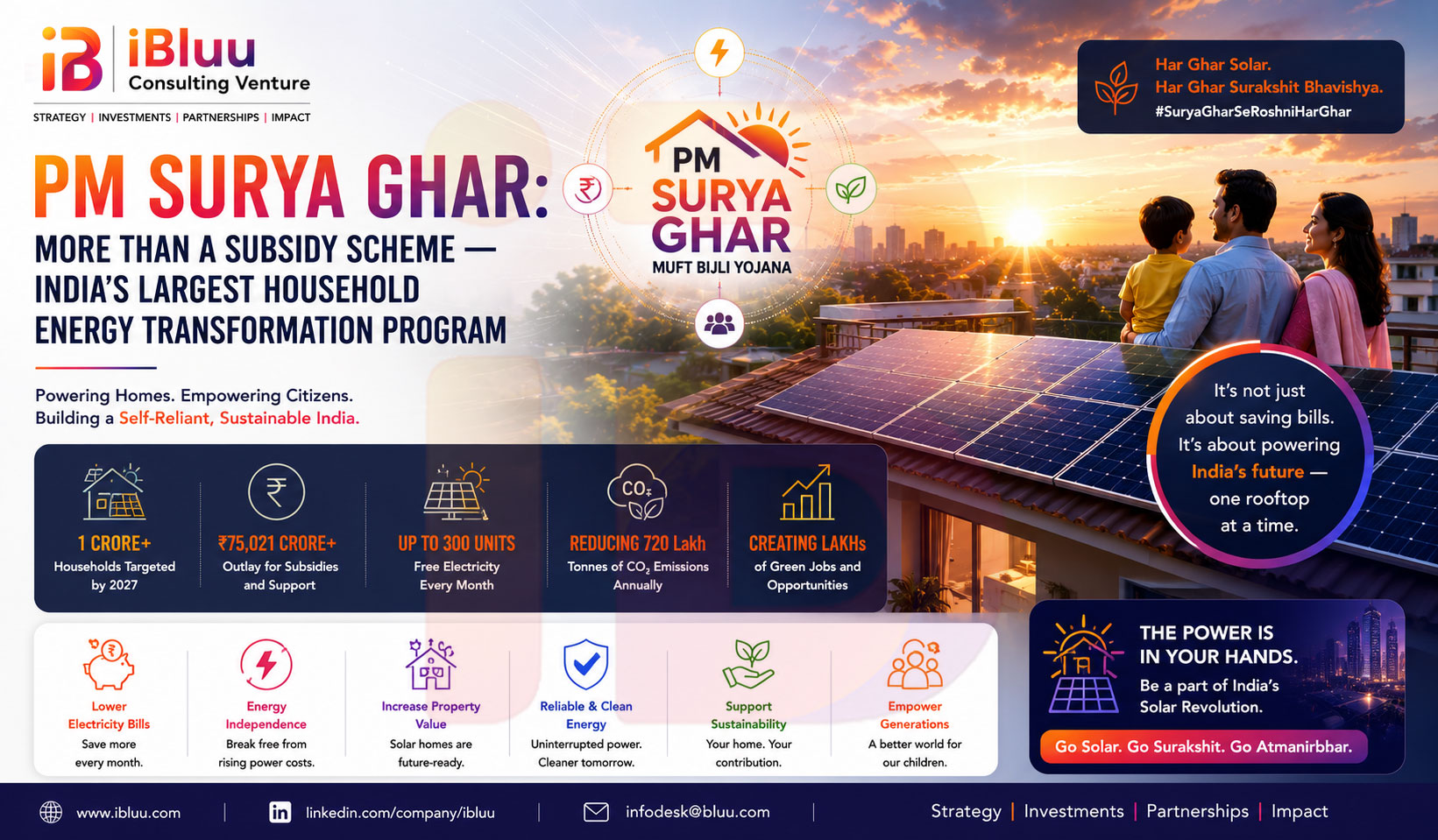
Launched in February 2024 with an approved outlay of approximately ₹75,021 crore, the program seeks to install rooftop solar systems on one crore (10 million) households, enabling families to generate their own electricity while accelerating India’s clean energy transition.
At its core, PM Surya Ghar is not merely a rooftop solar subsidy scheme.
It is a strategic attempt to democratize energy production.
For over a century, electricity moved in one direction:
Power Plant → Grid → Consumer
PM Surya Ghar changes that equation:
Solar Roof → Household → Grid
The citizen becomes both consumer and producer.
This is a structural shift in the economics of energy.
What Exactly Is PM Surya Ghar?
PM Surya Ghar: Muft Bijli Yojana is the Government of India’s flagship residential rooftop solar program designed to help households install solar panels through direct financial assistance, concessional financing, and simplified digital approvals.
The objective is straightforward:
- Reduce household electricity expenditure.
- Accelerate rooftop solar penetration.
- Lower dependence on imported fossil fuels.
- Reduce pressure on electricity distribution companies during peak hours.
- Support India’s long-term energy security goals.
The scheme targets up to 300 units of free electricity equivalent per month through rooftop solar generation for participating households.
Subsidy Structure
The central financial assistance is among the most generous rooftop solar support mechanisms globally.
| Rooftop Solar Capacity | Central Subsidy |
|---|---|
| 1 kW | ₹30,000 |
| 2 kW | ₹60,000 |
| 3 kW and above | ₹78,000 (maximum cap) |
For Group Housing Societies and Resident Welfare Associations, additional support is available for common infrastructure and EV charging facilities.
Program Scale and Progress
The scale of implementation is unprecedented in India’s residential energy market.
As of March 2026:
- More than 26 lakh rooftop solar installations had already been completed.
- Central financial assistance exceeding ₹17,967 crore had been disbursed.
- Applications crossed 53 lakh households on the national portal.
- The government continues to target 1 crore rooftop solar households under the scheme.
By June 2026, policymakers indicated expectations of crossing 75 lakh beneficiary households by the end of 2026, supported by newer implementation mechanisms including Utility Linked Aggregation models.
Why PM Surya Ghar Matters Strategically
1. Energy Security
India imports a significant share of its fossil fuel requirements.
Every rooftop solar installation marginally reduces dependence on imported energy sources.
At scale, millions of rooftop systems collectively function as a decentralized power generation network.
2. Grid Resilience
Large centralized power systems are vulnerable to congestion and transmission losses.
Distributed rooftop solar generation reduces stress on transmission infrastructure while improving local energy resilience.
3. Fiscal Efficiency
Unlike recurring consumption subsidies, rooftop solar creates productive infrastructure with a lifespan of 25 years or more.
The government effectively converts subsidy expenditure into a long-duration national asset.
4. Digital Energy Transition
PM Surya Ghar accelerates:
- Smart metering adoption.
- Net metering ecosystems.
- Digital billing systems.
- Distributed energy management.
Stakeholder Benefits
Benefits for Households
- Lower or near-zero electricity bills.
- Protection from future tariff increases.
- Potential income through surplus power exports under net metering.
- Higher property value.
- Energy independence.
Benefits for Government
- Reduced fossil fuel imports.
- Lower subsidy burdens over time.
- Support for national climate commitments.
- Progress toward renewable energy targets.
Benefits for Distribution Companies
While rooftop solar creates short-term revenue concerns, it can reduce peak demand pressures and improve network efficiency if managed properly.
Benefits for Industry
The scheme creates demand across:
- Solar modules.
- Inverters.
- Mounting structures.
- Electrical equipment.
- EPC services.
- Financing institutions.
- Maintenance providers.
Benefits for the Environment
- Lower carbon emissions.
- Reduced air pollution.
- Lower dependence on coal generation.
- Acceleration toward India’s net-zero ambitions.
The Economic Multiplier Effect
The rooftop solar value chain generates activity across manufacturing, logistics, installation, financing, engineering, and maintenance.
This creates:
- Skilled employment opportunities.
- MSME growth.
- Domestic manufacturing demand.
- Local entrepreneurship ecosystems.
PM Surya Ghar therefore functions not only as an energy policy but also as an industrial policy.
Challenges and Risks
No national infrastructure program is without execution risks.
Financing Challenges
Despite subsidy support, upfront customer contribution remains a barrier for many households.
Loan approvals and banking processes have slowed adoption in some regions.
DISCOM Resistance
Some state utilities remain cautious about rapid rooftop solar expansion because of concerns around revenue erosion from higher-paying consumers reducing grid purchases.
Rooftop Constraints
Many urban households face:
- Limited roof space.
- Structural limitations.
- Ownership disputes in apartment complexes.
Vendor Quality Risk
Rapid market growth increases risks related to:
- Substandard equipment.
- Poor installation quality.
- Inadequate after-sales service.
Grid Integration Challenges
Large-scale distributed generation requires:
- Smart grids.
- Advanced forecasting systems.
- Modernized distribution infrastructure.
The 2030 Outlook
PM Surya Ghar is expected to play a critical role in India’s wider renewable energy strategy.
India targets approximately 500 GW of non-fossil fuel electricity capacity by 2030, with rooftop solar expected to become a major contributor to distributed generation capacity.
Potential outcomes by 2030 include:
- Tens of millions of solar-equipped homes.
- Significant reduction in peak grid demand.
- Large-scale consumer participation in electricity markets.
- Expansion of battery storage adoption.
- Growth in residential EV charging ecosystems.
The program may ultimately become the foundation of India’s future decentralized energy economy.
Scenario Outlook
Base Case
Steady execution results in widespread rooftop adoption and stronger residential energy resilience.
Upside Case
Faster financing approvals, lower equipment prices, and battery adoption accelerate installations beyond current expectations.
Downside Case
Regulatory bottlenecks, financing delays, and utility resistance slow progress.
Strategic Recommendations
For Policymakers
- Accelerate smart grid deployment.
- Standardize state-level implementation frameworks.
- Expand low-cost financing mechanisms.
For Financial Institutions
- Simplify loan approvals.
- Develop specialized rooftop solar products.
For Solar Companies
- Prioritize quality and service differentiation.
- Invest in long-term customer relationships.
For Homeowners
- Evaluate rooftop solar as a long-term infrastructure investment rather than a short-term expense.
Final Perspective
The twentieth century centralized electricity production.
The twenty-first century may decentralize it.
PM Surya Ghar represents one of the world’s largest experiments in turning citizens into energy producers.
The significance extends beyond solar panels.
The program redefines the relationship between households and infrastructure.
It shifts energy from something people buy to something people produce.
That may ultimately become its most important legacy.
Strategic Perspective
The analytical depth of this perspective has been shaped by the strategic lens of J Parasher, Founder and Managing Director of iBluu Consulting Venture (iBCV), a venture of iBluu Corporations, whose work focuses on national capability building, infrastructure strategy, industrial competitiveness, and long-horizon economic transformation.
His perspective increasingly views infrastructure not merely as a sector, but as a strategic operating system linking energy security, economic growth, industrial development, and geopolitical resilience.
Disclaimer: This article is intended for informational and thought-leadership purposes only and does not constitute investment, financial, legal, engineering, or professional advice. Policy provisions, subsidy structures, and implementation timelines remain subject to updates from relevant government authorities.