+91 945 889 6091
  infodesk@ibluu.com
Stop Calling It Risk: How Dubai Real Estate Has Become the Market That Capitalizes from Global Turbulence
In periods of geopolitical volatility, capital does not seek excitement—it seeks certainty. Dubai’s real estate market is no longer a cyclical, sentiment-driven play; it has evolved into a structurally resilient, globally benchmarked safe-haven asset class.
While regional tensions intermittently disrupt sentiment, Dubai demonstrates anti-fragility—absorbing shocks while strengthening its long-term positioning. This resilience is anchored in three structural pillars: cash-dominant transactions, institutional maturity, and globally diversified capital flows.
Power Insight: In times of uncertainty, capital does not migrate toward noise—it consolidates within systems that have already proven their stability.
1. The Anti-Fragile Market Structure
Dubai’s real estate ecosystem has undergone a decisive transformation since the 2008 crisis, shifting from leverage-driven expansion to disciplined, liquidity-backed growth.
| Indicator (2025–2026) | Dubai | Global Benchmark (Avg.) | Strategic Implication |
|---|---|---|---|
| Cash Transactions | 60–65% | 25–40% | Minimal systemic leverage risk |
| Mortgage-to-GDP Ratio | Low | Moderate–High | Insulated from rate shocks |
| Transaction Value | AED 917 Bn | — | Deep, liquid market depth |
| Investor Nationalities | 150+ | Concentrated in most markets | Diversification reduces concentration risk |
Unlike Western markets vulnerable to interest rate cycles, Dubai’s cash-heavy structure eliminates cascade risks, positioning it as a structurally stable investment environment.
2. Historical Resilience: A Proven Cycle of Recovery
Dubai’s real estate market is not defined by the absence of crises—but by its speed and strength of recovery.
Crisis Response Pattern:
- 2008–09 Financial Crisis: Market correction → regulatory overhaul → stronger governance framework
- 2014 Oil Shock: Regional slowdown → capital relocation into Dubai
- COVID-19: Short-term disruption → fastest post-pandemic luxury recovery globally
- Recent Geopolitical Tensions: Sentiment dip → continued transaction momentum
Strategic Observation: Every external shock has reinforced Dubai’s role as the region’s capital preservation hub, accelerating inward capital flows rather than triggering prolonged outflows.
3. Governance, Defense & Continuity: The Invisible Backbone
Investor confidence is not built on returns alone—it is underpinned by system reliability.
- Operational Continuity: Critical infrastructure, including aviation and logistics networks, demonstrates near-immediate recovery cycles.
- Defense Assurance: High interception and protection capabilities reinforce physical asset security.
- Policy Stability: Proactive governance and sovereign backing ensure market continuity even during external shocks.
This combination creates a rare alignment of physical, institutional, and policy-level security, unmatched across most emerging markets.
4. From Speculative Cycle to Safe-Haven Asset Class
Dubai’s real estate demand is no longer transient—it is structurally anchored.
Key Structural Drivers:
- Golden Visa Program: Converts short-term residents into long-term stakeholders
- End-User Shift: Increasing proportion of owner-occupiers vs. speculative investors
- Luxury Market Depth: Sustained transactions in ultra-prime segments (AED 100M+)
- Yield Superiority:
| City | Avg. Rental Yield |
|---|---|
| Dubai | 6–9% |
| London | 3–4% |
| New York | 3–5% |
| Singapore | 3–4% |
Insight: Dubai uniquely combines high yield + capital preservation + lifestyle premium, a rare triad in global real estate.
5. Economic Fundamentals: The Real Anchor
Real estate resilience is ultimately a derivative of economic strength.
- Non-Oil GDP Growth (2026E): 3.5–4%
- Global Business Hub: Continued inflow of corporates, startups, and family offices
- Tourism Leadership: Sustained global top-tier destination status
- Talent Magnet: Increasing long-term expat retention
Dubai’s economy has decisively transitioned from oil dependency to a diversified, service-driven growth engine, providing a stable demand base for real estate.
6. Global Benchmarking: Competing with the World’s Safest Markets
| Factor | Dubai | London | Singapore | Zurich |
|---|---|---|---|---|
| Yield | High | Low | Low | Very Low |
| Tax Efficiency | High | Moderate | Moderate | Low |
| Residency Incentives | Strong | Limited | Selective | Limited |
| Market Liquidity | High | High | High | Moderate |
Dubai’s competitive edge lies in its ability to blend emerging market returns with developed market stability—a positioning few global cities can replicate.
7. Scenario Modeling & Risk Calibration
A mature investment narrative demands realism, not optimism bias.
| Scenario | Probability | Market Impact | Strategic Interpretation |
|---|---|---|---|
| Base Case | High | 5–8% stabilization/correction | Healthy consolidation phase |
| Best Case | Moderate | 8–12% appreciation (prime assets) | Accelerated capital inflows |
| Worst Case | Low | 10–15% correction (secondary assets) | Contained downside due to cash dominance |
Key Risk Mitigants:
- High liquidity buffer (cash transactions)
- Diversified global investor base
- Strong sovereign balance sheet
Conclusion: Downside risks are asymmetrical and contained, while upside remains structurally supported.
8. ESG & Future Value Drivers
Dubai’s next growth phase will be defined by sustainability and smart urbanization.
- Green building regulations and ESG-aligned developments
- Smart city infrastructure and digital governance
- Climate-resilient urban planning
These factors will increasingly influence valuation premiums and institutional capital allocation.
9. Strategic Recommendations for Investors
For HNIs & Family Offices:
- Prioritize prime, income-generating assets
- Adopt a 5–10 year holding horizon
- Leverage current sentiment softness for entry
For Institutional Investors:
- Focus on portfolio diversification into high-yield geographies
- Partner with regulated, transparent developers
- Integrate ESG considerations into asset selection
For Corporates:
- Utilize Dubai as a regional headquarters + asset base strategy
- Align real estate investments with long-term operational presence
10. The Strategic Role of IBCV (iBluu Consulting Venture Private Limited)
In a market where opportunity and complexity coexist, strategic navigation becomes the differentiator.
IBCV, a venture of iBluu Corporations, operates at the intersection of:
- Investment Advisory and Market Entry Strategy
- Strategic Government Engagement
- M&A and Partnership Structuring
- Institutional-Grade Due Diligence
The analytical depth underpinning this perspective reflects the strategic framework of J Parasher, Founder and Managing Director of iBluu Corporations, whose work emphasizes national capability building, global benchmarking, and long-horizon economic positioning.
His lens reframes real estate not merely as an asset class, but as a strategic lever within global capital flows and geopolitical positioning.
Closing Insight — The Fortress Thesis
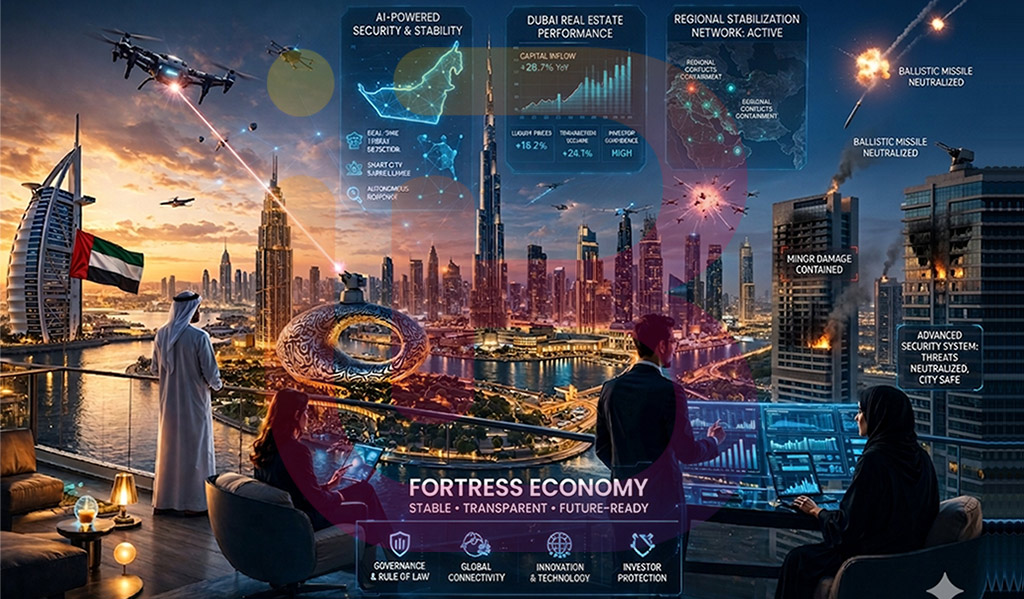
Dubai is not immune to regional volatility—but it is no longer defined by it.
Its real estate market has transitioned into a fortress economy, where resilience is engineered, not assumed.
Final Power Line:
In an uncertain world, the safest destination for capital is rarely the newest opportunity—it is the market that has already endured the worst, adapted faster, and emerged structurally stronger.