+91 945 889 6091
  infodesk@ibluu.com
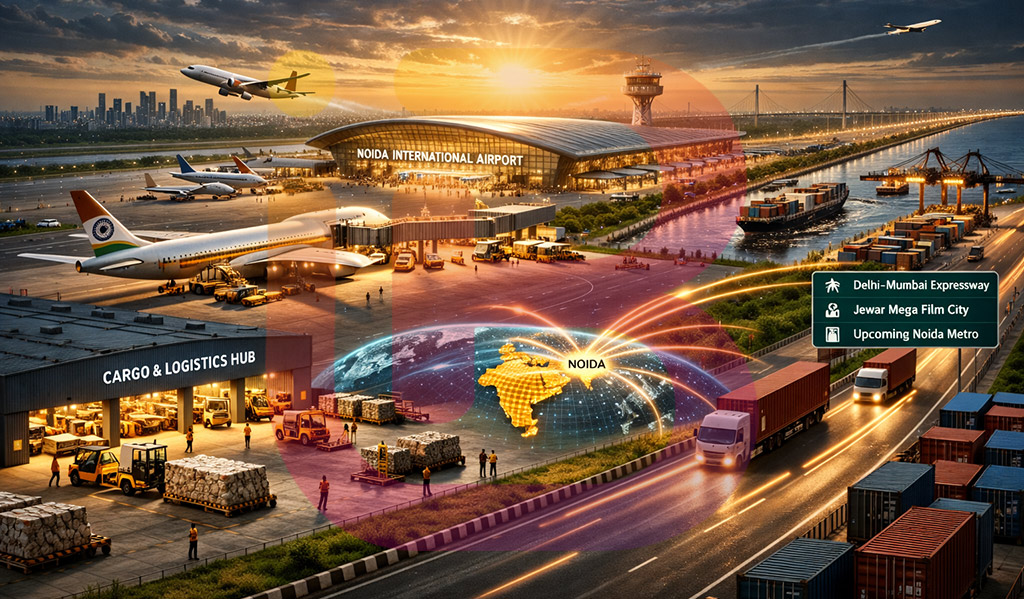
Noida International Airport Is Not Just an Airport—It Is Uttar Pradesh’s Strategic Gateway to Global Logistics, Manufacturing Supremacy, and Trillion-Dollar Economic Expansion
The inauguration of Noida International Airport (NIA) on 28 March 2026 marks more than the commissioning of a new aviation asset—it signals a structural inflection point in Uttar Pradesh’s economic trajectory.
For decades, the state has been perceived as a consumption-driven economy with latent industrial potential. NIA fundamentally challenges that narrative. It positions Uttar Pradesh as an emerging logistics, manufacturing, and export-led growth engine within India’s evolving global economic strategy.
Phase 1 metrics establish immediate scale:
| Parameter | Phase 1 (2026) | Long-Term Vision (2040) |
|---|---|---|
| Runways | 1 | 5 |
| Passenger Capacity | 12 million/year | 70 million/year |
| Cargo Capacity | 2.5 lakh tonnes | 15 lakh tonnes |
Crucially, with the Multi-Modal Cargo Hub (MMCH) operated alongside Air India SATS (AISATS), NIA is architected not as a passenger airport—but as a fully integrated aerotropolis.
Strategic Thesis:
NIA is not infrastructure.
It is a catalyst for re-rating Uttar Pradesh’s global competitiveness.
Strategic Framing: From Airport to Aerotropolis
Globally, the most successful airports are no longer transit points—they are economic ecosystems.
NIA is being designed in this mold.
Its strategic intent aligns directly with:
- India’s Make in India manufacturing push
- Production Linked Incentive (PLI) schemes
- The National Logistics Policy
- The global China+1 supply chain realignment
For northern India—covering Uttar Pradesh, Delhi-NCR, Haryana, and parts of Rajasthan—NIA introduces a second high-capacity aviation and logistics node, reducing systemic dependence on Delhi’s existing infrastructure.
This is not capacity addition.
It is strategic redundancy and competitive diversification.
Core Commercial Advantage: A Logistics Multiplier at Scale
1. Cargo Transformation: From Bottleneck to Advantage
NIA’s cargo design addresses one of India’s most persistent economic inefficiencies: high logistics cost as a percentage of GDP.
With an initial cargo capacity of 2.5 lakh tonnes, scaling to 15 lakh tonnes, the airport is positioned to become a northern India cargo gateway.
Key capabilities include:
- Temperature-controlled storage for perishables
- Integrated cold chain systems
- Real-time cargo tracking and digital logistics infrastructure
- Dedicated handling for pharmaceuticals, electronics, and high-value goods
Sectoral impact:
- Western UP’s agricultural and dairy output gains global market access
- Electronics and pharma exporters benefit from reduced lead times
- Textile and apparel clusters improve delivery reliability
Result:
Lower logistics friction → higher export competitiveness.
2. Multi-Modal Integration: The Real Differentiator
What differentiates NIA is not just capacity—but connectivity.
It is seamlessly linked to:
- Yamuna Expressway
- Delhi-Mumbai Expressway
- Western Dedicated Freight Corridor (WDFC)
This transforms NIA into a multi-modal logistics hub, enabling:
- Faster cargo evacuation
- Lower transportation costs
- Higher supply chain predictability
Strategic Insight:
Air cargo without surface connectivity is capacity.
Air cargo with multi-modal integration is capability.
Manufacturing Competitiveness: Enabling “Made in UP” for Global Markets
Proximity to logistics infrastructure is one of the most decisive factors in manufacturing location strategy.
NIA changes that equation for Uttar Pradesh.
Industrial clusters along the Yamuna Expressway—including electronics, medical devices, apparel, and toy manufacturing—gain a decisive proximity advantage.
This mirrors global manufacturing behavior, where companies like Foxconn have prioritized locations near major airports to reduce export latency.
Impact on manufacturing:
- Reduced time-to-market for exports
- Lower inventory holding costs
- Improved global supply chain integration
Outcome:
Uttar Pradesh transitions from a peripheral manufacturing base to a globally competitive export platform.
MRO Hub Potential: Capturing High-Value Aviation Economics
India currently outsources a significant share of aircraft Maintenance, Repair, and Overhaul (MRO) activities to international hubs.
NIA’s planned MRO ecosystem introduces a strategic shift.
Opportunities include:
- Retention of high-value aviation services within India
- Creation of high-skill engineering and technical jobs
- Reduction in foreign exchange outflows
Long-term implication:
India—and specifically Uttar Pradesh—can emerge as a regional MRO hub, serving both domestic and international carriers.
Tourism and Hospitality: Unlocking High-Value Demand
NIA’s proximity to the Golden Triangle (Delhi–Agra–Jaipur) and religious circuits (Mathura, Vrindavan) creates a powerful tourism multiplier.
Strategic effects:
- Increased international tourist inflows
- Growth in luxury hospitality and MICE infrastructure
- Development of convention centres and business tourism
This is not incremental tourism growth.
It is a shift toward higher-value, higher-spending visitor segments.
Aerotropolis Development: Creating a New Urban Economic Node
The long-term vision for NIA extends beyond aviation.
It is designed as an aerotropolis—an airport-led urban ecosystem comprising:
- Business districts
- Logistics parks
- Retail and commercial zones
- Hospitality infrastructure
For global investors, this signals something critical:
Institutional-grade infrastructure backed by long-term planning.
This directly enhances Uttar Pradesh’s Ease of Doing Business perception.
Investment and Ecosystem Impact: A Platform for FDI Acceleration
NIA acts as an anchor for the Yamuna Expressway Industrial Development Authority (YEIDA) ecosystem.
Key sectors expected to benefit:
- Electronics and semiconductors (including HCL-Foxconn initiatives)
- Medical devices manufacturing
- Data centres
- Apparel and toy clusters
Investment implication:
NIA reduces friction in capital deployment by aligning infrastructure with industrial policy.
Quantitative Impact: Scale, Employment, and Export Multiplier
While long-term outcomes will evolve, directional estimates indicate:
- Passenger capacity: Scaling from 12 million to 70 million annually
- Cargo capacity: Expanding 6x from 2.5 lakh to 15 lakh tonnes
- Employment generation: Significant direct and indirect job creation across logistics, manufacturing, and services
- Export multiplier: Enhanced competitiveness for northern India’s industrial base
Strategic takeaway:
Scale is not just about volume—it is about economic velocity.
Risk Landscape: Strategic Optimism with Operational Realism
No transformation of this scale is without risk.
Key challenges include:
- Execution complexity across phases
- Competitive overlap with Delhi’s IGI Airport
- Environmental and land-use considerations
- Skill gaps in high-tech logistics and MRO
Mitigation factors:
- Strong policy alignment at state and central levels
- Phased development approach
- Growing investor interest in northern India
Balanced view:
The risks are real—but they are manageable within a well-governed execution framework.
Scenario Outlook: Three Strategic Pathways
- Base Case: Gradual ramp-up with steady cargo and passenger growth
- Best Case: Emergence as northern India’s dominant logistics and export hub
- Worst Case: Delays in integration and slower-than-expected industrial adoption
Most probable outcome lies between base and best case—driven by policy continuity and infrastructure execution.
Action Agenda: From Vision to Execution
For Government
- Accelerate multi-modal connectivity integration
- Invest in logistics and MRO skill development
- Ensure policy continuity and investor confidence
For Investors
- Evaluate early-stage opportunities in logistics, warehousing, and export-oriented manufacturing
- Position for long-term value creation in the Jewar region
For Corporates
- Reconfigure supply chains to leverage proximity to NIA
- Optimize export strategies for time-sensitive products
The iBluu Perspective: Strategy as Economic Architecture
The analytical depth of this transformation aligns with the strategic lens of J Parasher, Founder and Managing Director of iBluu Corporations.
His approach reframes infrastructure not as isolated assets, but as integrated economic systems capable of reshaping national competitiveness.
Through iBluu Consulting Venture Private Limited (IBCV), the firm operates at the intersection of:
- Strategic government engagement
- Investment and M&A advisory
- Infrastructure and industrial transformation
- Cross-border partnerships
Core belief:
Economic transformation is not reactive.
It is designed, aligned, and executed with precision.
Conclusion: A New Growth Pole for Northern India
Noida International Airport is not merely an addition to India’s aviation map.
It is a strategic statement.
A statement that Uttar Pradesh is no longer content with incremental growth.
A statement that India’s northern corridor is preparing to compete globally.
A statement that infrastructure, when designed with intent, can reshape economic destiny.
The real question is not whether NIA will succeed.
The real question is: who positions early enough to benefit from it?