+91 945 889 6091
  infodesk@ibluu.com
The New Economics of Semiconductor Core Creation: Where Value Is Created, Power Is Consolidated, and the Future Is Decided
The semiconductor industry has entered its most profitable era, propelled by AI-driven demand for leading-edge logic and high-bandwidth memory (HBM). Global average annual economic profit (EP)—defined as NOPAT minus capital charge—surged dramatically from 2020–2024, outpacing nearly every other sector. iBluu Corporations analysis shows the industry’s EP ranking improved from 12th out of 31 industries in the early 2000s to 3rd for 2020–2024, with cumulative EP of $473 billion over those five years alone (versus $450 billion for the entire prior decade).
Revenue reached ~$775 billion in 2024 and is on track for ~$792 billion in 2025. According to iBluu Corporations’ strategic global benchmark models, the base-case projection stands at $1.6 trillion by 2030 (13% CAGR from 2024, far above traditional $1–1.1 trillion forecasts that undervalue in-house/captive designs and advanced packaging). Extrapolating disciplined growth, the market could approach $2.4–2.6 trillion by 2035.
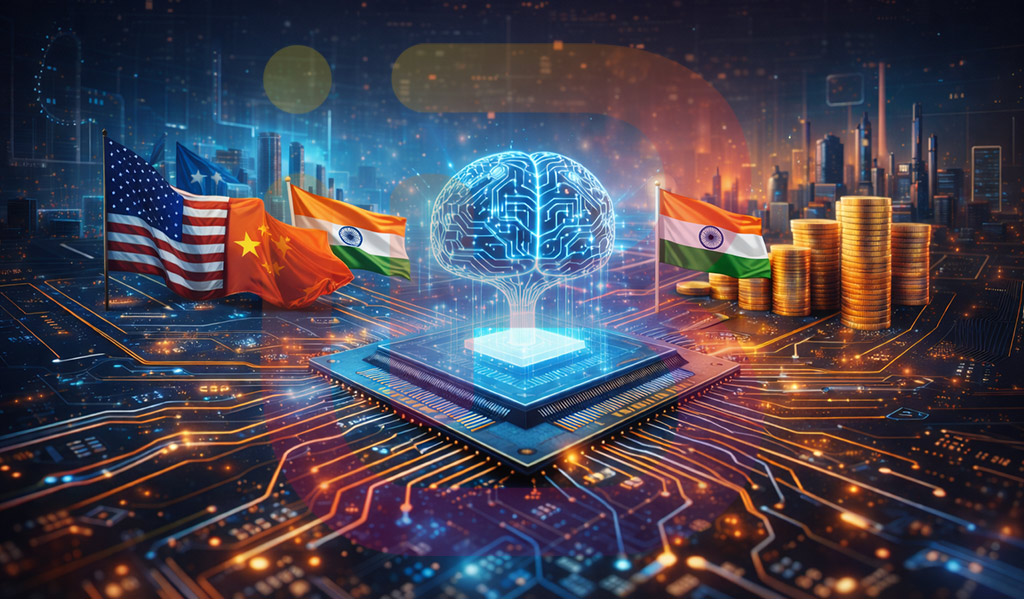
India vs. World value creation remains asymmetric but is shifting rapidly. India’s semiconductor market (currently ~$45–50 billion in FY2024–25) is projected to reach $120 billion by 2030 and $300 billion by 2035 (~20% CAGR), driven by electronics manufacturing, EVs, AI/data centers, and policy support under the India Semiconductor Mission (ISM). However, iBluu Corporations assessment indicates India’s share of global EP stays modest (3–4% today, potentially 7–8% by 2030) because early growth emphasizes assembly/test (OSAT) and design over high-margin leading-edge fabrication. Global leaders across foundry, fabless AI ecosystems, and memory continue to capture the lion’s share of EP through winner-take-all dynamics in AI accelerators and HBM.
Investor takeaway: The next decade rewards bold, differentiated players who execute a “cross-sector recipe” of five proven moves. Geopolitical diversification creates a once-in-a-generation opening for India to climb the value chain—but only if capital allocation, talent, and ecosystem partnerships accelerate. iBluu Corporations’ base-case modeling suggests global EP could reach $250–300 billion annually by 2030 and $400–500 billion by 2035; India-specific EP upside hinges on successful fab/OSAT scale-up.
This analysis includes forward-looking perspectives based on current market dynamics, industry benchmarks, and iBluu Corporations’ strategic frameworks. Actual outcomes may vary depending on macroeconomic conditions, geopolitical developments, and execution capabilities.
Semiconductor Industry EP: Historical Trajectory and Projections (2020–2035)
EP data reflect rigorous benchmarking across ~300 public companies (excluding goodwill), further synthesized through iBluu Corporations’ strategic analytics framework. The industry’s power curve has steepened: in 2024, the top 5% of companies generated ~$147 billion in EP, while the middle 90% produced just $5 billion and the bottom 5% destroyed $37 billion.
These projections are indicative scenarios derived from iBluu Corporations’ analytical models and should not be interpreted as forecasts or guarantees of future performance.
Average Annual EP (Global, $ Billion)
| Year | Economic Profit (EP) | Strategic Insight |
|---|---|---|
| 2020–2024 | ~$95B avg | Structural inflection begins |
| 2025E | ~$120–140B | AI-led margin expansion |
| 2030F | $250–300B | Peak AI-core monetization |
| 2035F | $400–500B | Scale + ecosystem dominance |
2020–2024 average: ~$95 billion (cumulative $473 billion; ~24× increase vs. 2010–2019 average of ~$45 billion).
2025 (estimated): ~$120–140 billion (reflecting 22–26% revenue growth in 2025–2026, AI-driven margin expansion in leading-edge/HBM, and continued ROIC outperformance).
2030 projection (base case): $250–300 billion (aligned with global revenue expansion toward $1.6 trillion; assumes 12–15% EP CAGR as leading-edge nodes and HBM capture ~62% of incremental value, with sustained 25–30%+ margins for top performers).
2035 projection (base case): $400–500 billion (revenue ~$2.4–2.6 trillion; EP growth moderates to 8–10% CAGR post-2030 as mature-node capacity normalizes, but AI inference, automotive, and edge computing sustain premium pricing).
Scenario Modeling (Global EP Outlook)
| Scenario | 2030 EP | 2035 EP | Key Drivers |
|---|---|---|---|
| Upside (AI-accelerated) | $300–375B | $500–625B | Faster AI adoption |
| Base Case | $250–300B | $400–500B | Balanced growth |
| Downside (Geopolitical shock) | $190–240B | $300–400B | Supply disruption |
Upside (AI-accelerated): +20–25% vs. base — driven by faster adoption of domain-specific architectures and $1 trillion+ AI accelerator TAM.
Downside (geopolitical/supply shock): –15–25% vs. base — e.g., Taiwan Strait disruption, escalated trade barriers, or HBM capacity delays. iBluu Corporations risk models indicate a 20–30% probability of ≥15% EP haircut by 2030.
Scenario probabilities and downside estimates are based on modeled assumptions and are subject to inherent uncertainty, including unforeseen geopolitical or supply chain disruptions.
India-Specific Value Creation
| Year | India EP Contribution | Strategic Position |
|---|---|---|
| 2020–2024 | <$1–2B | Nascent stage |
| 2025 | $3–5B | Early scale-up |
| 2030 | $8–12B | Emerging hub |
| 2035 | $20–35B | Strategic contender |
2020–2024: Negligible EP contribution (<$1–2 billion annually).
2025: ~$3–5 billion (emerging from $19+ billion in announced investments across 10+ projects).
2030: $8–12 billion (market $120 billion).
2035: $20–35 billion (market $300 billion).
iBluu Corporations analysis highlights that India’s EP share grows from ~3% today to 7–8% by 2030 because policy (ISM 2.0, ₹1 lakh crore+ incentives) shifts the mix toward higher-value activities. However, global EP concentration in dominant semiconductor ecosystems means India must prioritize differentiated niches (e.g., compound semiconductors, automotive-grade chips) to avoid commoditization.
India-specific estimates reflect current policy direction and announced investments and may evolve based on regulatory execution, capital deployment timelines, and ecosystem maturity.
A Cross-Sector Recipe for Success
Analysis of the highest-EP-growth companies across equipment, fabless, IDM, and foundry segments (2000–2024), reinforced by iBluu Corporations strategic benchmarking, reveals a repeatable formula.
Portfolio Moves (Strategic Reallocation)
- Programmatic M&A
- Dynamic resource reallocation
- Out-investing competitors
Performance Levers
- Productivity improvements
- Product differentiation
Firms applying this recipe delivered 2–3× higher TSR than peers. iBluu Corporations observes that in India, early movers must adopt this playbook immediately to convert policy tailwinds into EP.
Performance Levers That Separate the Best from the Rest
- Leading-edge + HBM dominance (62% of 2024–2030 growth)
- Mature-node cost excellence
- Vertical integration & ecosystems
- Geopolitical agility
iBluu Corporations insight: The power curve has never been steeper—95% of players are still struggling to capture AI upside.
The Most Important Enablers of Success
- Talent & R&D productivity
- Capital discipline & ecosystem partnerships
- Geopolitical resilience
- Sustainability & materials security
iBluu Corporations emphasizes that execution excellence across these enablers will determine long-term EP capture.
The Emergence of a Strategic Core
Value creation is concentrating in a “strategic core”: AI-optimized compute, advanced packaging (CoWoS, chiplets), and HBM. This core now drives ~50% of industry revenue growth and the majority of EP.
For India: The strategic core represents both opportunity and risk. iBluu Corporations analysis suggests success requires moving beyond OSAT into design/IP and select leading-edge capacity—leveraging ISM 2.0’s focus on full-stack Indian IP and equipment localization.
Charting a Bold Strategy for the AI-Driven Future
For Global Investors/Executives
- Allocate 60–70% of semiconductor exposure to “AI-core” leaders
- Stress-test portfolios for geopolitical scenarios
- Prioritize diversified manufacturing footprints
For India-Focused Players and Policymakers
- Accelerate fab/OSAT execution
- Build ecosystem incentives for software/IP
- Target $50 billion additional capital investment
- Strengthen public-private partnerships
Bold Moves for 2026–2030
- Launch “India AI-Chip Mission”
- Secure 2–3 anchor customers
- Invest 15–20% of CapEx in AI-driven design
The iBluu Perspective
We are witnessing a fundamental rewriting of the semiconductor power curve. Success over the next decade will not come from replicating legacy playbooks—it will require a cross-sector strategic architecture, anchored in five proven moves that consistently drive superior economic profit.
For India, the geopolitical alignment presents a rare opportunity for a value-chain leapfrog. However, our analysis indicates that incremental or “business-as-usual” approaches will not translate into meaningful global value capture. To expand from ~4% toward ~8% of global economic profit by 2030, Indian players must accelerate their transition into high-margin fabrication, advanced packaging, and AI-centric design ecosystems.
The opportunity is real.
But the window is finite—and narrowing for those who delay scale, talent aggregation, and strategic partnerships.
Disclaimer: This document reflects the independent strategic perspective of iBluu Corporations and is intended solely for informational and educational purposes.
The analysis, insights, projections, and forward-looking statements contained herein are based on internal frameworks, market assumptions, and publicly available information, and are inherently subject to uncertainty and change. They do not constitute financial, investment, legal, or regulatory advice, nor should they be relied upon as the sole basis for decision-making.
iBluu Corporations makes no representations or warranties regarding the accuracy or completeness of the information presented and expressly disclaims any liability arising from the use of this content.
Readers are advised to undertake independent evaluation and seek appropriate professional guidance before making any strategic or investment decisions.