+91 945 889 6091
  infodesk@ibluu.com
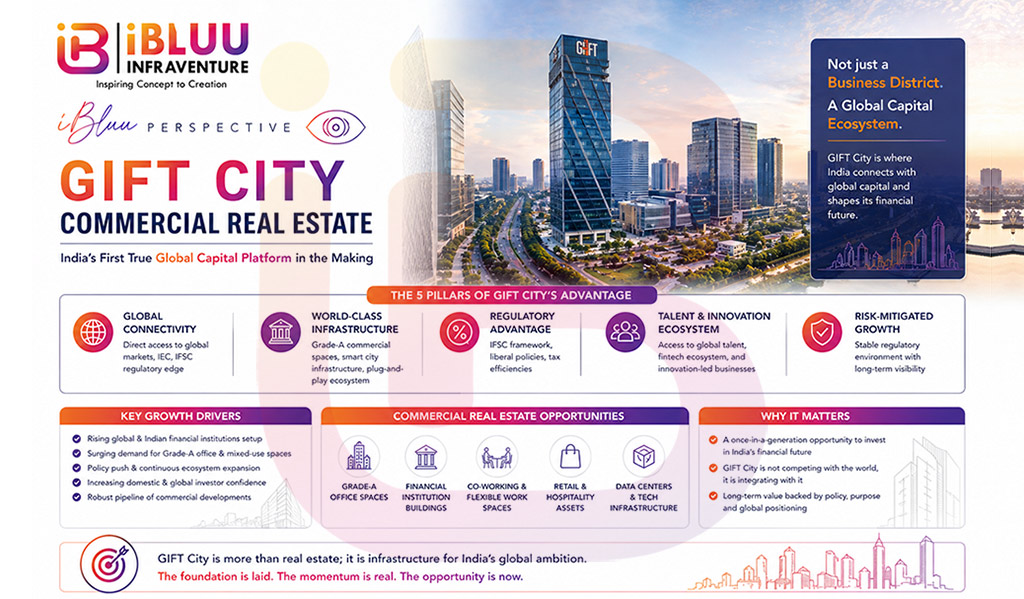
iBluu Perspective: GIFT City Commercial Real Estate — The Rise of India’s First True Global Financial Core
GIFT City is no longer a speculative urban experiment. It is rapidly consolidating into India’s most strategically designed financial-commercial ecosystem, built to repatriate global capital flows historically routed through Dubai, Singapore, and London.
With monthly IFSC exchange turnover consistently exceeding $90–100 billion, over 1,150 registered entities, and banking assets surpassing $100 billion, GIFT City is transitioning from infrastructure build-out to capital activation phase.
The implication is structural:
Commercial real estate here is not a passive asset class. It is an extension of India’s financial system.
Market Architecture: A Controlled, Policy-Driven Supply Model
Unlike traditional Indian commercial markets, GIFT City operates under a centralized master-planned supply regime, governed by the International Financial Services Centres Authority (IFSCA).
This creates three defining characteristics:
- Supply discipline → No uncontrolled speculative oversupply
- Tenant quality filtering → Financial institutions, global firms, regulated entities
- Policy-backed demand → Tax incentives, regulatory arbitrage, global access
Result:
Higher pricing stability + lower vacancy volatility compared to conventional CBDs
Commercial Property Benchmarking (2026)
1. Office Assets (Grade A / IFSC-Compliant)
| Category | Price Range (₹/sq ft) | Monthly Rent (₹/sq ft) | Yield (%) |
|---|---|---|---|
| Core IFSC Towers | ₹9,000 – ₹14,500 | ₹80 – ₹140 | 7.5% – 10% |
| Premium Financial Blocks | ₹14,500 – ₹18,000+ | ₹120 – ₹180 | 8% – 11% |
Insight:
Compared to Mumbai (BKC yields ~5–7%), GIFT City offers 150–300 bps yield premium, driven by lower entry cost and institutional leasing.
2. Retail & High-Street Commercial
| Category | Price Range (₹/sq ft) | Monthly Rent (₹/sq ft) | Yield (%) |
|---|---|---|---|
| Ground Floor Premium Retail | ₹18,000 – ₹28,000 | ₹180 – ₹350 | 9% – 12% |
| Mixed-Use Retail | ₹12,000 – ₹20,000 | ₹120 – ₹220 | 8% – 10% |
Insight:
Retail is still under-penetrated, but early movers benefit from monopoly-like catchment control.
3. Land Parcels (Commercial Development)
| Category | Price Range (₹/sq yd) |
|---|---|
| Core IFSC Zone | ₹1.5 lakh – ₹2.5 lakh |
| Peripheral Expansion Zones | ₹80,000 – ₹1.4 lakh |
Insight:
Land pricing is policy-regulated, but future repricing potential remains significant as occupancy scales.
Demand Engine: Who Is Buying and Leasing?
Institutional & Corporate Demand
- 35+ global and domestic banks
- 60+ insurance and reinsurance entities
- Aircraft leasing firms (India’s emerging aviation financing hub)
- Global tech firms including IBM, Oracle
Investor Profile Breakdown
- HNIs / UHNIs (India + GCC): 35–40%
- NRIs (Middle East, UK, Africa): 25–30%
- Corporate investors & institutions: 20–25%
- Retail investors: <15%
Key Shift:
Unlike conventional markets, GIFT City is institution-first, retail-later.
Rental Economics & Return Profile
- Average lease tenure: 5–9 years (lock-in heavy)
- Vacancy rates: Lower than emerging CBD averages due to controlled supply
- Rental growth potential: 8–12% CAGR (aligned with occupancy ramp-up)
Total Return Profile (Base Case):
- Rental yield: 8–11%
- Capital appreciation: 10–15% CAGR
- Blended IRR: 16–22% (institutional-grade)
Infrastructure Flywheel: Value Acceleration Drivers
The next phase of value creation is infrastructure-led:
- Expansion of IFSC financial ecosystem
- Integration with Ahmedabad–Gandhinagar urban corridor
- High-speed connectivity upgrades
- Smart city infrastructure (district cooling, automated systems)
- Residential and social infrastructure scaling (schools, hotels, hospitals)
Critical Insight:
Unlike legacy cities, infrastructure here is not reactive—it is pre-engineered for scale.
Global Positioning: Competing with Financial Free Zones
GIFT City is structurally positioned against:
- Dubai International Financial Centre (DIFC)
- Singapore Financial District
- London Canary Wharf
Competitive Advantages:
- Tax-neutral regime
- Lower operating costs (30–60% vs global peers)
- India market access + regulatory arbitrage
Constraint:
- Ecosystem maturity still evolving
Risk Matrix: What Investors Must Factor
| Risk Factor | Impact | Probability |
|---|---|---|
| Ecosystem maturity lag | Medium | 30% |
| Policy dependency | Medium-High | 35% |
| Demand concentration (finance-heavy) | Medium | 25% |
| Liquidity risk (early phase market) | Medium | 30% |
Scenario Outlook (2026–2035)
- Base Case: 12–14% CAGR (steady institutional growth)
- Upside Case: 15–18% CAGR (global capital inflow acceleration)
- Downside Case: 8–10% CAGR (policy or demand slowdown)
The iBluu Thesis: GIFT City as a Financial-Real Estate Hybrid
According to iBluu InfraVenture Private Limited, a venture of iBluu Corporations:
GIFT City is not a real estate play.
It is a financial infrastructure asset class disguised as commercial property.
It represents:
- A capital repatriation mechanism for India
- A policy-engineered investment zone
- A long-cycle institutional real estate opportunity
The analytical lens is shaped by J Parasher, whose framework positions real estate not as a sector, but as a strategic economic system with capital, policy, and geopolitical intersections.
Actionable Strategy for Investors
For HNIs / NRIs:
- Early-stage entry into Grade A office or retail
- Focus on leased assets with institutional tenants
For Corporates:
- Secure long-term office positions before rental escalation
- Explore IFSC regulatory advantages
For Institutional Capital:
- Target portfolio aggregation
- Develop build-to-lease financial infrastructure assets
Conclusion: The Window Is Early, Not Open Forever
GIFT City today is where:
- Policy meets capital
- Infrastructure meets strategy
- India meets global finance
The real question is not whether to invest.
It is whether you are entering before or after institutional saturation.
Disclaimer: This article is for informational and strategic insight purposes only and does not constitute investment, financial, or legal advice. All data points are based on market estimates, publicly available information, and industry benchmarks as of 2025–2026. Investors are advised to conduct independent due diligence and consult professional advisors before making any investment decisions. iBluu InfraVenture Private Limited and its affiliates assume no liability for any decisions made based on this analysis.