+91 945 889 6091
  infodesk@ibluu.com
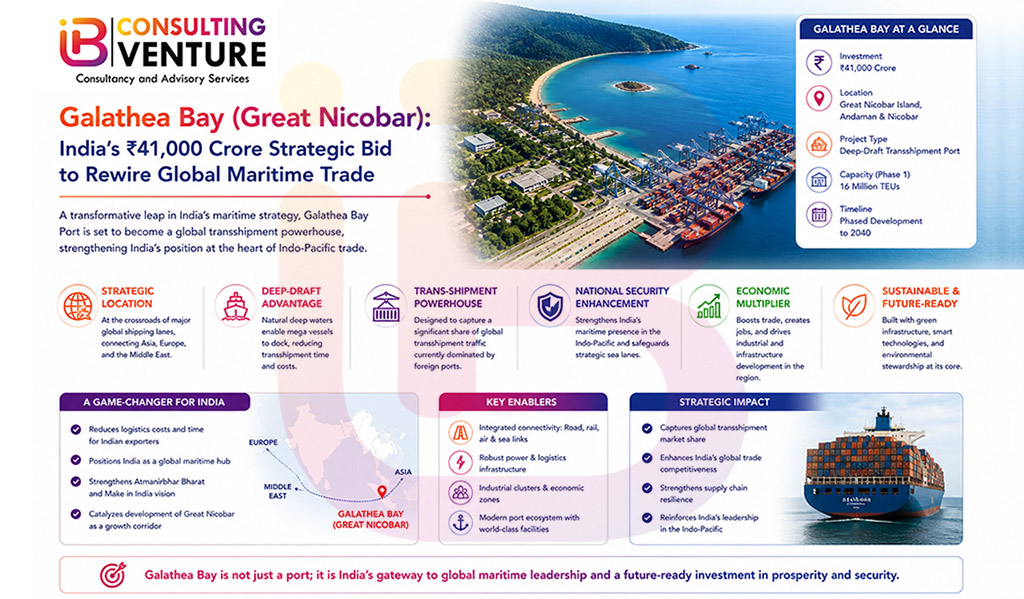
Galathea Bay (Great Nicobar): India’s ₹41,000 Crore Bid to Break Singapore–Colombo Dominance and Rewire the Economics of Global Maritime Trade
For decades, India has been one of the world’s largest trading economies operating without a globally dominant transshipment ecosystem of its own.
Despite its geographic advantage at the center of the Indian Ocean trade corridor, nearly 75% of India’s transshipped cargo has historically been routed through foreign ports such as Singapore, Colombo, and Port Klang. That meant billions in logistics value, maritime influence, port revenues, shipping control, and strategic leverage flowed outside India’s borders.
Galathea Bay in Great Nicobar changes that equation.
This is not merely a port infrastructure project. It is a geopolitical infrastructure play designed to reposition India at the center of Indo-Pacific maritime economics.
With an estimated investment exceeding ₹41,000 crore for the International Container Transshipment Terminal (ICTT)—and an integrated development vision potentially crossing ₹72,000–₹90,000 crore including airport, township, and energy infrastructure—Great Nicobar is emerging as one of the most strategically consequential infrastructure developments in modern Indian history.
At its core, the project represents a larger national shift:
India is no longer content being a participant in global trade routes.
It intends to become an architect of them.
Why Galathea Bay Matters Globally
The Malacca Strait Advantage
Geography—not ideology—still controls global trade.
Galathea Bay sits roughly 40 nautical miles from the Malacca Strait, one of the world’s most critical maritime chokepoints through which nearly 30–35% of global trade and a substantial share of global energy shipments pass annually.
Very few nations possess the ability to build a deep-water transshipment ecosystem this close to such a strategic corridor.
This location gives India three unprecedented advantages:
- Direct proximity to East–West shipping lanes
- Reduced deviation costs for ultra-large vessels
- Strategic maritime positioning across the Indo-Pacific region
In shipping economics, distance is power.
And Galathea Bay sits at one of the most valuable maritime intersections on Earth.
Competing With Singapore and Colombo Is No Longer a Theoretical Discussion
For years, the assumption across maritime economics was simple:
Singapore dominates efficiency.
Colombo dominates South Asian transshipment.
India remains dependent.
That assumption is now under pressure.
Galathea Bay is being designed specifically to challenge the structural advantages of regional transshipment leaders.
Strategic Benchmarking
| Infrastructure Parameter | Galathea Bay (Planned) | Colombo | Singapore |
|---|---|---|---|
| Natural Draft Depth | 20+ metres | ~18m | ~16–18m |
| Proximity to Malacca Strait | ~40 nautical miles | Moderate | Immediate |
| ULCV Handling Capability | Yes | Limited scale | Yes |
| Phase 1 Capacity | 4–5.6 million TEUs | ~7–8 million TEUs | 39+ million TEUs |
| Long-Term Target Capacity | 16 million TEUs | Moderate expansion | Mature mega-scale |
The most important differentiator is not capacity alone.
It is strategic intent.
Singapore became a global maritime superpower because it integrated ports, finance, logistics, policy, and trade architecture into one coordinated system.
India is now attempting something structurally similar in Great Nicobar.
The Infrastructure Stack Behind the Vision
The transshipment terminal is only one component of a far larger strategic ecosystem.
The broader Great Nicobar master plan includes:
- A greenfield international airport for civilian and military operations
- Strategic urban and township development
- Integrated logistics and industrial infrastructure
- A 450 MVA gas and solar-based power ecosystem
- Maritime and defense-linked infrastructure capabilities
This matters because globally competitive ports do not operate in isolation.
They require aviation connectivity, energy reliability, digital logistics systems, urban workforce ecosystems, warehousing networks, customs efficiency, and geopolitical security integration.
India appears to be designing Great Nicobar not as a port project—but as a long-horizon maritime economic zone.
Why the Natural Depth Changes Everything
One of Galathea Bay’s most underestimated advantages is its natural draft depth exceeding 20 metres.
This is strategically critical.
Modern shipping economics increasingly favors Ultra Large Container Vessels (ULCVs), capable of carrying massive cargo volumes with lower per-container operating costs.
However, many Indian ports lack the depth necessary to accommodate these vessels efficiently.
Galathea Bay changes that dynamic.
Its deep natural harbor reduces dredging dependency, lowers long-term operational costs, and creates the ability to host next-generation global shipping fleets.
In maritime infrastructure economics, natural depth is not just an engineering advantage.
It is a multi-decade competitive moat.
India’s Larger Maritime Ambition
This project aligns directly with India’s broader strategic transformation agenda:
- Sagarmala
- Indo-Pacific maritime expansion
- Supply chain resilience frameworks
- Defense-linked logistics infrastructure
- Blue economy development
- Trade route diversification
As global supply chains shift amid geopolitical fragmentation, nations controlling strategic logistics corridors will hold disproportionate economic influence.
The next era of globalization will not simply belong to manufacturing economies.
It will belong to logistics civilizations.
Galathea Bay is India’s signal that it intends to become one.
Investment Outlook: What Global Capital Will Watch Closely
Global investors evaluating Great Nicobar will focus on five critical variables:
1. Execution Speed
Mega infrastructure success depends less on announcements and more on delivery discipline.
2. Environmental Governance
The project has attracted environmental scrutiny due to ecological sensitivity in Great Nicobar. Long-term investor confidence will depend heavily on sustainable development compliance and mitigation frameworks.
3. Trade Volume Capture
The ability to attract shipping lines away from entrenched transshipment hubs will determine commercial viability.
4. Defense and Strategic Integration
Its location provides enormous defense relevance in the Indo-Pacific. This increases long-term strategic importance beyond commercial shipping alone.
5. Policy Stability
Stable maritime regulation, customs modernization, and international trade alignment will be essential for scaling competitiveness.
The Economic Multiplier Effect
If executed effectively, the economic implications extend far beyond port revenues.
Potential impact areas include:
- Maritime logistics
- Ship management
- Warehousing and cold chains
- Aviation-linked trade
- Insurance and marine finance
- International shipping services
- Export competitiveness
- Energy logistics
- Regional employment generation
- Strategic defense infrastructure
This is precisely why Great Nicobar is increasingly being viewed not merely as an infrastructure project—but as a sovereign capability platform.
The Global Signal India Is Sending
The world is entering an era where infrastructure is becoming geopolitical currency.
Ports are no longer passive cargo destinations.
They are strategic instruments of economic influence, defense positioning, capital attraction, and supply chain control.
China understood this through Belt and Road.
Singapore understood this through maritime-financial integration.
Dubai understood this through logistics-led economic architecture.
India is now beginning to operationalize its own version.
Galathea Bay represents a structural declaration:
India does not intend to remain peripheral to global trade architecture.
It intends to shape it.
iBCV Perspective: Infrastructure as National Economic Architecture
From the perspective of iBluu Consulting Venture Private Limited (iBCV), a venture of iBluu Corporations, Great Nicobar represents the convergence of infrastructure, maritime economics, geopolitics, logistics intelligence, and long-term capital strategy.
The project reflects a broader global reality:
The next generation of economic superpowers will not be defined solely by GDP growth.
They will be defined by control over strategic infrastructure systems.
At iBCV, infrastructure is viewed not merely as construction—but as economic architecture capable of reshaping national competitiveness, capital flows, trade leverage, and geopolitical influence.
The analytical depth behind this perspective is shaped significantly by the strategic framework of J Parasher, Founder and Managing Director of iBluu Corporations, whose work consistently focuses on long-horizon economic transformation, industrial capability building, infrastructure intelligence, and global strategic benchmarking.
His perspective reframes infrastructure not as a sectoral discussion—but as a sovereign-scale strategic system with enduring geopolitical and economic consequences.
Final Perspective
Galathea Bay is not simply a ₹41,000 crore port project.
It is a test of whether India can transition from being a major trading nation to becoming a major trade-routing power.
That distinction matters enormously.
Because nations that control production participate in the economy.
But nations that control logistics architecture influence the global system itself.
Great Nicobar may ultimately become one of the most important infrastructure experiments India has undertaken in the 21st century.
Not because of the port alone.
But because of what it signals about India’s strategic ambition.
Disclaimer: This article is intended solely for informational, strategic, and analytical purposes and should not be interpreted as financial, investment, legal, geopolitical, maritime, infrastructure, or policy advice. All market observations, infrastructure projections, capacity estimates, economic interpretations, and strategic viewpoints are based on publicly available information, industry trends, government announcements, and independent analytical perspectives available at the time of writing. Certain projections and forward-looking statements may involve assumptions, uncertainties, and evolving market conditions that could materially impact actual outcomes. Readers, investors, institutions, policymakers, and stakeholders are advised to conduct independent due diligence and consult appropriate professional advisors before making investment, policy, commercial, infrastructure, or strategic decisions. Views expressed in this article reflect analytical perspectives and do not constitute official recommendations or guarantees of future performance.