+91 945 889 6091
  infodesk@ibluu.com
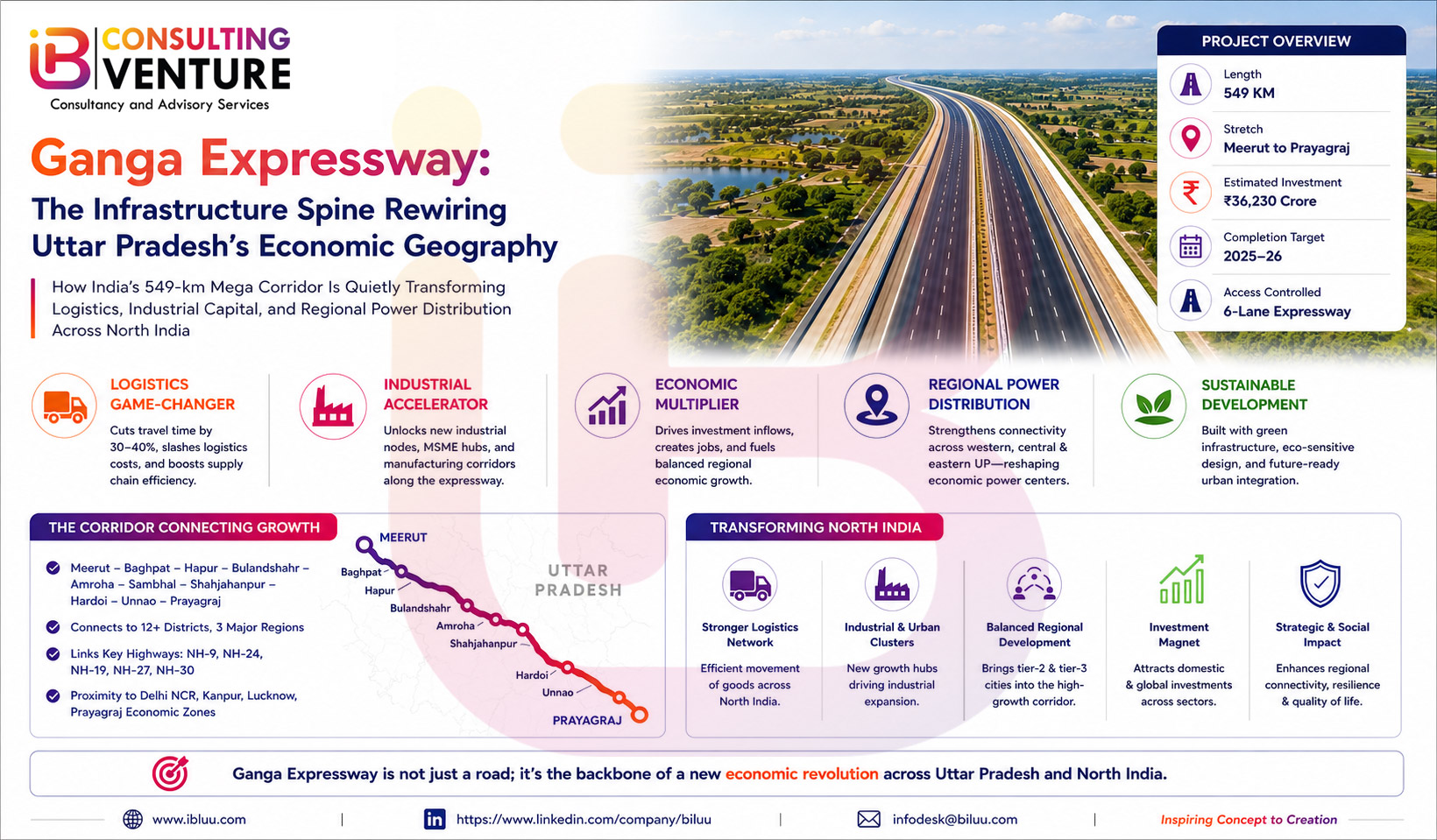
The 594-Km Ganga Expressway: High-Speed Economic Corridor Rewiring Uttar Pradesh into India’s Next Hub for Logistics Velocity, Industrial Growth, Defense Infrastructure, and Capital Expansion
For decades, Uttar Pradesh carried one of the largest demographic and agricultural bases in India — but without the transport architecture required to convert scale into sustained economic velocity.
That structural gap is now being aggressively rewritten.
The Ganga Expressway, a 594-kilometre, six-lane greenfield corridor stretching from Meerut to Prayagraj, is far more than a transport project. It represents a strategic reconfiguration of northern India’s economic geography — one designed to compress distance, accelerate logistics efficiency, unlock land value, integrate industrial corridors, and reposition Uttar Pradesh into India’s emerging infrastructure-led growth cycle.
At a national level, the expressway is becoming part of a much larger strategic doctrine: infrastructure as economic statecraft.
And in that context, the Ganga Expressway is not merely a highway.
It is a capital corridor.
India’s Infrastructure Doctrine Is Changing
Historically, infrastructure projects in India were viewed as public utility assets.
Today, they are increasingly being designed as:
- capital attraction mechanisms,
- industrial acceleration platforms,
- logistics optimization systems,
- defense-support infrastructure,
- and long-horizon regional transformation engines.
The Ganga Expressway sits directly inside this new strategic framework.
The corridor traverses some of Uttar Pradesh’s most economically underpenetrated but agriculturally productive districts — including Hapur, Bulandshahr, Amroha, Sambhal, Budaun, Shahjahanpur, Hardoi, Unnao, Rae Bareli, and Pratapgarh — creating a high-speed development spine across the state.
Its strategic importance is not merely geographical.
It is economic integration at scale.
The Economic Logic Behind the Ganga Expressway
1. Compressing Time to Unlock Economic Productivity
One of the most transformational impacts of the expressway is time compression.
The current travel time between Meerut and Prayagraj ranges from 12 to 15 hours depending on congestion and road conditions.
Once fully operational, the corridor is expected to reduce travel time to approximately 6–7 hours.
This seemingly logistical improvement has deep macroeconomic consequences:
| Strategic Impact | Economic Effect |
|---|---|
| Faster freight movement | Lower logistics costs |
| Reduced fuel consumption | Improved supply-chain efficiency |
| Better intercity connectivity | Expanded labor mobility |
| Quicker agricultural transport | Reduced wastage and higher farmer realization |
| Faster industrial access | Increased manufacturing competitiveness |
For a state with one of India’s largest agricultural economies, logistics modernization alone could significantly improve value-chain efficiency across food processing, warehousing, and agri-export sectors.
A Logistics Corridor with National Implications
India’s logistics costs remain structurally elevated compared to major export economies.
Efficient expressway infrastructure directly impacts:
- inventory cycles,
- trucking turnaround times,
- manufacturing competitiveness,
- and supply-chain reliability.
The Ganga Expressway’s integration with:
- Yamuna Expressway,
- Agra-Lucknow Expressway,
- Purvanchal Expressway,
- and future freight corridors
creates a compounding network effect rather than isolated infrastructure value.
This transforms Uttar Pradesh from a transit-heavy state into an integrated logistics ecosystem.
The implications are substantial.
The corridor can evolve into:
- a warehousing hub,
- industrial manufacturing cluster,
- agricultural processing belt,
- and e-commerce logistics backbone.
Real Estate Is Already Responding
One of the earliest indicators of infrastructure-led transformation is land repricing.
Historically, large-scale expressway development in India has triggered:
- industrial land appreciation,
- township expansion,
- logistics park development,
- and speculative capital inflows into peri-urban regions.
The Ganga Expressway is expected to generate similar effects.
Key Emerging Real Estate Themes
1. Industrial and Warehousing Demand
Large land parcels along the corridor are becoming increasingly attractive for:
- logistics parks,
- cold storage infrastructure,
- industrial parks,
- and manufacturing units.
2. Satellite Urbanization
Interchange zones are likely to emerge as:
- micro-commercial hubs,
- residential townships,
- hospitality clusters,
- and service economies.
3. Agricultural Value Appreciation
Improved freight access increases the commercial viability of agricultural land and food-processing investments.
This is especially relevant for districts historically constrained by transport inefficiencies.
Infrastructure Is Becoming India’s New Capital Multiplier
The deeper strategic story is this:
India is shifting from metro-centric growth to corridor-centric growth.
The next generation of economic expansion is increasingly being shaped by:
- expressways,
- freight corridors,
- industrial nodes,
- logistics platforms,
- ports,
- and multimodal infrastructure systems.
The Ganga Expressway fits directly into this national transition.
Its importance extends beyond Uttar Pradesh.
It contributes to:
- north India supply-chain resilience,
- inter-state freight optimization,
- rural industrialization,
- and manufacturing decentralization.
Defense and Strategic Utility
One of the project’s most strategically significant components is the 3.5-kilometre emergency airstrip in Shahjahanpur.
This allows fighter aircraft and military transport systems to operate during:
- national emergencies,
- defense mobilization,
- and disaster-response situations.
Globally, dual-use infrastructure — combining civilian and strategic utility — is increasingly viewed as critical national capability.
The inclusion of military-operational infrastructure signals India’s broader approach toward resilient strategic logistics architecture.
Environmental and Social Considerations
As a greenfield project, the expressway benefits from:
- modern alignment planning,
- reduced dense urban displacement,
- controlled engineering execution,
- and integrated plantation initiatives.
However, long-term sustainability will depend on:
- ecological management,
- land-use discipline,
- groundwater governance,
- and urbanization planning around emerging corridors.
Infrastructure without governance eventually creates congestion-led inefficiency.
Infrastructure with planning creates economic compounding.
That distinction will define the long-term success of the corridor.
Strategic Investment Outlook
From an investment perspective, the Ganga Expressway creates a multi-decade opportunity matrix across:
| Sector | Potential Impact |
|---|---|
| Warehousing | High |
| Logistics Parks | High |
| Industrial Manufacturing | High |
| Food Processing | High |
| Commercial Real Estate | Moderate to High |
| Residential Expansion | Moderate |
| Hospitality & Transit Economy | Moderate |
For long-horizon investors, the key thesis is not merely road infrastructure.
It is economic migration.
Capital typically follows:
- infrastructure,
- logistics efficiency,
- industrial clustering,
- employment creation,
- urban expansion,
- and finally consumer demand.
The Ganga Expressway is positioning multiple districts to enter that cycle.
The Larger National Narrative
India’s infrastructure buildout is no longer incremental.
It is systemic.
Expressways like:
- Delhi-Mumbai,
- Purvanchal,
- Dwarka,
- Samruddhi Mahamarg,
- and Ganga Expressway
collectively indicate a structural transformation in how India approaches economic development.
The objective is increasingly clear:
build national competitiveness through integrated physical infrastructure.
That is precisely why projects like the Ganga Expressway matter far beyond transportation metrics.
They alter:
- investment geography,
- industrial competitiveness,
- regional economic inclusion,
- and long-term capital allocation patterns.
iBCV Perspective
At iBCV (iBluu Consulting Venture Private Limited), a venture of iBluu Corporations, we view the Ganga Expressway not simply as a transportation corridor, but as a strategic economic multiplier capable of reshaping industrial, logistics, and investment dynamics across northern India.
The analytical depth of this perspective is informed by the strategic lens of J Parasher, Founder and Managing Director of iBluu Corporations, whose work focuses on national capability building, infrastructure intelligence, and long-horizon economic transformation.
From our perspective, the next decade of Indian growth will increasingly be defined not only by cities — but by corridors.
And those who understand corridor economics early will likely shape the next generation of industrial and investment leadership in India.
Disclaimer: This article is intended solely for informational, strategic, and educational purposes and should not be construed as investment, legal, financial, or regulatory advice. All statistics, projections, infrastructure details, and market interpretations are based on publicly available information, industry trends, secondary research, and internal analytical perspectives believed to be reliable at the time of writing; however, no representation or warranty is made regarding absolute accuracy or future outcomes. Infrastructure timelines, economic projections, land valuations, policy directions, and investment conditions remain subject to market dynamics, regulatory changes, execution risks, geopolitical factors, and government approvals. Readers, investors, institutions, and stakeholders are advised to conduct independent due diligence and seek professional advisory support before making any investment, infrastructure, or strategic business decisions. The perspectives expressed herein reflect the analytical and strategic views of iBCV (iBluu Consulting Venture Private Limited), a venture of iBluu Corporations, and are intended to contribute to broader discussions surrounding infrastructure-led economic transformation and long-term national development.