+91 945 889 6091
  infodesk@ibluu.com
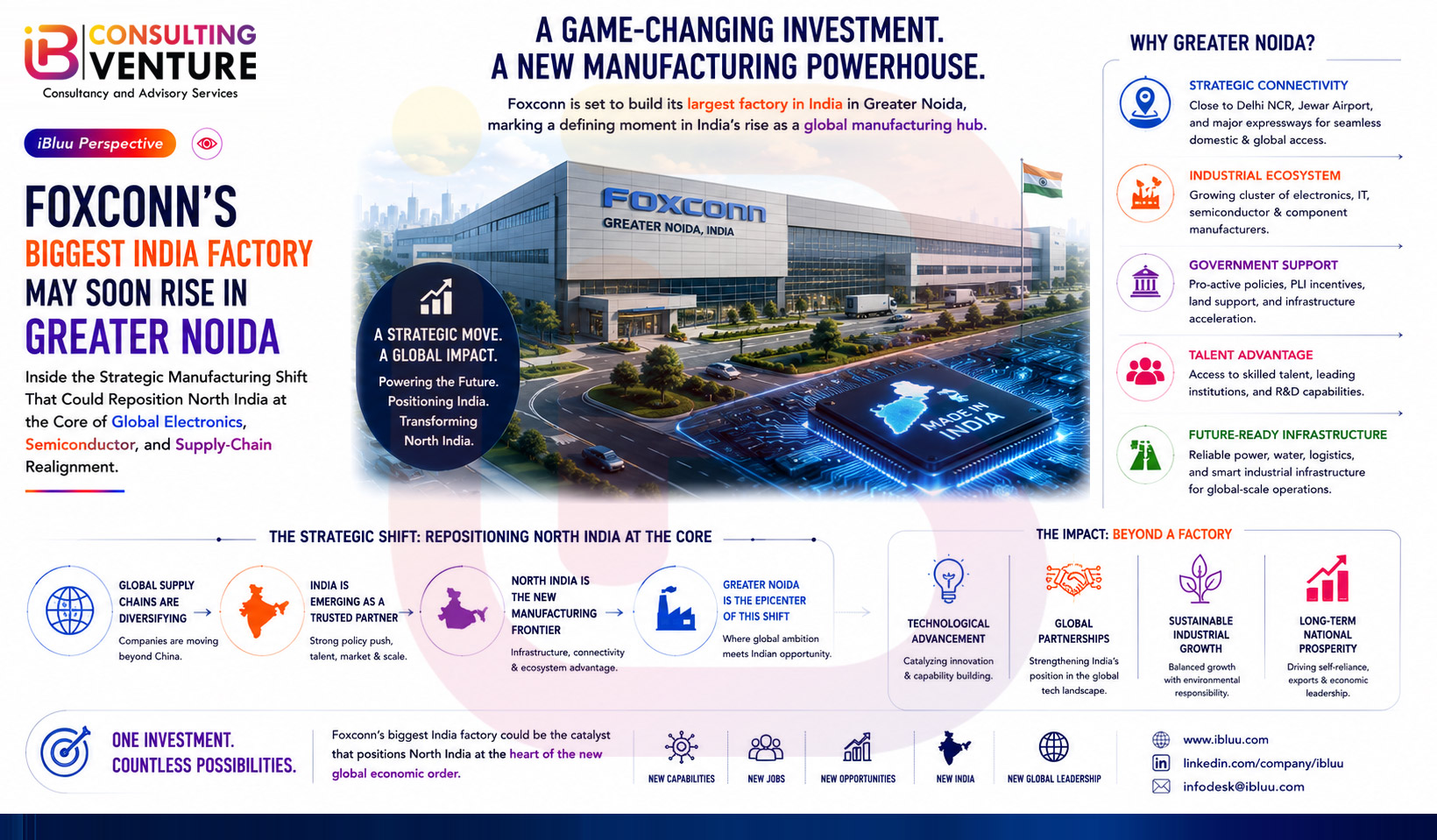
Foxconn’s Largest North India Facility May Soon Rise in Greater Noida—A Defining Moment in India’s Global Electronics and Semiconductor Manufacturing Corridor
Inside the Strategic Manufacturing Shift That Could Reposition North India at the Core of Global Electronics, Semiconductor, and Supply-Chain Realignment
The global manufacturing map is being redrawn.
And India is no longer standing at the edge of that transformation. It is increasingly becoming one of its central pillars.
In what could emerge as one of the most consequential industrial developments in North India’s modern manufacturing history, Taiwan-based Foxconn is advancing plans for a massive 300-acre manufacturing facility along the Yamuna Expressway corridor in Greater Noida. If finalized at the anticipated scale, the project could become Foxconn’s first—and potentially largest—manufacturing ecosystem in North India.
But this story is bigger than a factory.
It reflects a far deeper global shift involving supply-chain diversification, geopolitical manufacturing realignment, semiconductor localization, export-driven industrial policy, and India’s growing emergence as a strategic alternative to China within global electronics manufacturing.
Why This Project Matters Far Beyond Uttar Pradesh
The proposed facility is strategically positioned near the upcoming Noida International Airport within the Yamuna Expressway Industrial Development Authority (YEIDA) corridor.
That geography is not accidental.
It represents the convergence of:
- Logistics infrastructure
- Export-oriented manufacturing
- Semiconductor ecosystems
- High-speed connectivity
- Integrated industrial townships
- Dedicated freight and airport access
- Electronics supply-chain clustering
Industry estimates suggest the project could generate nearly 40,000 direct and indirect jobs while integrating worker housing, supplier parks, logistics infrastructure, and manufacturing operations into a self-sustaining industrial ecosystem.
This is precisely how modern industrial corridors are built globally.
Not as isolated factories.
But as vertically integrated economic systems.
India Is No Longer Competing Only for Factories — It Is Competing for Global Supply Chains
For nearly two decades, China dominated the world’s electronics manufacturing architecture.
Today, that model is fragmenting.
Rising geopolitical tensions, supply-chain vulnerabilities exposed during the pandemic, tariff pressures, labor diversification strategies, and Western de-risking policies have fundamentally altered global manufacturing priorities.
Foxconn’s accelerating India expansion reflects that structural transition.
India now offers something global manufacturers increasingly prioritize:
- Market scale
- Political stability
- Large workforce availability
- Expanding digital consumption
- Production-linked incentives (PLI)
- Export manufacturing ambitions
- Growing semiconductor policy support
- Improving logistics infrastructure
More importantly, India offers diversification at scale.
That matters enormously for multinational manufacturing giants.
Foxconn’s Expanding India Footprint
Foxconn’s India strategy is no longer experimental.
It is becoming structural.
Below is a strategic overview of Foxconn’s key manufacturing and investment ecosystems across India as of 2026:
| Location | State | Major Activity | Key Partner / Client | Approx. Scale |
|---|---|---|---|---|
| Sriperumbudur | Tamil Nadu | iPhone manufacturing | Apple | Major operational hub |
| Devanahalli (Bengaluru) | Karnataka | Upcoming large-scale smartphone manufacturing | Apple ecosystem | Multi-billion-dollar project |
| Hyderabad | Telangana | AirPods and electronics manufacturing | Apple supply chain | Expanding |
| Greater Noida (Proposed) | Uttar Pradesh | Smartphones / EVs / electronics / integrated ecosystem | Under discussion | ~300 acres |
| Sector 28, YEIDA | Uttar Pradesh | Semiconductor OSAT facility | HCL Group JV | ~48 acres |
Foxconn’s India investments are now estimated to be moving toward multi-billion-dollar long-term deployment commitments across manufacturing, semiconductors, logistics, and component ecosystems.
Why Greater Noida Has Emerged as a Strategic Electronics Corridor
The Noida-Greater Noida-Yamuna Expressway belt is rapidly evolving into one of India’s most important electronics manufacturing clusters.
The region already contributes nearly half of India’s mobile phone exports through concentrated manufacturing activity involving:
- Smartphones
- Consumer electronics
- Components
- Assembly operations
- Export ecosystems
What makes this corridor particularly powerful is supply-chain density.
Manufacturing ecosystems become globally competitive not merely because factories exist—but because suppliers, logistics operators, workforce pools, semiconductor support, warehousing, and export infrastructure operate within tightly integrated proximity.
That ecosystem effect is now becoming visible across Greater Noida.
The presence of the HCL-Foxconn semiconductor OSAT venture further strengthens the corridor’s strategic positioning in advanced electronics manufacturing.
The Semiconductor Connection Is Critical
One of the most underestimated aspects of Foxconn’s India strategy is its semiconductor adjacency.
Globally, electronics manufacturing is increasingly tied to semiconductor localization strategies.
India’s semiconductor ambitions—supported by central government incentives and state-level industrial policies—are beginning to attract serious global attention.
The proposed HCL-Foxconn OSAT facility in Uttar Pradesh focusing on Display Driver Integrated Circuits (DDICs) represents a major early signal.
Why does this matter?
Because future electronics ecosystems will increasingly depend on:
- Chip packaging
- Semiconductor assembly
- Testing infrastructure
- Display technologies
- Advanced electronics integration
Foxconn’s positioning across both manufacturing and semiconductor ecosystems gives India a stronger foothold in higher-value electronics infrastructure.
Could Greater Noida Rival Bengaluru in Foxconn’s India Strategy?
Possibly.
Foxconn’s Bengaluru expansion is already projected to become one of the company’s largest facilities globally outside China.
However, the Greater Noida proposal carries unique strategic advantages:
- Direct access to North Indian consumer markets
- Airport-led export infrastructure
- Lower logistics concentration risk
- Integrated industrial planning
- Semiconductor adjacency
- Strong state-level policy support
If executed successfully, the Yamuna Expressway corridor could emerge as North India’s answer to major Asian manufacturing zones.
The Economic Multiplier Effect Could Be Massive
Large-scale manufacturing ecosystems do not only create factory jobs.
They create entire secondary economies.
Potential multiplier effects include:
- Real estate expansion
- Logistics and warehousing growth
- Supplier ecosystem formation
- Hospitality demand
- Urban infrastructure upgrades
- Skill-development ecosystems
- SME manufacturing integration
- Export revenue acceleration
This is how manufacturing reshapes regional economies over decades.
The same pattern transformed:
- Shenzhen in China
- Vietnam’s northern industrial belt
- Taiwan’s semiconductor corridors
- Thailand’s automotive clusters
India is now attempting similar industrial-scale transformation models.
Why Global Investors Are Watching India More Aggressively
Foxconn’s expansion signals something larger to global markets.
It indicates that multinational corporations increasingly view India not simply as a domestic consumption economy—but as a strategic manufacturing and export platform.
That distinction matters.
Global capital follows long-duration industrial ecosystems.
Particularly those linked to:
- Electronics
- Semiconductors
- EV supply chains
- AI infrastructure
- Data centers
- Renewable-powered manufacturing
India now sits at the intersection of all six.
Risks Still Exist — And They Cannot Be Ignored
Despite the momentum, several structural challenges remain:
- Land acquisition complexity
- Power reliability consistency
- Supply-chain depth
- Semiconductor dependency
- Workforce skill scaling
- Policy execution speed
- Global demand cyclicality
India’s long-term success will depend not merely on attracting factories—but on sustaining globally competitive manufacturing ecosystems over decades.
That requires execution discipline at every level.
The Strategic Signal Is Clear
Foxconn’s proposed Greater Noida manufacturing ecosystem is not just another industrial investment headline.
It represents a strategic signal.
The world’s largest electronics manufacturers are beginning to place long-term industrial bets on India’s manufacturing future.
And increasingly, those bets are becoming larger, faster, and structurally deeper.
From an iBCV perspective, this is not simply a factory story.
It is the early architecture of a much larger industrial transformation that could redefine India’s role in global electronics manufacturing, semiconductor ecosystems, and export-driven economic growth over the next decade.
The analytical depth of this perspective has been shaped by the strategic lens of J Parasher, Founder and Managing Director of iBluu Corporations, whose work focuses on industrial competitiveness, infrastructure ecosystems, global manufacturing transitions, and long-horizon economic transformation.
Disclaimer: This article is intended solely for informational, strategic, and analytical purposes and should not be construed as investment, legal, financial, or policy advice. Certain projections, investment references, industrial estimates, and development timelines are based on publicly available information, industry reports, market intelligence, and ongoing discussions available as of May 2026. Actual project scope, investment size, manufacturing categories, and implementation timelines may evolve subject to regulatory approvals, corporate decisions, and market conditions.