+91 945 889 6091
  infodesk@ibluu.com
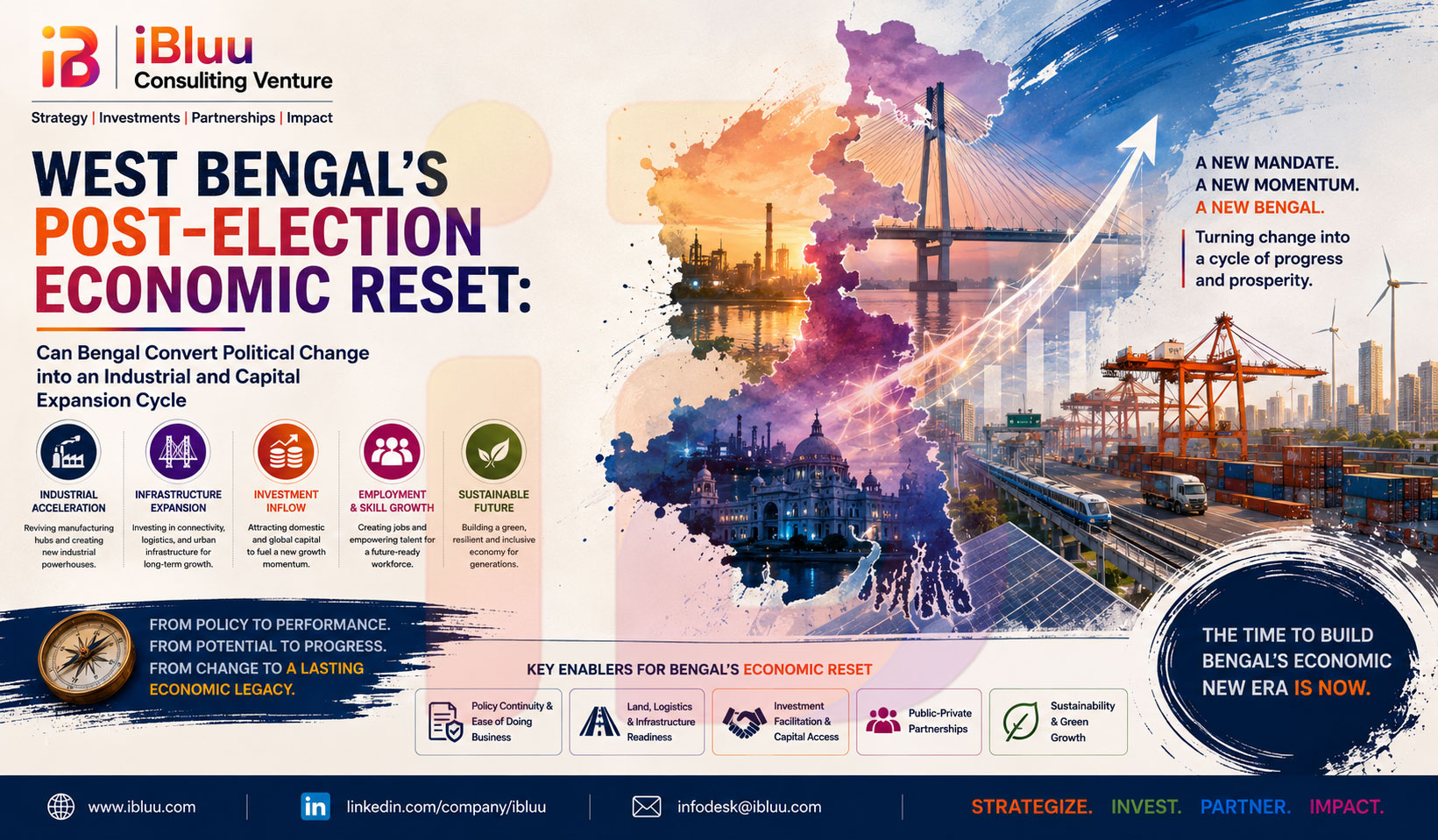
West Bengal’s Growth Architecture: Connecting Capital, Infrastructure, Industry and Technology to Build Eastern India’s Next Economic Engine
From Kolkata’s technology ambitions to Haldia’s chemical economy, Durgapur’s manufacturing base and Siliguri’s emerging logistics role, West Bengal is attempting something larger than an investment drive: a structural reset of its economic architecture.
West Bengal has entered a consequential new economic phase.
The new administration has placed industrialisation, infrastructure, investment attraction, employment generation, technology, land availability and ease of doing business much closer to the centre of its economic agenda.
The FY2026–27 state budget of approximately ₹4.39 lakh crore provides the fiscal framework for this repositioning. The budget targets total expenditure of ₹4,38,775 crore, with a fiscal deficit target of 2.9% of GSDP and a projected GSDP of approximately ₹21.48 lakh crore.
Yet Bengal’s opportunity is larger than its budget.
The state sits at a strategic intersection of eastern India, the Northeast, Bangladesh-facing trade routes, the Bay of Bengal, mineral-rich eastern India, established manufacturing clusters and a large urban talent pool.
The challenge is equally clear: West Bengal does not merely need more investment announcements. It needs an investment-conversion system.
That means converting investor interest into land-ready projects, projects into financial closure, financial closure into construction, and construction into productive employment, exports and durable economic value.
That is where the next phase of Bengal’s economic story will be decided.
1. The Political Transition Has Created an Economic Window
Political change does not automatically create economic growth.
But it can create a window for institutional repositioning.
West Bengal’s new administration has explicitly signalled an attempt to alter the investment proposition through a new industrial policy, land reforms, streamlined approvals, stronger law-and-order mechanisms, technology-sector incentives and renewed engagement with large domestic and international businesses.
The proposed industrial policy is designed around several investor-facing reforms, including:
- streamlined single-window approvals;
- GIS-enabled land banks;
- clearer incentive frameworks;
- cluster-based industrial development;
- stronger logistics infrastructure;
- rationalised approvals;
- a dedicated Global Capability Centre ecosystem;
- and a forthcoming startup-policy framework.
The important point is that these are not simply administrative reforms.
They are capital-enablement mechanisms.
For an investor, a ₹1,000 crore project does not become investable merely because the state offers incentives.
It becomes investable when:
land + approvals + infrastructure + utilities + policy certainty + offtake + financing + execution
align within an acceptable risk envelope.
Bengal’s proposed policy architecture therefore deserves to be judged by one metric above all others:
How much announced capital can the state convert into operational productive capacity?
2. Bengal’s Fiscal Architecture: Ambition Meets Constraint
The FY2026–27 budget is significant in scale.
Total expenditure is budgeted at ₹4,38,775 crore, while GSDP is projected at approximately ₹21.48 lakh crore. The state has targeted a fiscal deficit of 2.9% of GSDP, or roughly ₹62,421 crore. Revenue deficit is targeted at approximately ₹21,984 crore, equivalent to 1% of GSDP.
These numbers create an important investment-policy tension.
West Bengal needs to spend aggressively on:
- roads;
- rail connectivity;
- urban infrastructure;
- industrial parks;
- logistics;
- power;
- digital infrastructure;
- skills;
- healthcare;
- technology ecosystems.
But the state also needs fiscal discipline.
Therefore, the next phase cannot depend exclusively on government expenditure.
The strategic requirement is to crowd in private capital.
The state must increasingly use public expenditure as catalytic capital—creating the infrastructure and institutional conditions that allow private investors to deploy substantially larger pools of capital.
This is the difference between:
government spending on infrastructure
and
government using infrastructure to mobilise an investment ecosystem.
3. The First Investment Signal: A ₹6,000-Crore Haldia Chemical Platform
One of the clearest industrial signals is coming from Haldia.
Haldia Petrochemicals’ approximately ₹6,000 crore phenol-acetone project is scheduled for commissioning/inauguration in October 2026.
The project, developed through Adplus Polymers & Chemicals, includes India’s first on-purpose propylene unit based on olefin-conversion technology and what has been described as the country’s largest phenol plant.
Its importance extends beyond the headline investment.
Phenol and acetone are industrial building blocks with applications across:
- pharmaceuticals;
- paints and coatings;
- automotive components;
- chemicals;
- plastics;
- industrial materials.
The project therefore has downstream multiplier potential.
This is exactly the type of investment Bengal should pursue:
not merely a factory, but an industrial node capable of generating secondary manufacturing, logistics, warehousing, engineering, chemicals and export activity around itself.
Haldia can become significantly more valuable if the state builds a broader chemicals and materials ecosystem around the anchor asset.
4. L&T and the Rise of Kolkata’s Technology Economy
Bengal’s investment narrative is also moving beyond conventional manufacturing.
Larsen & Toubro has outlined more than ₹4,500 crore of potential investment in West Bengal over the coming years.
Its technology expansion includes a multi-phase software/technology campus in Kolkata’s New Town/Silicon Valley area, with total investment of around ₹2,500 crore and an estimated employment potential of approximately 25,000 jobs.
L&T has also proposed a Tier-III data centre in Kolkata, with reported investment of around ₹2,000 crore.
By late August, the technology push had already advanced materially, with LTM inaugurating its Global Delivery & AI Competency Centre in Kolkata.
This matters because Bengal’s technology opportunity is different from simply trying to replicate Bengaluru.
Kolkata’s competitive proposition can instead be built around:
engineering + IT services + AI + analytics + GCCs + financial services + eastern India market access + lower operating costs.
The strategic ambition should not be:
“Become another Bengaluru.”
It should be:
“Build the technology gateway for Eastern and Northeastern India.”
That is a more differentiated proposition.
5. Semiconductor Ambition: From Interest to Industrial Proof
The state’s semiconductor ambitions are another potentially transformative development.
Mitsubishi has expressed interest in establishing a semiconductor-related manufacturing facility in West Bengal, with Durgapur and Panagarh identified as potential locations for evaluation. Further site assessment and discussions were planned during 2026.
This should be treated as investor interest—not yet a confirmed semiconductor investment.
That distinction is critical.
A semiconductor ecosystem requires far more than land.
It requires:
- highly reliable electricity;
- high-quality water;
- clean-room infrastructure;
- precision engineering;
- chemicals and gases;
- specialised logistics;
- skilled labour;
- supplier ecosystems;
- testing and packaging capability;
- regulatory certainty;
- and proximity to downstream electronics manufacturing.
If Bengal can develop this ecosystem, Durgapur–Panagarh could become a meaningful industrial technology corridor.
If it cannot, semiconductor announcements will remain announcements.
The test is execution.
6. Industrial Re-Industrialisation: Bengal Must Reuse What It Already Owns
One of West Bengal’s biggest advantages is often overlooked:
it already possesses industrial geography.
Howrah, Hooghly, Durgapur, Asansol, Haldia, Kharagpur and other industrial belts have existing industrial memory, transport infrastructure, skilled labour pools and supplier networks.
The challenge is that parts of this infrastructure have become underutilised.
The government is therefore reviewing older industrial parks, land utilisation and infrastructure gaps while preparing proposals under the Centre’s BHAVYA industrial-development framework. The focus is increasingly on whether industrial land is actually usable, legally clear and infrastructure-ready—not merely recorded as industrial land on paper.
This is potentially one of the highest-return economic strategies available to Bengal.
Greenfield development is expensive.
Brownfield revival can be faster.
The state should therefore pursue a dual strategy:
Greenfield corridors for new-generation industries.
Brownfield revitalisation for legacy industrial ecosystems.
7. The Land Question Is Still Bengal’s Central Economic Variable
No serious analysis of West Bengal’s industrial future can avoid land.
The state’s industrial history demonstrates how land acquisition can become economically and politically sensitive.
The new administration is therefore examining land policy, land banks, land ceilings and mechanisms to make industrial land more accessible while attempting to protect legitimate public interests. The government has also been reviewing legacy industrial land and preparing GIS-enabled approaches to improve land readiness.
This creates a difficult but necessary balance.
Investors require:
certainty of title + possession + infrastructure + speed.
Citizens require:
fair compensation + transparency + rehabilitation + trust.
The winning land policy is therefore neither:
“land at any cost”
nor
“land avoidance at any cost.”
It is:
transparent, legally bankable, GIS-enabled industrial land assembly.
If Bengal can achieve this, it could materially change the state’s investment equation.
8. The New Industrial Policy: The Real Test Is Incentive Design
The government has been preparing a new industrial policy intended to make Bengal more competitive.
The proposed framework includes a stronger single-window mechanism, land banks, cluster development, incentives and a focus on GCCs and startups.
But an even more important policy signal has emerged:
Industrial incentives may increasingly be linked to employment generation rather than simply investment size.
This is strategically interesting.
A ₹5,000 crore automated facility and a ₹5,000 crore labour-intensive manufacturing ecosystem can generate radically different employment outcomes.
If incentives are tied to measurable employment, Bengal could shift from:
capital attraction
toward
economic value creation.
That is a much more sophisticated incentive architecture.
However, employment should not become the only metric.
A globally competitive industrial policy should evaluate projects across:
- direct employment;
- indirect employment;
- exports;
- domestic value addition;
- technology transfer;
- supplier development;
- tax contribution;
- energy efficiency;
- infrastructure utilisation;
- and long-term capital formation.
The objective should be economic multipliers—not merely headline investment numbers.
9. The ₹5,000-Crore Incentive Question
The proposed industrial incentive framework has been discussed around a package of approximately ₹5,000 crore. The emerging policy debate also includes linking incentives more closely to jobs.
This raises a fundamental capital-allocation question:
How much economic value should Bengal generate for every rupee of fiscal incentive?
That question should become central to policy evaluation.
A ₹100 crore incentive supporting a ₹1,000 crore project is not automatically good.
Nor is a ₹10 crore incentive supporting a ₹500 crore project automatically better.
The correct measure is the risk-adjusted economic multiplier.
A sophisticated incentive framework should therefore measure:
Fiscal support → private capital → employment → exports → tax base → supplier ecosystem → long-term GSDP contribution.
That is how Bengal can avoid competing purely through subsidies.
10. Railways Could Become the State’s Biggest Economic Multiplier
One of the most consequential infrastructure developments is the push to accelerate 61 railway projects, collectively reported at more than ₹1 lakh crore.
The state has committed to helping resolve land-related bottlenecks so these projects can progress.
The wider railway programme includes station redevelopment, flyovers and underpasses and major connectivity improvements.
Eastern Railway separately indicated plans to invest approximately ₹12,000 crore over the next four to five years in capacity enhancement, multi-tracking, yard modernisation and terminal development.
For Bengal, this is not merely transportation infrastructure.
It is industrial infrastructure.
Better rail connectivity can:
- reduce logistics costs;
- improve freight reliability;
- expand industrial catchment areas;
- connect manufacturing clusters to ports;
- improve labour mobility;
- strengthen MSME supply chains;
- connect North Bengal to eastern markets;
- and improve access to the Northeast.
Infrastructure should therefore be judged not by kilometres constructed, but by economic throughput created.
11. The Port Strategy Is Being Rewritten
The Tajpur deep-sea port story also illustrates the new administration’s approach.
The earlier Tajpur proposal has effectively been closed, with the state instead examining an alternative greenfield port location at Dadanpatrabar, around 10 km away, where the government has identified approximately 1,700 acres.
The reported interest of the Adani Group in participating in a future tender for the alternative location adds another layer to the opportunity. The group has also expressed interest in other Bengal infrastructure projects, including the proposed Kalyani airport and a large hospital in New Town.
The strategic lesson is straightforward:
A port is never only a port.
A commercially viable deep-sea port requires:
port + rail + road + warehouses + industrial hinterland + customs + logistics + reliable utilities + cargo volumes.
Bengal’s challenge is therefore to build an integrated maritime-industrial ecosystem, not simply a port terminal.
12. Siliguri Could Become Bengal’s Northern Capital of Trade
The state’s economic strategy also needs to move beyond Kolkata.
Siliguri occupies an unusually strategic position.
It is the gateway connecting:
- West Bengal;
- the Northeast;
- Nepal;
- Bhutan;
- North Bengal;
- and wider eastern trade networks.
The state’s budget framework includes plans for a technology/IT facility of approximately 50,000 square feet in Siliguri and a broader ambition to develop the city as a logistics and trade hub. It also includes a common tea-processing centre and support for North Bengal’s industrial clusters.
This could create a second economic axis:
Kolkata → Haldia → Durgapur
for manufacturing, logistics and exports;
and
Siliguri → Northeast → Nepal/Bhutan
for trade, logistics, services and regional connectivity.
That would make Bengal’s economic geography much more distributed.
13. The Startup and Venture-Capital Layer
Industrial transformation cannot depend exclusively on large corporations.
The next phase also requires a stronger entrepreneurial ecosystem.
The proposed startup framework includes discussions around:
- a ₹40 crore incubation fund;
- a ₹60 crore venture-capital fund;
- and a ₹50 crore science and technology talent-attraction fund.
The objective is to strengthen local innovation and address talent outmigration.
But the larger opportunity is to connect startups with Bengal’s existing industrial strengths.
The state should encourage startups in:
- industrial automation;
- logistics technology;
- AI;
- agritech;
- fintech;
- climate technology;
- advanced manufacturing;
- semiconductor design;
- healthcare technology;
- maritime technology;
- and industrial software.
Capital should not merely create startups.
Capital should create industrial capability.
14. The Technology–Manufacturing Convergence
One of Bengal’s potentially strongest economic advantages is the ability to combine its historical industrial base with its emerging technology economy.
Consider the architecture:
Durgapur–Panagarh: advanced manufacturing, steel, engineering, semiconductors.
Haldia: chemicals, petrochemicals, maritime logistics and downstream manufacturing.
Kolkata/New Town: AI, IT, GCCs, financial services and digital infrastructure.
Kharagpur: engineering, manufacturing and technology.
Siliguri: logistics, trade, tea, warehousing and Northeast connectivity.
This creates the possibility of a distributed industrial economy, rather than an overwhelmingly Kolkata-centric model.
That is strategically important.
15. What Global Investors Will Actually Watch
Investors will not judge Bengal by policy speeches.
The emerging investment map can be viewed through following strategic engines:
| Economic Engine | Current Signal | Strategic Opportunity |
|---|---|---|
| Petrochemicals & chemicals | ₹6,000 crore Haldia complex | Downstream chemical ecosystem |
| Technology & AI | L&T/LTM expansion; proposed data-centre investment | GCCs, AI, global delivery |
| Manufacturing | Birla Opus and other industrial investments | Cluster-based manufacturing |
| Transport & logistics | ₹83,433 crore sanctioned railway pipeline; Dankuni connectivity | National freight integration |
| Maritime | ₹19,209 crore proposed maritime pipeline through 2031 | Eastern India logistics gateway |
| Startups | ₹100 crore combined incubation/VC allocation | Private-capital mobilisation |
| Land & industrial reform | Urban land-ceiling reform | Large-scale project enablement |
The important point is that these are not independent stories.
They can reinforce each other.
16. The Biggest Opportunity: Repositioning Bengal in India’s Investment Map
India’s economic geography is changing.
Gujarat has built a powerful industrial and logistics ecosystem.
Maharashtra remains a financial and industrial powerhouse.
Tamil Nadu has established deep manufacturing capabilities.
Karnataka dominates technology and innovation.
Telangana has developed a strong technology-pharma platform.
Andhra Pradesh and Odisha are competing aggressively in logistics, manufacturing and energy.
West Bengal therefore cannot win by copying them.
Bengal needs its own investment thesis.
That thesis could be:
Eastern India’s integrated industrial, technology, logistics and trade gateway.
Its competitive advantages are distinctive:
- Kolkata’s talent and services ecosystem;
- Haldia’s industrial and maritime base;
- Durgapur’s manufacturing infrastructure;
- Kharagpur’s engineering ecosystem;
- Siliguri’s regional trade position;
- proximity to Bangladesh;
- access to the Northeast;
- Bay of Bengal connectivity;
- and an existing industrial base that can be modernised.
The opportunity is to connect these assets into one economic system.
17. The Capital Expansion Equation
For Bengal, the objective should not simply be to maximise FDI.
It should be to maximise productive capital formation.
That includes:
FDI + domestic private investment + institutional capital + infrastructure finance + venture capital + public capex + industrial reinvestment.
The state can accelerate this through a three-layer model.
Layer 1 — Public catalytic infrastructure
Government builds or enables:
- roads;
- rail;
- ports;
- industrial parks;
- utilities;
- digital infrastructure.
Layer 2 — Private industrial capital
Corporates deploy capital into:
- manufacturing;
- chemicals;
- technology;
- data centres;
- semiconductors;
- logistics;
- healthcare;
- energy.
Layer 3 — Institutional capital
Private-equity, infrastructure funds, sovereign capital and pension investors finance scalable platforms.
This creates a multiplier effect.
Public infrastructure should unlock private capital; private capital should create productive capacity; productive capacity should expand the state’s tax and employment base.
That is the economic flywheel Bengal needs.
18. What Could Go Wrong?
A serious investor-centric assessment must also identify the downside.
Policy execution risk
A strong policy document without predictable implementation will not change investor behaviour.
Land risk
Unclear titles, fragmented ownership or delays can destroy project timelines.
Infrastructure bottlenecks
Industrial parks without reliable utilities or logistics remain stranded assets.
Fiscal pressure
Aggressive incentives can become expensive if not linked to measurable economic outcomes.
Talent leakage
Technology and advanced manufacturing require specialised human capital.
Project concentration
Overreliance on a few large conglomerates can create concentration risk.
Political expectations
A new government faces pressure to demonstrate rapid economic results. This can create incentives for headline announcements before projects reach financial closure.
Execution credibility
The market will ultimately distinguish between: announced investment, committed investment, financial close, construction, commissioning and operational output.
Capital competition
Bengal is competing against Gujarat, Maharashtra, Karnataka, Telangana, Tamil Nadu, Andhra Pradesh, Odisha and Uttar Pradesh.
Investors have alternatives.
Reputation risk
A single high-profile project failure can influence the perception of hundreds of future investors.
Those are eight very different milestones.
19. The iBluu Strategic Lens: From Investment Attraction to Investment Conversion
From an iBluu Corporations perspective, the central question is not whether West Bengal can attract capital.
It clearly can.
The more important question is: Can Bengal convert investor interest into investable, executable and scalable economic platforms?
That requires a different approach to consulting and government–industry engagement.
Investors entering Bengal will need to evaluate:
- sector selection;
- industrial cluster suitability;
- land strategy;
- regulatory architecture;
- state and central incentives;
- infrastructure availability;
- partner identification;
- government engagement;
- transaction structuring;
- project feasibility;
- risk allocation;
- financing;
- and long-term exit strategy.
This is where strategic advisory can move beyond conventional market-entry consulting.
The winning model is not: “Find an opportunity.”
It is: “Design the pathway from opportunity to execution.”
20. A 2026–2030 Investment Roadmap for Bengal
If the current policy direction is executed effectively, West Bengal could move through four stages.
Phase I — 2026: Reset
Priority:
- industrial policy;
- land policy;
- investor confidence;
- law-and-order credibility;
- stalled-project resolution;
- single-window reforms.
Phase II — 2027: Conversion
Priority:
- land allocation;
- financial closures;
- industrial parks;
- logistics infrastructure;
- GCC expansion;
- startup ecosystem.
Phase III — 2028–2029: Industrial Scaling
Priority:
- manufacturing expansion;
- semiconductor/electronics ecosystem;
- chemicals;
- data centres;
- logistics;
- ports;
- renewable and emerging-energy industries.
Phase IV — 2030: Economic Platform
The objective should be to create an integrated Bengal economic system where: industry + technology + logistics + capital + exports + talent reinforce one another.
21. The Strategic Bottom Line
West Bengal is not starting from zero.
It is starting from a complicated but potentially valuable base of industrial assets, talent, infrastructure, geography and market access.
The political transition has created a new policy window.
The budget has established a fiscal framework.
Large corporations are signalling renewed interest.
Rail infrastructure is receiving major attention.
Kolkata is strengthening its technology proposition.
Haldia is deepening its chemical-industrial base.
Durgapur–Panagarh is being positioned for advanced manufacturing and potentially semiconductor activity.
Siliguri is being positioned as a northern logistics and technology node.
The real opportunity is therefore not a collection of unrelated projects.
It is the creation of a new economic architecture.
But Bengal should be judged by a harder standard.
Investment announcements are not economic growth.
MOUs are not factories.
Land allocation is not production.
Policy announcements are not competitiveness.
And capital commitments are not economic transformation until they become operational assets, productive employment, exports, innovation and recurring economic value.
That is the standard global investors will apply.
And that is the standard West Bengal should apply to itself.
The iBluu View
The next decade could represent one of the most consequential economic repositioning opportunities in West Bengal’s modern history.
The state possesses the ingredients.
What it needs now is execution architecture.
If policy reform, land readiness, infrastructure, institutional governance and private capital begin moving in the same direction, Bengal can potentially transform its historic strengths into a modern investment proposition.
The ambition should not be to become a copy of another Indian state.
Bengal should build an economic model that is unmistakably its own: Eastern India’s industrial, technology, logistics and capital gateway.
The next chapter will not be written by political transition alone.
It will be written by execution.
Strategic Perspective
The analytical perspective of this article is shaped by J Parasher, Founder and Managing Director of iBluu Consulting Venture (iBCV), a venture of iBluu Corporations, whose strategic work focuses on national capability building, global industrial benchmarking, infrastructure transformation, investment strategy, institutional partnerships and long-horizon economic development.
From this perspective, state-level economic transformation should not be evaluated merely through the volume of investment announced.
The deeper measure is the quality of capital attracted, the productivity of that capital, the industrial ecosystems created around it and the extent to which infrastructure, technology, talent and institutions compound into durable economic advantage.
Disclaimer: This article is intended solely for strategic thought leadership and informational purposes. It does not constitute investment, financial, legal, tax, political or policy advice. Investment proposals, policy initiatives and project developments discussed in the article may be subject to regulatory approvals, commercial negotiations, financing, land availability and other execution conditions. Announced investments should not be interpreted as completed investments or guarantees of future economic outcomes. Forward-looking observations represent analytical perspectives and should not be treated as confirmed commitments by any company, investor or government authority.