+91 945 889 6091
  infodesk@ibluu.com
India’s Electric Vehicle Market Enters Its Most Strategic Decade
The electric vehicle (EV) revolution in India is no longer a niche sustainability narrative or an experimental transition led by subsidies and environmental activism. It is rapidly evolving into one of the most strategically important industrial, geopolitical, and infrastructure transformations in modern Indian economic history.
What began as a climate-linked mobility initiative has now expanded into a multi-trillion-rupee economic ecosystem spanning advanced manufacturing, battery infrastructure, rare minerals, charging networks, semiconductors, energy storage, renewable power integration, logistics modernization, software intelligence, and industrial supply-chain realignment.
India’s EV market is increasingly becoming a national economic strategy.
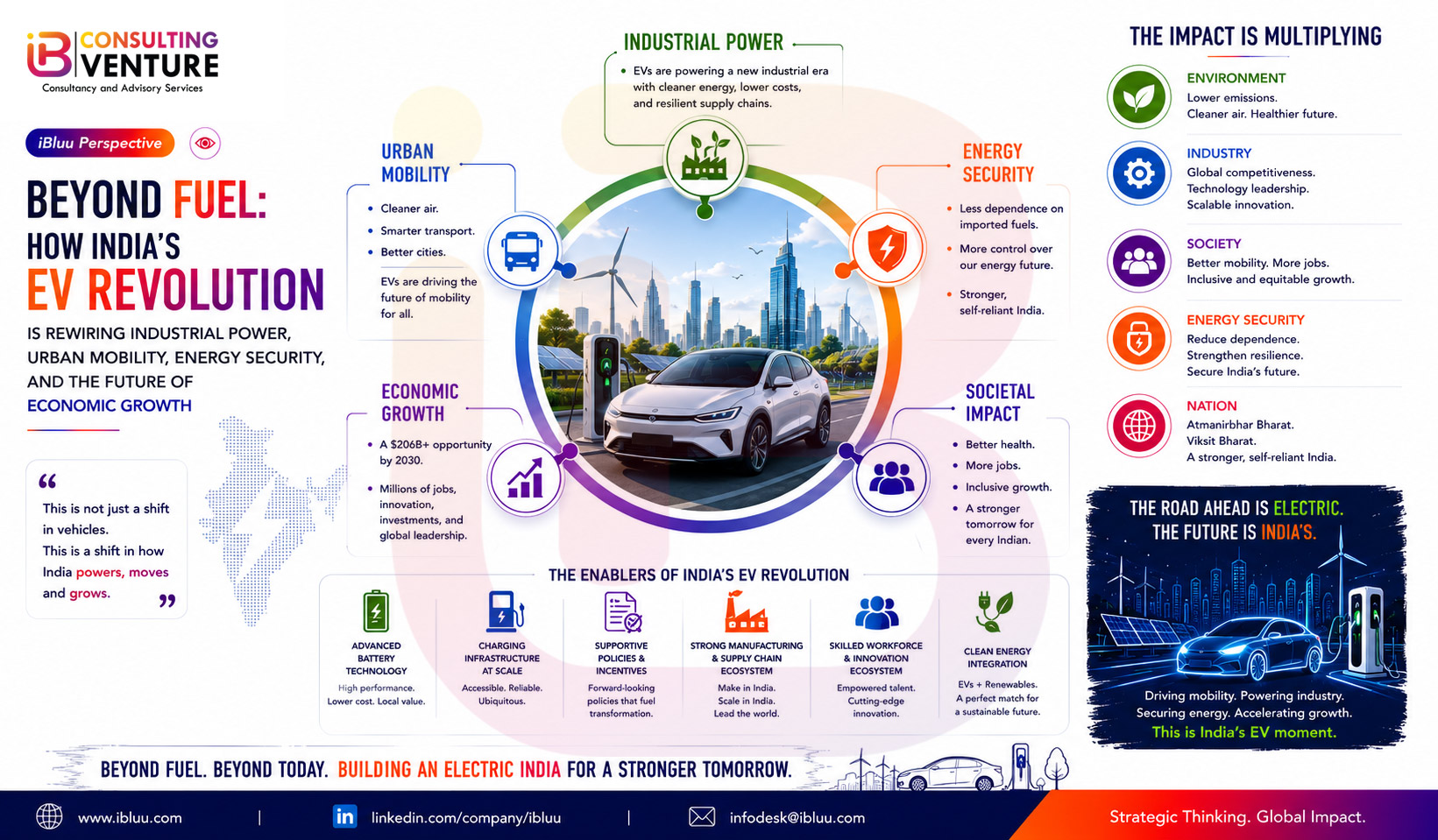
The shift is not merely about replacing internal combustion engines with batteries. It is about reducing oil dependence, reshaping urban infrastructure, strengthening domestic manufacturing capabilities, attracting global capital, accelerating renewable energy integration, improving trade balances, and positioning India within the next global industrial architecture.
According to industry estimates, India’s EV market could exceed USD 150–200 billion by 2030, while broader EV-linked ecosystems—including batteries, charging infrastructure, grid modernization, software, and mobility platforms—could create one of the largest industrial opportunity cycles in Asia.
From the perspective of iBCV (iBluu Consulting Venture Private Limited), a venture of iBluu Corporations, India’s EV transition is not simply a mobility shift. It represents the emergence of an integrated economic system connecting energy security, digital infrastructure, industrial competitiveness, and long-term geopolitical resilience.
India’s EV Market by 2026: The Numbers Behind the Momentum
India’s EV adoption curve has accelerated sharply after the global fuel price shocks witnessed during 2022–2024, supply-chain disruptions, and rising urban fuel costs.
By May 2026:
- India’s cumulative EV registrations are estimated to have crossed 8–9 million units
- Annual EV sales are projected to exceed 3 million units
- EV penetration in two-wheelers has crossed approximately 12–14%
- Electric three-wheelers have emerged as the single largest EV success category globally in urban mobility
- Battery manufacturing investments announced in India exceed USD 40 billion
- Charging infrastructure installations continue expanding across highways, metros, logistics parks, and commercial hubs
Industry forecasts suggest that by 2035:
- EV penetration could exceed 60–70% in two-wheelers
- Commercial fleet electrification could become mainstream
- Electric buses may dominate urban public mobility
- India’s EV ecosystem could contribute over USD 300 billion to the economy directly and indirectly
- Oil import savings could become one of the biggest macroeconomic advantages of the transition
Which EV Segments Are Winning in India?
1. Electric Two-Wheelers: The Real Volume Engine
India’s EV revolution is overwhelmingly driven by electric scooters and motorcycles.
This is where India differs fundamentally from Western EV markets.
High fuel prices, dense urban mobility, lower ownership costs, and rapid last-mile delivery growth have made electric two-wheelers the strongest-performing segment in the country.
Leading players include:
- Ola Electric
- TVS Motor Company
- Bajaj Auto
- Ather Energy
- Hero MotoCorp
Electric scooters are increasingly becoming economically superior to petrol-powered alternatives for urban consumers and commercial delivery fleets.
2. Electric Three-Wheelers: India’s Most Underrated EV Success Story
India is quietly becoming one of the world’s largest electric three-wheeler ecosystems.
Urban passenger mobility and logistics delivery economics have heavily favored electrification due to predictable routes and lower operating costs.
States such as Uttar Pradesh, Delhi, Bihar, and West Bengal have seen particularly strong adoption.
This category is already commercially viable in many cities without heavy subsidy dependence.
3. Electric Cars: Growing Rapidly but Facing Structural Constraints
Passenger EV cars remain in an expansion phase but still face major affordability and charging challenges.
Leading companies include:
- Tata Motors
- Mahindra & Mahindra
- MG Motor India
- BYD
- Hyundai Motor India
Tata Motors continues to dominate India’s passenger EV segment through aggressive pricing, localized manufacturing, and early infrastructure investments.
However, premium EV demand remains highly concentrated in metro markets.
Top 10 States with the Highest EV Adoption in India (2026 Estimate)
| Rank | State | Key Strength |
|---|---|---|
| 1 | Maharashtra | Urban adoption + charging infrastructure |
| 2 | Uttar Pradesh | Massive e-rickshaw ecosystem |
| 3 | Karnataka | Tech ecosystem + startups |
| 4 | Delhi | Strong policy support |
| 5 | Tamil Nadu | Manufacturing hub |
| 6 | Gujarat | Industrial and infrastructure incentives |
| 7 | Rajasthan | Fleet electrification growth |
| 8 | Telangana | EV manufacturing investments |
| 9 | Kerala | Public transport electrification |
| 10 | West Bengal | Three-wheeler penetration |
These states collectively represent the strategic backbone of India’s EV expansion.
The Real Trigger Behind India’s EV Acceleration: Fuel Economics
The global fuel disruptions and energy price volatility after geopolitical tensions significantly accelerated EV acceptance in India.
Consumers increasingly realized that:
- Petrol prices may remain structurally elevated
- Operating economics favor EVs over time
- Fleet operators gain massive savings through electrification
- Energy security matters at the national level
This fundamentally changed consumer psychology.
EVs moved from being “future technology” to “economic necessity.”
Government Policies Driving the EV Transition
India’s EV growth is heavily supported by aggressive policy intervention.
Major schemes include:
FAME India Scheme
The Faster Adoption and Manufacturing of Electric Vehicles (FAME) initiative remains the backbone of EV incentives.
PLI Scheme for Advanced Chemistry Cells
India is aggressively incentivizing domestic battery manufacturing.
State-Level EV Policies
States including Gujarat, Maharashtra, Tamil Nadu, Telangana, and Delhi offer:
- Capital subsidies
- Registration waivers
- Manufacturing incentives
- Charging infrastructure support
Battery Manufacturing Push
India aims to reduce dependence on imported lithium-ion cells and strengthen domestic supply chains.
The Biggest Challenges Facing India’s EV Market
Despite rapid momentum, several structural constraints remain.
1. Battery Dependence on Imports
India still depends heavily on imported battery materials and cells.
2. Charging Infrastructure Gaps
Tier-2 and Tier-3 cities still face inadequate charging density.
3. Grid Stability
Large-scale EV adoption will require major power distribution upgrades.
4. Affordability
Battery costs continue to limit mass-market passenger EV adoption.
5. Rare Earth and Mineral Security
Lithium, cobalt, and nickel supply chains remain globally concentrated.
Why Global Investors Are Closely Watching India’s EV Market
Global capital is no longer viewing India’s EV sector as a speculative mobility story.
It is increasingly being viewed as:
- A manufacturing opportunity
- A battery ecosystem opportunity
- A renewable integration opportunity
- A data infrastructure opportunity
- A logistics transformation opportunity
- A long-duration infrastructure investment cycle
Major investors, sovereign wealth funds, and global infrastructure players are now deeply active across:
- EV manufacturing
- Battery plants
- Charging infrastructure
- Mobility financing
- Fleet electrification
- Energy storage systems
The convergence of EVs with renewable energy and data infrastructure is becoming especially important.
The Strategic Link Between EVs, Renewable Energy, and Data Infrastructure
The future EV economy is not only about vehicles.
It is about integrated infrastructure systems.
Electric mobility increasingly intersects with:
- Renewable energy generation
- Grid-scale battery storage
- AI-enabled mobility systems
- Smart charging ecosystems
- Data centers
- Urban digital infrastructure
This is where India’s broader industrial transformation becomes visible.
Countries that dominate EV ecosystems may also dominate:
- Energy storage
- Industrial batteries
- Smart infrastructure
- Grid intelligence
- Next-generation manufacturing
The Economic Multiplier Effect of India’s EV Expansion
The EV ecosystem may become one of India’s largest employment and industrial multipliers over the next decade.
The transition impacts:
- Auto manufacturing
- Software engineering
- Battery chemistry
- Mining
- Logistics
- Infrastructure
- Semiconductor demand
- Renewable energy demand
- Electronics manufacturing
Few industrial transitions in India’s modern history possess this level of cross-sector economic impact.
iBluu Perspective: EVs Are Becoming a National Strategic Asset
According to J Parasher, Founder and Managing Director of iBluu Corporations, India’s EV transition should not be viewed purely through the lens of automotive disruption.
It represents a much deeper restructuring of industrial power.
“The future leaders of the global economy will not simply manufacture vehicles. They will control integrated ecosystems spanning batteries, software, semiconductors, renewable energy, charging infrastructure, and energy storage. India’s EV transition is gradually becoming part of a much larger strategic economic architecture.”
This transformation is not linear.
It will involve supply-chain battles, infrastructure bottlenecks, policy shifts, mineral competition, and technology disruption.
But the direction is increasingly irreversible.
India is no longer asking whether EV adoption will happen.
The real question now is whether India can capture enough value across the EV supply chain to emerge not merely as a consumer market—but as one of the defining industrial powers of the electric mobility era.
Conclusion: India’s EV Revolution Is Ultimately About Economic Sovereignty
The global EV race is not just about sustainability.
It is about:
- Industrial dominance
- Energy independence
- Supply-chain control
- Technological sovereignty
- Infrastructure intelligence
- Strategic capital deployment
India’s EV market is rapidly becoming one of the most consequential economic transformation stories of the decade.
The countries that successfully integrate mobility, energy, batteries, software, manufacturing, and infrastructure into one coordinated ecosystem may ultimately shape the next industrial order.
India has now entered that race decisively.
Disclaimer: This article is intended solely for informational, strategic, and industry insight purposes and should not be interpreted as financial, investment, regulatory, or legal advice. Market estimates, projections, policy interpretations, and industry observations are based on publicly available information, sectoral trends, government announcements, and internal analytical perspectives available as of May 2026. Readers, investors, institutions, and stakeholders are advised to conduct independent due diligence and consult professional advisors before making investment or strategic business decisions.