+91 945 889 6091
  infodesk@ibluu.com
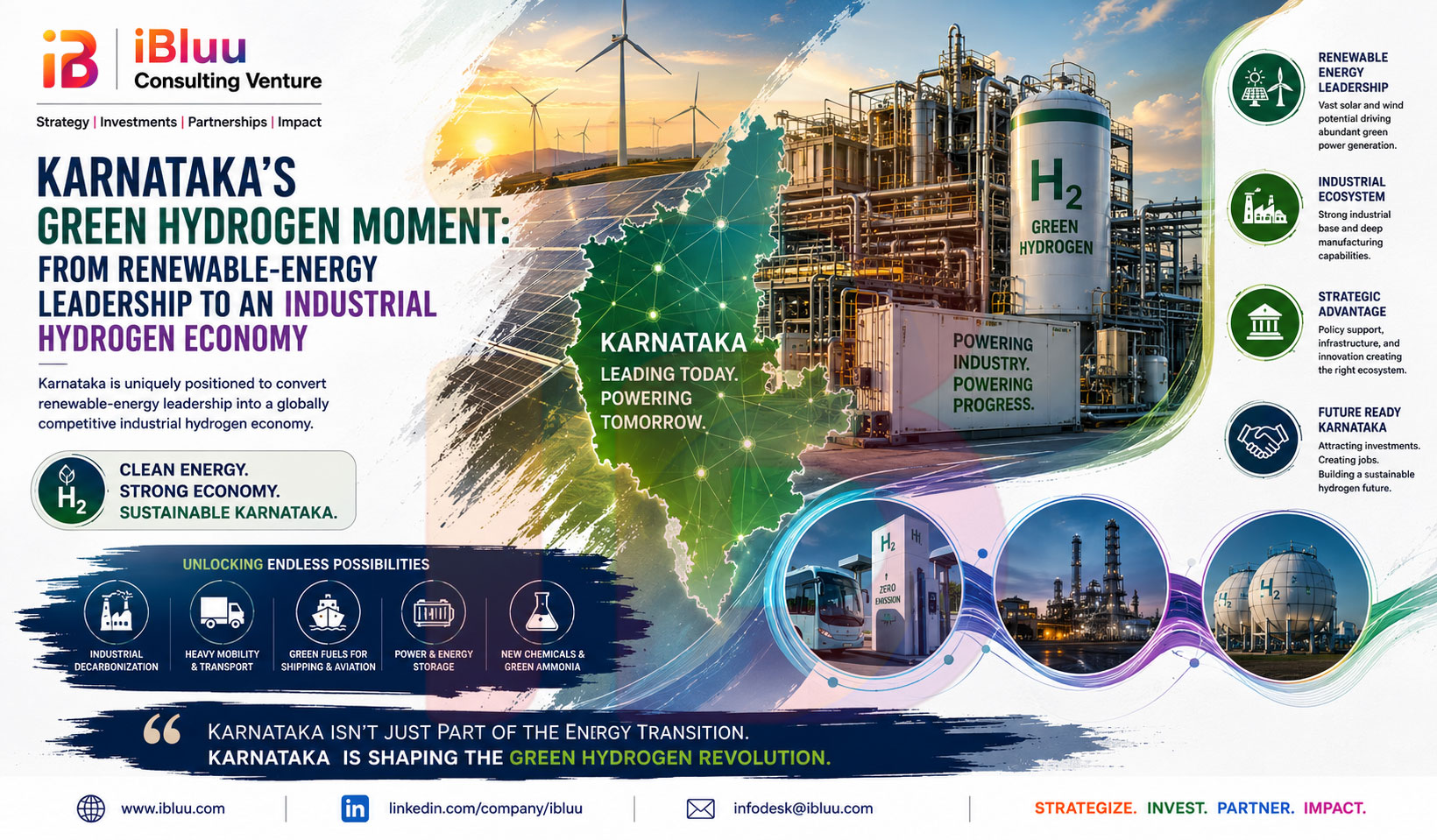
Karnataka’s Green Hydrogen Moment: From Renewable-Energy Leadership to an Industrial Hydrogen Economy
Karnataka Is Moving From Electrons to Molecules
Karnataka has already established itself as one of India’s important renewable-energy markets. The next strategic question is whether the state can convert that renewable advantage into a commercially scalable green-hydrogen ecosystem.
The opportunity is becoming more consequential.
Green hydrogen can connect Karnataka’s renewable-energy base with some of the hardest-to-decarbonise sectors of the economy: steel, refining, chemicals, fertilizers, shipping and potentially synthetic fuels.
But the state’s opportunity is no longer limited to hydrogen production.
A more ambitious architecture is emerging around renewable electricity + electrolyzers + hydrogen + green ammonia + industrial demand + ports + data centres + digital infrastructure.
The proposed ₹83,480-crore Bengaluru–Tumakuru integrated platform by Luxembourg-based Innovation Platform Capital (iPC) is a striking example. The proposal combines up to 1,000 MW of green-hydrogen capacity with approximately 2,250 MW of hyperscale data-centre capacity, with the first phase involving ₹17,114 crore, two 200-MW data-centre campuses and a 500-MW green-hydrogen and power complex.
This is more than a hydrogen story.
It is a signal that the economics of clean energy are beginning to converge with the economics of digital infrastructure.
Yet Karnataka faces a fundamental policy dilemma.
Large hydrogen projects are highly capital intensive and relatively employment-light. The state must therefore determine whether fiscal incentives create sufficient economic value through investment, exports, industrial decarbonisation, technology capability, tax revenues and supply-chain development.
That makes Karnataka’s green-hydrogen journey less about announcing megaprojects—and more about allocating capital intelligently.
1. Karnataka’s Green Hydrogen Matrix
The state’s emerging ecosystem can be viewed through four distinct investment engines.
| Investment engine | Emerging Karnataka example | Strategic significance |
|---|---|---|
| Digital–hydrogen convergence | iPC’s proposed Bengaluru–Tumakuru platform | Links clean energy, hydrogen and hyperscale computing |
| Industrial decarbonisation | JSW Energy’s Vijayanagar plant | Demonstrates captive hydrogen demand in green steel |
| Export-oriented molecules | Mangaluru green-ammonia projects | Connects renewable energy to port-led export economics |
| Technology ecosystem | Electrolyzer and hydrogen technology activity around Bengaluru/Tumakuru | Creates potential for equipment, engineering and R&D capabilities |
The National Green Hydrogen Mission’s own project database already identifies multiple Karnataka projects across Mangaluru, Bengaluru, Ballari and other locations, including projects associated with ACME, AM Green, Avaada, JSW, MRPL, ReNew, O2 Power and Shell.
But the headline number of projects is less important than which projects can reach financial close, secure offtake and achieve competitive delivered hydrogen costs.
That is where Karnataka’s real test begins.
2. The Sovereign Reality Check: Ambition Versus Fiscal Economics
Karnataka’s Green Hydrogen Policy 2024–29 has been under discussion for some time.
The Union government’s December 2024 response to Parliament stated that Karnataka planned to notify the policy. Subsequent reporting through August 2026 indicates that approval remained pending.
Why the hesitation?
Because green hydrogen is fundamentally different from conventional industrial investment.
It requires substantial expenditure across:
- renewable generation;
- electrolyzers;
- hydrogen compression and storage;
- water treatment;
- transmission;
- pipelines;
- ammonia conversion where applicable;
- logistics;
- safety systems;
- and downstream offtake infrastructure.
Reported estimates have placed the potential fiscal burden of proposed Karnataka incentives at approximately ₹20,000 crore. The policy debate has therefore focused on whether the employment, revenue and broader economic multipliers justify that level of support.
This is not an anti-hydrogen argument.
It is an investment-allocation question.
The relevant metric should not simply be:
How much investment can Karnataka announce?
It should be:
How much durable economic value can Karnataka generate per rupee of fiscal support?
That changes the policy conversation.
3. The Employment Paradox
Green hydrogen presents a classic industrial-policy dilemma.
Large capital investments can produce relatively few direct jobs once the facilities are operational.
Recent reporting around Karnataka’s policy debate has cited an estimate of roughly 15–20 direct jobs for every ₹100 crore invested in green-hydrogen projects.
That does not mean hydrogen has low economic value.
It means Karnataka should avoid measuring the sector through direct employment alone.
The stronger economic model is:
Hydrogen plant → electrolyzer manufacturing → engineering services → renewable projects → equipment supply → logistics → ammonia → ports → export → industrial decarbonisation → technology capability.
The state should therefore condition incentives increasingly around:
- domestic value addition;
- technology transfer;
- local manufacturing;
- export generation;
- R&D;
- skills;
- downstream industrial consumption;
- and measurable emissions reduction.
The policy objective should be economic density—not merely employment density.
4. JSW Energy: The Captive-Offtake Blueprint
If Karnataka wants to understand where green hydrogen becomes commercially credible, Vijayanagar provides one of the strongest current examples.
JSW Energy commissioned its first green-hydrogen plant adjacent to JSW Steel’s Vijayanagar facility.
The plant has capacity to produce 3,800 tonnes per annum of green hydrogen and 30,000 tonnes per annum of green oxygen, with hydrogen supplied directly to the DRI unit under a seven-year offtake agreement with JSW Steel.
The project forms part of JSW Energy’s allocation under the national SIGHT programme.
This model is strategically important because it solves one of green hydrogen’s biggest problems:
Who will buy the hydrogen?
A captive industrial offtake arrangement reduces merchant-market risk.
It also creates a direct chain:
Renewable electricity → electrolyzer → hydrogen → DRI → lower-carbon steel.
That is significantly more bankable than producing hydrogen first and searching for customers later.
JSW has also indicated an ambition to progressively supply 85,000–90,000 TPA of green hydrogen and 720,000 TPA of green oxygen by 2030 under its broader relationship with JSW Steel.
The lesson for investors is clear:
The strongest hydrogen project may not be the one with the biggest electrolyzer. It may be the one with the strongest offtake economics.
5. Mangaluru: Karnataka’s Potential Hydrogen Export Gateway
If Vijayanagar represents industrial hydrogen, Mangaluru represents a different opportunity:
hydrogen derivatives + maritime logistics + export markets.
The MNRE National Green Hydrogen Mission project database lists several announced projects around Mangaluru, including projects involving ACME, AM Green, Avaada, O2 Power, ReNew and others.
The significance of Mangaluru is geographic.
Green hydrogen itself can be expensive and difficult to transport over long distances.
Converting it into derivatives such as green ammonia can make maritime transportation and international trade more practical.
Mangaluru therefore has the potential to become part of a broader chain:
Renewable power → Hydrogen → Green ammonia → Port → International market.
This could position Karnataka within the emerging international market for low-carbon molecules.
But export economics must be tested rigorously against:
- electricity cost;
- electrolyzer utilisation;
- water cost;
- ammonia conversion efficiency;
- port infrastructure;
- shipping;
- certification;
- carbon accounting;
- and international offtake pricing.
A green-ammonia project is not automatically competitive merely because it has access to renewable power.
6. Bengaluru–Tumakuru: The Digital-Industrial Convergence
The most unconventional proposal in Karnataka may be iPC’s integrated Bengaluru–Tumakuru platform.
The proposed ₹83,480-crore investment spans three phases and combines approximately 2,250 MW of data-centre capacity with 1,000 MW of green-hydrogen capacity. The first phase is proposed at ₹17,114 crore, comprising two 200-MW data-centre campuses and a 500-MW green-hydrogen and power complex.
The proposal reportedly requires approximately 1,000 acres in its first phase.
More importantly, it introduces a difficult resource question:
Water.
The first phase is expected to require approximately 13 million litres of water per day, with the developer proposing to source around 85% from treated sources and recycle a substantial portion of the water.
This is exactly where conventional project analysis becomes insufficient.
A hydrogen project should not be evaluated only on:
₹ investment + MW + tonnes of hydrogen.
It must also be evaluated on:
water + transmission + land + renewable availability + utilisation + storage + logistics + offtake + certification.
That is the real project equation.
7. The Water Constraint Could Become a Strategic Constraint
Electrolysis requires water.
The direct water requirement for producing hydrogen is not enormous compared with many industrial processes, but once purification, cooling, treatment, recycling and associated infrastructure are considered, the system-level water requirement becomes materially relevant.
For a large integrated project, the issue becomes less:
“Does Karnataka have enough water?”
and more:
“Can the project secure a reliable, non-potable and economically viable water source without competing with higher-value municipal and agricultural demand?”
The iPC proposal offers an important direction by targeting treated water.
That model should become increasingly important for Karnataka.
Potential sources include:
- treated municipal wastewater;
- industrial effluent after appropriate treatment;
- CETP-treated water;
- recycled process water.
But circular water is not free.
The state must account for:
- tertiary-treatment plants;
- pumping;
- pipelines;
- storage;
- energy consumption;
- treatment reliability;
- quality monitoring;
- and long-term supply contracts.
A future hydrogen cluster may therefore require water infrastructure almost as carefully planned as electricity infrastructure.
8. Karnataka Should Think in Hydrogen Clusters—Not Individual Projects
A statewide hydrogen strategy should avoid treating every project as an isolated industrial unit.
Three broad clusters are strategically logical.
Cluster I — Mangaluru: Export & Maritime Hydrogen
Primary opportunity:
Green ammonia + port infrastructure + shipping + export.
Potential users and ecosystem participants include:
- ammonia producers;
- ports;
- renewable developers;
- shipping companies;
- fertilizer players;
- international offtakers;
- certification providers.
Cluster II — Vijayanagar–Ballari–Belagavi: Industrial Decarbonisation
Primary opportunity:
Steel + hydrogen + renewable power + industrial gases.
This is where captive hydrogen can potentially achieve stronger economics because the molecule replaces an existing industrial input or fossil-intensive process.
The JSW Vijayanagar model provides an early commercial reference point.
Cluster III — Bengaluru–Tumakuru–Kolar: Digital & Technology Hydrogen
Primary opportunity:
Data centres + renewable energy + hydrogen + electrolyzer technology + R&D.
The iPC proposal illustrates how this cluster could evolve beyond traditional energy infrastructure into a digital-industrial ecosystem.
That distinction matters.
Karnataka’s strongest competitive advantage may ultimately be the ability to integrate technology and energy, rather than simply produce hydrogen cheaply.
9. The Technology Question: PEM Versus Alkaline Is Not a Binary Bet
Electrolyzer technology selection will influence project economics.
Two major technologies dominate current commercial discussions:
Alkaline electrolyzers
Advantages include:
- longer commercial track record;
- potentially lower capital cost;
- use of more established materials.
Challenges include:
- slower dynamic response in some configurations;
- implications for highly variable renewable operation.
PEM electrolyzers
Advantages include:
- strong dynamic response;
- compact footprint;
- suitability for variable renewable electricity.
Challenges include:
- higher cost in many configurations;
- reliance on scarce catalyst materials such as iridium in current PEM designs.
For Karnataka, the strategic answer may not be to select a single technology.
The better approach is to match technology with operating architecture:
stable renewable supply → appropriate electrolyzer technology
variable renewable supply → appropriate dynamic capability
industrial captive demand → utilisation optimisation
export platform → scale and reliability
Technology procurement therefore becomes a financial decision, not merely an engineering decision.
10. The National Policy Layer: SIGHT Changes the Economics
Karnataka’s developers are not operating solely within state policy.
They can potentially leverage India’s National Green Hydrogen Mission, approved with an overall outlay of ₹19,744 crore through FY2030, including the SIGHT programme.
The national mission targets by 2030 include:
- at least 5 million metric tonnes per annum of green-hydrogen production;
- approximately 125 GW of associated renewable-energy capacity;
- more than ₹8 lakh crore of total investment;
- and significant fossil-fuel import reduction and emissions benefits.
SIGHT is particularly important because it attempts to address one of hydrogen’s fundamental problems:
Green hydrogen is currently expensive relative to conventional hydrogen and fossil alternatives.
Competitive bidding and incentives can narrow that gap while developers build scale.
Karnataka therefore needs to optimise the combination:
State incentives + SIGHT + renewable policy + open access + transmission + industrial offtake.
That is where project economics can change materially.
11. Certification Could Become a Cost-of-Capital Issue
Karnataka’s partnership with the Green Hydrogen Organisation (GH2) is strategically relevant.
The collaboration with KREDL includes support on:
- policy and regulatory frameworks;
- project appraisal;
- regional hydrogen hubs;
- international standards;
- certification;
- skills;
- and investment mobilisation.
GH2 also describes independent assurance mechanisms and certification for green hydrogen and derivatives.
This is not merely an ESG reporting exercise.
For internationally financed projects, credible certification can influence:
- bankability;
- export eligibility;
- buyer confidence;
- green-premium potential;
- ESG investment;
- and potentially the cost of capital.
The future hydrogen market will increasingly distinguish between:
hydrogen that is marketed as green
and
hydrogen whose carbon intensity can be independently demonstrated.
That distinction will become commercially significant.
12. The Economics: The Real Investment Equation
Investors should not assess a green-hydrogen project using capex alone.
A more useful framework is:
Levelised Cost of Hydrogen + Cost of Delivered Hydrogen + Cost of Carbon Compliance
The critical variables include:
- Renewable electricity cost
- Electrolyzer capex
- Electrolyzer utilisation
- Financing cost
- Water and treatment cost
- Compression and storage
- Grid and transmission charges
- Renewable intermittency
- Replacement stack costs
- Hydrogen transportation
- Ammonia conversion where applicable
- Certification
- Offtake price
- Policy incentives
- Carbon value or green premium
This creates an uncomfortable reality:
A low-cost renewable-energy state does not automatically produce low-cost green hydrogen.
The cheapest electrons are valuable.
But the entire molecule chain determines competitiveness.
13. The Infrastructure Bottleneck: Power Evacuation
Karnataka’s hydrogen ambitions also depend on transmission.
A hydrogen plant may require large volumes of renewable electricity at predictable cost and quality.
That creates a three-layer infrastructure requirement:
Generation → Transmission → Electrolysis
If transmission capacity arrives late, the electrolyzer can become an underutilised asset.
This is particularly important for projects built around dedicated renewable generation.
Therefore, Karnataka’s green-hydrogen strategy should be integrated with:
- renewable-energy planning;
- transmission planning;
- open-access frameworks;
- energy storage;
- power banking;
- and industrial load planning.
Hydrogen policy without grid planning would be incomplete.
14. Why Karnataka Can Win—and Where It Could Lose
Karnataka has several structural advantages:
Renewable-energy depth
The state has an established renewable-energy ecosystem and an existing policy architecture for renewable development. Its Renewable Energy Policy 2022–27 targets at least 10 GW of renewable capacity by 2027.
Industrial base
Steel, refining, chemicals, manufacturing and engineering provide potential domestic demand.
Technology ecosystem
Bengaluru provides an unusually deep technology, engineering, research and talent base.
Port access
Mangaluru creates an avenue toward maritime logistics and exports.
Institutional ecosystem
KREDL, industry, research institutions and private developers can support cluster development.
But there are also structural weaknesses:
- high land competition around Bengaluru;
- water stress;
- transmission constraints;
- policy uncertainty;
- high capital intensity;
- limited mature domestic hydrogen demand;
- competition from Gujarat, Odisha, Andhra Pradesh and Tamil Nadu;
- and potentially high renewable-power balancing costs.
Karnataka therefore cannot win by subsidy alone.
15. Karnataka Versus Other Hydrogen States
The national competition is becoming more sophisticated.
Gujarat
Strongest advantage:
renewables + industrial base + ports + petrochemicals + export orientation.
Odisha
Strongest advantage:
steel + mining + industrial clusters + ports.
Andhra Pradesh
Strongest advantage:
large renewable resources + ports + green-ammonia ambitions.
Tamil Nadu
Strongest advantage:
renewables + ports + manufacturing + industrial demand.
Karnataka
Strongest advantage:
renewables + technology + engineering + industrial demand + Bengaluru’s digital ecosystem + Mangaluru port.
Therefore, Karnataka should not attempt to become merely another large green-ammonia production state.
Its differentiated proposition could be:
India’s technology-led green-hydrogen and digital-industrial ecosystem.
That is a much stronger strategic identity.
16. The iBCV Investment Lens: Three Tests Before Capital Deployment
From an iBluu Consulting Venture (iBCV) perspective, international investors evaluating Karnataka should apply three primary tests.
Test 1 — Resource Optimisation
Do not size electrolyzers first.
Start with the renewable-energy curve.
Model:
solar profile + wind profile + storage + electrolyzer load factor + contracted power + grid availability.
The objective is to maximise productive electrolyzer utilisation while minimising delivered electricity cost.
Test 2 — Circular Water Security
Treat water as strategic infrastructure.
Before financial close, investors should establish:
- source;
- quality;
- treatment;
- pipeline;
- redundancy;
- cost;
- long-term contract;
- and regulatory approvals.
Water security should be a bankability condition—not an environmental footnote.
Test 3 — Global Certification Alignment
Design certification into the project from inception.
Not after construction.
Not immediately before export.
From day one.
This can reduce future compliance friction and strengthen access to international offtakers and ESG-oriented capital.
17. The Next Opportunity Is Not Hydrogen Alone
Karnataka should think beyond H₂.
The higher-value opportunity may lie in hydrogen derivatives and downstream industrial products.
Potential pathways include:
Green hydrogen → green ammonia
Green hydrogen → green methanol
Green hydrogen → low-carbon steel
Green hydrogen → sustainable aviation fuel
Green hydrogen → low-carbon chemicals
Green hydrogen → maritime fuels
That changes the economic equation.
Hydrogen becomes not simply an energy carrier but an industrial feedstock for the next generation of low-carbon manufacturing.
18. What Karnataka Should Do Next
A successful policy architecture should prioritise five actions.
1. Resolve policy uncertainty
The state needs clarity on incentives, eligibility, power charges, land, water and approvals.
2. Link incentives to outcomes
Fiscal support should be tied to:
- production;
- offtake;
- exports;
- local value addition;
- emissions reduction;
- technology development;
- and investment milestones.
3. Build cluster infrastructure
Government should coordinate:
power + transmission + water + land + logistics + safety + certification.
4. Prioritise captive demand
Steel, refining, chemicals and fertilizers can provide stronger early markets than speculative merchant hydrogen.
5. Build export-grade certification
International buyers will increasingly demand verifiable carbon intensity.
19. The Strategic Bottom Line
Karnataka’s green-hydrogen opportunity is real.
But the state’s competitive advantage will not be determined by the number of MoUs signed or the headline value of proposed investment.
It will be determined by conversion:
MoUs → financial close
Financial close → construction
Construction → production
Production → contracted offtake
Offtake → competitive economics
Competitive economics → scalable industrial ecosystem
That is the chain that matters.
JSW’s Vijayanagar project demonstrates the value of captive industrial demand. Mangaluru demonstrates the potential of hydrogen derivatives and maritime exports. The Bengaluru–Tumakuru proposal illustrates the emerging convergence between hydrogen, renewable power and hyperscale digital infrastructure. The national SIGHT programme provides an additional mechanism to narrow the cost gap, while the GH2 partnership introduces a pathway toward internationally credible standards and certification.
The strategic question for Karnataka is therefore no longer:
“Can we produce green hydrogen?”
The more consequential question is:
“Can Karnataka build a globally competitive industrial system around green hydrogen?”
If it can, the opportunity extends far beyond fuel.
It reaches into steel, chemicals, shipping, exports, digital infrastructure, electrolyzer manufacturing, engineering, finance and technology.
And that is where Karnataka’s next clean-energy advantage could become an industrial advantage.
Strategic Perspective
The analytical perspective in this article is shaped by J Parasher, Founder and Managing Director of iBluu Consulting Venture (iBCV), a venture of iBluu Corporations, whose strategic lens focuses on national capability building, global industrial benchmarking, infrastructure transformation, cross-border partnerships and long-horizon economic value creation.
From this perspective, green hydrogen should not be treated as another renewable-energy vertical.
It is a potential industrial operating system connecting renewable power, infrastructure, manufacturing, technology, capital and international trade.
For Karnataka, the opportunity is therefore not simply to become a producer of green hydrogen.
The opportunity is to become one of India’s most sophisticated platforms for converting clean energy into industrial competitiveness.
Disclaimer: This article is intended for strategic and informational purposes only and does not constitute investment, financial, legal, tax, engineering or policy advice. Project capacities, investment values and timelines identified as proposed or announced are subject to approvals, financial close, land and infrastructure availability, regulatory conditions and project execution. Announced investments and MoUs should not be interpreted as committed capital or completed projects. Policy positions, incentive structures and project economics may change. Investors should undertake independent technical, commercial, legal, regulatory, environmental and financial due diligence before making investment decisions.