+91 945 889 6091
  infodesk@ibluu.com
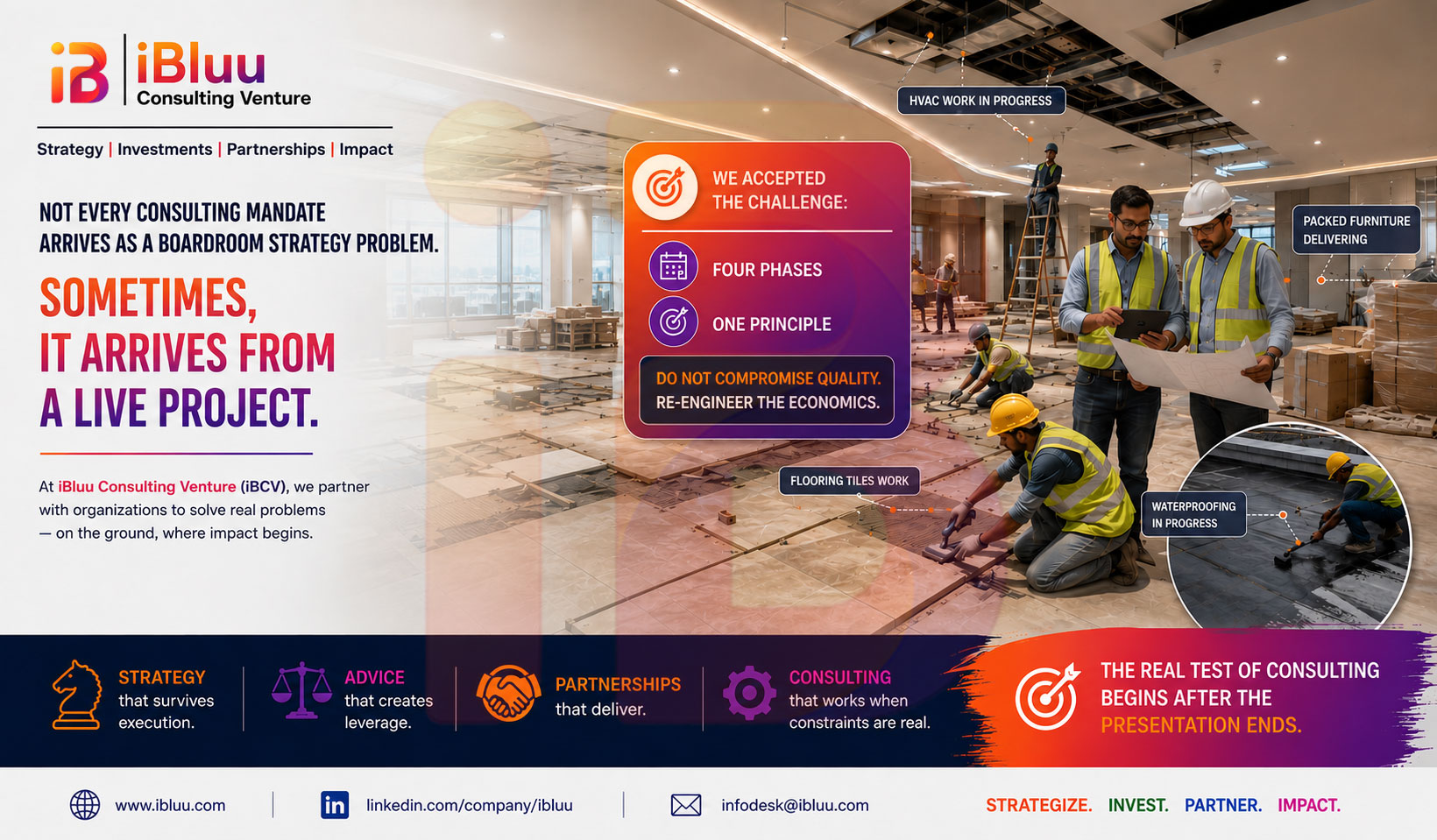
From Budget Pressure to Execution Advantage: How iBluu’s Strategic Consulting Turned a Complex Project-Completion Challenge into a Value-Creation Opportunity
How iBluu Consulting Venture (iBCV) stepped into a complex live-project challenge to help a South India-based construction company manage critical finishing, procurement and project-completion requirements in Northeast India—under intense budget pressure.
In consulting, some of the most interesting mandates do not arrive with a conventional brief.
They arrive with a problem.
A problem that sits somewhere between procurement, project management, cost optimisation, vendor management, technical coordination and execution risk.
Recently, iBluu Consulting Venture (iBCV), a venture of iBluu Corporations, encountered exactly such a challenge.
A construction company headquartered in South India, executing a project in Northeast India, approached iBluu with a very specific problem:
The structure was progressing. Quality was not the issue. The remaining challenge was how to complete the project—without allowing the cost pressure created by delays to compromise the quality standard.
That distinction changed everything.
The Real Problem Was Not Construction. It Was the Final Mile of Construction.
The project had already established a strong quality benchmark.
The construction company’s work was being inspected by multiple departments and authorities, and the feedback on the quality of structural and construction work was positive.
There was no fundamental concern around workmanship quality.
But project delays had created a new pressure point.
As timelines moved, the overall project economics became increasingly difficult to manage.
The remaining scope involved a wide range of finishing, technical and non-technical requirements, including:
- Tiles and flooring materials
- Furniture and interior-related requirements
- HVAC systems and associated components
- Lift-related requirements
- Technical equipment and products
- Non-technical products and materials
- Sanitaryware and toilet fittings
- Waterproofing-related works and materials
- Fixtures and finishing products
- Ancillary construction-completion requirements
- Vendor and supplier coordination
- Procurement optimisation
- Cost-sensitive project completion
The challenge was therefore not simply:
“How do we procure these items?”
The real question was:
How do we deliver the required quality, within a severely constrained budget, while keeping a live construction project moving toward completion?
That is a very different consulting problem.
The iBCV Mandate: Solve the Cost Problem Without Creating a Quality Problem
After several rounds of discussions, iBCV decided to take on the challenge.
The mandate was built around two non-negotiable principles:
1. Cost discipline
The remaining project scope had to be delivered within an extremely tight budget framework.
2. Quality protection
Cost optimisation could not become a disguised reduction in quality.
This was particularly important because the client had already established an A-grade quality benchmark.
For iBCV, therefore, the objective was not to find the cheapest supplier.
It was to identify the best-value solution.
That distinction became the foundation of the engagement.
From Cost Cutting to Value Engineering
There is a significant difference between cost cutting and value engineering.
Cost cutting asks:
“Where can we spend less?”
Value engineering asks:
“How can we achieve the required outcome at the optimum total cost without compromising critical performance?”
iBCV approached the project through the second lens.
The objective was to systematically examine:
Specification → Product → Supplier → Commercial Terms → Logistics → Installation → Quality → Total Cost
rather than evaluating purchase price in isolation.
Because a cheaper product can become an expensive decision if it creates:
- replacement costs;
- installation problems;
- delays;
- maintenance issues;
- quality failures;
- warranty complications;
- rework;
- or additional logistics costs.
The lowest quotation is therefore not necessarily the lowest project cost.
The cheapest procurement decision can sometimes be the most expensive project decision.
A Four-Phase Execution Framework
Given the complexity of the remaining work and the client’s financial constraints, iBCV structured the mandate into four phases.
This was designed to create greater control over:
- scope;
- procurement;
- budgets;
- vendors;
- quality;
- timelines;
- and execution.
Rather than attempting to solve every requirement simultaneously, the project was divided into manageable execution blocks.
This enabled the team to identify priorities, establish realistic budget benchmarks, engage relevant suppliers and continuously compare commercial outcomes against the client’s approved financial parameters.
Phase I & Phase II: Turning a Difficult Budget Into an Executable Procurement Strategy
The first two phases have now been substantially completed within the agreed execution framework.
The most important outcome was not merely completing procurement activities.
It was achieving the required balance between:
Quality + Price + Availability + Delivery + Reliability
In several instances, iBCV and its associates were able to identify products and solutions that met the client’s quality expectations while remaining within the project’s constrained budget.
In some cases, negotiated and sourced prices performed better than the internal target prices and budget assumptions initially established for those requirements.
That result created an unexpected benefit:
Budget pressure became an opportunity to challenge conventional procurement assumptions.
The Power of an Established Associate Network
One of the most important lessons from this engagement is that consulting capability is not always about having the largest internal team.
Sometimes it is about having the right ecosystem.
iBCV was able to draw upon its longstanding network of associates, suppliers, specialists and business relationships.
These associates did something particularly important:
They treated an iBluu commitment as their own commitment.
That alignment made a material difference.
Instead of viewing the mandate as another commercial assignment, the associates worked toward a common objective:
Deliver the required quality. Respect the client’s budget. Protect the timeline. Solve the problem.
This is the kind of ecosystem-based execution capability that becomes increasingly valuable when projects enter their most difficult stages.
Why Northeast India Added Another Layer of Complexity
The geographical dimension cannot be ignored.
The client was headquartered in South India, while the project was being executed in Northeast India.
That creates practical challenges beyond conventional procurement.
Depending on the product or requirement, project teams can face considerations involving:
- supplier availability;
- geographical distance;
- freight and logistics;
- transportation economics;
- delivery timelines;
- local vendor ecosystems;
- installation support;
- after-sales service;
- product replacement;
- technical coordination;
- and vendor accountability.
A procurement strategy that works perfectly in one region may not necessarily work in another.
The objective therefore was not simply to identify a supplier.
It was to identify a commercially viable and operationally reliable supply solution for the actual project location.
What iBCV Actually Brought to the Table
This engagement demonstrates how iBCV’s broader consulting capabilities can intersect within a single live project.
Strategic Business Consulting
Understanding the client’s underlying commercial problem rather than treating individual procurement requirements in isolation.
Investment & Commercial Advisory
Evaluating expenditure priorities and commercial implications under constrained financial conditions.
Infrastructure Advisory
Understanding the relationship between project execution, specifications, procurement and completion requirements.
Institutional & Vendor Partnerships
Connecting the project with relevant suppliers, associates and specialist capabilities.
Transaction & Procurement Advisory
Supporting commercial evaluation, negotiation and sourcing decisions.
Cost Optimisation
Searching for opportunities to achieve required specifications at commercially sustainable prices.
Execution Coordination
Helping bridge the gap between procurement decisions and actual project requirements.
This is where iBCV’s broader consulting model becomes particularly relevant.
The mandate may begin as a procurement problem. But solving it effectively requires strategy, commercial intelligence, partnerships and execution discipline.
The iBCV Philosophy: Do Not Compromise Quality. Re-engineer the Economics.
This project reinforces a principle that is central to iBCV’s approach:
When the budget becomes tighter, the answer should not automatically be lower quality. The answer should be smarter economics.
That can mean:
- finding alternative suppliers;
- benchmarking prices;
- negotiating better commercial terms;
- identifying equivalent or superior products;
- optimising procurement quantities;
- reducing unnecessary cost layers;
- improving supplier competition;
- evaluating total landed cost;
- leveraging existing relationships;
- and challenging assumptions embedded in the original budget.
The objective is not to make the project cheap.
The objective is to make the project commercially intelligent.
A Different Definition of Consulting
Traditional consulting is often associated with:
Strategy → Presentation → Recommendation
Live-project consulting can look very different.
It is closer to:
Problem → Diagnosis → Network → Negotiation → Procurement → Coordination → Execution → Outcome
That difference matters.
A project does not become successful because a consultant produces a sophisticated presentation.
It becomes successful when the recommendations survive contact with:
- suppliers;
- prices;
- logistics;
- timelines;
- specifications;
- budgets;
- site conditions;
- and real-world execution.
The real test of consulting begins after the presentation ends.
What This Engagement Demonstrates About iBCV
For iBluu Consulting Venture, this assignment represents an important extension of its consulting journey.
iBCV is building its capability around a simple proposition:
Consulting should not merely explain the problem. It should help solve it.
The firm’s broader platform covers:
- Strategic Business Consulting
- Investment Advisory
- Infrastructure & Renewable Energy Advisory
- Strategic Government Engagement & Relations Advisory
- Institutional Partnerships & Transaction Advisory
- Real Estate Investment Consulting
- Mergers & Acquisitions Advisory
- Joint Venture & Capital Structuring
- Cross-Border Partnerships & Market Entry Strategy
- IT Advisory & Digital Transformation Consulting
But engagements such as this demonstrate another important dimension:
Execution-oriented commercial problem solving.
Because businesses do not always need another strategy document.
Sometimes they need someone who can enter a difficult situation, understand the constraints, activate the right ecosystem and help create a workable path forward.
The Bigger Lesson for Project Owners
There is a broader lesson here for infrastructure and construction companies.
When a project experiences delays, the damage rarely remains confined to the timeline.
It can cascade into:
Delay → Cost escalation → Budget compression → Procurement pressure → Vendor pressure → Execution risk → Margin erosion
The longer this chain remains unmanaged, the more difficult recovery becomes.
Therefore, project owners should consider commercial recovery and procurement optimisation as strategic disciplines, rather than treating them as administrative functions.
The earlier the intervention, the greater the potential room for optimisation.
From Budget Pressure to Strategic Advantage
The first two phases of this engagement have provided an encouraging proof point for iBCV.
Despite the project’s tight financial environment, the focus remained uncompromising:
Protect quality. Protect the budget. Protect execution.
And the results so far reinforce an important principle:
Budget constraints do not always require compromise. Sometimes they force better thinking.
The next phases will continue to focus on translating this philosophy into practical project outcomes.
A New Dimension of iBluu’s Consulting Journey
For a growing consulting platform, every assignment brings a different test.
Some require strategic thinking.
Some require institutional relationships.
Some require investment intelligence.
Some require government engagement.
Some require transaction structuring.
And some require something much more operational:
Finding a way to make a difficult project work.
This engagement belongs to the last category.
It demonstrates that consulting can move beyond conventional advisory boundaries and into the commercial execution layer of a live project—where budgets are real, timelines are real, quality expectations are real and outcomes matter.
For iBCV, that is precisely where consulting becomes most meaningful.
The iBCV Perspective
Good consulting identifies possibilities.
Strong consulting creates options.
Exceptional consulting helps convert those options into outcomes.
At iBCV, our ambition is to build a consulting platform that operates across the entire spectrum—from strategy and capital to partnerships, infrastructure and execution.
Because the most valuable advice is not necessarily the advice that sounds the most sophisticated.
It is the advice that works when the real-world constraints arrive.
Strategic Perspective
The analytical and strategic perspective behind iBluu’s approach is shaped by J Parasher, Founder and Managing Director of iBluu Consulting Venture (iBCV), a venture of iBluu Corporations, whose work focuses on business strategy, infrastructure, investment opportunities, institutional partnerships, cross-border engagement and long-horizon value creation.
His broader philosophy is straightforward:
Consulting should create commercial leverage—not merely commercial commentary.
That philosophy is increasingly reflected in iBCV’s approach to complex, multi-dimensional business and infrastructure challenges.
About iBluu Consulting Venture (iBCV)
iBluu Consulting Venture (iBCV) is a venture of iBluu Corporations, focused on strategic consulting and advisory across business, investment, infrastructure, renewable energy, government engagement, institutional partnerships, transactions, real estate, M&A, joint ventures, capital structuring, cross-border market entry and digital transformation.
The platform works across the intersection of strategy, capital, institutions, infrastructure and partnerships, with an emphasis on converting complex opportunities into structured and actionable outcomes.
Confidentiality and Disclaimer: This case study has been presented in an anonymised and generalised form to protect client confidentiality. Specific client identity, project location, contract value, commercial terms, supplier identities and other commercially sensitive information have not been disclosed. References to project progress and outcomes represent the engagement status and experience described by iBCV and should not be interpreted as independently audited financial or project-performance results.