+91 945 889 6091
  infodesk@ibluu.com
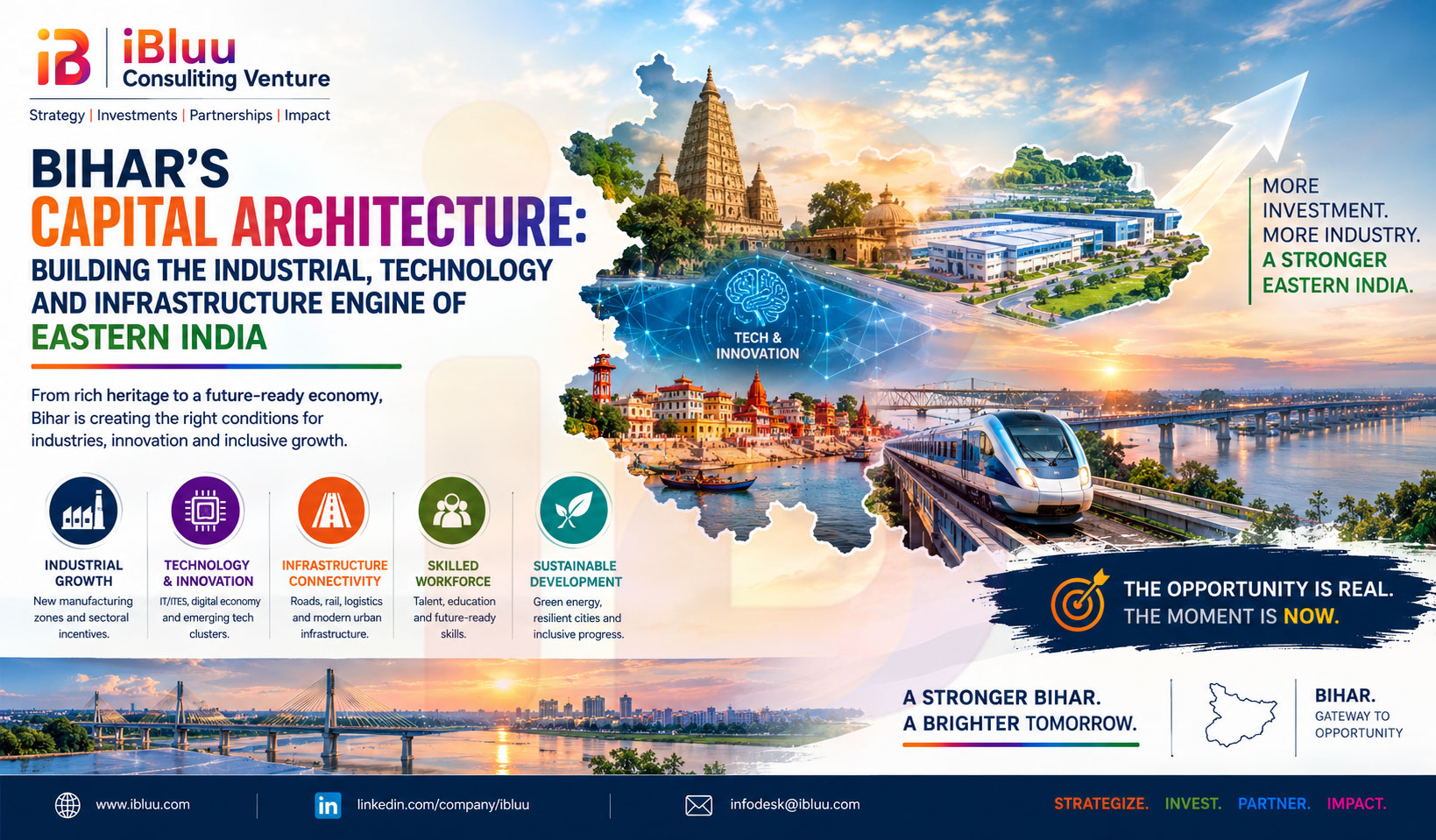
Bihar’s Capital Architecture: Building the Industrial, Technology and Infrastructure Engine of Eastern India
From an agrarian economy to an emerging industrial, technology and infrastructure platform, Bihar is attempting one of Eastern India’s most consequential economic transformations.
For decades, Bihar’s economic narrative was dominated by agriculture, low industrialisation, infrastructure deficits and the outward migration of its working population.
That narrative is becoming increasingly incomplete.
Bihar is now assembling a different economic architecture—one built around industrial land, manufacturing clusters, technology, semiconductors, GCCs, logistics, urban expansion, renewable energy, food processing and large-scale infrastructure financing.
The ambition is enormous.
The state has articulated a five-year objective of attracting ₹50 lakh crore of investment, alongside a broader industrial expansion programme covering five mega food parks, 10 industrial parks, 100 MSME parks, sector-specific clusters and expanded skills infrastructure. A separate ₹25,000 crore industrial-development financing programme has been approved to support land acquisition and industrial infrastructure.
But the more important story is not the headline number.
It is the architecture being assembled underneath it.
Bihar is trying to convert infrastructure from a constraint into a capital multiplier.
Executive Perspective: Bihar Is Moving From Resource Potential to Capital Formation
Bihar’s economic structure is already changing.
In 2024–25, services accounted for an estimated 54% of the state’s economy at current prices, while agriculture and manufacturing each contributed approximately 23%. Real GSDP growth was estimated at 8.6%, significantly above the national estimate for that year.
That creates an unusual starting point.
Bihar does not need to abandon agriculture to industrialise.
It needs to industrialise around agriculture, infrastructure, technology, logistics and human capital.
The emerging model therefore has several interconnected layers:
Agriculture → processing → manufacturing → logistics → exports
Talent → technology → GCCs → AI → high-value services
Land → industrial parks → factories → supply chains → capital formation
Energy → digital infrastructure → data centres → technology ecosystems
Urbanisation → townships → commercial real estate → services → consumption
The strategic opportunity is to make these systems reinforce one another.
Because investment does not compound when projects operate in isolation.
Capital compounds when infrastructure, industry, technology and demand connect.
1. The First Signal: Bihar Is Creating a New Capital Pipeline
The scale of the current investment ambition is visible in the numbers.
In August 2026, Bihar signed MoUs worth approximately ₹51,600 crore with 10 industrial groups, covering steel, nuclear energy, textiles, food processing and pharmaceuticals. The proposals are expected to generate more than 27,000 direct jobs.
The largest individual proposal was a ₹22,500 crore nuclear-energy project from Global Renewable Advanced Clean Energy, while major steel proposals included:
- approximately ₹6,836 crore from Nakshatra Iron & Steel;
- ₹6,000 crore from Ankur Steel;
- ₹5,500 crore from Shri Langta Baba Metals & Power;
- and several additional steel-sector proposals.
This is strategically important.
Bihar is not merely pursuing traditional low-value manufacturing.
It is attempting to move upward into capital-intensive industrial sectors.
But there is an important investor distinction:
An MoU is a pipeline signal—not deployed capital.
The real economic value will be created only when proposals move through land allocation, environmental approvals, financial closure, construction, commissioning and commercial operations.
That conversion rate will ultimately determine Bihar’s investment credibility.
2. The ₹25,000 Crore Industrial Infrastructure Bet
In July 2026, the state approved a plan authorising the Infrastructure Development Authority to raise up to ₹25,000 crore through institutional borrowing backed by a state guarantee.
The funds are intended for:
- industrial land acquisition;
- industrial infrastructure;
- new industrial zones;
- and enabling infrastructure for future investment.
This distinction matters.
The ₹25,000 crore is not itself equivalent to ₹25,000 crore of private investment.
It is enabling capital.
And enabling capital can be more strategically important than direct subsidy when it creates investment-ready land and infrastructure.
The logic is simple:
No land → no factory.
No factory → no employment.
No infrastructure → no bankable project.
Bihar is therefore attempting to finance the platform before asking private capital to occupy it.
That is the correct direction.
3. The ₹50 Lakh Crore Ambition: Scale Must Be Matched by Conversion
The state has articulated a five-year ambition to attract approximately ₹50 lakh crore of investment.
The roadmap includes:
- five mega food parks;
- 10 industrial parks;
- 100 MSME parks;
- 31 new modern industrial parks across 29 districts;
- approximately 14,036 acres proposed for those 31 parks;
- sector-specific parks including textile and pharmaceutical clusters;
- rapid development of the Gaya Integrated Manufacturing Cluster;
- and large-scale industry-linked skill development.
The number is ambitious enough to require a completely different investment-management architecture.
Bihar cannot pursue ₹50 lakh crore through investor outreach alone.
It needs a capital-conversion engine.
That means tracking every major proposal through a measurable pipeline:
Lead → DPR → Land → Approval → Financing → Financial Close → Construction → COD → Employment → Exports.
The state’s future credibility should ultimately be measured not by the size of its proposal book, but by the conversion ratio from announced investment to commissioned productive assets.
4. Bihar’s Technology Pivot: From Back-End Hub to Technology Platform
One of the most significant structural changes is Bihar’s attempt to build a new-age technology economy.
The state has formally constituted committees to develop Bihar as an eastern technology hub and a “global back-end hub”/global workplace, with plans encompassing:
- semiconductor manufacturing;
- Global Capability Centres;
- a Mega Tech City;
- FinTech City;
- defence-related industrial development;
- and technology-led employment.
The ambition is important because technology can change Bihar’s economic equation without requiring every new job to be tied to heavy physical infrastructure.
A successful technology ecosystem could create:
higher-value employment + exportable services + digital infrastructure + entrepreneurial capital + global corporate linkages.
That is a different economic multiplier from conventional manufacturing.
5. Semiconductor Strategy: Bihar Is Entering the National Technology Race
Bihar’s Semiconductor Policy 2026 is one of the most aggressive components of the state’s industrial strategy.
The policy has been notified and seeks to create an enabling environment for semiconductor and electronic-component manufacturing, with state support designed to complement central semiconductor incentives.
The policy framework includes substantial incentives for qualifying semiconductor projects, including:
- state support linked to central assistance;
- concessional land allocation;
- stamp-duty and land-conversion exemptions;
- power-related incentives;
- SGST support;
- interest support;
- skill-development assistance;
- and support for design and electronic-component businesses.
The stated policy architecture also provides for token land allocation linked to project cost and preferential support for large technology investments.
This is not simply an industrial-policy decision.
It is a strategic attempt to enter a value chain that sits at the intersection of:
AI + electronics + defence + automotive + telecom + healthcare + industrial automation + national security.
However, Bihar should avoid a common policy mistake.
A semiconductor ecosystem cannot be built around incentives alone.
It requires:
power quality + ultra-reliable water + clean-room infrastructure + skilled engineers + specialised logistics + supplier ecosystems + R&D + testing/packaging capability + global technology partnerships.
The real opportunity may therefore lie not only in fabs, but in ATMP/OSAT, electronics components, semiconductor design, testing, industrial electronics and specialised supply chains.
6. GCCs and the New Services Economy
Bihar’s GCC Policy 2026 is another important structural intervention.
The objective is to attract global and domestic companies to establish centres covering:
- technology;
- analytics;
- finance;
- research;
- business processes;
- digital operations;
- and other knowledge-intensive functions.
This could become one of Bihar’s most scalable investment opportunities.
Why?
Because GCCs can generate substantial economic value without requiring the land intensity of traditional manufacturing.
Bihar’s competitive proposition could combine:
large talent pool + lower operating costs + improving digital infrastructure + state incentives + expanding urban centres.
The state has also been strengthening technology infrastructure and has announced plans for a Bihar Tech Portal for startups and industry.
The strategic objective should be larger than attracting call centres.
Bihar should target:
AI engineering, cybersecurity, financial analytics, engineering design, healthcare analytics, semiconductor design, cloud operations, legal-process services and global business operations.
That is where the value density becomes materially higher.
7. AI: The Most Important Technology Multiplier
Bihar’s AI strategy is still developing, but the direction is unmistakable.
The state has publicly articulated the ambition to become an AI hub, has initiated AI-focused programmes and is integrating AI into governance and technology education.
The opportunity is larger than government automation.
AI can become a platform for:
- agritech;
- healthcare;
- education;
- financial inclusion;
- public-service delivery;
- logistics;
- language technology;
- manufacturing;
- cybersecurity;
- and startup creation.
The state should therefore treat AI not as a standalone “technology sector”, but as horizontal economic infrastructure.
The question is not:
How many AI companies can Bihar attract?
It is:
How many industries can become more productive because AI is built into their operating model?
8. Data Centres: Bihar’s Underappreciated Digital Infrastructure Opportunity
A 2026 independent research assessment suggested that Bihar’s existing power surplus could support nine to 12 mid-sized enterprise and government-cloud data centres without requiring new generation, potentially supporting up to $4 billion of investment and around 51,500 jobs by 2035.
This should be treated as an opportunity scenario, not a committed investment pipeline.
But the strategic logic is compelling.
Data centres require:
- reliable electricity;
- competitive power costs;
- land;
- fibre;
- cooling infrastructure;
- water;
- physical security;
- low latency;
- and predictable regulation.
Bihar’s power position and location provide an opportunity to build a Tier-2 digital infrastructure market.
The most important missing layer is connectivity.
A robust dark-fibre and high-capacity network connecting Bihar to Kolkata and other national data corridors could materially improve the state’s proposition. The independent assessment specifically identified fibre connectivity and single-window clearances as critical enablers.
If executed well, Bihar could potentially develop a complementary digital infrastructure ecosystem:
Data centres + GCCs + AI + cloud + cybersecurity + electronics.
That is far more powerful than a standalone data-centre park.
9. Vaishali and the Electronics Manufacturing Opportunity
A proposed large-scale electronics and industrial park in Rajapakar, Vaishali, has been associated with an estimated ₹20,000–30,000 crore investment potential and the creation of a large employment ecosystem.
However, this remains a proposed/concept-stage opportunity rather than realised capital and should not be presented as a committed investment.
Its strategic significance lies in the potential to create a manufacturing ecosystem around:
- electronics;
- components;
- assembly;
- ancillary manufacturing;
- logistics;
- warehousing;
- repair and refurbishment;
- and technology services.
The opportunity is to create an ecosystem rather than a single park.
10. Gaya Integrated Manufacturing Cluster: The Industrial Anchor
The Integrated Manufacturing Cluster at Gaya may be one of Bihar’s most important industrial assets.
The cluster spans approximately 1,670 acres, with a project cost of about ₹1,339 crore, projected investment potential of ₹16,524 crore and estimated employment potential of approximately 1,09,185 jobs.
Its sectoral focus includes:
- building materials;
- agri-food processing;
- leather goods;
- garments;
- furniture;
- handloom and handicrafts;
- engineering and fabrication;
- medical equipment.
Its location is strategically significant because of proximity to:
- Gaya International Airport;
- NH-19;
- NH-22;
- rail infrastructure;
- the Eastern Dedicated Freight Corridor;
- inland waterways;
- and the wider eastern logistics network.
Gaya can therefore become more than an industrial park.
It can become an industrial gateway linking Bihar’s manufacturing base to national and export markets.
11. Freight Infrastructure: The Missing Link Is Becoming an Advantage
Industrialisation requires logistics.
The Eastern Dedicated Freight Corridor provides Bihar with access to a higher-capacity freight network connecting industrial regions with eastern ports and national supply chains.
For Gaya and adjoining industrial nodes, the combination of road, rail, airport and inland-waterway connectivity can materially reduce logistics friction.
This is particularly important for:
- steel;
- engineering;
- cement;
- textiles;
- food processing;
- pharmaceuticals;
- electronics;
- and heavy industrial equipment.
The strategic value of infrastructure should therefore be measured not merely by kilometres of roads or railway lines.
It should be measured by:
how much logistics cost and transit time it removes from the supply chain.
12. Roads and Expressways: Building the Physical Spine of Capital
Bihar is simultaneously increasing road connectivity.
Three major road projects approved through the PPP appraisal framework in March 2026 have a combined estimated investment of approximately ₹25,204 crore. The broader infrastructure pipeline includes major greenfield and elevated-road projects, including the Patna–Purnea corridor and the Bihar section of the Varanasi–Ranchi–Kolkata Greenfield Highway.
The state budget also provides substantial allocations for transport, roads, energy and urban development.
For 2026–27, Bihar has estimated ₹39,377 crore of capital outlay, while the fiscal deficit is budgeted at approximately ₹39,112 crore, or 2.99% of GSDP.
This is an important fiscal architecture.
The state is attempting to convert public borrowing and public expenditure into productive capital assets.
That strategy works only if the resulting infrastructure raises private-sector productivity.
13. Sonepur Greenfield Airport: A New Aviation Gateway
Bihar’s aviation strategy is also expanding.
The state Cabinet approved land acquisition for the proposed Sonepur Greenfield International Airport in Saran district.
Approximately 4,200 acres have been identified, with around ₹1,302 crore approved for land acquisition. The target is to complete the project by 2030. The proposal includes two long runways designed for large aircraft.
The airport could fundamentally change the economic geography of North Bihar.
Its potential impact extends beyond passengers.
A large international airport can support:
- air cargo;
- perishables;
- pharmaceuticals;
- electronics;
- high-value manufacturing;
- tourism;
- hospitality;
- MRO;
- logistics;
- and business travel.
The airport should therefore be planned as an aviation-led economic zone, not simply an airport project.
14. Energy: The Critical Constraint Behind the Technology Ambition
Every industrial and technology strategy eventually collides with one fundamental requirement:
power.
Bihar’s current energy requirements and generation profile make energy expansion strategically unavoidable.
The state has now announced a much larger renewable-energy ambition, with a reported plan for approximately ₹1.38 lakh crore of solar investment over five years, targeting 24 GW of renewable capacity and 6 GWh of storage by 2030.
This is a significant strategic pivot.
Because Bihar cannot build:
AI + data centres + semiconductor manufacturing + modern industry
without a much deeper power ecosystem.
15. Kajra: From Solar Project to Energy Infrastructure Platform
The Kajra Solar Project is already demonstrating how renewable energy can support the state’s industrial ambitions.
Phase I comprises approximately 185 MW of solar capacity integrated with battery storage, with the project valued at around ₹1,810 crore. A second phase is expected to raise the total project to approximately 301 MW of solar capacity, with expanded battery storage, targeted for completion around January 2027.
The strategic significance goes beyond renewable generation.
For Bihar, storage is increasingly important because industrial and digital consumers require firm, predictable electricity, not merely intermittent generation.
The future energy architecture should therefore combine:
solar + storage + transmission + industrial PPAs + green open access + data-centre demand.
That creates a potential virtuous cycle.
16. Urbanisation as an Economic Multiplier
Bihar’s industrial strategy is being accompanied by a major urban expansion programme.
The state has approved 11 greenfield satellite townships, while a July 2026 agreement with HUDCO provides for up to ₹1 lakh crore of long-term financing for 12 greenfield satellite townships. The financing can carry repayment terms of up to 25 years.
This is far more important than a conventional housing programme.
If industrial zones, logistics nodes and technology clusters are surrounded by planned urban infrastructure, the state can create:
jobs + housing + services + consumption + commercial real estate + transport + education + healthcare.
In other words:
Industrialisation can create cities; cities can deepen industrialisation.
That is the urban-industrial flywheel Bihar should deliberately build.
17. The Industrial Incentive Architecture
Bihar’s Industrial Investment Promotion Package 2025 is designed to reduce the initial capital burden for investors.
The package provides, subject to eligibility and project conditions:
- capital subsidy of up to 30% of approved project cost;
- interest subvention up to ₹40 crore;
- SGST reimbursement of up to 300% of approved project cost over 14 years;
- concessional/free land structures for qualifying large projects;
- employment-generation incentives;
- skill-development incentives;
- renewable-energy incentives;
- export incentives;
- and support for quality certification and intellectual property.
The package has been extended through 31 December 2026 or until the new industrial investment policy comes into force, whichever is earlier.
This is a powerful incentive stack.
But investors should assess the economics beyond headline subsidies.
The critical question is:
What is the post-incentive operating competitiveness of the project?
A project should survive because of productivity—not because of incentives.
18. Agriculture: Bihar’s Industrialisation Starts With Its Strongest Existing Asset
Bihar should not industrialise by abandoning agriculture.
It should industrialise agriculture itself.
The state’s agricultural base creates opportunities across:
- food processing;
- cold chains;
- warehousing;
- ethanol;
- dairy;
- fisheries;
- makhana;
- fruits and vegetables;
- grain processing;
- seed technology;
- agri-logistics;
- exports.
The Makhana ecosystem is particularly interesting because Bihar has the opportunity to move from commodity production toward branded, processed and export-oriented value chains.
Similarly, grain-based ethanol can create a new industrial interface between agriculture, energy and manufacturing.
The strategic objective should be:
farm output → processing → packaging → branding → logistics → export.
Every additional processing layer captures more economic value within the state.
19. The Investment Architecture Now Emerging
The opportunity can be viewed as seven interconnected capital engines:
| Capital Engine | Emerging Bihar Opportunity | Strategic Multiplier |
|---|---|---|
| Manufacturing | Gaya IMC, steel, textiles, pharmaceuticals | Industrial supply chains |
| Technology | GCCs, AI, IT/ITeS, tech hubs | High-value employment |
| Electronics | Semiconductor, components, electronics parks | Strategic technology capability |
| Digital infrastructure | Data centres, fibre, cloud | Digital economy |
| Logistics | EDFC, highways, MMLP, airports | Lower logistics friction |
| Energy | Solar + BESS + transmission | Industrial power security |
| Urbanisation | 11/12 greenfield townships | Demand + commercial ecosystem |
The most important insight is that none of these engines should be developed independently.
The real economic prize lies at their intersections.
20. The Emerging Bihar Investment Map
The next phase of Bihar’s economic geography could increasingly look like this:
Patna–Fatuha
Finance, technology, logistics, GCCs and urban services.
Gaya–Dobhi
Integrated manufacturing, engineering, textiles, food processing and export-oriented industry.
Vaishali
Electronics, manufacturing and industrial ancillary ecosystem.
Muzaffarpur
Textiles, bags, food processing and MSME manufacturing.
Begusarai–Barauni
Energy, petrochemicals, manufacturing and industrial supply chains.
Bhagalpur
Textiles, technical education, AI/computer science and emerging technology capabilities.
Saran–Sonepur
Aviation, logistics, urban expansion and North Bihar connectivity.
Lakhisarai–Kajra
Renewable energy and storage.
Darbhanga–North Bihar
Aviation, education, healthcare, services and regional commerce.
This is how Bihar can move from district-level development to corridor-level economic development.
21. The Hardest Problem: Converting Announced Capital Into Deployed Capital
Bihar’s investment story is increasingly compelling.
But its greatest risk is also obvious.
Execution.
There is a substantial difference between:
₹50 lakh crore target
and
₹50 lakh crore deployed capital.
There is a difference between:
₹51,600 crore MoUs
and
₹51,600 crore commissioned assets.
There is a difference between:
₹25,000 crore borrowing capacity
and
₹25,000 crore productive industrial infrastructure.
And there is a difference between:
₹4 billion data-centre potential
and
operational data-centre capacity.
Investors will ultimately judge Bihar by one metric:
How quickly can the state move from investment intent to investment reality?
That should become the central KPI of the next economic cycle.
22. Scenario Framework: What Could Bihar Become?
Scenario A — Fragmented Growth
Projects remain isolated, approvals remain slow, infrastructure develops unevenly and announced investments experience high attrition.
Result: strong headlines, modest capital formation.
Scenario B — Industrial Acceleration
Industrial parks, logistics infrastructure and incentives begin working together.
Result: manufacturing expands, MSMEs deepen, employment rises and supply chains localise.
Scenario C — Integrated Economic Transformation
Technology, manufacturing, energy, logistics, urbanisation and capital markets converge.
Result: Bihar becomes a major eastern economic platform rather than simply a low-cost industrial destination.
The third scenario is the strategic prize.
23. What Bihar Must Do Next
Five priorities could determine whether the investment cycle compounds.
1. Build Investment-Ready Land
Land banks must become bankable land banks—title-cleared, GIS-mapped, utility-connected and approval-ready.
2. Create Project Conversion Cells
Every strategic project should have an accountable execution pathway:
land → approval → financing → construction → commissioning.
3. Build Sector Ecosystems, Not Standalone Parks
A semiconductor park without component suppliers is incomplete.
A steel plant without downstream manufacturing is incomplete.
A data centre without fibre and power redundancy is incomplete.
An industrial park without housing and logistics is incomplete.
4. Make Energy a Competitive Advantage
Bihar’s renewable and storage expansion should be directly connected to industrial PPAs, technology parks and data-centre infrastructure.
5. Measure Investment Conversion
The state should publish a transparent dashboard tracking:
proposals → sanctioned projects → financial close → construction → commissioning → jobs → exports.
That would materially strengthen investor confidence.
24. The Geopolitical Opportunity
Bihar’s economic transformation also has a wider strategic dimension.
Its location places it within the larger economic geography of:
Eastern India + the Indo-Gangetic industrial belt + Nepal-facing trade routes + the eastern logistics network + access toward Kolkata and the Bay of Bengal.
As India seeks to diversify manufacturing beyond established western and southern clusters, Eastern India will require new industrial platforms.
Bihar can become one of them.
Its competitive proposition should therefore not be:
“Bihar is cheaper.”
That is insufficient.
The stronger proposition is:
“Bihar can become a scalable eastern platform where land, labour, logistics, technology, energy and domestic demand converge.”
That is an investable thesis.
25. The iBluu Strategic Lens: Bihar Is Becoming a Systems-Consulting Opportunity
From the strategic perspective of J Parasher, Founder and Managing Director of iBluu Corporations, Bihar’s transformation should not be evaluated as a collection of individual government projects or corporate announcements.
It should be evaluated as an emerging economic system.
The central question is:
Can Bihar connect capital, infrastructure, technology, industrial capability, talent and markets into a self-reinforcing investment ecosystem?
That is where strategic consulting becomes more consequential than conventional sector advisory.
The next generation of investors will require more than site identification.
They will require:
- market-entry strategy;
- project-readiness assessment;
- land and infrastructure intelligence;
- government engagement;
- JV and alliance structuring;
- capital mobilisation;
- investment-risk assessment;
- industrial ecosystem mapping;
- cross-border partnerships;
- technology and supply-chain strategy;
- and execution governance.
For Bihar, the strategic opportunity is not simply to attract capital.
It is to make capital productive, scalable and repeatable.
26. The Bigger Bet: From Migrating Talent to Retained Economic Capability
Perhaps the most important transformation is not a road, airport, industrial park or technology policy.
It is the possibility of changing Bihar’s relationship with its own talent.
For decades, Bihar has exported human capital.
The next economic cycle could allow it to retain more of that capability through:
GCCs + technology + manufacturing + entrepreneurship + research + urbanisation + infrastructure.
The objective should not merely be:
“Jobs in Bihar.”
It should be:
“High-value careers, companies, capital and intellectual property created in Bihar.”
That is a much deeper economic transformation.
Conclusion: Bihar Is Not Building Projects. It Is Attempting to Build an Economic Platform.
Bihar’s investment story is moving beyond conventional infrastructure-led development.
The state is simultaneously building:
industrial land, manufacturing clusters, technology policy, semiconductor capability, GCC incentives, AI capacity, renewable energy, storage, logistics infrastructure, airports, expressways, urban townships and capital-financing mechanisms.
The numbers are substantial.
A ₹50 lakh crore five-year investment ambition.
A ₹25,000 crore industrial-development financing programme.
Approximately ₹51,600 crore of fresh investment MoUs signed in August 2026.
A potential ₹1 lakh crore HUDCO financing framework for greenfield satellite townships.
A ₹16,524 crore investment-potential Gaya manufacturing cluster.
A potential $4 billion data-centre opportunity identified by independent analysis.
A proposed ₹20,000–30,000 crore Vaishali electronics ecosystem.
A ₹1.38 lakh crore renewable-energy ambition linked to a target of 24 GW renewable capacity and 6 GWh storage by 2030.
These numbers should not be read as guaranteed capital.
They should be read as signals of an emerging capital architecture.
And that distinction is critical.
Because Bihar’s next challenge is not attracting ambition.
It is executing ambition.
The state has begun assembling the pieces.
Now it must connect them.
Land must become projects.
Projects must become factories.
Factories must become supply chains.
Supply chains must become exports.
Technology must become capability.
Infrastructure must become productivity.
Capital must become compounding economic value.
If Bihar can make those connections work at scale, the transformation will be considerably larger than an industrialisation programme.
It could become one of India’s most important examples of how a historically under-industrialised economy can use infrastructure, technology, capital and institutional reform to redesign its economic trajectory.
The next Bihar will not be defined by what it promises.
It will be defined by what it builds—and how quickly that built capacity begins to compound.
Strategic Perspective
The analytical depth of this article is shaped by the strategic lens of J Parasher, Founder and Managing Director of iBluu Consulting Venture (iBCV), a venture of iBluu Corporations, whose work focuses on national capability building, global industrial benchmarking, strategic capital mobilisation and long-horizon economic transformation.
His perspective reframes consulting beyond conventional sectoral advisory—as a strategic economic system capable of connecting capital, infrastructure, innovation, industrial capability and geopolitical opportunity.
For Bihar, that system-level perspective is increasingly relevant.
The opportunity is no longer simply to attract investment.
The opportunity is to architect an economy in which investment continuously creates more investment.
Disclaimer: This article is intended for strategic thought leadership and informational purposes only. It does not constitute investment, financial, legal, tax, policy or political advice. Investment targets, MoUs, proposed projects and investment-potential figures should not be interpreted as equivalent to realised or financially closed capital. Project values, timelines, incentives and policies may change subject to government approvals, land availability, regulatory clearances, financing, commercial negotiations and execution. Independent projections and scenario estimates are presented as opportunities or analytical possibilities, not guaranteed outcomes.