+91 945 889 6091
  infodesk@ibluu.com
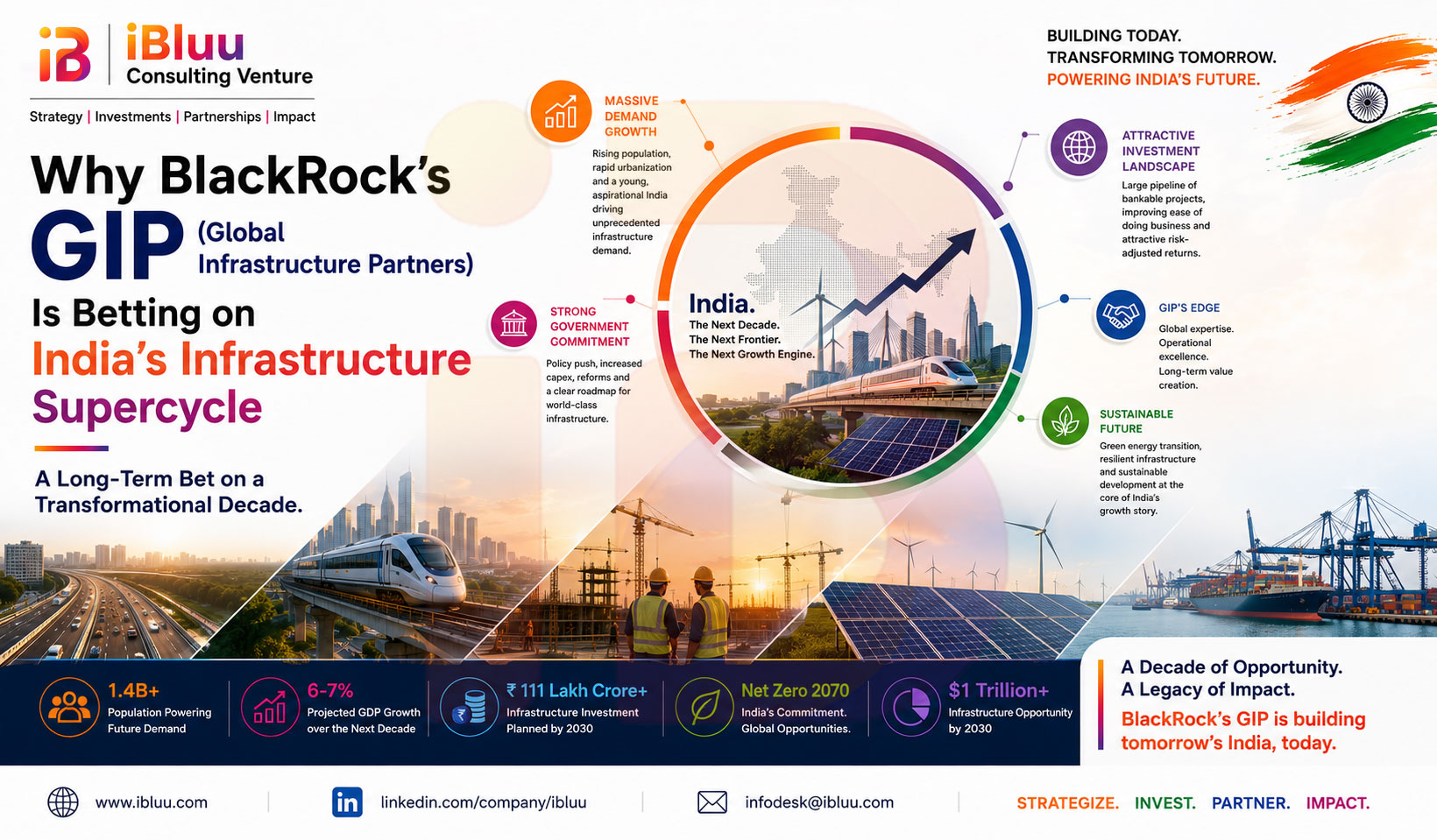
From Infrastructure Assets to Economic Architecture: Why India Has Become a Core Investment Thesis for BlackRock’s Global Infrastructure Partners
India has become one of the most consequential infrastructure investment markets in the world—and the increasingly aggressive positioning of BlackRock through Global Infrastructure Partners (GIP) is a signal worth studying.
But there is an important distinction.
It would be inaccurate to describe GIP as having publicly announced a single, enormous India investment target. Its India strategy has instead developed through platform acquisitions, renewable-energy investments, transport concessions, partnerships and capital commitments, with the latest major disclosed commitment being up to ₹3,000 crore into Aditya Birla Renewables.
The more important story is therefore not one headline transaction.
It is capital positioning.
GIP is increasingly placing itself where India’s infrastructure requirements intersect with long-duration institutional capital: renewable power, hybrid energy, roads, digital infrastructure and potentially the broader infrastructure ecosystem required by electrification, industrialisation and AI.
And BlackRock’s own investment research is increasingly explicit about India’s attractiveness. Its Investment Institute has identified India among emerging markets it favors because the country sits at the intersection of several structural “mega forces,” while its infrastructure research identifies India, Indonesia, Mexico and Saudi Arabia as markets with strong potential for increased infrastructure investment.
1. The Bigger Question: Why India?
The simplest explanation is scale.
The sophisticated explanation is the convergence of multiple infrastructure demand cycles.
India is simultaneously experiencing:
- rapid urbanisation;
- rising electricity consumption;
- industrial capacity expansion;
- renewable-energy deployment;
- grid modernisation;
- logistics and highway development;
- digitalisation;
- data-centre expansion;
- electrification of transport;
- manufacturing relocation;
- supply-chain diversification;
- and growing demand for institutional-quality infrastructure assets.
BlackRock’s infrastructure research estimates that India’s urban population could reach approximately 600 million by 2036, compared with 31% of the population in 2011, and estimates an infrastructure investment requirement of around $840 billion by 2036. It also expects India’s energy demand to increase by more than 60% over the next 20 years.
That combination is unusual.
Many emerging markets offer high growth.
India offers high growth + demographic scale + infrastructure deficits + policy support + capital-market depth + expanding private participation.
For an infrastructure investor, that is a powerful combination.
2. Why India Versus Other Infrastructure Markets?
GIP invests globally. Its portfolio spans energy, transport, digital infrastructure and water/waste, with assets across developed and emerging markets. Following BlackRock’s acquisition, the combined GIP platform has approximately $170 billion in AUM, around 600 professionals and more than 300 active investments across more than 100 countries.
So why allocate additional attention to India?
Because India’s infrastructure opportunity is not one-dimensional.
China
China offers extraordinary infrastructure scale, but the investment environment is increasingly shaped by geopolitical considerations, mature infrastructure build-out in several categories, demographic pressures and capital-market/regulatory complexities.
Southeast Asia
Indonesia, Vietnam and the Philippines offer attractive demographic and infrastructure opportunities, but their individual addressable markets are considerably smaller than India’s.
Middle East
Saudi Arabia and the UAE offer enormous infrastructure programmes and strong sovereign balance sheets, but much of the opportunity is programme-driven and concentrated around specific mega-project ecosystems.
Latin America
Brazil and other markets offer compelling infrastructure opportunities but carry higher exposure to political, currency and macroeconomic volatility in many asset classes.
India
India combines scale, growth, infrastructure scarcity and institutional demand.
That matters.
GIP does not need India to become the world’s easiest infrastructure market.
It needs India to become one of the world’s largest pools of investable infrastructure cash flows.
That is already happening.
3. GIP’s India Strategy Has Evolved Over Time
GIP’s Indian presence is not new.
One of the defining transactions came in 2017, when a GIP-led consortium agreed to acquire Equis Energy for approximately $5 billion including assumed liabilities.
The transaction gave GIP exposure to Equis’s renewable portfolio across Asia-Pacific, including approximately 900 MW of renewable capacity in India across wind and solar projects and development assets. The Indian portfolio included projects in states such as Andhra Pradesh, Madhya Pradesh, Maharashtra, Karnataka, Gujarat and Telangana.
This was strategically important.
GIP was not entering India merely to purchase a single solar project.
It was acquiring a renewable-energy platform with operating assets, development capability and geographical diversification.
That distinction remains relevant to understanding its current strategy.
4. From Renewable Assets to Infrastructure Platforms
GIP subsequently built exposure to Indian renewable infrastructure through platforms including Vector Green Energy.
Vector eventually became a substantial Indian renewable platform. When Singapore’s Sembcorp Industries acquired Vector Green in 2022, the platform had approximately 583 MW of assets across 13 states, comprising 495 MW of operational solar, 24 MW of operational wind and 64 MW of solar under development.
Sembcorp paid approximately ₹2,780 crore, or about $474 million, for the platform.
This illustrates an important characteristic of infrastructure investing:
GIP can create value not only through holding assets, but by building institutional-grade platforms that become strategically valuable to other infrastructure operators.
The exit does not necessarily mean India became less attractive.
It demonstrates the capital recycling model.
5. Vena Energy: Another Major India Renewable Platform
GIP also became a major shareholder in Vena Energy.
Vena Energy India developed a substantial renewable portfolio and pipeline. By 2025–26, reports indicated that GIP was exploring an exit from the Indian platform, with the business described as having approximately 1.1 GW of renewable capacity and a potential transaction valuation in the ₹4,500–5,000 crore range.
This is a critical point for investors:
GIP’s India thesis should not be interpreted as “buy and never sell.”
Infrastructure private equity is fundamentally about:
Acquire → scale → operationally improve → institutionalise → recycle capital → redeploy into the next opportunity.
India can therefore remain strategically attractive even when GIP exits individual assets.
6. The Newest Signal: Aditya Birla Renewables
The most significant recent disclosed GIP commitment is its investment in Aditya Birla Renewables.
In December 2025, GIP agreed to invest up to ₹3,000 crore, comprising an initial ₹2,000 crore commitment and a potential additional ₹1,000 crore greenshoe option, for a minority stake.
The transaction valued ABREN at approximately ₹14,600 crore enterprise value.
At the time, ABREN had approximately 4.3 GW across solar, hybrid, floating-solar and round-the-clock renewable assets across 10 states, with an ambition to exceed 10 GW.
This is arguably more strategically significant than the headline rupee amount.
Why?
Because GIP is investing in a growth platform, not simply purchasing a mature asset.
That creates exposure to India’s next wave of renewable deployment.
7. The Emerging ABREN–GIP–Sprng Equation
The strategy became even more consequential in 2026.
Aditya Birla Renewables agreed to acquire Sprng Energy from Shell in a transaction reported at approximately $1.8 billion including debt.
The acquisition is expected to add around 5 GW, taking ABREN’s overall portfolio toward approximately 9.3 GW, subject to closing and integration.
GIP is expected to participate in the financing alongside Aditya Birla/Grasim.
If executed as planned, this would transform GIP’s relationship with ABREN from a relatively straightforward minority growth investment into participation in a significantly larger Indian renewable-energy platform.
That is precisely the kind of platform economics infrastructure investors seek.
8. GIP Is Not Only About Renewable Energy
The second major pillar is transport infrastructure.
In September 2024, GIP and VINCI announced an agreement involving HKR Roadways, which holds a concession for the SH1 motorway near Hyderabad.
The concession covers approximately 206 km and runs until 2041. VINCI Highways was to invest approximately €40 million and hold 51%, with GIP holding 49%.
This is strategically important because it shows GIP’s India thesis moving beyond:
solar → renewable platforms → transport concessions.
It also demonstrates a preferred GIP model:
Global infrastructure operator + institutional infrastructure capital + Indian concession asset
That is a powerful formula for India’s next infrastructure cycle.
9. The Sectoral Investment Map
Based on publicly disclosed transactions and strategic positioning, GIP’s India exposure can broadly be understood as follows:
| SectorGIP India positioningStrategic rationale | ||
|---|---|---|
| Renewable energy | High | Long-duration contracted cash flows + energy transition |
| Solar | High | Scale, declining technology costs and policy support |
| Wind | Established | Diversification and hybrid generation |
| Hybrid/RTC renewables | Growing | Firm power and improved asset utilisation |
| Roads/highways | Growing | Long concessions + inflation-linked/toll cash flows |
| Digital infrastructure | Strategic opportunity | AI, data centres and power demand |
| Transmission/grid | Potential growth area | Renewable integration |
| Energy storage | Emerging opportunity | Grid flexibility and firm renewable power |
| Ports/logistics | Global GIP strength; India opportunity | Supply-chain transformation |
| Water/waste | Global GIP capability | Urbanisation and municipal infrastructure |
GIP itself has historically focused on energy, transport, digital infrastructure and water/waste. BlackRock has also emphasised digital infrastructure, logistics hubs and decarbonisation as structural infrastructure themes.
10. Where Could GIP Go Next?
The next opportunity set is potentially much broader than conventional renewable generation.
Renewables + BESS
India’s renewable build-out increasingly requires storage.
Solar and wind assets alone cannot solve evening peak demand, grid balancing and firm renewable power requirements.
That creates opportunities in:
- utility-scale BESS;
- solar + storage;
- wind + storage;
- round-the-clock renewable energy;
- hybrid projects;
- grid-scale storage platforms.
Transmission
India’s renewable ambitions are creating a parallel requirement:
build generation → move generation → balance generation.
Transmission is therefore becoming an investable infrastructure layer in its own right.
Data Centres and AI Infrastructure
This could become one of the most important long-term intersections.
BlackRock’s GIP platform is already deeply exposed globally to digital infrastructure. BlackRock says GIP has more than 40 global data centres in its portfolio and describes GIP as a channel connecting investors to the global infrastructure opportunity created by AI and digitalisation.
India’s combination of:
AI + data centres + renewable power + transmission + digital connectivity
could create an infrastructure investment ecosystem rather than a collection of isolated assets.
11. India Is Also Part of a Larger Indo-Pacific Strategy
In 2024, GIP and KKR co-chaired an Indo-Pacific infrastructure coalition targeting approximately $25 billion of investment across the region.
The initiative identified opportunities including hybrid renewables and smart meters in India alongside green data centres in Indonesia and renewable energy in the Philippines.
That matters because India is not being evaluated in isolation.
It is increasingly positioned as one node in a wider Indo-Pacific infrastructure and supply-chain architecture.
12. Why BlackRock Wants the GIP Platform
BlackRock’s acquisition of GIP closed on October 1, 2024.
The combination created an infrastructure platform with approximately $170 billion of AUM, 600 professionals and more than 300 active investments globally.
But the strategic rationale goes beyond scale.
BlackRock brings:
- global institutional relationships;
- public-market expertise;
- private-credit capabilities;
- risk analytics;
- technology;
- Aladdin;
- global distribution.
GIP brings:
- infrastructure origination;
- operating expertise;
- private infrastructure equity;
- corporate partnerships;
- project-level knowledge;
- infrastructure asset management.
BlackRock itself describes the combination as enabling stronger origination and co-investment opportunities.
India benefits from precisely this combination.
13. BlackRock’s India View Is Bigger Than GIP
This distinction is important.
BlackRock’s India strategy ≠ GIP’s India strategy.
BlackRock has exposure across public and private markets, and its India presence also includes Jio BlackRock.
BlackRock’s own 2026 investment commentary says it favors India among emerging markets because the country sits at the intersection of multiple structural forces.
That makes India strategically relevant to the broader BlackRock platform—not merely to GIP.
14. How Much Has GIP Invested in India?
This requires careful interpretation.
There is no reliable publicly disclosed single number representing GIP’s cumulative lifetime India investment across all equity, debt, co-investments, acquisitions and platform transactions.
Therefore, quoting a headline such as “GIP has invested $X billion in India” without defining the methodology would be misleading.
What can be established publicly includes:
- 2017: GIP-led consortium acquired Equis Energy globally for approximately $5 billion including assumed liabilities, bringing an India renewable portfolio of roughly 900 MW into the platform.
- Vector Green: GIP-backed platform was later sold to Sembcorp for approximately ₹2,780 crore.
- HKR Roadways: GIP partnered with VINCI in a Telangana highway concession.
- ABREN: GIP committed up to ₹3,000 crore.
These figures should not simply be added together because they represent different transaction structures, consortium interests, asset values, enterprise values and exits.
The intellectually honest conclusion is:
GIP has established a material and multi-cycle presence in Indian infrastructure, but its publicly disclosed India commitments do not support a precise single cumulative investment figure.
15. Is There an India Investment Target?
Again, no specific publicly announced India-wide GIP target has been identified.
But there is a stronger signal.
GIP closed its fifth flagship infrastructure fund at $25.2 billion, the largest-ever client capital raise for a private infrastructure fund, according to BlackRock. BlackRock is also pursuing a broader ambition to raise $400 billion cumulatively across private markets by 2030.
This does not mean $25.2 billion—or any particular portion of it—is earmarked for India.
But it dramatically increases GIP’s global deployment capacity.
And India is clearly within the platform’s strategic universe.
16. Why India Makes Economic Sense for GIP
From an infrastructure investor’s perspective, India offers six particularly attractive characteristics.
1. Scale
A single national market can support multiple large platforms.
2. Long-duration demand
Energy, transport and digital infrastructure are not short-cycle consumption themes.
3. Contracted cash flows
PPAs, concessions and availability-based infrastructure models can provide relatively predictable revenue streams.
4. Platform consolidation
India’s fragmented infrastructure market creates opportunities to aggregate assets.
5. Capital recycling
Institutional platforms can be built, scaled and subsequently sold to strategic investors.
6. Structural underinvestment
India still requires enormous incremental infrastructure investment.
That creates opportunity for private capital.
17. The Risks GIP Cannot Ignore
The India thesis is compelling—but it is not risk-free.
Regulatory risk
Changes in tariffs, concessions, environmental approvals, land policy or sector regulation can alter project economics.
DISCOM/payment risk
Renewable projects remain exposed to counterparty quality and payment discipline.
Land and transmission risk
Generation capacity without timely transmission can destroy project economics.
Interest-rate risk
Infrastructure valuations are sensitive to the cost of long-term capital.
Currency risk
Foreign investors ultimately evaluate returns in dollars or other base currencies.
Execution risk
India’s infrastructure pipeline is enormous, but project execution can be slower than investment models initially assume.
Political and policy risk
India’s policy direction is broadly supportive, but state-level implementation varies.
Valuation risk
India’s attractiveness has attracted substantial capital.
That means the biggest threat may eventually become:
too much capital chasing too few genuinely high-quality assets.
18. The iBluu Perspective: The Opportunity and the Warning
From the perspective of iBluu Corporations, GIP’s India strategy should be interpreted neither as a foreign-capital success story nor simply as another private-equity transaction.
It represents something more consequential:
India is becoming an infrastructure platform that global capital wants to scale—not merely a market in which global capital wants to participate.
That distinction matters.
The advantages are substantial:
Capital mobilisation:
Global infrastructure capital can accelerate projects that domestic balance sheets alone may not fund at sufficient speed.
Operational discipline:
Institutional investors can introduce global governance, asset-management and performance-management standards.
Technology transfer:
Global partnerships can improve project development, digital monitoring, storage, grid integration and infrastructure operations.
Platform creation:
Rather than financing isolated assets, capital can build scalable infrastructure companies.
Global validation:
Large institutional transactions strengthen India’s credibility as a long-duration infrastructure destination.
But there are potential disadvantages.
The risks include:
Ownership concentration:
Strategic infrastructure assets require careful governance.
Return extraction:
Institutional investors ultimately seek risk-adjusted financial returns.
Asset recycling:
A platform may be sold once it reaches institutional maturity.
Competition for premium assets:
Global capital can drive valuations upward.
Policy dependence:
Private infrastructure still depends heavily on public policy, concessions and regulation.
Therefore, the objective should not be:
“Attract foreign capital at any cost.”
It should be:
“Attract the right capital into the right infrastructure, under the right governance and at the right valuation.”
That is the more sophisticated infrastructure strategy.
19. The Larger Strategic Picture
The most interesting part of GIP’s India story is not the ₹3,000 crore ABREN commitment.
It is the architecture surrounding it.
India’s next infrastructure cycle is converging across:
- Renewable energy
- Storage
- Transmission
- Roads
- Logistics
- Digital infrastructure
- Data centres
- AI
- Industrialisation
- Urbanisation.
These are not independent sectors anymore.
A data centre needs power.
Power needs generation.
Generation needs transmission.
Renewable generation increasingly needs storage.
Industrialisation needs logistics.
Logistics needs roads and ports.
Urbanisation needs transport, water and digital infrastructure.
The infrastructure opportunity is therefore becoming interconnected.
And that is precisely where a platform such as GIP can have an advantage.
20. The Bottom Line
GIP is not investing in India because India happens to be fashionable.
It is investing because India increasingly fits the structural characteristics that long-duration infrastructure capital seeks:
scale, growth, essential services, long-term demand, infrastructure scarcity, policy support and opportunities for platform creation.
The more important development is that GIP now sits inside BlackRock.
That gives the infrastructure platform access to a far broader institutional ecosystem—and potentially a much larger capital, origination and co-investment network.
India, meanwhile, is moving into an infrastructure cycle where capital is no longer merely required to build assets; it is required to build systems.
That changes the investment game.
The next generation of Indian infrastructure winners may not be the companies that simply own the most megawatts, kilometres or assets.
They may be the platforms capable of integrating capital, technology, operations, policy, infrastructure and long-duration demand into scalable businesses.
That is why GIP’s India strategy deserves attention.
The real story is not that global capital is coming to India.
The real story is that India is becoming important enough for global infrastructure capital to build its next generation of platforms here.
Strategic Perspective
The analytical perspective in this article is shaped by J Parasher, Founder and Managing Director of iBluu Consulting Venture (iBCV), a venture of iBluu Corporations, whose strategic lens focuses on national capability building, global industrial benchmarking, infrastructure transformation, cross-border partnerships and long-horizon economic value creation.
From this perspective, infrastructure investment should not be viewed merely as a financial transaction. It is an instrument through which capital, technology, institutional capability and national economic ambition converge.
Disclaimer: This article is for informational and strategic thought-leadership purposes only and does not constitute investment, financial, legal or tax advice. Transaction values, investment commitments and portfolio information are based on publicly available sources and may change subject to regulatory approvals, financial close, transaction completion and subsequent corporate developments. Historical investments and exits should not be interpreted as indicators of future performance. References to future opportunities represent strategic analysis, not confirmation of investment intentions by GIP or BlackRock.