+91 945 889 6091
  infodesk@ibluu.com
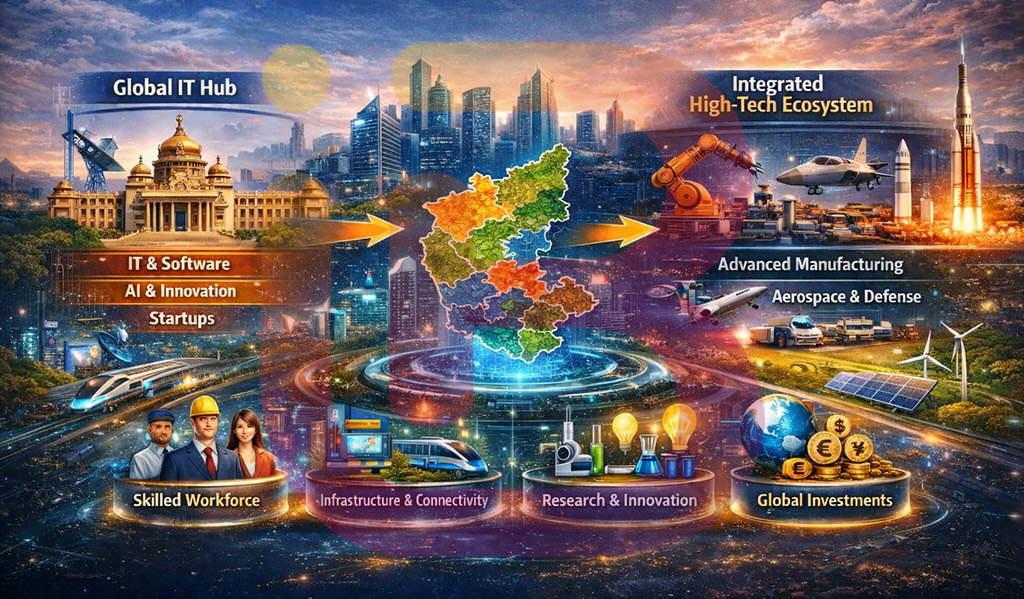
Karnataka Strategic Thesis: From Global IT Capital to Asia’s Most Integrated High-Technology Industrial Ecosystem
Karnataka is no longer evolving—it is redefining its economic identity at speed and scale. What began as India’s IT and services epicenter is now being deliberately re-engineered into Asia’s next high-technology manufacturing, deep-tech, and green-energy powerhouse.
- Current GSDP (FY25–26): ~₹30.7 lakh crore (~$370 billion)
- 2032 Target: $1 trillion economy
- 2035 Outlook: $1.5–1.8 trillion; high-income status (per capita >$16,100)
- Investment Pipeline: ₹10.27 lakh crore (GIM 2025)
- Jobs Potential: 20 lakh by 2030
This is not diversification.
This is a systemic economic re-architecture, aligned with global capital shifts, China+1 supply chain realignment, and green industrial transitions.
Strategic Thesis and Framing: The High-Tech Power Pivot
Karnataka’s transformation is anchored in a deliberate pivot from services concentration (~65% GSDP) to a balanced, high-value industrial ecosystem.
Core Strategic Drivers:
- China+1 advantage: Capturing global manufacturing relocation
- Talent density: One of the world’s deepest tech talent pools
- Policy agility: Investor-centric, flexible incentive architecture
- Ecosystem layering: IT + Manufacturing + Deep-tech + Energy integration
Unlike peer states:
- Tamil Nadu dominates in manufacturing scale
- Gujarat leads in capital-intensive industrialization
Karnataka’s edge is convergence—where innovation meets industrial execution.
Investment Landscape: Scale, Sources, and Strategic Capital Flows
Karnataka’s investment thesis is defined by depth, not just volume.
Total Investment Momentum
- ₹12+ lakh crore proposals (FY22–FY25)
- ₹10.27 lakh crore commitments at GIM 2025
- ₹4.03 lakh crore confirmed projects; ₹6.24 lakh crore MoUs
Key Investors and Capital Sources
Domestic Giants:
- JSW Group: ₹1.2 lakh crore (renewables, steel, cement)
- Baldota Group: ₹54,000 crore (integrated steel)
- Tata Power & ReNew: ₹50,000 crore each (renewables)
Global Capital:
- Lam Research: ₹10,000 crore (semiconductor ecosystem)
- Volvo: ₹1,400 crore (EV trucks)
- Honda: ₹600 crore (EV manufacturing)
- Safran: ₹225 crore (aerospace)
- Schneider Electric: ₹2,247 crore (electrical + R&D)
Government & Institutional Push:
- 12 Investment Zones across 30,000+ acres
- Alignment with Semiconductor Mission, PLI, and logistics policies
Sectoral Depth & City-Level Specialisation: The “Beyond Bengaluru” Strategy
Karnataka’s most strategic move is geographic decentralisation—with ~75% of new investments outside Bengaluru.
Sectoral Allocation (GIM 2025)
- Renewable Energy: ~41% (~₹4.26 lakh crore)
- Core Manufacturing: ~₹1.6 lakh crore
- Sunrise Sectors (EV, Aerospace, ESDM): ~₹1.39 lakh crore
- Infrastructure & Logistics: ~₹1.08 lakh crore
City–Sector Mapping
| Region / City | Key Sectors | Strategic Rationale |
|---|---|---|
| Bengaluru | Aerospace, Semiconductors, GCCs | Global tech capital + deep talent |
| Chitradurga | Aerospace, MRO | Land availability + policy push |
| Tumakuru | Electronics, Semiconductor R&D | Proximity to Bengaluru |
| Vijayapura / North Karnataka | Renewable Energy | Solar & wind corridor advantage |
| Dharwad / Hubballi | Manufacturing, Startups | Emerging Tier-2 innovation hubs |
| Chikkaballapur | EV & Mobility | Strategic logistics location |
Insight:
Karnataka is de-risking growth concentration while unlocking Tier-2 industrial acceleration—a model few Indian states have executed at scale.
Policy Architecture: Capital Efficiency as a Strategic Weapon
The Karnataka Industrial Policy 2025–30 is not incentive-driven—it is ROI-engineered.
Key Policy Levers
- Flexible Incentives:
- 25% Capital Subsidy or
- 2.5% Production-Linked Incentive (7 years)
- Ease of Doing Business:
- Affidavit-Based Clearance (instant project initiation)
- 150+ services under a single digital window
- Mega Project Incentives:
- 100% stamp duty exemption
- Dedicated nodal officers
- Capex Reduction Impact:
- 40–60% effective cost optimization for aligned investors
Economic Trajectory & Scenario Modelling
Growth Pathway
| Year | GSDP Estimate | Implication |
|---|---|---|
| 2025 | ~$370B | High-growth baseline |
| 2032 | ~$1T | Structural inflection point |
| 2035 | $1.5–1.8T | High-income transition |
Scenario Analysis
- Base Case (10–12% CAGR): $1T by 2032–33
- Best Case (13–15% CAGR): $1T by 2030; high-income by 2034
- Downside Case (8–9% CAGR): Delayed to 2035+
Stakeholder Value Creation: Multi-Layered Economic Impact
For the State
- 20 lakh jobs by 2030
- Reduced dependency on Bengaluru
- Stronger fiscal resilience
For Investors
- 15–20% IRR potential in sunrise sectors
- Access to one of the world’s largest tech talent pools
- Policy certainty + cost efficiency
For Central Government
- ~20% contribution to national exports
- ~65% share in aerospace exports
- Strategic alignment with Viksit Bharat 2047
For Society
- High-skill employment
- Tier-2 city development
- Rising per capita income
ESG & Sustainability: Competitive Advantage, Not Compliance
Karnataka is India’s renewable energy leader, with ~63% of installed capacity green.
Key ESG Levers
- 50% capital subsidy for sustainable investments
- Circular economy incentives
- Green industrial processes aligned with EU/US standards
Strategic Outcome
- Export resilience against carbon-border taxes
- Positioning as a low-carbon manufacturing hub
Risk Landscape: Quantified and Strategic
Key Risks
- Regional Imbalance:
Bengaluru still contributes ~38–40% of GSDP - Fiscal Pressure:
Revenue deficit ~0.7% of GSDP; liabilities ~₹8.24 lakh crore - Water Stress & Infrastructure Gaps
- Talent Shortage in Advanced Manufacturing
- Declining Central Devolution:
~23% drop under Finance Commission
Mitigation Imperatives
- Accelerated infrastructure in North Karnataka
- Skill development aligned with semiconductors & EVs
- Water resilience investments
- ESG-led industrial planning
Global Positioning: Karnataka as a Strategic Capital Magnet
Global investors increasingly view Karnataka as:
- India’s most mature high-tech ecosystem
- A China+1 execution hub, not just a candidate
- A deep-tech + manufacturing convergence model
It is not competing for capital—it is absorbing strategic capital flows.
Strategic Recommendations: Investor & Policy Playbook
For Investors
- Prioritize EV, semiconductor, and green energy clusters
- Expand into Tier-2 GCC ecosystems
- Leverage policy-led capex reduction
For Government
- Scale infrastructure beyond Bengaluru
- Accelerate water and energy resilience
- Strengthen global academic–industry partnerships
For Corporates
- Integrate R&D + manufacturing + digital capabilities
- Align with ESG to future-proof exports
IBCV Perspective: Strategic Systems, Not Sectoral Plays
The analytical depth of this thesis reflects the strategic lens of iBluu Consulting Venture Private Limited (IBCV)—a venture of iBluu Corporations.
Under the leadership of J Parasher, Founder & Managing Director, the focus is clear:
Economic transformation must be engineered as a system—not pursued as isolated sectoral growth.
IBCV operates at the intersection of:
- Strategic consulting
- Government engagement
- Investment advisory
- M&A and partnerships
The real opportunity is not in participating in growth.
It is in architecting it.
Conclusion: Karnataka Is Engineering Economic Dominance
Karnataka is not chasing a trillion-dollar milestone.
It is redefining how trillion-dollar economies are built.
The state’s model—convergence of technology, manufacturing, policy, and sustainability—is not just scalable.
It is replicable globally.
The next decade will not be about who grows faster.
It will be about who builds deeper, stronger, and smarter economic systems.
Karnataka has already made its move.