+91 945 889 6091
  infodesk@ibluu.com
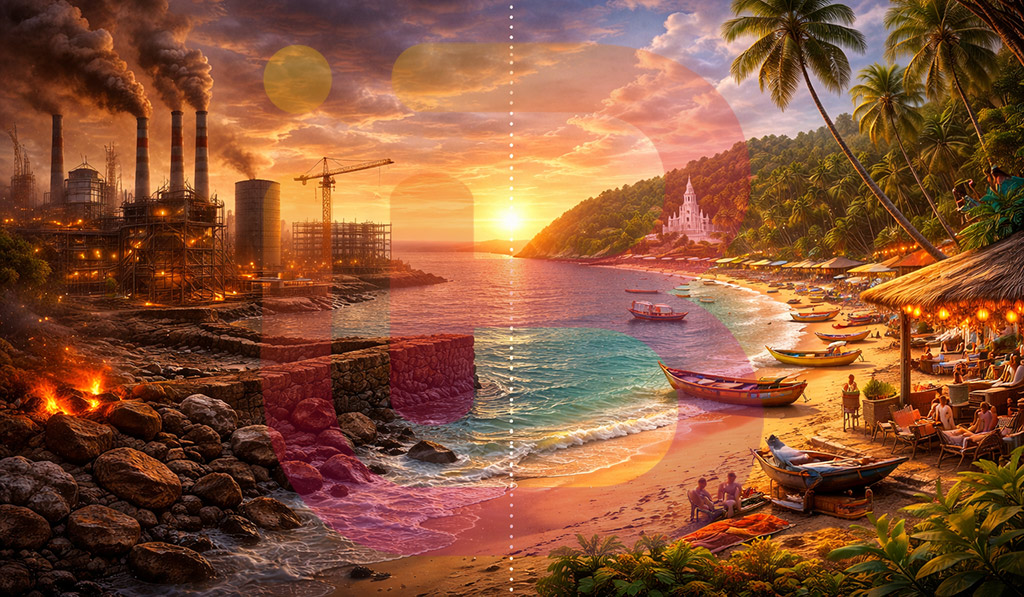
In the Age of Over-Industrialization, Goa Emerges as India’s Costa Rica Moment
Why is Goa absent from conversations around semiconductor fabs, AI data centers, defense corridors, and mega manufacturing hubs?
The answer is not neglect.
It is strategy.
In a decade where states are aggressively competing for scale, subsidies, and industrial headlines—Goa has made a radically different choice:
It is competing for scarcity.
While others race to become the next factory floor, Goa is quietly positioning itself as something far rarer— a high-value, low-footprint, globally desirable “soul economy.”
This is not underdevelopment.
This is intentional restraint as a strategic advantage.
The Ecological Red Line: Growth Has Boundaries Here
At the heart of Goa’s decision-making lies a non-negotiable truth:
It sits within the Western Ghats—one of the world’s most critical biodiversity hotspots.
- ~60% forest cover
- Extensive mangrove ecosystems (~212 km²)
- 4 wildlife sanctuaries + 1 national park
- Rich coastal and marine ecosystems
This is not just land.
This is a living ecological asset of global importance.
Over the past two decades, Goa has repeatedly rejected or delayed high-impact industrial projects—from steel plants to large-scale infrastructure expansions—not due to incapacity, but due to collective environmental consciousness backed by judicial enforcement.
Strategic Insight:
Goa has drawn a clear line — economic growth cannot come at the cost of ecological collapse.
Policy by Design: Filtering Capital, Not Chasing It
Unlike states building massive industrial land banks, Goa’s policy architecture is deliberately selective.
The Goa Industrial Policy prioritizes:
- Green industries: IT, biotech, renewable micro-grids
- White industries: knowledge services, R&D, non-polluting sectors
- Tourism & wellness ecosystems
And restricts:
- Red-category, high-pollution industries
- Large-scale heavy manufacturing in sensitive zones
Yes, a single-window clearance system exists.
But the real filter is not speed—it is standards.
Strategic Insight:
Goa is not anti-investment.
It is anti-misaligned investment.
Economic Reality: Small Scale, High Value
Goa’s economy is often misunderstood through the lens of size.
| Metric | Insight |
|---|---|
| GSDP (2024–25) | ₹1.05–1.1 lakh crore (~$13B) |
| Per Capita Income | ₹5.8–6.0 lakh (Top in India) |
| Tourism Contribution | ~30–35% (direct + indirect) |
| Visitors | ~9 million annually (pre-COVID peak) |
| Unemployment | ~4–5% (among lowest in India) |
This is not a volume-driven economy.
It is a premium-value economy.
Strategic Insight:
Goa proves that wealth per citizen can matter more than scale of output.
The “Boutique State” Thesis: Scarcity is the New Power
Think of Goa not as a mass-production hub—but as a curated, high-value ecosystem.
It attracts:
- Boutique hospitality investments
- Wellness and longevity ecosystems
- High-end real estate
- Niche startups (health-tech, ocean-tech, regenerative tourism)
Globally, it is perceived closer to:
- Maldives (experience economy)
- Santorini (premium tourism)
- Costa Rica (eco-first development model)
Not Shenzhen. Not an industrial corridor.
Strategic Insight:
Goa is building brand equity, not industrial density.
The Human Advantage: Preserving the “Susegad” Economy
In a world driven by speed, stress, and automation, Goa offers something fundamentally different:
Susegad—a philosophy of calm, balanced, meaningful living.
This is not laziness.
It is a conscious rejection of unsustainable velocity.
- Clean air
- Cultural continuity
- Social cohesion
- High literacy (~88%+)
- Strong civic engagement
Strategic Insight:
Goa is not optimizing for GDP alone.
It is optimizing for quality of life as a strategic asset.
The Hidden Strength: Long-Term Resilience
What looks like under-industrialization today may become strategic superiority tomorrow.
Goa’s model offers:
- Lower exposure to climate risks
- Reduced water and energy stress
- Strong ESG alignment for future capital flows
- Retained land for high-value future use
As global regulations like carbon border taxes tighten,
low-impact economies may outperform heavy industrial hubs.
The Trade-Offs: A Balanced Reality
This model is not without costs:
- Limited industrial job creation
- Dependence on tourism cycles
- Youth migration to larger states
- Urban pressure in high-tourism zones
But these are managed trade-offs, not structural failures.
The Strategic Twist: Investors Are Not Ignoring Goa
They are waiting.
Waiting for:
- Projects aligned with ecological integrity
- High-value, low-footprint innovation
- Sustainable, long-horizon returns
Because Goa demands something rare:
Respect. Alignment. Vision.
Investor Implications: A Different Playbook
Goa is not the place for:
- Semiconductor mega fabs
- Heavy manufacturing clusters
- Large-scale industrial corridors
Goa is the place for:
- Regenerative tourism
- Wellness & longevity ecosystems
- Ocean-tech and blue economy innovation
- Niche biotech and R&D
- Sustainable luxury and experiential assets
Strategic Insight:
This is not a scale game.
This is a precision investment landscape.
Conclusion: The State That Refused to Become Ordinary
In a world obsessed with scale, speed, and industrial dominance, Goa has made a quiet but powerful decision:
To remain extraordinary.
Its silence in the industrial race is not absence.
It is discipline.
Its lack of mega-projects is not weakness.
It is clarity.
And its refusal to become a factory floor is not resistance.
It is vision.
A Strategic Lens from IBCV
At iBluu Consulting Venture Private Limited (IBCV), a venture of iBluu Corporations, we view Goa not as an outlier—but as a signal of the next economic evolution.
Under the strategic lens of J Parasher, Founder and Managing Director of iBluu Corporations, this model reframes growth:
From scale → to sustainability
From volume → to value
From expansion → to preservation
Final Thought
In a world chasing scale, the rarest commodity is authenticity.
Goa is not selling land.
It is offering something far more valuable:
A future that still feels human.