+91 945 889 6091
  infodesk@ibluu.com
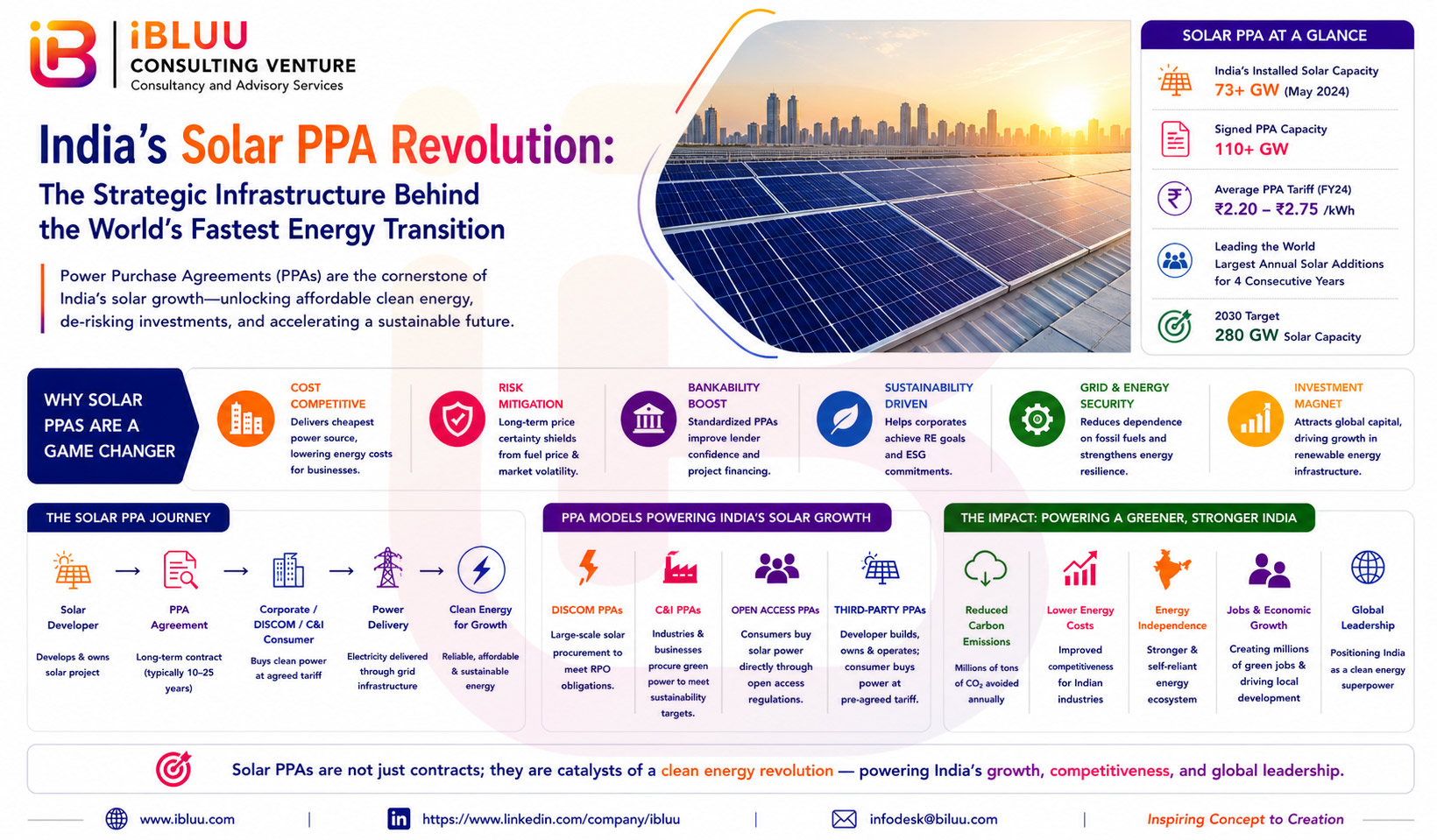
India’s Solar PPA Economy: Long-Term Renewable Contracts Driving Global Capital Into India for Corporate Expansion, Export Growth, and Long-Term Energy Security
India’s solar transition is no longer an environmental narrative.
It is now an infrastructure-scale economic transformation reshaping capital allocation, industrial competitiveness, sovereign energy security, and global investment geography.
At the center of this transition sits one of the most consequential financial-engineering instruments in modern infrastructure economics: the Solar Power Purchase Agreement (PPA).
What appears, on the surface, to be a contractual mechanism between developers and power buyers is, in reality, the foundational architecture enabling India’s renewable-energy scale-up.
The PPA market is becoming the operating system of India’s clean-energy economy.
As of early 2026, India has crossed approximately 150 GW of cumulative installed solar capacity, with more than 110 GW originating from utility-scale projects largely governed by long-term PPAs. This expansion is directly aligned with India’s strategic objective of achieving 500 GW of non-fossil fuel capacity by 2030—one of the world’s most ambitious energy transition programs.
The scale is historic.
But the structural implications are even larger.
Why Solar PPA Projects Have Become India’s Dominant Renewable-Energy Model
The rise of PPA-led solar infrastructure in India is not accidental.
It is the result of four converging strategic realities:
| Strategic Driver | Why It Matters |
|---|---|
| Revenue Visibility | Long-term PPAs provide predictable cash flows for 15–25 years |
| Bankability | Enables easier debt financing and infrastructure investment |
| Energy Cost Stability | Protects industries from volatile conventional power tariffs |
| ESG & Decarbonization Pressure | Corporates increasingly require green-energy procurement |
This framework transforms renewable energy from a volatile infrastructure bet into a financially modelable long-duration asset class.
For investors, PPAs reduce uncertainty.
For lenders, they improve project viability.
For corporates, they create energy-cost predictability.
For governments, they accelerate clean-energy deployment without direct fiscal burden.
In effect, the PPA ecosystem has industrialized renewable-energy financing in India.
India Is No Longer a Solar Market. It Is Becoming a Global Renewable Manufacturing and Energy Platform.
The global investment community has recognized this shift aggressively.
Over the past five years, India has emerged as one of the world’s largest renewable-energy investment destinations, attracting sovereign funds, pension capital, infrastructure funds, climate-focused institutional investors, and multinational energy companies.
Major foreign investors in India’s solar and renewable ecosystem include:
| Country | Key Investors / Companies |
|---|---|
| UAE | Masdar, ADNOC-linked clean-energy entities |
| Singapore | Temasek, GIC, Sembcorp |
| Canada | Brookfield Renewable |
| France | TotalEnergies |
| Norway | Norfund |
| Japan | SoftBank Energy |
| United States | BlackRock, KKR, Goldman Sachs-backed infrastructure funds |
| Saudi Arabia | PIF-linked strategic energy interest |
| Malaysia | Gentari |
| United Kingdom | Actis, CDC Group (British International Investment) |
The significance of this capital flow extends beyond energy.
Global capital is increasingly viewing India not merely as a power-consumption market, but as a strategic renewable-energy manufacturing and export ecosystem capable of competing with China across selected value chains.
That is a geopolitical shift—not merely an infrastructure trend.
The Three Solar PPA Economies Emerging Inside India
1. Utility-Scale Solar Parks: The Backbone of India’s Renewable Expansion
India’s utility-scale solar parks remain the dominant segment of the PPA ecosystem.
Mega-projects such as:
- Bhadla Solar Park (Rajasthan) – ~2,245 MW
- Khavda Renewable Energy Park (Gujarat) – targeting ~30 GW
- Pavagada Solar Park (Karnataka)
- Rewa Ultra Mega Solar Project (Madhya Pradesh)
are reshaping the economics of power generation at continental scale.
These projects operate primarily under long-term PPAs facilitated by:
- SECI
- NTPC
- State DISCOMs
- Government-backed procurement structures
The strategic logic is clear:
India is attempting to create energy abundance at industrial scale while lowering long-term electricity costs for manufacturing expansion.
2. Commercial & Industrial (C&I) Open Access: India’s Fastest-Growing Solar Opportunity
The most disruptive growth segment is now Commercial & Industrial Open Access solar.
Following the Green Energy Open Access Rules, the threshold for direct renewable-energy procurement was reduced from 1 MW to 100 kW, unlocking access for mid-sized enterprises.
This policy shift is structurally important.
It democratizes renewable-energy procurement beyond large conglomerates.
Industries now increasingly sign direct PPAs to bypass higher grid tariffs and secure predictable energy pricing.
Key sectors leading adoption include:
- Data centers
- Steel manufacturing
- Automotive
- FMCG
- Pharmaceuticals
- Textiles
- Warehousing & logistics
- IT campuses
Industry estimates indicate that C&I open-access additions may exceed ~15 GW in FY2026 alone.
This segment is rapidly becoming one of India’s most investable energy categories.
3. FDRE Projects: The Future of Dispatchable Renewable Infrastructure
The next evolution of India’s solar economy is Firm Dispatchable Renewable Energy (FDRE).
Unlike conventional solar projects, FDRE integrates:
- Solar generation
- Wind energy
- Battery Energy Storage Systems (BESS)
to deliver round-the-clock renewable power.
This solves one of renewable energy’s biggest structural limitations: intermittency.
Juniper Green Energy’s commissioning of India’s first FDRE project (~259 MWp solar + 200 MWh storage) signals the beginning of India’s transition toward grid-stabilized renewable infrastructure.
This category may become one of the most valuable energy asset classes of the next decade.
Why Global Investors Are Accelerating Into India’s Solar PPA Market
Global infrastructure capital is attracted to India for six strategic reasons:
| Investment Factor | Strategic Implication |
|---|---|
| Massive Demand Growth | India remains one of the world’s fastest-growing energy markets |
| Long-Term Policy Visibility | 2030 renewable targets create investment continuity |
| Stable PPA Structures | Long-duration contracted cash flows |
| Manufacturing Push | PLI schemes boosting domestic solar manufacturing |
| Energy Transition Economics | Renewable tariffs increasingly cheaper than thermal power |
| Geopolitical Diversification | Investors reducing China concentration risk |
India is now positioned at the intersection of:
- energy transition,
- manufacturing diversification,
- infrastructure expansion,
- and climate capital deployment.
Very few markets globally offer all four simultaneously.
The Risks That Investors Must Not Ignore
Despite the structural opportunity, India’s solar PPA market still faces execution and systemic challenges.
Key Risks Include:
1. DISCOM Financial Fragility
Delayed payments from state electricity distribution companies remain one of the sector’s biggest concerns.
2. Land Acquisition Complexity
Large-scale projects increasingly face rising land costs and local resistance.
3. Grid Connectivity Bottlenecks
Transmission infrastructure expansion is struggling to keep pace with renewable capacity additions.
4. Tariff Compression
Aggressive bidding has compressed margins across utility-scale projects.
5. Supply-Chain Vulnerability
Dependence on imported cells and wafers remains strategically sensitive despite domestic manufacturing initiatives.
The next decade will separate disciplined renewable infrastructure platforms from speculative capacity expansion.
India’s Solar Transition Is Now Moving From Capacity Creation to Energy-System Architecture
The next phase of India’s renewable-energy expansion will likely be driven by:
- AI-led energy management systems
- Grid-scale battery storage
- Hybrid renewable parks
- Green hydrogen integration
- Smart transmission networks
- Carbon markets
- Industrial decarbonization infrastructure
This transition changes the nature of opportunity.
The future winners may not necessarily be the largest solar developers.
The future winners may be those who control:
- transmission ecosystems,
- storage infrastructure,
- integrated energy intelligence,
- and strategic industrial partnerships.
The Emerging Role of Strategic Advisory Firms in India’s Solar Infrastructure Ecosystem
As solar infrastructure scales, the complexity of execution is rising rapidly.
Projects now require:
- cross-border capital coordination,
- EPC partnerships,
- land aggregation,
- regulatory navigation,
- state-level engagement,
- technology alliances,
- debt structuring,
- and supply-chain integration.
This is where strategic consulting and infrastructure advisory firms are becoming increasingly critical.
iBCV (iBluu Consulting Venture Private Limited), a venture of iBluu Corporations, has entered this evolving renewable-energy ecosystem through consulting and advisory mandates associated with solar projects operating under the PPA framework across multiple Indian states.
The role of iBCV includes:
- strategic consulting,
- alliance structuring,
- JV facilitation,
- project partnership alignment,
- infrastructure coordination,
- investment engagement,
- and ecosystem integration support.
This reflects a broader shift occurring across India’s infrastructure economy:
Execution capability is no longer enough.
Strategic integration capability is becoming the real differentiator.
The Strategic Lens Behind the Analysis
The analytical framework underlying this assessment is influenced by the strategic perspective of J Parasher, Founder and Managing Director of iBluu Corporations, whose work consistently emphasizes long-horizon economic systems, industrial competitiveness, sovereign capability creation, and infrastructure-led national transformation.
His approach reframes renewable energy not merely as a sustainability sector, but as a strategic geopolitical and industrial platform capable of influencing:
- export competitiveness,
- manufacturing scale,
- energy sovereignty,
- and long-term economic resilience.
Final Perspective: India’s Solar PPA Market Is Quietly Becoming One of the World’s Most Important Infrastructure Stories
The global energy transition is often discussed through the language of climate.
But markets are ultimately transformed through the language of economics.
India’s solar PPA ecosystem is succeeding because it aligns:
- energy affordability,
- infrastructure scalability,
- industrial competitiveness,
- and long-duration investment economics.
That combination is extraordinarily powerful.
The real transformation is not that India is installing more solar panels.
The real transformation is that India is building the financial, regulatory, and industrial architecture capable of supporting one of the largest clean-energy expansions in modern economic history.
And the implications of that transition will extend far beyond electricity.
They will shape manufacturing, exports, logistics, industrial policy, geopolitical positioning, and global capital flows for decades ahead.
Disclaimer: This article is intended solely for informational, strategic, and industry insight purposes and does not constitute investment, legal, financial, regulatory, engineering, or policy advice. All statistics, market estimates, capacity figures, investment trends, and strategic interpretations are based on publicly available information, industry reports, market observations, and analytical assessments available at the time of publication. Readers, investors, institutions, corporations, and stakeholders are advised to conduct independent due diligence and seek professional advisory consultation before making any investment, infrastructure, commercial, financial, policy, or strategic decisions. iBCV (iBluu Consulting Venture Private Limited), iBluu Corporations, and associated entities disclaim any liability arising from reliance on this content.