+91 945 889 6091
  infodesk@ibluu.com
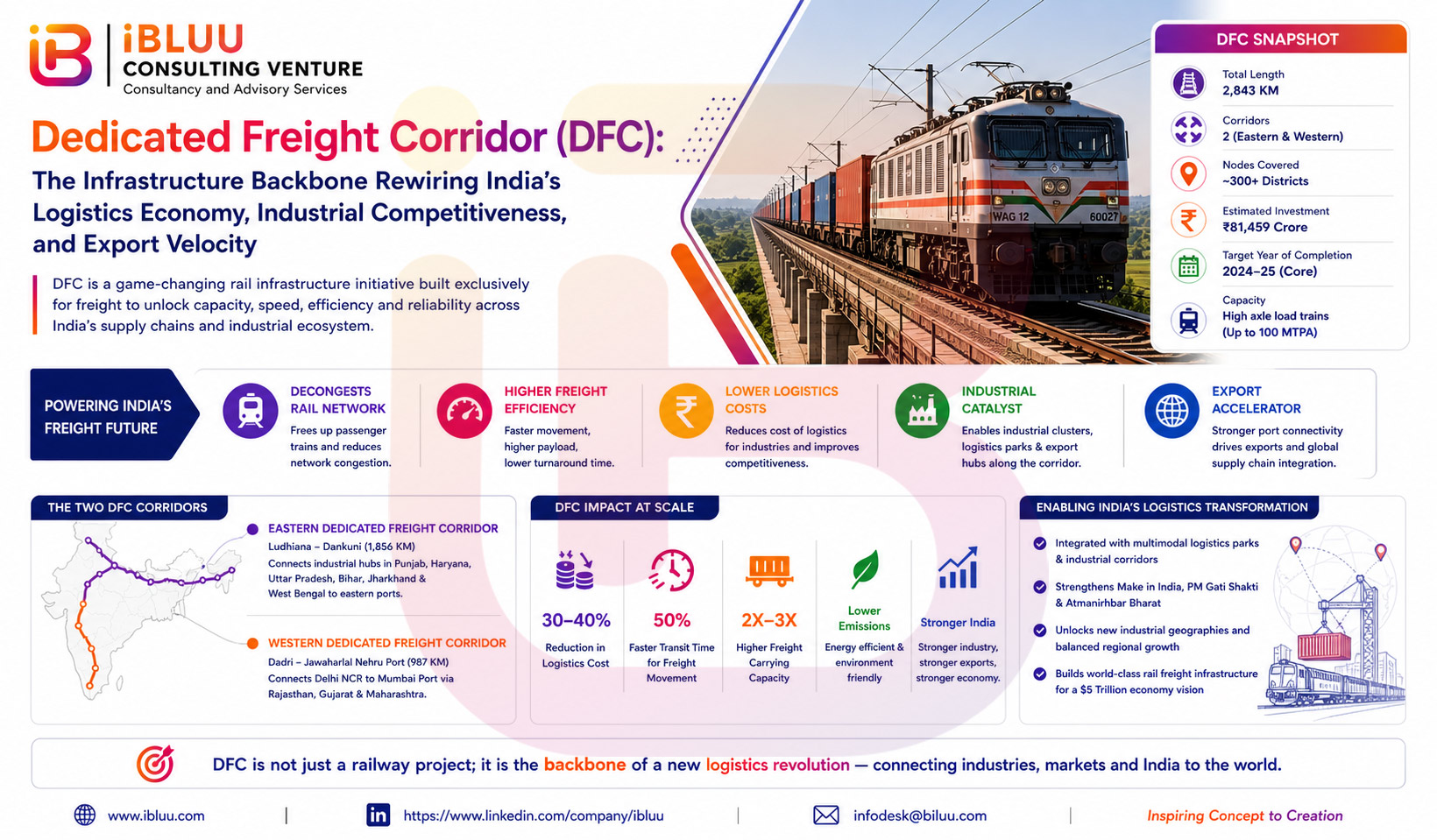
Dedicated Freight Corridor (DFC): The Infrastructure Megaproject Powering India’s Logistics Economy, Industrial Expansion, and Global Trade Scale
India’s Dedicated Freight Corridor (DFC) is often described as a railway modernization project.
That description fundamentally understates what is actually being built.
The Dedicated Freight Corridor is not merely transportation infrastructure. It is one of the most strategically important economic architecture projects in modern Indian history — a systemic attempt to redesign the movement of goods, industrial productivity, logistics economics, and export competitiveness at national scale.
For decades, India’s economic growth was constrained not by lack of demand, capital, or industrial ambition — but by logistics inefficiency.
Manufacturing costs remained elevated.
Supply chains remained fragmented.
Port connectivity remained inconsistent.
Freight movement remained slow, congested, and operationally expensive.
The DFC changes that equation.
And over the next decade, its impact may extend far beyond railways — influencing industrial corridors, warehousing, manufacturing clusters, export competitiveness, real estate demand, logistics investments, and India’s positioning within the global supply-chain order.
India’s Logistics Challenge Was Never Small — It Was Structural
Historically, Indian Railways operated passenger and freight trains on the same network.
The result:
- severe congestion,
- unpredictable transit times,
- low average freight speeds,
- inefficient cargo scheduling,
- and constrained industrial throughput.
Freight trains on conventional rail routes often moved at average speeds of approximately 25 kmph.
That created enormous hidden costs across the economy:
- delayed inventory cycles,
- higher warehousing requirements,
- inefficient port evacuation,
- elevated fuel consumption,
- and reduced export competitiveness.
In modern industrial economies, logistics speed is not an operational metric.
It is an economic weapon.
The Dedicated Freight Corridor was designed to directly address that structural weakness.
What Is the Dedicated Freight Corridor?
The Dedicated Freight Corridor (DFC) is a specialized high-capacity freight railway network being developed by the Dedicated Freight Corridor Corporation of India Limited (DFCCIL), under Indian Railways.
The two major operational corridors include:
Western Dedicated Freight Corridor (WDFC)
Connecting Dadri (Uttar Pradesh) to Jawaharlal Nehru Port Trust (JNPT), Mumbai.
Eastern Dedicated Freight Corridor (EDFC)
Connecting Ludhiana (Punjab) to Sonnagar/Dankuni alignment in eastern India.
Combined, these corridors represent one of the world’s largest freight rail infrastructure modernization programs.
But the real significance lies in what they unlock economically.
The DFC Is Rewiring India’s Industrial Geography
The Western DFC is strategically aligned with:
- Delhi-Mumbai Industrial Corridor (DMIC),
- export manufacturing clusters,
- logistics parks,
- container terminals,
- industrial smart cities,
- and port-led industrialization.
Meanwhile, the Eastern DFC acts as:
- an industrial raw-material artery,
- a coal and energy transportation backbone,
- and a supply-chain stabilizer for northern and eastern India.
Together, they are reshaping how industrial India moves.
This is not transportation optimization.
This is national productivity restructuring.
Freight Speed Changes the Entire Economic Equation
Under the DFC system, freight train speeds can reach approximately 100 kmph — nearly four times faster than conventional freight movement.
This is transformational.
Because faster freight movement directly impacts:
- manufacturing cycle efficiency,
- export turnaround,
- inventory optimization,
- warehousing economics,
- port evacuation,
- and working capital management.
For businesses, logistics delays silently destroy margins.
For economies, they weaken competitiveness.
Reducing transit time between Mumbai and Delhi to under 48 hours fundamentally changes the operational economics of manufacturing and trade.
The Western DFC Could Become India’s Export Spine
The Western DFC may ultimately emerge as one of India’s most economically consequential infrastructure corridors.
Why?
Because it connects India’s manufacturing and consumption hinterland directly with major ports including:
- JNPT,
- Mundra,
- Pipavav,
- and western maritime gateways.
This matters enormously in a world where export competitiveness increasingly depends on:
- logistics reliability,
- port integration,
- multimodal synchronization,
- and supply-chain predictability.
India’s manufacturing ambition cannot scale if cargo movement remains slow and fragmented.
The Western DFC directly addresses that bottleneck.
The Eastern DFC Is Quietly Becoming India’s Energy Security Corridor
While the Western DFC attracts export attention, the Eastern DFC carries equally critical strategic importance.
It is designed to ensure seamless movement of:
- coal,
- steel,
- cement,
- fertilizers,
- food grains,
- and industrial bulk cargo.
India’s energy infrastructure remains deeply dependent on reliable coal logistics.
Any disruption impacts:
- power generation,
- industrial production,
- and economic continuity.
The Eastern DFC therefore functions not merely as freight infrastructure — but as a strategic economic stability mechanism.
The Engineering Scale of the DFC Is Underappreciated
The technical architecture behind the DFC represents a significant leap in freight modernization.
Key Infrastructure Capabilities
| Capability | Strategic Significance |
|---|---|
| Freight speeds up to 100 kmph | Faster industrial throughput |
| Higher axle loads (up to 32.5 tonnes) | Greater cargo carrying capacity |
| Double-stack container operations | Massive logistics efficiency gains |
| 100% electrification | Lower emissions and fuel dependency |
| Automated signalling systems | High-density operational safety |
| Kavach safety integration | Advanced collision prevention |
| Dedicated freight-only tracks | Reduced congestion and scheduling conflicts |
The Western DFC’s high-rise overhead electrification enabling double-stack container trains is particularly significant.
Few countries possess freight systems optimized at this scale for container efficiency.
The DFC Is Also a Real Estate and Industrial Corridor Story
One of the most underestimated effects of the DFC will likely emerge in:
- industrial land appreciation,
- warehousing growth,
- logistics parks,
- manufacturing clusters,
- freight-linked urbanization,
- and multimodal commercial ecosystems.
Infrastructure changes land economics.
The regions surrounding DFC nodes are already attracting:
- logistics operators,
- warehousing developers,
- industrial manufacturers,
- institutional investors,
- and integrated supply-chain players.
The next major industrial real estate cycle in India may increasingly become corridor-driven rather than city-driven.
The Real Opportunity Begins After Completion
Many analysts mistakenly view DFC completion as the end goal.
In reality, completion is merely the starting line.
The next phase is far larger:
- industrial corridor integration,
- multimodal logistics parks,
- private freight terminals,
- AI-enabled logistics systems,
- time-tabled freight operations,
- digital freight intelligence,
- automated cargo ecosystems,
- and export-led manufacturing expansion.
The DFC creates the physical backbone.
The real economic multiplier comes from the ecosystem built around it.
The Carbon and Sustainability Impact Matters More Than Expected
Global supply chains are increasingly shaped by sustainability metrics.
The DFC’s fully electrified freight architecture provides:
- lower carbon intensity,
- higher energy efficiency,
- reduced diesel dependency,
- and long-term emissions reduction potential.
Over the next 30 years, this may materially strengthen India’s position as global manufacturers increasingly evaluate ESG-aligned supply-chain destinations.
Infrastructure competitiveness is no longer just about cost.
It is about sustainability-adjusted efficiency.
The Golden Quadrilateral Freight Expansion Could Be Even Bigger
The planned expansion through:
- East Coast Corridor,
- East-West Corridor,
- and North-South Corridor
under the broader Golden Quadrilateral Freight Corridor (GQFC) framework could dramatically expand India’s logistics integration.
If fully executed, India may eventually create one of the world’s largest integrated freight mobility systems.
That would fundamentally alter:
- domestic industrial connectivity,
- export competitiveness,
- inland manufacturing economics,
- and national logistics efficiency.
Global Context: Why the DFC Matters Geopolitically
Global supply chains are being reorganized.
Manufacturers increasingly prioritize:
- resilience,
- diversification,
- speed,
- redundancy,
- and infrastructure reliability.
Countries that cannot move goods efficiently will lose industrial relevance.
The DFC positions India more competitively within:
- China+1 supply-chain diversification,
- export manufacturing relocation,
- industrial investment flows,
- and regional trade integration.
This is why the DFC matters beyond transportation.
It is industrial geopolitics through infrastructure.
iBCV Perspective: Infrastructure Is Becoming India’s Economic Operating System
According to iBCV (iBluu Consulting Venture Private Limited), a venture of iBluu Corporations, the Dedicated Freight Corridor represents a broader shift in India’s development model — from fragmented infrastructure expansion toward synchronized economic systems architecture.
The convergence of:
- freight modernization,
- industrial corridors,
- manufacturing clusters,
- logistics intelligence,
- multimodal integration,
- and export infrastructure
is gradually creating a new industrial framework for India.
The strategic analytical perspective reflected in this assessment aligns with the broader economic lens of J Parasher, Founder and Managing Director of iBluu Corporations, whose work consistently focuses on industrial competitiveness, infrastructure-led economic transformation, and long-term national capability building.
His perspective increasingly frames infrastructure not as isolated public expenditure — but as strategic economic leverage capable of reshaping investment flows, industrial productivity, and geopolitical competitiveness.
And the DFC is precisely that kind of leverage.
Conclusion: The Dedicated Freight Corridor Is Not a Railway Project — It Is a National Economic Multiplier
The Dedicated Freight Corridor may ultimately become one of the most economically consequential infrastructure systems India has built in the modern era.
Because its impact extends far beyond rail.
It influences:
- manufacturing competitiveness,
- logistics economics,
- export velocity,
- industrial real estate,
- freight efficiency,
- supply-chain resilience,
- and national productivity.
The countries dominating the next industrial cycle will not simply be those that manufacture more.
They will be the countries that move goods faster, cheaper, cleaner, and more reliably.
That is the strategic significance of the DFC.
India is no longer merely building rail infrastructure.
It is building the logistics backbone of a future industrial power.
Disclaimer: This article is intended solely for strategic, informational, and analytical purposes and should not be interpreted as financial, investment, legal, policy, or infrastructure advisory. Data, projections, infrastructure timelines, and economic interpretations are based on publicly available information, industry analysis, and broader market perspectives believed to be reliable at the time of writing; however, no representation or warranty is made regarding absolute accuracy or completeness. Infrastructure execution, regulatory frameworks, freight economics, industrial investments, and policy outcomes remain subject to change. Readers, investors, institutions, and stakeholders are advised to conduct independent due diligence and seek professional advisory before making investment, policy, infrastructure, or business decisions. The perspectives reflected in this article represent strategic market observations and broader economic interpretation from iBCV (iBluu Consulting Venture Private Limited), a venture of iBluu Corporations.