+91 945 889 6091
  infodesk@ibluu.com
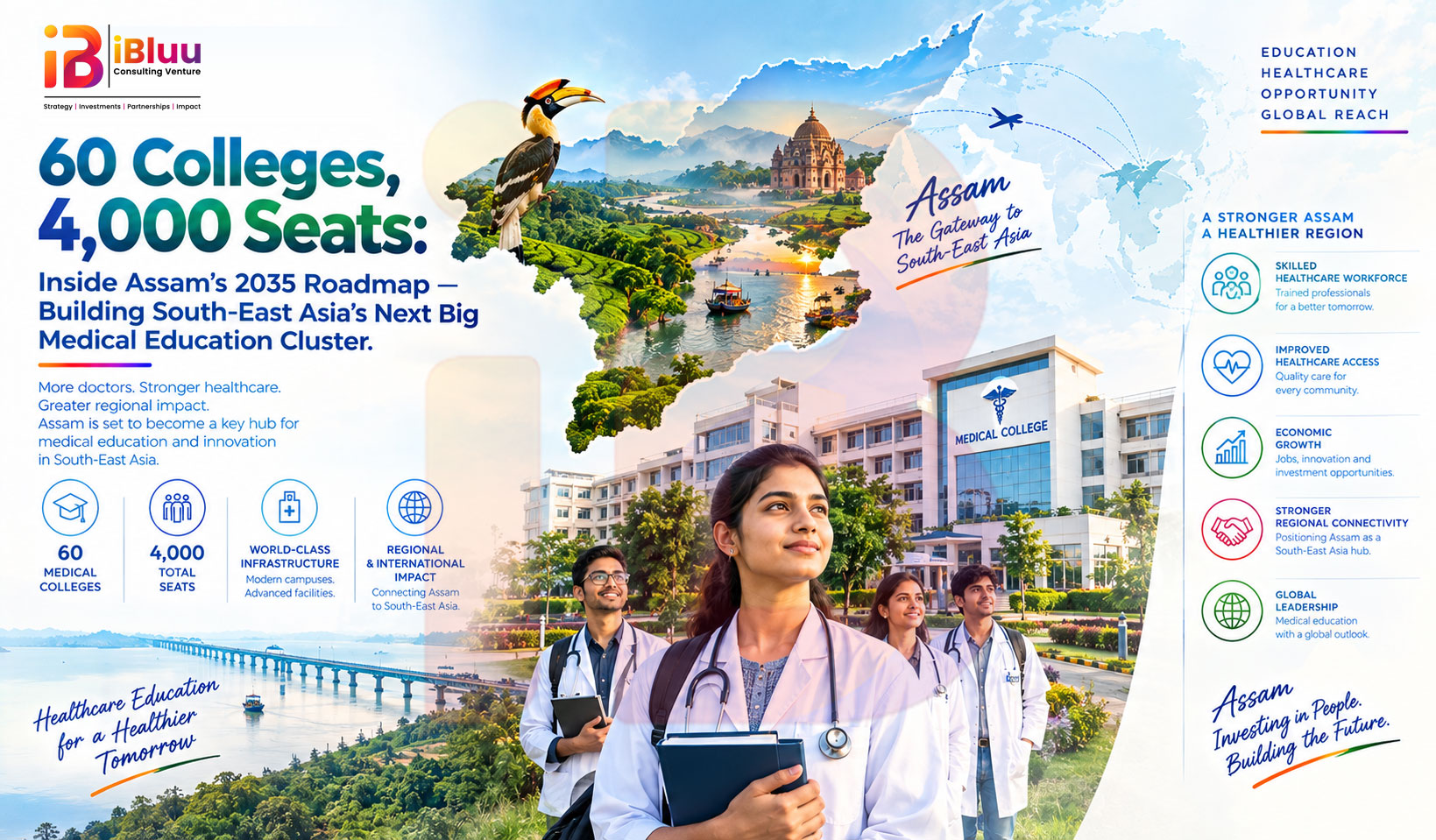
Inside Assam’s 2035 Roadmap to Build South-East Asia’s Next Medical Education Powerhouse—Anchored in Clinical Excellence, Global Talent and Institutional Capability
60 Colleges, 4,000 MBBS Seats: From Regional Healthcare Expansion to Global Talent Infrastructure—How Assam Could Transform Medical Education, Specialised Clinical Care, Research, Workforce Mobility and Cross-Border Partnerships into a New Engine of Economic Transformation.
Executive Summary: Assam Is Building More Than Medical Colleges
Assam’s medical education ambitions point towards a much larger economic proposition: the emergence of a healthcare, education and skilled-workforce ecosystem serving North-East India and potentially extending into South Asia and South-East Asia.
The state’s ambition is substantial. It is targeting 4,000 MBBS seats by 2031 and has articulated a longer-term vision of more than 60 medical colleges by 2035. Recent announcements indicate that Assam has 16 medical colleges and is planning 32 additional institutions, alongside the expansion of specialised clinical infrastructure and professional education. These are ambitious policy objectives—not completed infrastructure—and their success will depend on the pace of approvals, funding, faculty recruitment, clinical capacity and institutional quality.
The strategic opportunity is not simply to produce more doctors.
It is to create a system in which medical education, hospital networks, biomedical research, nursing, diagnostics, digital health, pharmaceutical services and international workforce partnerships reinforce one another.
That distinction matters.
A medical college can expand educational access. A connected network of medical colleges, teaching hospitals, research centres, simulation laboratories, nursing institutions and industry partners can create an economic cluster.
Assam’s opportunity is to move from building medical institutions to building medical capabilities—and from producing graduates to exporting globally relevant healthcare expertise.
The distinction will determine whether the 2035 vision becomes a sustainable regional growth engine or a large infrastructure programme carrying substantial operating and financing obligations.
1. The Numbers Behind the 2035 Vision
Assam has already expanded its medical education infrastructure considerably. The next phase will test whether the state can translate institutional growth into higher-quality clinical training, stronger workforce availability and internationally competitive capabilities.
The ambition at a glance
| Strategic indicator | Position or target | What it means |
|---|---|---|
| Existing medical college network | 16 institutions reported in 2026 | The starting platform for expansion |
| MBBS seats | 1,975 approved seats in the 2026–27 seat matrix as reported in September 2026 | Current baseline; subject to regulatory updates |
| Annual MBBS seat ambition | 4,000 by 2031 | More than doubles the reported current seat capacity |
| Medical college ambition | More than 60 by 2035 | Long-term expansion across public and private participation |
| Additional institutions | 32 more medical colleges announced in the expansion plan | A major pipeline requiring phased implementation |
| District-level education vision | One medical college, one engineering college and one university in every district | Regional access and distributed skills development |
| Specialised cancer-care network | A planned network of 17 cancer facilities | A foundation for advanced care, referral networks and clinical learning |
| International workforce development | Language and skills pathways, including Japanese-language training initiatives | Potential bridge between education and overseas employment |
The current seat baseline and 2031 target are grounded in the latest reported state figures and published seat-matrix data. The 2035 college ambition and district-level model should be understood as policy aspirations, not as evidence that all institutions have been approved, funded or scheduled for completion.
The arithmetic reveals the scale of the challenge. Moving from 1,975 approved seats to 4,000 requires an increase of approximately 103%—more than doubling annual intake capacity. Reaching the 2035 institutional ambition will require a parallel expansion in faculty, teaching hospitals, laboratories, student accommodation, equipment, digital infrastructure and recurring operating expenditure.
The strategic question is therefore not whether Assam can announce more institutions.
It is whether institutional capacity can expand without diluting educational quality or creating financially fragile campuses.
2. The Real Strategic Shift: From Healthcare Access to Healthcare Capability
Medical education policy is often measured through colleges opened, seats approved and buildings completed. Those metrics matter, but they are incomplete.
A more sophisticated assessment asks whether the expansion improves five interconnected outcomes:
- Access: Can students and patients reach institutions without disproportionate travel and financial burden?
- Capability: Are graduates receiving rigorous clinical exposure, supervised practice and contemporary training?
- Retention: Can Assam attract and retain doctors, nurses, researchers, faculty and specialised healthcare professionals?
- Innovation: Can institutions develop research, diagnostics, clinical data and technology-enabled care capabilities?
- Market relevance: Can graduates and institutions serve domestic needs while meeting legitimate international standards?
These outcomes reinforce one another. Better clinical infrastructure strengthens education. Stronger education improves recruitment and retention. Research capabilities create opportunities for industry partnerships. International recognition can attract students, visiting faculty and collaborative programmes.
But the sequence is not automatic.
If seat capacity expands faster than faculty and patient-facing clinical infrastructure, the system risks producing nominal capacity rather than substantive capability.
The objective must be to expand the capacity to teach, diagnose, treat and innovate—not merely the capacity to enrol.
3. “One District, One Institution”: The Geography of Human Capital
Assam’s district-level education vision—one medical college, one engineering college and one university in every district—offers a potentially transformative approach to regional development.
Its significance extends beyond education.
A medical college can anchor a broader local economy involving healthcare employment, diagnostic services, pharmacies, laboratories, student housing, transport, food services, medical equipment distribution and professional training. When linked with engineering education and a university, the potential expands into health technology, biomedical engineering, data analytics, public health, medical devices and applied research.
The strongest version of this model is not three disconnected institutions in every district. It is a coordinated regional capability platform.
Consider the potential relationships:
| Institutional layer | Strategic function | Wider economic spillover |
|---|---|---|
| Medical college and teaching hospital | Clinical training and healthcare delivery | Doctor and nursing employment, diagnostics and hospital services |
| Engineering college | Technology and engineering talent | Biomedical devices, health IT, equipment maintenance and automation |
| University | Research and interdisciplinary learning | Public health, data science, management and applied research |
| Nursing and allied-health institutions | Workforce development | Nursing, laboratory technology, rehabilitation and patient-care services |
| Industry and clinical partners | Applied training and innovation | Internships, technology adoption, research collaboration and specialised employment |
This model can distribute economic opportunity beyond Guwahati and reduce the concentration of professional education in a few urban centres.
However, one institution in every district should not be interpreted as a requirement to build every institution from scratch. Existing colleges, district hospitals, regional universities and technical institutes may offer opportunities for phased integration, shared facilities and carefully structured partnerships.
Nor does every district necessarily require the same scale of medical infrastructure. Population, disease burden, referral patterns, transport access, faculty availability and fiscal capacity should determine institutional configuration.
The goal should be equitable access to quality—not uniform construction irrespective of demand.
4. Four Thousand MBBS Seats: The Workforce Mathematics
The 4,000-seat target by 2031 is one of the most consequential milestones in Assam’s medical education strategy.
At the reported baseline of 1,975 seats, the state needs to add approximately 2,025 annual seats to reach the target.
That is not simply an admissions exercise. Each additional seat creates a multi-year obligation to provide appropriate teaching, clinical exposure, supervision and assessment.
A simplified planning framework illustrates the scale:
| Planning variable | Illustrative implication |
|---|---|
| Additional annual intake required | Approximately 2,025 seats, relative to the 1,975-seat baseline |
| Course duration | Five-and-a-half-year MBBS pathway, including the compulsory internship |
| Mature-cohort effect | A sustained increase in annual intake creates a much larger number of students requiring simultaneous training and supervision |
| Faculty requirement | Additional teaching faculty, clinical supervisors and academic leadership |
| Clinical requirement | Sufficient patient volumes, specialty departments, diagnostic services and supervised practical training |
| Student infrastructure | Laboratories, libraries, hostels, simulation facilities and digital learning systems |
| Postgraduate pathway | Additional residency positions, specialty departments and accredited training capacity |
The 5.5-year course duration means that seat expansion creates a rolling pipeline of students across multiple academic years. Capacity must therefore be planned across the entire training cycle rather than only against the next admission round.
The postgraduate dimension is equally important. MBBS expansion alone cannot produce the specialists required for oncology, emergency medicine, anaesthesia, radiology, pathology, critical care and other advanced disciplines.
Assam will need to coordinate undergraduate expansion with postgraduate and super-specialty training, nursing education, allied-health programmes and continuing professional development.
The strategic objective should be to create a complete workforce ladder—from entry-level patient care to specialist practice, academic medicine and clinical research.
More seats are the input. More competent, deployable and well-supported healthcare professionals are the outcome.
5. The Cancer-Care Network: A Foundation for Clinical Scale
Assam’s cancer-care programme offers an important example of how distributed healthcare infrastructure can support a wider medical education ecosystem.
The Assam Cancer Care Foundation, established through a partnership between the state government and Tata Trusts, was designed around a distributed model of cancer diagnosis and treatment. Its planned network comprises 17 facilities, combining advanced centres with regional treatment and diagnostic capacity. Seven centres were inaugurated in April 2022, and additional facilities have been brought into the network or remained in development through subsequent phases.
The strategic value is larger than the number of hospitals.
A connected cancer-care system can support:
- Earlier diagnosis and more systematic referral pathways.
- Oncology, pathology, radiology and specialised nursing training.
- Multidisciplinary clinical practice and shared treatment protocols.
- Remote consultations and coordinated case management.
- Clinical research and better use of specialised equipment.
- Training partnerships across medical colleges and regional hospitals.
Cancer care also exposes a critical workforce constraint. Advanced equipment cannot deliver its full value without trained oncologists, radiographers, pathologists, oncology nurses, medical physicists and other specialised personnel. Workforce development must therefore advance alongside capital expenditure.
The broader lesson is highly relevant to Assam’s 2035 roadmap: specialised clinical networks can become the operating backbone of medical education, not merely a parallel healthcare programme.
If teaching institutions are systematically connected to these networks, students can benefit from stronger clinical exposure, faculty can collaborate across facilities, and research capabilities can develop around real regional health needs.
6. Guwahati and the Emerging Clinical-Research Core
Guwahati is positioned to play a central role in Assam’s advanced medical education and referral system.
Institutions such as Gauhati Medical College and Hospital, together with AIIMS Guwahati and the wider network of medical colleges, provide a foundation for advanced clinical care, academic collaboration and specialised training. The state’s health university, Srimanta Sankaradeva University of Health Sciences, can also play a coordinating role in academic standards and professional education.
But a true medical hub requires more than several large hospitals within one city.
It requires a connected system of:
- Referral medicine: Regional hospitals that can transfer complex cases to higher-capability centres.
- Academic medicine: Structured collaboration between teaching faculty, clinicians and researchers.
- Clinical data infrastructure: Secure, interoperable systems supporting patient care, quality improvement and approved research.
- Specialised diagnostics: Pathology, imaging, molecular diagnostics and laboratory networks.
- Research partnerships: Collaboration with universities, biotechnology firms, pharmaceutical companies and medical-device developers.
- Professional development: Continuous training for doctors, nurses, technicians and hospital managers.
This is where Assam could build a distinctive advantage. Rather than attempting to reproduce every metropolitan healthcare model, the state could specialise in regional referral medicine, cancer care, tropical and infectious diseases, public health, maternal and child health, emergency medicine and digitally enabled healthcare delivery—subject to clinical demand, research capacity and sustained investment.
The strategic choice is to build depth in selected areas while ensuring that foundational care remains strong across the state.
7. From Local Education to an International Workforce Pipeline
The international dimension of Assam’s ambition is particularly important because the healthcare workforce market is becoming increasingly interconnected.
Ageing populations, nursing shortages and rising long-term care requirements in some advanced economies create potential opportunities for qualified healthcare professionals. Assam’s location, education infrastructure and youthful workforce could help it participate in these markets.
Japan is one potential destination. The state has published information on Japanese-language testing associated with the specified skilled-worker programme for the nursing-care sector. This is a tangible workforce-development pathway, but it should not be confused with a blanket requirement that all medical students study Japanese or a guarantee of overseas employment.
A credible international workforce strategy needs several layers.
Language proficiency. Japanese, Korean or other language training should be aligned to specific destination markets and occupations. Language proficiency is essential for safe patient interaction, professional integration and regulatory compliance.
Recognised qualifications. Overseas employment depends on the destination country’s licensing, credential-recognition, examination and immigration requirements. A language certificate is not a substitute for professional registration.
Occupation-specific pathways. Registered nursing, nursing assistance, elder care, medical technology and physician practice have different qualification and licensing requirements. These pathways must not be conflated.
Ethical recruitment. Transparent contracts, reasonable recruitment costs, worker protection and reliable grievance mechanisms are critical to a sustainable talent-export model.
Post-placement support. Language training, cultural orientation, workplace preparation and continuing professional development can improve retention and employer confidence.
Assam should also distinguish between exporting talent and losing talent.
International mobility can generate income, skills and professional networks, but aggressive outward recruitment may worsen local shortages if domestic workforce planning is weak. A balanced system should expand training capacity, improve working conditions and create credible career pathways at home while supporting voluntary international mobility.
The objective is not to send the largest number of workers abroad. It is to develop professionals whose skills are recognised, whose employment is ethical and whose careers create value for both Assam and destination markets.
8. The South-East Asian Opportunity: Geography Is an Advantage, Not a Business Model
Assam’s geographic position creates a potential platform for healthcare collaboration with Bangladesh, Bhutan, Nepal and Myanmar, as well as selected South-East Asian markets.
However, geography alone does not create an international medical education hub. Students and patients choose destinations based on quality, affordability, recognition, accessibility, language, safety and confidence in clinical outcomes.
Assam’s international strategy should therefore distinguish between three markets.
Market A: Regional medical education
Potential international students may be attracted by affordable tuition, accessible accommodation, recognised qualifications and strong clinical training. To compete, Assam would need clear international admissions processes, appropriate student support, transparent fees and evidence of academic quality.
Market B: Cross-border clinical care
Patients may seek services that are unavailable locally, difficult to access or more expensive in their home market. The opportunity is strongest in selected specialties where Assam can demonstrate reliable outcomes, efficient referral pathways and clear pricing.
This requires more than hospital infrastructure. International patient services need referral coordination, interpreters, travel support, transparent billing, medical records and follow-up care.
Market C: Healthcare workforce and training partnerships
Universities and hospitals can develop joint training, visiting-faculty programmes, nursing-care curricula, simulation-based education and continuing professional development.
Such partnerships can build institutional credibility before large-scale international student recruitment becomes commercially viable.
The correct strategic sequence is to establish quality and recognition, build selected cross-border partnerships, demonstrate service reliability and then scale international recruitment.
Assam should not market itself as a global hub before it has built globally credible capabilities. It should build the capabilities that make the claim defensible.
9. The Financial Architecture: Who Pays, Who Operates and Who Bears the Risk?
The medical education opportunity is substantial, but the financial model deserves the same scrutiny as the infrastructure ambition.
Medical colleges and teaching hospitals are capital-intensive, operationally complex institutions. Their cost base includes land, construction, medical equipment, laboratories, faculty, clinical staff, utilities, consumables, maintenance, digital systems and regulatory compliance.
There is no single reliable capital-cost figure that can be applied to every proposed Assam medical college without knowing its size, location, bed strength, specialty mix, teaching facilities, existing assets and delivery model. A credible investment case must therefore be based on institution-specific feasibility studies rather than a headline multiplication of colleges by an assumed cost.
The institutional cost stack
| Cost category | Key investment question |
|---|---|
| Land and site development | Is the site accessible, serviceable and suitable for long-term clinical operations? |
| Academic and hospital construction | What bed capacity, teaching space and specialty mix are required? |
| Medical equipment | Can procurement, utilisation, maintenance and replacement be funded over the asset lifecycle? |
| Faculty and clinical workforce | Can the institution recruit and retain qualified staff at a sustainable cost? |
| Digital infrastructure | Are hospital information systems, cybersecurity, connectivity and data governance adequately funded? |
| Student infrastructure | Are hostels, laboratories, libraries and simulation facilities included in the complete project cost? |
| Operating expenditure | Can salaries, medicines, consumables, utilities and maintenance be financed every year? |
| Quality assurance | Is there sufficient provision for accreditation, audits, clinical governance and continuing education? |
The critical distinction is between capital expenditure and sustainable operating capacity.
A building can be financed through a one-time capital allocation. A teaching hospital requires recurring expenditure for as long as it operates.
Public funding and private participation
Public investment will remain essential where institutions serve underserved districts, deliver low-margin essential services or address strategic workforce shortages.
Private capital may have a role in selected medical colleges, diagnostics, hospitals, student accommodation, equipment services, digital health and allied-health education. Public-private partnerships may also help structure particular projects, provided risk allocation and service obligations are explicit.
But private participation should not be treated as a universal funding solution. Medical education is heavily regulated, clinical quality cannot be compromised, and affordability obligations can conflict with investor return expectations.
Each project needs a transparent financial model covering:
- Total project cost and contingency.
- Construction and commissioning schedule.
- Faculty recruitment and ramp-up costs.
- Student intake and utilisation assumptions.
- Hospital occupancy and specialty mix.
- Fee income and affordability constraints.
- Public-service obligations and potential subsidies.
- Maintenance, equipment replacement and lifecycle costs.
- Debt-service capacity, downside scenarios and exit constraints.
The bankability test is not whether a project can be built. It is whether the institution can remain clinically credible, financially sustainable and accessible over its operating life.
10. Investment Opportunities Beyond the Medical College
The larger opportunity may lie in the ecosystem surrounding the institution rather than in college construction alone.
A growing medical education network can generate demand across multiple adjacent sectors.
| Opportunity | Potential investment or partnership model | Principal diligence question |
|---|---|---|
| Diagnostics and laboratory networks | Hospital contracts, regional hubs and specialist partnerships | Is there sufficient patient volume and qualified staffing? |
| Medical equipment and maintenance | Procurement, leasing and managed-service contracts | Can equipment utilisation justify the lifecycle cost? |
| Digital health and hospital systems | Software, implementation and managed services | Are interoperability, cybersecurity and procurement risks controlled? |
| Nursing and allied-health training | Public, private and collaborative education models | Are course quality and employer demand demonstrable? |
| Student housing and campus services | Development, leasing and facility management | Is student demand sufficient outside major centres? |
| Clinical research support | Research services and institutional partnerships | Are ethics, governance, patient consent and data protection robust? |
| Medical logistics and supply chains | Distribution, cold-chain and inventory services | Can scale, reliability and procurement discipline be sustained? |
| International education services | Student recruitment and support partnerships | Are qualifications recognised and recruitment practices ethical? |
| Rehabilitation and long-term care | Specialist facilities and integrated service models | Is there a clear referral base and viable payer mix? |
The best investment opportunities will not necessarily be the largest projects. They will be the opportunities with the clearest demand, measurable utilisation, strong counterparties and manageable operating risks.
Investors should avoid underwriting demand simply because a new medical college has been announced nearby. A proposed campus does not automatically generate a viable hospital, accommodation market or research ecosystem.
11. The Research and Technology Layer: From Clinical Demand to Innovation
A competitive medical education cluster needs a technology and research strategy that extends beyond teaching equipment.
Assam could develop selected areas of research around regional health priorities, including cancer, infectious diseases, maternal and child health, emergency medicine, public health and healthcare delivery across geographically dispersed communities.
Potential platforms include:
- Clinical research and evidence-generation partnerships.
- Biomedical and diagnostic technology evaluation.
- AI-assisted workflows where clinically validated and appropriately governed.
- Telemedicine and remote specialist consultation.
- Digital pathology and radiology collaboration.
- Medical-device testing and maintenance capabilities.
- Health informatics, epidemiology and population-health research.
- Simulation-based education and continuing professional training.
These opportunities require strong safeguards. Patient privacy, informed consent, research ethics, data security, algorithmic reliability and clear clinical accountability are non-negotiable.
AI and digital systems should strengthen clinical judgement and service access—not be treated as substitutes for trained professionals or rigorous medical oversight.
The most valuable research model will connect real clinical problems to academic expertise and carefully selected industry partners.
A medical hub becomes more strategically valuable when it can generate knowledge, test solutions and improve care—not merely consume imported technology.
12. Geopolitics and Regional Positioning: The Healthcare Dimension of Act East
Assam’s potential healthcare role also intersects with India’s wider regional connectivity and economic engagement with neighbouring countries.
The state’s location can support professional exchanges, education partnerships, clinical collaboration and selected cross-border healthcare services. Yet regional proximity should not be mistaken for frictionless access.
International healthcare and education partnerships must account for visa rules, professional licensing, recognition of qualifications, patient mobility, payment systems, language, data protection and diplomatic conditions.
The strongest approach is selective rather than indiscriminate.
Assam could begin with institution-to-institution partnerships, visiting-faculty arrangements, nursing-care training, joint research and clearly defined referral programmes. These are more manageable starting points than attempting to attract large volumes of international patients or students before service quality and administrative systems are ready.
The strategic objective should be to establish trusted, repeatable partnerships that can grow over time.
Regional geography opens the door. Institutional credibility determines whether partners walk through it.
13. The Risks: Where the 2035 Roadmap Could Lose Momentum
The roadmap’s ambition is real. So are its execution risks.
Risk 1: Infrastructure outpaces faculty
Medical colleges cannot operate as intended without qualified faculty and clinical supervisors. Rapid expansion may intensify competition for experienced doctors and academic staff.
Response: Use phased approvals, faculty development, structured academic partnerships, retention incentives and realistic commissioning milestones.
Risk 2: Seat growth dilutes clinical exposure
More students without proportionate patient volumes, equipment and supervised training can weaken educational outcomes.
Response: Link seat approvals and expansion decisions to verifiable teaching-hospital capacity, clinical workload, staffing and quality indicators.
Risk 3: Construction succeeds while operations struggle
Projects can be completed physically but underperform because recurring funding, recruitment and maintenance were underestimated.
Response: Require whole-life cost models, operating reserves and multi-year staffing plans before major capital commitments.
Risk 4: Uneven regional demand
Some districts may not support the same scale or specialty mix as larger urban centres.
Response: Match facilities to regional need; use shared services, satellite teaching facilities, district hospitals and referral networks where appropriate.
Risk 5: Private capital is misaligned with public purpose
Investor returns, fee affordability and access to essential services may conflict if contracts are poorly structured.
Response: Define clinical obligations, affordability safeguards, quality requirements, performance reporting and risk-sharing arrangements in advance.
Risk 6: International recruitment is overestimated
Interest from foreign students or overseas employers may not convert into actual enrolment, licensing or placement.
Response: Validate demand through signed partnerships, employer commitments, student research and destination-country qualification requirements.
Risk 7: Brain drain undermines local services
International employment may be attractive to graduates, while local hospitals continue to face shortages.
Response: Improve domestic career pathways and working conditions, expand workforce supply and structure international programmes ethically.
Risk 8: Research ambitions lack the necessary foundation
Research centres without funding continuity, qualified investigators, ethics systems and institutional partnerships may struggle to produce meaningful results.
Response: Concentrate initial investment on selected centres of excellence with clear research priorities and measurable outputs.
The central risk is not a lack of ambition. It is the possibility of expanding physical capacity faster than institutional capability.
14. Three Scenarios for 2035
The state’s future is not predetermined by the number of colleges announced. It will depend on the quality of execution and the depth of integration across education, healthcare and industry.
| Scenario | What happens | Strategic outcome |
|---|---|---|
| Downside: Expansion without integration | Institutions open, but staffing, clinical exposure, operating finance and research partnerships lag | More physical capacity, uneven quality and persistent operational pressure |
| Base case: Strong regional network | Seat expansion progresses, district-level access improves, and teaching hospitals become better connected | Assam strengthens its role as North-East India’s medical education and referral-care centre |
| Upside: Integrated healthcare cluster | Education, specialised clinical networks, research, digital health, private participation and international partnerships reinforce one another | Assam develops selected capabilities with national and cross-border relevance |
These are strategic scenarios, not statistical forecasts. Assigning probabilities or financial returns would require a detailed project pipeline, fiscal data, operating-cost estimates, workforce projections and verified demand evidence.
The upside scenario is possible only if the state builds institutional quality and economic linkages alongside physical infrastructure.
15. What Assam Should Do Now: A Practical Execution Agenda
The next phase should move from broad ambition to a disciplined implementation architecture.
For state policymakers
1. Publish a phased medical education masterplan. Set out institution-wise status, proposed intake, regulatory milestones, land readiness, funding source, faculty plan and expected commissioning date.
2. Build a workforce-first expansion model. Forecast doctors, nurses, specialists, faculty and allied-health professionals required under different demand scenarios.
3. Link investment to quality gates. Establish measurable thresholds for faculty availability, clinical exposure, equipment readiness, patient safety and academic performance.
4. Integrate teaching hospitals into regional networks. Develop referral protocols, shared specialist services, telemedicine links and structured clinical rotations.
5. Create a transparent project-finance framework. Disclose capital commitments, recurring funding requirements, procurement status and key delivery risks.
6. Develop a focused international strategy. Prioritise a small number of credible education, clinical and workforce partnerships before expanding into additional markets.
For universities and healthcare institutions
- Build faculty-development and clinical-supervision programmes.
- Strengthen nursing, allied-health and postgraduate pathways.
- Develop research partnerships tied to defined clinical priorities.
- Introduce language training where it serves a verified workforce pathway.
- Establish clear systems for clinical governance, research ethics and data protection.
- Measure graduate outcomes, employer satisfaction and professional retention.
For investors and developers
- Evaluate projects on whole-life economics rather than construction cost alone.
- Validate demand and staffing availability before committing capital.
- Assess regulatory, clinical, affordability and public-service obligations.
- Prioritise enabling services where demand and utilisation can be demonstrated.
- Structure public-private contracts with clear responsibilities and measurable performance standards.
- Treat international recruitment and medical tourism as opportunities to validate—not assumptions to capitalise in advance.
For international partners
- Begin with institutional collaboration and specific training needs.
- Map qualification recognition and professional licensing before recruiting.
- Establish transparent agreements on curriculum, assessment and placement.
- Build ethical recruitment, worker protection and post-placement support into programme design.
- Evaluate partnerships on graduate competency, patient safety and sustained outcomes.
16. The Metrics That Will Determine Success
Assam should measure the roadmap through a public performance dashboard that tracks whether institutional expansion is producing real-world value.
| Dimension | Suggested performance indicators |
|---|---|
| Infrastructure delivery | Projects commissioned against schedule; budget variance; regulatory readiness |
| Academic capacity | Approved and filled seats; faculty vacancies; student-to-faculty ratios |
| Clinical quality | Patient safety indicators; clinical training exposure; quality-assurance performance |
| Workforce outcomes | Graduation rates; postgraduate progression; recruitment and retention |
| Regional access | Travel time to essential services; referral completion; utilisation by underserved populations |
| Research | Funded projects; peer-reviewed outputs; clinical collaborations and translation into practice |
| Financial sustainability | Operating cost per student; utilisation; maintenance backlog; recurring funding coverage |
| International engagement | Active institutional agreements; eligible student enrolment; compliant workforce placements |
| Private participation | Capital deployed; projects commissioned; service quality and contractual performance |
These indicators should be disaggregated by institution and region. Statewide averages can conceal significant differences in quality and access.
Targets should be published only where baselines and measurement methods are defined. Otherwise, dashboards risk becoming another reporting exercise rather than a tool for accountability.
17. The Larger Economic Proposition: Healthcare as Productive Infrastructure
Medical education is often treated as a social-sector expenditure. That description is incomplete.
A well-designed healthcare education system builds human capital, improves access to essential services, creates skilled employment and supports productivity across the wider economy.
Its economic effects extend into construction, equipment, pharmaceuticals, diagnostics, digital services, accommodation, transport, research and professional training. More importantly, stronger healthcare capacity can improve the resilience of communities and the attractiveness of a region for investment and skilled workers.
The benefits are not automatic. They depend on quality, access, workforce retention, financial sustainability and whether institutions solve genuine healthcare needs.
But the strategic logic is powerful.
Healthcare can be both a public-service foundation and a platform for economic capability.
Assam’s ambition creates an opportunity to connect those two objectives: improve healthcare access for its population while building institutions capable of attracting students, research partners, employers and selected cross-border collaborations.
The most credible path is not to pursue international visibility at the expense of domestic needs. It is to build a high-quality regional system whose strengths make wider participation possible.
18. iBluu Perspective: Build the Capability, Then Scale the Cluster
The defining opportunity in Assam’s 2035 roadmap is the convergence of education, healthcare, technology, workforce development, research and regional connectivity.
A medical college is an institution. A teaching hospital is a clinical asset. A cancer-care network is specialised infrastructure. A university is a platform for knowledge.
Their combined value emerges when they operate as one connected economic and human-capital system.
That requires more than capital expenditure. It requires institutional design, disciplined project sequencing, workforce planning, sustainable financing, technology integration and partnerships that create measurable value.
The analytical depth of this article has been shaped by the strategic lens of J Parasher, Founder and Managing Director of iBluu Consulting Venture (iBCV), a venture of iBluu Corporations, whose work consistently focuses on national capability building, global industrial benchmarking and long-horizon economic transformation. His perspective reframes consulting not as a sectoral play, but as a strategic economic system with export potential, innovation leverage and geopolitical relevance.
From this perspective, Assam’s medical education roadmap should be assessed through a wider chain of value creation:
Education → Clinical Capability → Research → Technology → Skilled Employment → Regional Integration → International Collaboration → Economic Competitiveness.
The role of strategic advisory is to help connect these layers—translating public ambition into executable programmes, investable opportunities and measurable outcomes.
Conclusion: The 2035 Test Is Not How Many Colleges Assam Builds
Assam has an opportunity to strengthen its position as a medical education and healthcare centre for North-East India, with the potential to develop selected international capabilities over time.
The 4,000-seat target by 2031 and the ambition to exceed 60 medical colleges by 2035 establish the scale of the challenge. The next stage must focus on quality, workforce availability, clinical capacity, operating sustainability and partnerships that deliver real value.
The state does not need to choose between widening domestic healthcare access and building international relevance. It can pursue both—but only if expansion is designed around institutional capability rather than infrastructure counts.
The defining question is not whether Assam can build more medical colleges.
It is whether those colleges can become the foundation of a connected system that trains better professionals, delivers stronger clinical outcomes, generates research, creates skilled employment and serves regional needs with international credibility.
Sixty colleges may define the scale of the ambition. Four thousand seats may define the next milestone. But quality, capability and trust will determine the legacy.
Assam’s opportunity is not merely to produce more healthcare professionals. It is to build a healthcare ecosystem that the region can rely on—and the wider world has reason to engage with.
Disclaimer: This article is an independent strategic analysis intended for informational and thought-leadership purposes. Government targets, institutional expansion plans and seat figures reflect publicly reported positions available at the time of writing and may change subject to regulatory approvals, funding, implementation schedules and official revisions. Scenario analysis and investment opportunities are indicative, not forecasts or guarantees of returns. Any investment, public-private partnership, education or workforce programme should be evaluated through appropriate legal, regulatory, financial, clinical and operational due diligence.