+91 945 889 6091
  infodesk@ibluu.com
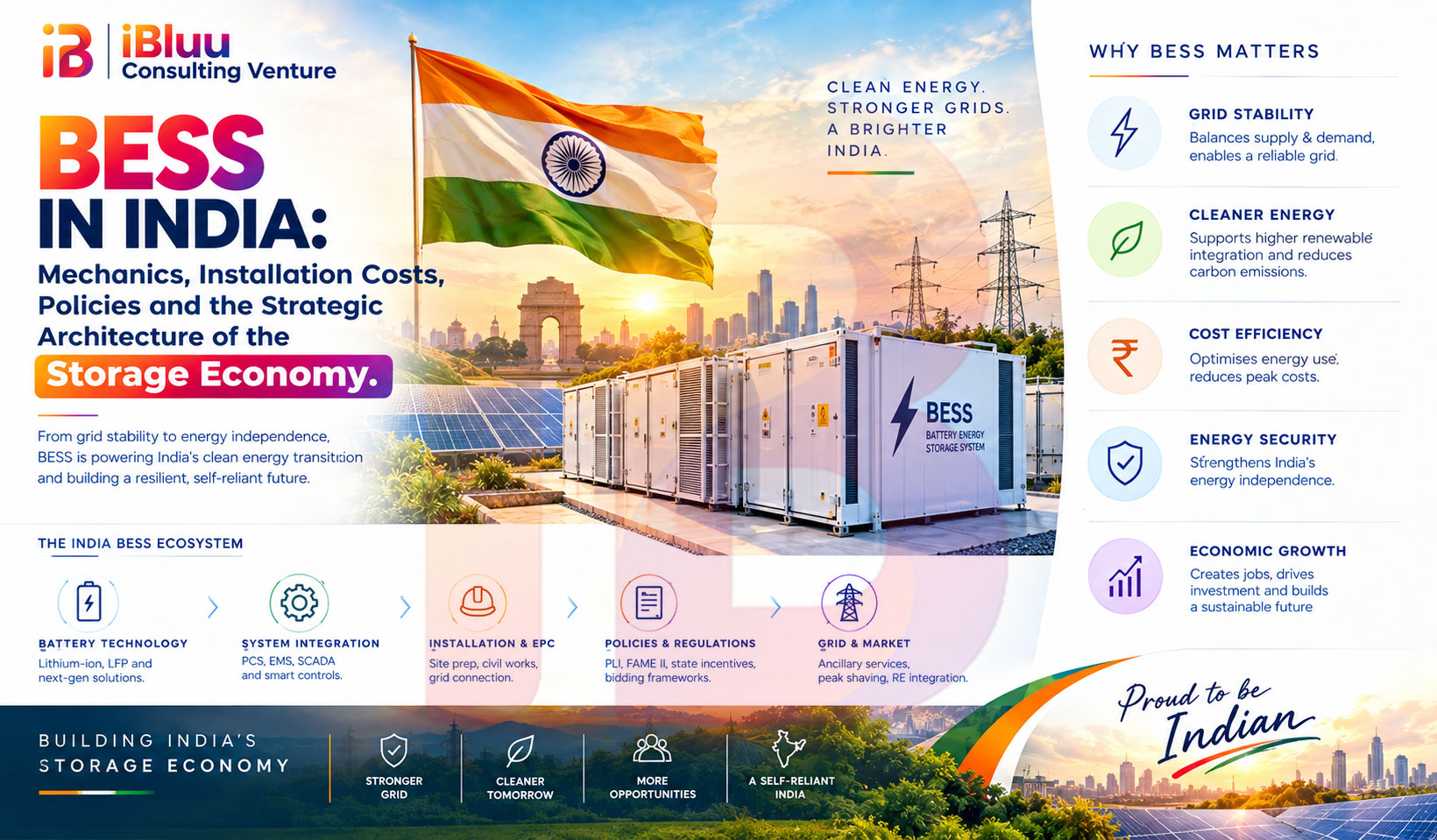
BESS in India: Mechanics, Installation Costs, Policies and the Strategic Architecture of the Storage Economy
From intermittent renewable generation to dispatchable power: how Battery Energy Storage Systems are reshaping India’s electricity market, infrastructure economics and investment landscape.
India’s renewable-energy story is entering a more consequential phase.
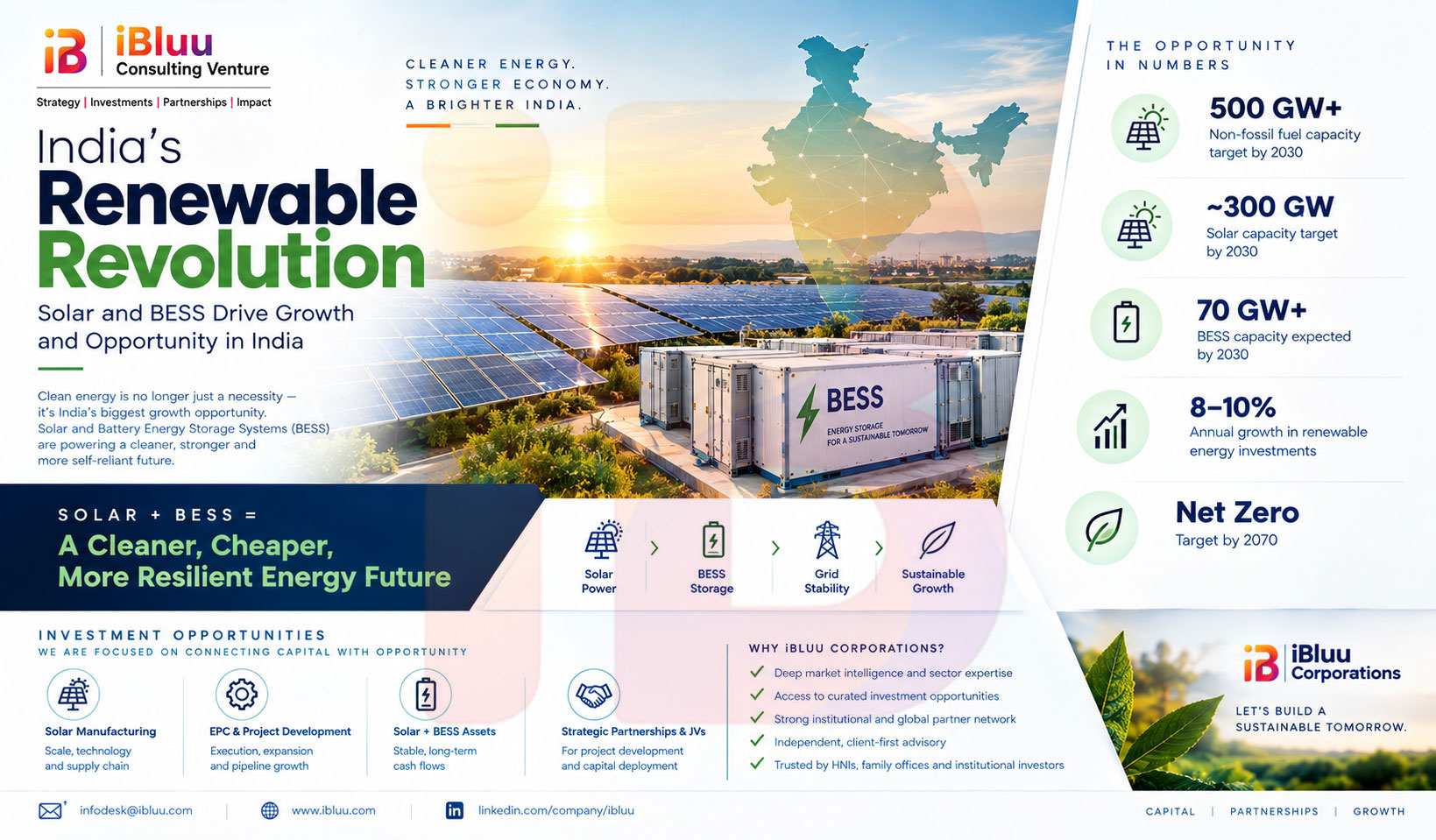
The country has already demonstrated that renewable generation can scale. As of 31 August 2026, India had approximately 168.04 GW of installed solar capacity and 304.33 GW of total non-fossil electricity capacity. India had already crossed the 300 GW non-fossil milestone in July 2026—more than 60% of its 500 GW 2030 target.
The next challenge is fundamentally different.
India does not simply need more renewable electricity. It needs the ability to decide when that electricity is available, where it is delivered and how reliably it can serve demand.
That is the strategic role of Battery Energy Storage Systems (BESS).
BESS can absorb electricity when generation exceeds immediate demand and discharge it when the system needs additional power. In a renewable-heavy grid, this transforms storage from an auxiliary technology into a critical piece of power infrastructure.
The implication is significant: solar creates energy abundance; BESS creates temporal flexibility.
And as India’s renewable fleet expands, flexibility is becoming an economic asset.
1. Why BESS Has Become Strategically Important for India
Solar and wind are inherently variable.
Solar generation peaks during daylight hours, while electricity demand often peaks at different times. Wind output can also fluctuate according to weather conditions. As the share of variable renewable energy rises, the power system must increasingly manage mismatches between generation, demand, transmission availability and grid stability.
BESS addresses part of this mismatch.
A simplified operating cycle is:
Low-demand / high-renewable generation → Charge BESS → Store electricity → Peak-demand / low-renewable generation → Discharge BESS
This enables several applications:
- Renewable-energy time shifting
- Peak-load management
- Grid balancing
- Frequency and ancillary services
- Renewable firming
- Reduction of renewable curtailment
- Transmission congestion management
- Capacity support
- Commercial and industrial peak management
- Diesel-generator replacement in selected applications
- Backup and reliability services
- Energy arbitrage where market structures permit it
The Central Electricity Authority has identified energy storage as essential for integrating India’s growing renewable fleet. Its planning framework projects 236.22 GWh of BESS requirement by 2031–32, alongside 175.18 GWh from pumped storage, taking total projected storage requirements to approximately 411.4 GWh.
This is not a marginal infrastructure requirement.
It represents a new capital-intensive layer of India’s power system.
2. The Difference Between GW and GWh
One of the most important concepts for evaluating BESS is the distinction between power capacity and energy capacity.
GW = how much power the system can deliver at a given moment.
GWh = how much energy the system can store and deliver over time.
For example:
100 MW / 200 MWh BESS
can theoretically discharge at 100 MW for approximately two hours, subject to operating limits, usable state of charge, efficiency and reserve requirements.
A:
100 MW / 400 MWh BESS
represents approximately four hours of nominal duration at a 100 MW discharge rate.
This distinction is fundamental to investment analysis.
A 1 GW BESS is not economically comparable with another 1 GW BESS unless the duration, usable energy, cycling profile, degradation assumptions, efficiency and revenue model are also understood.
MW defines power.
MWh defines duration.
Revenue depends on how both are used.
3. How a BESS Actually Works
A utility-scale BESS is not simply a container full of batteries.
It is an integrated electrical, digital, thermal and safety system.
Core architecture
| Component | Strategic Function |
|---|---|
| Battery cells | Store electrical energy electrochemically |
| Battery modules/racks | Aggregate cells into scalable storage blocks |
| Battery Management System (BMS) | Monitors voltage, temperature, current, state of charge and system health |
| Power Conversion System (PCS) | Converts DC battery power to AC and AC to DC |
| Energy Management System (EMS) | Determines when and how the battery charges and discharges |
| Thermal management | Controls operating temperature and protects performance |
| Transformer & switchgear | Connects the BESS to the electrical network |
| Protection systems | Isolate faults and protect equipment and grid |
| SCADA/communications | Enables monitoring, control and operational visibility |
| Fire detection/suppression | Addresses thermal-event and fire-safety risks |
| HVAC/cooling | Maintains acceptable operating conditions |
| Civil infrastructure | Foundations, roads, drainage, fencing and site infrastructure |
| Grid interconnection | Connects the BESS to transmission or distribution infrastructure |
The intelligence layer is increasingly as important as the battery itself.
A poorly optimised BESS can have the right installed capacity but the wrong operating strategy.
A sophisticated BESS is therefore simultaneously a chemical system, power-electronics platform, software system and grid asset.
4. Lithium-Ion Is Dominant—But Technology Risk Still Matters
Lithium-ion technology currently dominates the utility-scale BESS market because of its combination of energy density, response speed, commercial maturity and declining costs.
Within lithium-ion systems, LFP chemistry has become particularly important for stationary storage because of its safety and cycle-life characteristics.
However, investors should avoid treating battery chemistry as a static choice.
The technology landscape includes:
- Lithium-ion/LFP
- NMC and other lithium-ion chemistries
- Sodium-ion
- Flow batteries
- Other emerging electrochemical technologies
- Pumped-storage alternatives for longer-duration requirements
The correct question is therefore not:
“Which battery is cheapest?”
It is:
“Which technology produces the lowest risk-adjusted cost of delivered storage over the required operating profile?”
That requires analysing degradation, round-trip efficiency, cycle life, augmentation, warranty coverage, thermal performance, safety architecture, supply chain and residual value.
5. What Does BESS Installation Cost in India?
This is where considerable confusion exists in the market.
There is no single universal BESS installation price per kWh.
Costs vary according to:
- Battery chemistry
- Duration
- Cell pricing
- DC/AC architecture
- PCS rating
- EMS and SCADA requirements
- Transformer and switchgear
- Grid-connection voltage
- Civil works
- Land and site preparation
- Fire-safety systems
- Cooling requirements
- EPC scope
- Warranty requirements
- Degradation guarantees
- Augmentation provisions
- Financing costs
- Taxes and duties
- Project location
- Procurement volume
Historical official benchmark
The Government’s original 2023 VGF framework assumed BESS system costs of approximately ₹2.20–₹2.40 crore per MWh during 2023–26 for the initial 4,000 MWh programme.
However, this should not be treated as the current universal turnkey price.
The economics have moved rapidly.
Recent competitive procurement has demonstrated a sharp decline in the cost of storage service. Government-reported competitive bidding showed BESS storage cost falling from approximately ₹10.18/kWh in 2022–23 to around ₹2.1/kWh without VGF, with approximately ₹2.8/kWh indicated for a 1.5-cycle-per-day utilisation assumption.
The critical distinction
₹/kWh of storage tariff is not the same thing as ₹/kWh of BESS capital cost.
The former reflects the cost of providing storage service under a specific utilisation and contractual framework.
The latter describes the capital investment required to build the physical system.
Confusing these two metrics can materially distort an investment model.
6. A Better BESS Cost Framework
For serious project evaluation, the cost stack should be separated into:
1. Battery/DC block
Cells, modules, racks, BMS and associated DC equipment.
2. Power-conversion layer
PCS, transformers, switchgear and protection.
3. Balance of system
EMS, SCADA, HVAC, fire protection, cabling and auxiliary systems.
4. Civil and site infrastructure
Foundations, roads, drainage, fencing and buildings.
5. Grid interconnection
Evacuation infrastructure, substation interface and metering.
6. EPC and commissioning
Engineering, construction, testing and commissioning.
7. Development and financing
Land, approvals, development expenditure, interest during construction and other financing costs.
8. Lifecycle costs
O&M, augmentation, replacement components, insurance and end-of-life management.
The investor should therefore evaluate:
Initial CAPEX + financing cost + lifecycle augmentation + O&M + degradation
rather than a headline battery price.
7. What Makes BESS Economics Attractive?
The economic value of BESS comes from multiple potential revenue or cost-saving streams.
A. Time shifting
Store relatively low-value or excess electricity and discharge it during higher-value periods.
B. Peak management
Reduce peak power procurement or demand exposure for commercial and industrial consumers where applicable.
C. Renewable firming
Combine solar or wind with storage to provide a more predictable delivery profile.
D. Grid services
Storage can participate in specified ancillary-service markets and provide balancing capabilities subject to applicable regulations and market access. Energy storage systems have been made eligible for specified secondary and tertiary reserve ancillary services under the applicable regulatory framework.
E. Curtailment reduction
Where renewable generation is constrained by grid conditions, storage can absorb energy that might otherwise be curtailed.
F. Transmission optimisation
Strategically located storage can help manage temporal congestion and reduce the need for some forms of immediate network reinforcement, although it is not a universal substitute for transmission investment.
G. Reliability
For selected C&I, infrastructure and critical-load applications, BESS can improve power continuity and reduce dependence on diesel backup.
The strongest business models may therefore be those that stack multiple value streams rather than rely on a single arbitrage opportunity.
8. India’s BESS Policy Architecture
India’s BESS ecosystem is no longer dependent on a single policy.
It is being supported by a growing framework covering planning, procurement, financing, storage obligations, grid integration and technical standards.
Energy Storage Obligations
India’s Energy Storage Obligation trajectory increases from 1% in FY2023–24 to 4% by FY2029–30, with annual increments of 0.5 percentage points. Renewable electricity purchased from ESS can also qualify toward Renewable Purchase Obligation compliance under the framework.
This creates a structural demand signal for storage.
BESS VGF
The Union Government’s 2023 VGF scheme initially targeted 4,000 MWh of BESS capacity with support of up to 40% of capital cost, backed by an overall outlay of ₹9,400 crore, including ₹3,760 crore of budgetary support.
The programme subsequently expanded.
The implementation framework now covers approximately 13,850 MWh through the market, state and CPSU components with ₹3,760 crore of budgetary support, alongside an additional 30 GWh supported through the Power System Development Fund with ₹5,400 crore of financial support.
This is better understood as project-level viability support, not a blanket consumer subsidy for purchasing batteries.
Procurement reform
Tariff-based competitive bidding has created a clearer procurement mechanism for large-scale ESS, while storage is increasingly appearing directly inside renewable tenders.
For example, procurement structures have combined solar capacity with specified ESS capacity, demonstrating the movement from standalone renewable procurement toward firmed renewable power.
Transmission and grid integration
The national storage framework also recognises ESS as part of the broader electricity infrastructure and provides a policy framework for grid connectivity and transmission treatment, with transmission-charge provisions evolving over time and subject to project-specific eligibility and applicable orders.
This is important because the economics of a BESS project can change materially depending on its point of interconnection and transmission-charge treatment.
9. Co-Locating BESS with Solar
India is increasingly moving toward the integration of storage directly with renewable projects.
The Central Electricity Authority issued an advisory in 2025 recommending that future solar tenders incorporate a minimum two-hour co-located ESS equivalent to 10% of installed solar capacity to address intermittency and provide peak-period support.
This is strategically important.
A solar project plus BESS can evolve from:
“energy generation when the sun is available”
toward:
“contracted energy delivery according to a defined dispatch profile.”
That difference is fundamental to the future economics of renewable power.
10. Where BESS Creates the Greatest Strategic Value
The BESS opportunity is not geographically uniform.
Renewable-rich regions
States with significant solar and wind resources can use BESS to convert renewable abundance into more flexible power.
Industrial clusters
Industrial states can use storage closer to demand centres for peak management, reliability and renewable-power procurement.
Data centres and digital infrastructure
Data-intensive facilities require high power quality and reliability. Storage can become part of an integrated renewable-plus-backup architecture.
Commercial and industrial consumers
C&I users may increasingly evaluate BESS alongside open-access renewable procurement, captive generation and conventional backup.
Transmission-constrained regions
Strategically located storage can provide flexibility where generation and demand are temporally mismatched.
The emerging principle is simple:
The best BESS location is not necessarily where the cheapest battery can be installed. It is where the storage asset has the highest system and commercial value.
11. The Hidden Vulnerabilities of BESS
BESS is strategically important—but it is not risk-free infrastructure.
1. Battery degradation
Capacity declines with cycling, temperature and time.
A project that assumes nameplate capacity remains constant throughout its economic life is structurally mis-modeled.
2. Thermal runaway and fire risk
Battery safety is a critical engineering and underwriting issue.
Current technical work and safety requirements increasingly emphasise BMS monitoring, thermal management, container safety, separation distances, ventilation and fire-protection architecture.
3. Technology obsolescence
A battery system installed today may face a different technology-cost environment several years later.
4. Augmentation risk
Developers may need to add battery capacity over the asset’s life to maintain contracted performance.
5. Revenue concentration
A BESS dependent on one revenue stream is exposed to changes in tariffs, market rules or utilisation.
6. Market-design risk
Merchant storage economics depend heavily on electricity-market structures, ancillary-service markets and regulatory evolution.
7. Financing risk
High leverage can magnify the impact of degradation, utilisation shortfalls and interest-rate changes.
8. Supply-chain risk
Cells, critical minerals, electronics and power-conversion components create exposure to global manufacturing concentration, commodity prices, trade policy and geopolitical disruption.
9. End-of-life risk
Recycling, second-life applications and disposal obligations must increasingly be incorporated into lifecycle planning.
12. BESS Is Also a Geopolitical Infrastructure Story
The storage economy is not purely an energy-sector story.
It intersects with:
Critical minerals → batteries → power electronics → manufacturing → grid infrastructure → industrial competitiveness.
Countries capable of controlling more of this value chain can reduce exposure to external supply shocks while building domestic manufacturing capability.
For India, this creates a strategic opportunity to move beyond importing complete systems toward deeper domestic participation across:
- Cells
- Battery packs
- Racks
- BMS
- PCS
- EMS
- Transformers
- Switchgear
- Cooling systems
- Safety systems
- Software
- Recycling
- Second-life applications
The strategic benchmark should therefore not be:
“How many GWh of BESS will India install?”
It should also be:
“How much of the economic value chain will India capture?”
13. Investor Due-Diligence Framework
A sophisticated BESS investment committee should examine at least ten dimensions.
| Investment Dimension | Key Question |
|---|---|
| Resource | What renewable resource is being integrated, if any? |
| Grid | Is interconnection capacity secured? |
| Duration | Is the MW/MWh configuration appropriate? |
| Offtake | Who pays for the storage service? |
| Revenue | Contracted, merchant or hybrid? |
| Degradation | What capacity remains over the contracted life? |
| Augmentation | Who funds replacement/augmentation? |
| Technology | Chemistry, OEM bankability and warranty? |
| Safety | Fire, thermal and emergency-response architecture? |
| Financing | Debt structure, DSCR and refinancing exposure? |
| Regulation | What policy assumptions underpin revenue? |
| Exit | Is there a credible refinancing, sale or long-term ownership strategy? |
The most important financial metric may not be the lowest initial CAPEX.
It may be risk-adjusted lifecycle cost per reliable MWh delivered.
14. Three Possible Futures for India’s BESS Market
Scenario I — Capacity Expansion Without System Integration
India adds substantial renewable generation, but storage, transmission and market reform lag.
Result: higher congestion, curtailment risk and weaker utilisation of renewable assets.
Scenario II — Integrated Renewable Infrastructure
Solar, wind, BESS, pumped storage, transmission and industrial demand develop in parallel.
Result: renewable electricity becomes increasingly flexible, reliable and commercially valuable.
Scenario III — Renewable Industrial Transformation
Storage becomes embedded in data centres, advanced manufacturing, green hydrogen, EV ecosystems, industrial corridors and export-oriented production.
Result: renewable power becomes an industrial competitiveness platform rather than merely an electricity source.
The third scenario represents the largest economic opportunity—but also demands the greatest coordination across capital, policy, technology and infrastructure.
15. What Investors and Developers Should Do Now
First: Stop evaluating BESS purely as a battery asset.
Evaluate it as a power-system asset with multiple potential revenue streams.
Second: Underwrite the MWh, not just the MW.
Duration, utilisation and dispatch profile determine economic value.
Third: Model degradation from day one.
Do not treat battery capacity as static.
Fourth: Price augmentation explicitly.
If contracted availability must be maintained, replacement capital is part of the economics.
Fifth: Secure the grid before celebrating the project.
A cheap BESS without a credible interconnection strategy is not a cheap BESS.
Sixth: Separate CAPEX from storage tariff.
The two numbers answer different questions.
Seventh: Stress-test revenue.
Model contracted, merchant and hybrid cases where applicable.
Eighth: Treat safety as an investment issue, not merely an engineering checklist.
Ninth: Examine domestic manufacturing exposure.
Supply-chain resilience increasingly has financial value.
Tenth: Build around demand.
The strongest projects may ultimately be those positioned between renewable generation and high-value electricity consumption.
16. The Strategic Investment Thesis
India’s renewable revolution is moving through three distinct stages:
Stage 1 — Generate
Build solar and wind capacity.
Stage 2 — Store
Capture surplus electricity and shift it across time.
Stage 3 — Industrialise
Use reliable renewable power to accelerate manufacturing, digital infrastructure, mobility, hydrogen and other high-value economic activity.
BESS sits at the centre of the transition between the second and third stages.
It is the mechanism that can help convert intermittent renewable capacity into flexible electricity—and flexible electricity into industrial capability.
India’s projected requirement of 236.22 GWh of BESS by 2031–32 is therefore more than a storage target. It represents the emergence of an entirely new infrastructure asset class within India’s power economy.
The opportunity spans project development, EPC, battery manufacturing, power electronics, software, financing, insurance, operations, grid infrastructure, renewable integration and industrial energy management.
But the market will reward discipline.
Not every GWh will create equal value.
Not every MW will produce equal returns.
Not every low-cost battery will become a low-cost energy asset.
The decisive question is increasingly:
How intelligently can storage be positioned between renewable generation, the grid, capital and demand?
17. iBluu Perspective: From Storage Capacity to Economic Capacity
The strategic lens of J Parasher, Founder and Managing Director of iBluu Consulting Venture (iBCV), a venture of iBluu Corporations, views BESS as part of a much larger transformation in India’s economic architecture.
The opportunity is not simply to deploy batteries.
It is to connect:
Energy → Infrastructure → Storage → Capital → Industry → Technology → Employment → Competitiveness → Global Scale.
This perspective shifts the discussion from “How much BESS will India install?” to a more consequential question:
“What economic system can India build around the storage revolution?”
That is where BESS becomes more than an energy technology.
It becomes an infrastructure multiplier.
It can help renewable generation move beyond intermittency, help grids move beyond rigid supply-demand timing, help industries move toward cleaner and potentially more resilient power procurement, and help capital move toward a new class of infrastructure assets.
India’s first renewable revolution was about building capacity.
The next one will be about engineering flexibility.
And the larger transformation will be about turning that flexibility into industrial power.
The future of India’s energy economy will not be defined only by how much electricity the country can generate. It will be defined by how intelligently it can store, move, dispatch and monetise that electricity.
That is the strategic significance of BESS.
Conclusion
India has reached the point where renewable ambition must be matched by infrastructure intelligence.
Solar and wind can provide enormous quantities of low-carbon electricity. But without storage, transmission, sophisticated market mechanisms and industrial demand, a growing portion of that capacity can remain constrained by timing, geography and system flexibility.
BESS addresses one of the most important dimensions of that challenge.
Its economics are improving.
Its policy architecture is expanding.
Its procurement ecosystem is maturing.
Its strategic importance is rising.
But the largest opportunity will not belong simply to those who install batteries fastest.
It will belong to those who understand where storage creates the greatest system value, how that value can be contracted, how its risks can be financed, and how storage can become an enabler of India’s next industrial cycle.
The battery is the asset.
The architecture is the opportunity.
Disclaimer: This article is intended for strategic, educational and informational purposes only. BESS costs, tariffs, technology prices, project pipelines, policy provisions, regulatory requirements, financing conditions and market structures can change materially over time. Government-supported VGF programmes, storage tariffs and capital-cost benchmarks represent different economic measures and should not be treated as interchangeable. Project economics vary according to technology, duration, utilisation, degradation, augmentation, grid connection, offtake structure, financing, taxes, land, EPC scope and applicable regulations. Any investment, financing, acquisition, development or partnership decision should be based on independent technical, commercial, financial, legal, tax, regulatory and environmental due diligence. This article does not constitute investment advice, a financing commitment, an offer or solicitation, a return guarantee, or a recommendation to invest in any particular project, technology or financial instrument.