+91 945 889 6091
  infodesk@ibluu.com
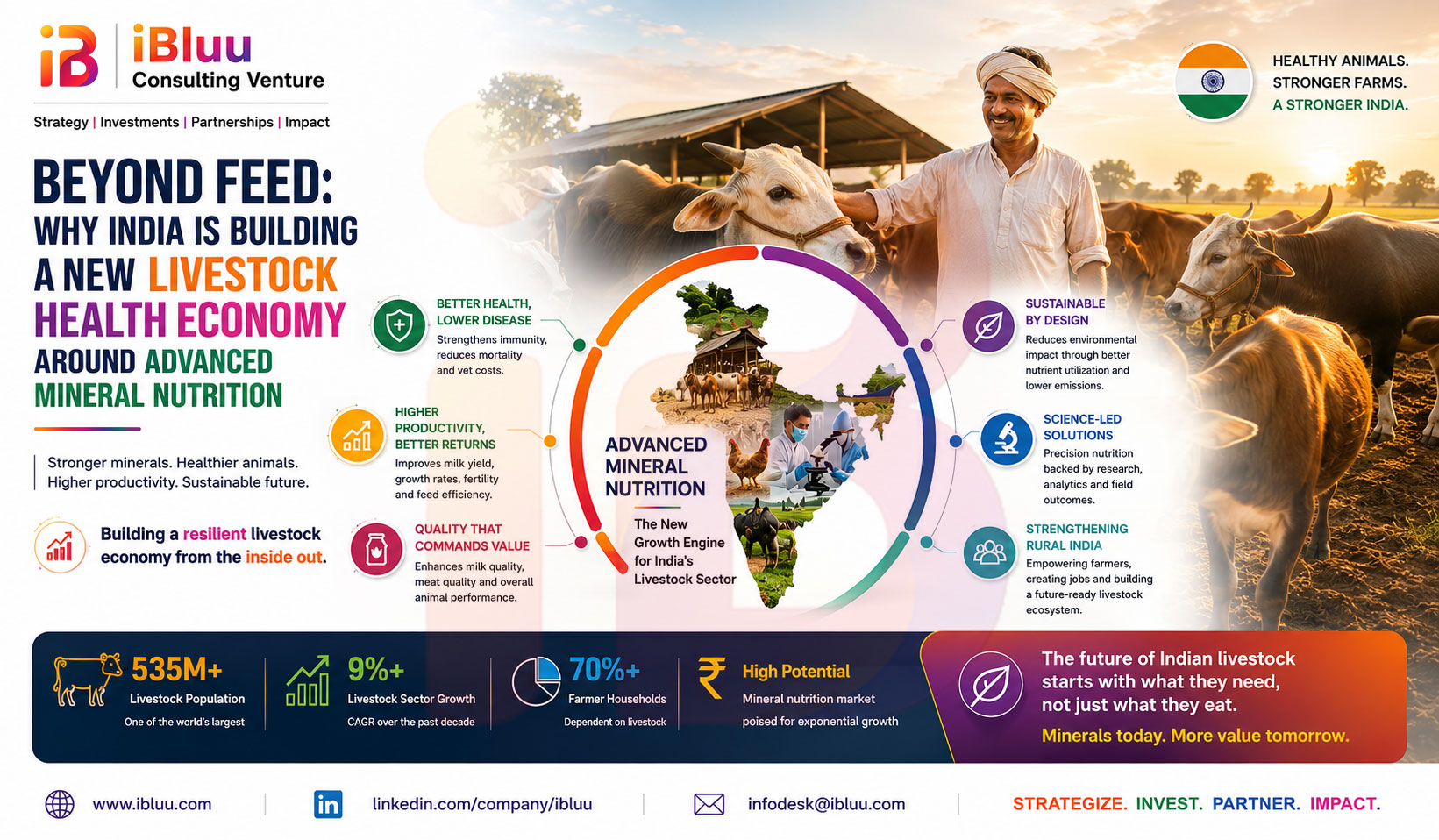
Beyond Feed: Why India Is Building a New Livestock Health Economy Around Advanced Mineral Nutrition
From basic supplementation to precision animal nutrition, India’s livestock sector is moving toward a productivity-led model in which minerals, feed science, veterinary technology and data converge to strengthen animal health, farmer incomes and the resilience of the dairy economy.
India’s livestock economy is entering a new phase.
For decades, the sector’s growth equation was dominated by animal numbers, fodder availability, breeding and veterinary care. The next phase is likely to be defined by something more sophisticated: how efficiently each animal converts nutrition into health, fertility, productivity and economic value.
That is placing advanced mineral nutrition at the centre of an emerging livestock-health opportunity.
India is already the world’s largest milk producer, contributing about 25% of global milk output. Milk production reached 247.87 million tonnes in 2024–25, up 3.58% from 239.30 million tonnes in 2023–24. The livestock sector provides livelihoods to approximately 8.5 crore rural households, while livestock’s share of India’s GVA has risen to 5.5% in 2023–24, from 4.4% in 2014–15 at current prices.
The underlying opportunity is therefore enormous.
But India’s competitive advantage will not come simply from producing more animals.
It will come from producing healthier, more productive and economically efficient animals.
And that is precisely where mineral nutrition becomes strategically important.
The Strategic Shift: From Animal Population to Animal Productivity
India’s 20th Livestock Census recorded approximately 536.76 million livestock, including more than 303.76 million bovines. More than 95% of the livestock population was located in rural areas.
This creates an extraordinary economic proposition.
Even a relatively small improvement in the productivity, reproductive efficiency or health status of a large livestock population can create significant aggregate economic value.
But productivity cannot be treated as a single variable.
It is an outcome of a system:
Genetics + Nutrition + Mineral Balance + Fodder + Veterinary Care + Disease Prevention + Management + Reproduction
India has invested substantially in breeding and genetic improvement through programmes such as the Rashtriya Gokul Mission (RGM). The Government revised RGM in March 2025, taking its total outlay for the 2021–22 to 2025–26 period to ₹3,400 crore, with greater emphasis on bringing quality breeding services, artificial insemination, IVF and sex-sorted semen closer to farmers.
But superior genetics cannot fully express their potential when the nutritional foundation is weak.
Genetic potential is the engine. Nutrition is the fuel.
Why Mineral Nutrition Is Becoming a Strategic Intervention
Minerals may be required in comparatively small quantities, but their biological importance is disproportionately large.
Calcium, phosphorus, magnesium, sodium, potassium, sulphur, zinc, copper, manganese, iodine, selenium and other trace elements participate in metabolic, skeletal, reproductive, immune and physiological functions.
Importantly, mineral availability varies according to soil, water, crop, fodder and geography.
That makes a universal “one-size-fits-all” formulation strategically inferior to area-specific and animal-specific nutrition.
The National Dairy Development Board (NDDB) explicitly notes that mineral levels vary across feeds and regions and has developed area-specific mineral-mixture formulations based on mineral mapping. NDDB identifies benefits including improved growth, reproductive efficiency, feed utilisation, milk production and immune response.
This is the foundation of the next-generation opportunity:
Premium veterinary mineral mixtures and nutritional supplements
Rather than treating mineral mixtures as commodity feed additives, the emerging model positions them as precision nutritional interventions designed to support:
- Animal health
- Immune function
- Growth
- Feed utilisation
- Milk productivity
- Milk solids/SNF performance
- Reproductive efficiency
- Calf development
- Reduced inter-calving intervals
- Productive lifespan
- Recovery from nutritional deficiencies
- Species-specific nutritional requirements
The commercial proposition is powerful because the value is ultimately measured not by kilograms of supplement sold, but by incremental economic output per animal.
The Economics Are Simple: Small Nutritional Inputs Can Influence Large Economic Outputs
A dairy farmer does not ultimately buy minerals.
The farmer buys productivity, reproductive reliability and lower biological risk.
That distinction matters.
If better nutritional management contributes to improved feed efficiency, reproductive performance, health status or milk output, the economic return can potentially exceed the cost of supplementation.
This creates a different commercial equation:
Low-value input → biological intervention → higher-value farm output
That is why advanced mineral nutrition can become attractive to both private enterprise and public-sector programmes.
The opportunity becomes even more significant when products are deployed through:
Dairy cooperatives → FPOs → veterinary networks → milk collection systems → rural entrepreneurs → digital livestock platforms
This converts mineral nutrition from a retail product into a distributed livestock productivity infrastructure.
India Already Has Scientific Validation—The Opportunity Is to Scale It
This is not an entirely new concept.
India’s public research institutions have spent years developing scientifically formulated mineral interventions.
ICAR-National Institute of Animal Nutrition and Physiology (ICAR-NIANP), Bengaluru, developed and commercialised Area Specific Mineral Mixture (ASMM) technology based on regional mineral deficiencies. The technology has been licensed to multiple organisations, including Karnataka Milk Federation and private manufacturers. ICAR has estimated the technology’s economic impact at approximately ₹400 crore per year in one reported assessment.
ICAR-NIANP has also commercialised mineral-mixture technology for sheep and goats, including formulations designed around species-specific mineral requirements.
Meanwhile, ICAR-National Dairy Research Institute (NDRI) reports commercialised technologies including anionic mineral mixtures, area-specific mineral mixtures, feed blocks and probiotics for calf health.
This creates an important investment signal:
The science is increasingly established. The larger opportunity is commercialisation, standardisation, distribution and last-mile adoption.
The Government Is Building the Enabling Infrastructure
India’s policy architecture is increasingly supportive of livestock nutrition, feed manufacturing, veterinary infrastructure and productivity enhancement.
Several schemes are particularly relevant.
1. Animal Husbandry Infrastructure Development Fund — AHIDF
AHIDF is arguably one of the most important financing platforms for private-sector participation.
The scheme has a revised outlay of approximately ₹29,110.25 crore through FY2025–26, and supports individual entrepreneurs, private companies, MSMEs, FPOs, Section 8 companies and dairy cooperatives. Eligible activities include animal-feed plants, veterinary vaccine and drug manufacturing, breed improvement, dairy and meat processing and animal-waste-to-wealth infrastructure.
Importantly for the nutrition opportunity, Government communications have specifically identified feed supplements, feed premixes, mineral-mixture plants and animal-feed testing laboratories among eligible areas under AHIDF. Eligible entities can access term loans of up to 90% of project cost, with a 3% interest subvention subject to scheme conditions.
That fundamentally changes the investment equation.
Government support can reduce the capital barrier for building livestock-nutrition manufacturing capacity.
2. National Livestock Mission — NLM
The National Livestock Mission is another important entrepreneurship platform.
Under its entrepreneurship component, eligible beneficiaries can receive 50% capital subsidy up to ₹50 lakh for specified feed and fodder value-addition infrastructure, subject to the applicable guidelines. The eligible universe includes individuals, FPOs, SHGs, JLGs, farmer cooperative organisations and Section 8 companies.
The Government reported 3,843 approved projects under the NLM entrepreneurship component with total project costs of approximately ₹2,672.65 crore and approved subsidies of ₹1,233.69 crore in the cited progress update. Feed-and-fodder projects accounted for 129 projects, with approximately 4.65 lakh metric tonnes per annum of capacity created.
For entrepreneurs, this indicates that India’s livestock sector is moving from a subsidy-dependent model toward a formal infrastructure and entrepreneurship ecosystem.
3. National Programme for Dairy Development — NPDD
NPDD focuses on strengthening organised milk procurement, processing, testing, cold-chain infrastructure and producer institutions.
Its relevance to mineral nutrition is indirect but strategically significant.
Why?
Because organised procurement networks create the distribution architecture through which nutritional interventions can reach farmers at scale.
A mineral-mixture manufacturer operating independently may face fragmented rural distribution.
A producer-owned dairy ecosystem can potentially provide:
Farmer access + veterinary interface + milk data + payment records + product distribution
That can materially reduce customer-acquisition and last-mile costs.
4. Rashtriya Gokul Mission — RGM
RGM’s focus on genetic improvement, artificial insemination, IVF and improved breeding services creates another strategic complement.
Better genetics increase the potential productivity of animals.
Advanced nutrition helps support the biological conditions required to express that potential.
Breeding without nutrition is incomplete productivity strategy.
The combination of genetic improvement + nutrition + veterinary care therefore represents a much stronger productivity architecture than any intervention operating independently.
The Startup Opportunity: Livestock Nutrition Is Becoming a Technology Market
The next opportunity may not belong exclusively to traditional feed manufacturers.
Startups can attack the sector through multiple models:
Precision Nutrition
Formulations based on species, breed, age, lactation stage and regional mineral profiles.
Digital Animal Health
Mobile platforms connecting farmers with veterinarians, nutritionists and diagnostic services.
AI-Assisted Ration Formulation
Data-driven feed and supplementation recommendations.
IoT-Based Livestock Monitoring
Sensors tracking activity, rumination, temperature, reproduction and behavioural indicators.
Nutrition + Veterinary Subscription
Recurring delivery of mineral supplements combined with veterinary monitoring.
Dairy Cooperative Platforms
Embedding nutrition into milk-procurement ecosystems.
FPO-Based Distribution
Using farmer organisations to aggregate demand and reduce distribution costs.
Climate-Smart Livestock
Nutrition interventions designed to improve productivity per animal and potentially reduce emissions intensity per unit of milk or meat.
The commercial model is shifting from selling products to managing outcomes.
That is a much larger opportunity.
Where CSR Capital Can Create Strategic Impact
Corporate India also has a potentially meaningful role.
CSR frameworks under Schedule VII encompass broad areas including rural development, environmental sustainability and animal welfare-related activities. The Ministry of Corporate Affairs has recognised animal welfare within the broader Schedule VII/CSR landscape, while CSR rules require eligible activities to meet applicable statutory conditions.
This creates potential avenues for CSR programmes around:
- Veterinary health camps
- Livestock nutrition awareness
- Mineral supplementation programmes
- Rural dairy productivity
- Women-led livestock enterprises
- FPO capacity building
- Indigenous breed conservation
- Animal-health diagnostics
- Fodder development
- Farmer training
- Climate-resilient livestock systems
However, companies should distinguish carefully between legitimate CSR programmes and normal commercial business expenditure. Activities undertaken in the ordinary course of business generally do not qualify as CSR, subject to specific statutory provisions and exceptions.
The strongest CSR models will therefore focus on measurable public benefit, not disguised product marketing.
A New Corporate Opportunity: From CSR Spending to Rural Productivity Infrastructure
The most sophisticated CSR programmes could move beyond distributing products.
Imagine a programme that combines:
10,000 livestock owners + veterinary camps + mineral mapping + nutritional supplementation + diagnostics + farmer training + digital monitoring + outcome measurement.
The impact could be measured through:
- Milk productivity
- Reproductive performance
- Calf survival
- Disease incidence
- Farmer income
- Supplement adoption
- Veterinary access
- Women participation
- Productivity per animal
This transforms CSR from a philanthropic expenditure into a measurable rural capability-building programme—while remaining compliant with applicable CSR rules.
The Investment Case: Why Companies Should Pay Attention
For investors and strategic companies, the opportunity has several attractive characteristics.
1. Massive Addressable Base
India’s livestock population is measured in hundreds of millions, while dairy alone supports approximately 8.5 crore rural households.
2. Recurring Consumption
Mineral supplements and nutritional products can generate recurring demand rather than one-time equipment revenue.
3. Productivity-Linked Value Proposition
Products can be positioned around measurable economic outcomes rather than commodity pricing alone.
4. Government Alignment
Livestock productivity, feed infrastructure, veterinary capacity and rural entrepreneurship are already embedded within national policy programmes.
5. Formalisation Opportunity
The transition from fragmented traditional practices to standardised nutrition creates room for organised companies.
6. Data Advantage
Companies that combine nutrition with animal-health and farm-level data could build differentiated platforms.
7. Export Potential
Once Indian manufacturers achieve strong formulation, manufacturing and quality systems, the opportunity could extend into livestock markets across Asia, Africa and other emerging economies.
But the Opportunity Comes With Real Risks
A sophisticated investment thesis must also acknowledge the constraints.
Scientific risk
A formulation must be evidence-based; exaggerated productivity claims can damage credibility.
Quality risk
Mineral purity, contamination, adulteration and formulation consistency are critical.
Adoption risk
Farmers may resist products without visible or demonstrable economic benefits.
Distribution risk
India’s rural livestock market remains highly fragmented.
Regulatory risk
Product classification, labelling, quality standards and applicable veterinary/feed regulations must be assessed carefully.
Input-cost risk
Mineral raw materials can experience commodity-price volatility.
Behavioural risk
Nutrition cannot compensate for poor genetics, inadequate fodder, disease burden or poor farm management.
Measurement risk
Companies must distinguish correlation from causation when claiming improvements in milk yield, fertility or health.
The strongest businesses will therefore sell evidence—not promises.
The Strategic Model for the Next Generation of Livestock-Nutrition Companies
A winning platform could integrate six layers:
1. Science
Validated mineral and nutritional formulations.
2. Manufacturing
Consistent, scalable and quality-controlled production.
3. Veterinary Expertise
Clinical and nutritional oversight.
4. Distribution
Dairy cooperatives, FPOs, dealers and digital channels.
5. Data
Animal-level and farm-level performance monitoring.
6. Finance
Government schemes, institutional capital, working capital and potentially CSR-supported programmes.
That creates a vertically integrated livestock-health platform.
And that is far more valuable than a conventional feed-supplement company.
The Larger Economic Opportunity
India’s livestock transformation is ultimately not just about milk.
It is about rural income, food security, nutrition, women-led livelihoods, agricultural resilience and national productivity.
The Government’s current data shows the scale of the underlying economy: India produced 247.87 million tonnes of milk in 2024–25 and remains the world’s largest milk producer.
The strategic challenge is now to increase the value generated per animal and per farmer, rather than relying primarily on expansion of the animal base.
Advanced mineral nutrition can become one component of that transformation.
Not the entire solution.
But an important one.
The Strategic Outlook: From Mineral Mixture to Livestock Productivity Platform
The next decade could see India’s livestock industry evolve from a largely fragmented production system toward a more science-led, data-enabled and productivity-oriented ecosystem.
Mineral nutrition sits at an interesting intersection of that transformation.
It connects:
Agricultural science → Veterinary health → Animal productivity → Dairy economics → Rural incomes → Food security
For startups, the opportunity is to transform nutritional science into scalable products and services.
For established companies, it is to move up the value chain from commodity feed toward specialised nutrition.
For dairy cooperatives, it is to integrate nutrition into farmer-productivity programmes.
For government, it is to strengthen standards, research, extension and access.
For corporates, it is to deploy CSR capital into measurable livestock-health and rural-capability programmes.
For investors, it is to recognise that livestock health is increasingly becoming productive infrastructure for India’s rural economy.
J Parasher’s Strategic Perspective
The analytical depth of this perspective is shaped by J Parasher, Founder and Managing Director of iBluu Consulting Venture (iBCV), a venture of iBluu Corporations, whose strategic work focuses on national capability building, global industrial benchmarking and long-horizon economic transformation.
His perspective reframes livestock nutrition not merely as an agricultural-input opportunity, but as part of a broader rural productivity and economic infrastructure system.
The strategic question is therefore no longer:
“How large is the animal-feed market?”
It is:
“How much additional economic value can India unlock by making its livestock healthier, more productive, more resilient and more scientifically managed?”
That is a significantly larger question.
And potentially, a significantly larger market.
The Bottom Line
India does not need simply more livestock products.
It needs more productive livestock systems.
That requires better genetics, better nutrition, better veterinary care, better fodder, better data and better farmer economics.
Advanced mineral nutrition can become an important building block in that architecture.
The future of India’s livestock economy will not be determined solely by how many animals the country has. It will be determined by how much productive value each animal can generate—sustainably, scientifically and economically.
That is why the next livestock-health opportunity may be hiding not in the volume of feed sold, but in the precision of nutrition delivered.
Strategic insight
India’s livestock-health opportunity is moving from animal husbandry to animal productivity—and advanced mineral nutrition could become one of the critical technologies powering that transition.
Disclaimer: This article is for strategic and informational purposes only and does not constitute veterinary, medical, nutritional, investment, legal, tax or regulatory advice. The efficacy of any mineral mixture or nutritional supplement depends on species, breed, age, physiological stage, baseline diet, mineral status, disease conditions and farm-management practices. Product claims should be supported by appropriate scientific evidence and comply with applicable Indian standards and regulations. Government-scheme eligibility, subsidy levels and financing conditions are subject to prevailing guidelines and approval by the competent authorities.