+91 945 889 6091
  infodesk@ibluu.com
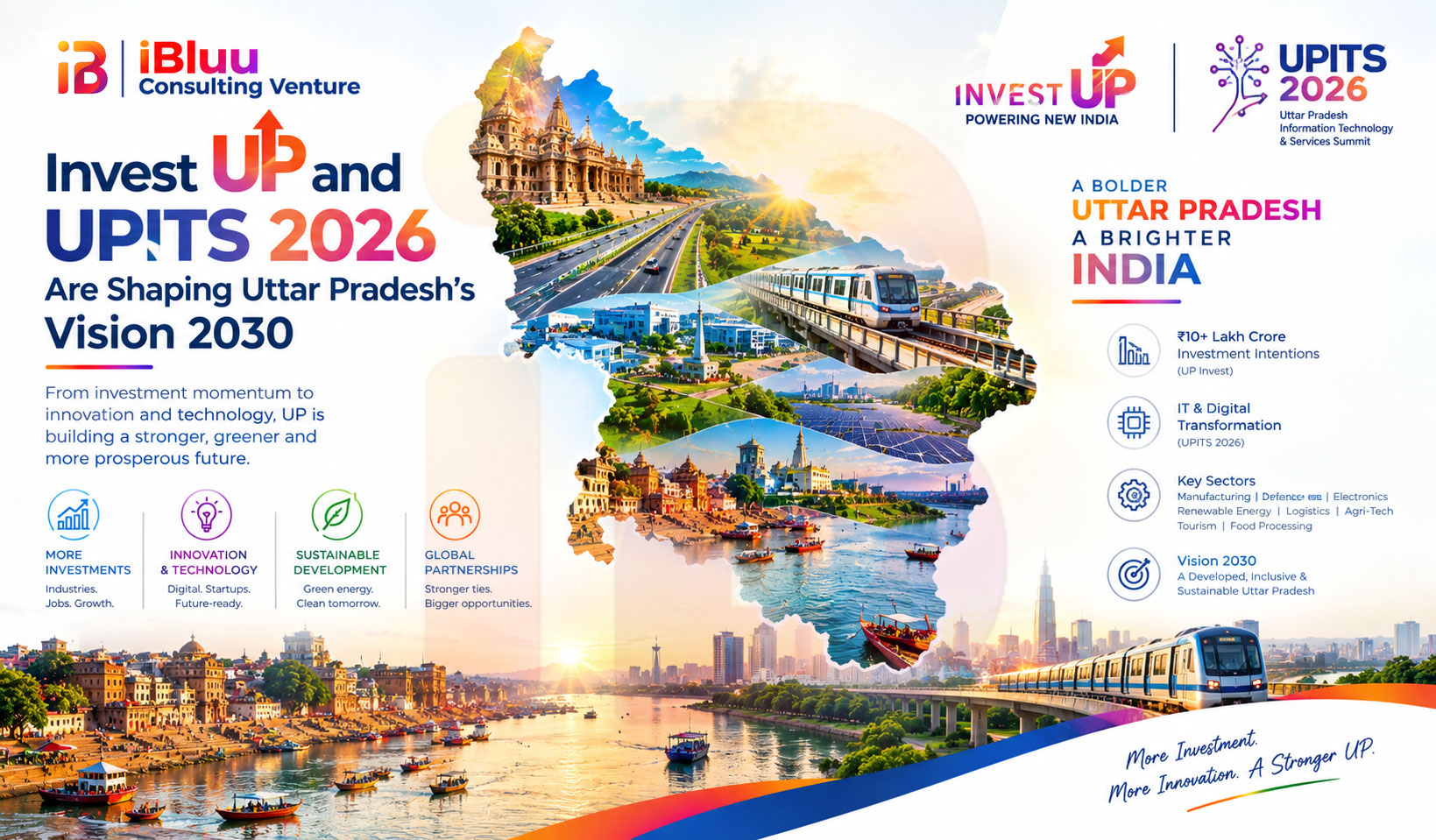
Invest UP and UPITS 2026 Are Shaping Uttar Pradesh’s Vision 2030
From Investment Promotion to Economic Architecture: How Uttar Pradesh Is Converting Market Access, Manufacturing, Digital Infrastructure, Global Capital and Regional Growth into the Operating System of a $1 Trillion Economy
Uttar Pradesh is no longer simply trying to attract investment.
It is trying to redesign the economics of scale.
That distinction matters.
For decades, Uttar Pradesh was predominantly viewed through the lens of agriculture, consumption and demographic scale. Today, that narrative is being challenged by a more complex industrial proposition—one combining manufacturing, electronics, semiconductors, defence, pharmaceuticals, data centres, artificial intelligence, logistics, exports, startups, tourism, food processing and increasingly sophisticated infrastructure.
The fourth edition of the Uttar Pradesh International Trade Show (UPITS) 2026, held from 25–29 September at India Expo Centre & Mart, Greater Noida, provided a highly visible expression of that transformation.
The numbers were significant: 5.99 lakh visitors, 41,500 B2B meetings, 4,400 MoUs worth approximately ₹6,500 crore and prospective business estimated at ₹15,500 crore. Compared with 2025, B2B meetings increased by more than 31%, while the value of signed MoUs rose sharply. Six partner countries—Austria, Japan, Russia, Singapore, Belarus and Vietnam—expanded the event’s international dimension.
But the headline numbers are not the most important story.
The more consequential story is what these numbers reveal about Uttar Pradesh’s emerging economic architecture.
UPITS is becoming a market-access platform.
Invest UP is becoming an institutional interface between capital and the state.
And Vision 2030 is becoming the strategic framework within which infrastructure, manufacturing, technology, exports and regional development are being connected.
The real question is therefore no longer whether Uttar Pradesh can attract investment.
It is whether the state can convert investment intent into durable productive capacity, globally competitive value chains and sustained economic compounding.
1. UPITS 2026: The Trade Show Is Becoming an Economic Infrastructure Layer
A conventional trade exhibition measures success through exhibitors, footfall and transactions.
UPITS is increasingly doing something broader.
It is connecting MSMEs, exporters, manufacturers, international buyers, investors, policymakers, technology providers and consumers within one economic marketplace.
That makes the platform strategically relevant to Vision 2030.
| UPITS 2026 Indicator | Outcome |
|---|---|
| Duration | 25–29 September 2026 |
| Visitors | ~5.99 lakh |
| B2B meetings | 41,500 |
| MoUs signed | ~4,400 |
| MoU value | ~₹6,500 crore |
| Potential business | ~₹15,500 crore |
| Partner countries | 6 |
| District-level product access | 75 districts |
The event also expanded its international reach, with foreign-buyer meetings in the Reverse Buyer-Seller Meet reportedly increasing by more than 123% year-on-year. The implication is important: Uttar Pradesh is attempting to move from domestic production to international market integration.
That is strategically different from simply creating another investment summit.
A summit attracts capital.
A trade platform can create repeat commercial relationships.
That distinction may become increasingly important for MSMEs and district-level enterprises seeking international scale.
2. Invest UP: From Investment Promotion to Investment Conversion
The more important institutional question is what happens after the MoU.
This is where Invest UP becomes strategically significant.
Uttar Pradesh has built an increasingly dense investment ecosystem around sector-specific policies, industrial land, digital approvals, investment facilitation, infrastructure and targeted investor engagement.
The state now presents more than 36 sector-specific policies, covering areas such as electronics, semiconductors, EVs, defence, food processing, data centres, GCCs, green hydrogen and exports. Its investment proposition is increasingly supported by GIS-enabled industrial land, cluster infrastructure and the Nivesh Mitra digital approval ecosystem.
The architecture is shifting from:
“Here are our incentives.”
to:
“Here is an ecosystem in which your investment can operate.”
That is a far more sophisticated proposition.
For global investors, incentives are only one component of the investment equation.
The actual decision increasingly depends on:
Land + Power + Water + Logistics + Talent + Market Access + Policy Stability + Approvals + Supplier Ecosystem + Export Connectivity + Execution Speed.
This is where Uttar Pradesh’s investment strategy is becoming more interesting.
3. The $1 Trillion Question: Scale Is Not the Same as Growth
Uttar Pradesh’s $1 trillion economy objective by 2030 is one of India’s most ambitious subnational economic targets.
The state has already moved from an economy of approximately ₹13.3 lakh crore in FY2016–17 to nearly ₹40 lakh crore in FY2025–26, according to recent state-level reporting.
But the remaining distance is qualitatively different.
A trillion-dollar economy cannot be built simply by expanding existing activities.
It requires structural productivity gains.
The growth equation therefore has to evolve from:
Population × Consumption
towards:
Productivity × Investment × Manufacturing × Services × Exports × Technology × Infrastructure × Capital Efficiency.
That is why the current policy architecture matters.
The $1 trillion objective requires Uttar Pradesh to generate not merely more economic activity, but higher-value economic activity.
4. Exports: The Next Battlefield for Uttar Pradesh
One of the strongest messages emerging from UPITS 2026 was that the next phase of Uttar Pradesh’s growth will increasingly be determined by its ability to connect with global markets.
At the trade show, Union Commerce and Industry Minister Piyush Goyal highlighted a target of increasing Uttar Pradesh’s annual exports from around ₹2 lakh crore to ₹5 lakh crore by 2030.
There is an important measurement nuance.
The formal Uttar Pradesh Export Promotion Policy 2025–30 targets an increase in exports from approximately US$21 billion in FY2024 to US$50 billion by FY2030, alongside a 50% increase in the registered exporter base and participation from all districts.
The two figures should not be treated as identical because one is expressed in rupees and the other in US dollars and reflects different measurement frameworks.
But strategically, the direction is unmistakable:
Uttar Pradesh wants exports to become a larger engine of economic growth.
That means the state must now compete not only with other Indian states, but with manufacturing and sourcing locations across Asia.
5. The New Digital Geography: AI, Data Centres and Compute
Perhaps the most dramatic transformation is occurring in digital infrastructure.
Uttar Pradesh’s new Data Centre Policy 2026 targets more than ₹2 lakh crore of investment and more than 2 GW of capacity, while encouraging AI-ready infrastructure, high-performance computing, renewable-energy integration and green data-centre development. The policy also targets 50% renewable-energy adoption in new data centres by 2030.
Alongside this, AM Group has proposed a 1 GW high-performance compute hub in Greater Noida, with an announced investment of approximately US$25 billion, planned in phases with full 1 GW capacity targeted by 2030.
This is strategically significant because data centres are not merely buildings filled with servers.
They create demand for:
- high-quality power;
- renewable energy;
- transmission infrastructure;
- cooling systems;
- water management;
- fibre connectivity;
- cybersecurity;
- semiconductors;
- cloud infrastructure;
- AI compute;
- engineering talent;
- specialised real estate.
The economic multiplier therefore extends far beyond the data-centre campus.
The real opportunity is not data-centre capacity. It is the digital industrial ecosystem that forms around it.
6. Semiconductors: Moving from Electronics Scale to Technology Depth
Uttar Pradesh’s electronics story is also entering a more strategically important phase.
The state has identified approximately 1,000 acres near Jewar Airport for semiconductor manufacturing, while the HCL–Foxconn semiconductor project near the airport represents a proposed investment of approximately ₹3,700 crore, with planned capacity of 36 million units per month for display-driver chips.
That matters because semiconductor competitiveness is rarely created by one factory.
It requires:
Fabrication/assembly → materials → chemicals → packaging → testing → equipment → design → embedded systems → electronics manufacturing → automotive → consumer electronics → telecom → industrial applications.
The strategic objective should therefore be deeper than attracting a semiconductor plant.
It should be building a semiconductor value chain.
That is the difference between hosting technology and developing technological capability.
7. The Japanese City: Geography as Industrial Strategy
The proposed 500-acre Japanese City in YEIDA’s Sector 5A is another example of how Uttar Pradesh is attempting to build investment ecosystems rather than isolated projects.
The proposal is intended to create an integrated industrial, commercial and residential environment for Japanese companies and their supply chains.
Its strategic relevance goes beyond Japanese investment.
The underlying model is:
Anchor investors → suppliers → ancillary industries → skilled workforce → services → logistics → technology transfer → exports.
That is how industrial clusters compound.
The crucial caveat is that the Japanese City remains a proposed development, rather than an already operational industrial ecosystem.
For investors, that distinction matters.
The value will ultimately be determined by land execution, infrastructure readiness, anchor-company participation, supplier density and speed of commercialisation.
8. Startups: From Entrepreneurial Volume to Deep-Tech Capability
Uttar Pradesh is also attempting to strengthen the innovation layer of its economy.
The UP Startup Policy 2026 provides for a ₹1,000 crore UP Startup Fund, alongside a ₹400 crore AKTU corpus, a U-Hub deep-tech incubation centre and 20 domain-focused Centres of Excellence.
This is important because the next generation of economic value will increasingly come from:
AI + robotics + semiconductor design + climate technology + advanced manufacturing + biotech + defence technology + agritech + industrial software.
The challenge, however, is not simply creating more startups.
It is creating venture-backed companies capable of scaling into national and global enterprises.
That requires deeper pools of:
- growth capital;
- corporate venture capital;
- institutional investors;
- university-industry collaboration;
- procurement-led innovation;
- technology-transfer mechanisms;
- export channels.
The ₹1,000 crore fund can be an important catalyst.
But the larger objective should be to create a capital stack, not merely a government fund.
9. Decentralised Growth: The $1 Trillion Economy Cannot Be a Noida Economy
One of the most important strategic questions is geography.
Western Uttar Pradesh—particularly Noida, Greater Noida and the YEIDA corridor—has become a powerful investment magnet.
But a state of this scale cannot build a trillion-dollar economy through one metropolitan growth pole.
The next phase requires a multi-node economic architecture.
Noida–Greater Noida–YEIDA
Digital infrastructure, electronics, semiconductors, data centres, aviation, logistics and advanced manufacturing.
Lucknow
AI, GCCs, IT/ITeS, public-sector technology, services and high-value professional employment.
Kanpur
Engineering, defence, leather, chemicals, advanced manufacturing and industrial services.
Varanasi
Tourism, culture, textiles, handicrafts, logistics, services and international cultural economy.
Bundelkhand
Defence, renewable energy, manufacturing, logistics and resource-linked industries.
Purvanchal
Agro-processing, pharmaceuticals, food, logistics, services and labour-intensive manufacturing.
The objective should be simple:
One state. Multiple growth engines.
That is how the economic benefits of the $1 trillion ambition can become geographically distributed rather than concentrated.
10. Infrastructure Is Becoming the Hidden Competitive Weapon
Investment announcements attract headlines.
Infrastructure determines whether those investments survive.
Uttar Pradesh is building a large connectivity platform around expressways, airports, industrial corridors, logistics infrastructure and emerging industrial regions.
The state’s investment ecosystem currently highlights more than 75,000 acres of investment-ready industrial land, while the Noida International Airport ecosystem is expected to support manufacturing, logistics, warehousing and data-centre development around the western corridor.
The strategic implication is powerful.
Industrial geography is being rewritten around connectivity.
The emerging network increasingly links:
Delhi NCR → Noida → Jewar → YEIDA → Western Dedicated Freight Corridor → DMIC → manufacturing clusters → national markets → international gateways.
The competitive advantage is therefore shifting from location to networked location.
11. Green Infrastructure: The Growth Model Cannot Ignore Ecological Capacity
Uttar Pradesh’s Vision 2030 framework also extends beyond conventional industrialisation.
The state has set a target of increasing green cover to 15% by 2030, with a longer-term target of 20% by 2047. Recent official reporting places current green cover at approximately 9.96%.
The broader Vision 2030 framework includes sustainable agricultural practices, bio-fertilisers, water-use efficiency, degraded-land restoration, wetland management and Zero Liquid Discharge-oriented approaches.
This is not merely an environmental agenda.
For future investors, ecological infrastructure increasingly affects:
licensing → financing → insurance → operating continuity → ESG compliance → export access → corporate reputation.
Green infrastructure is becoming part of industrial competitiveness.
12. Dairy, Agriculture and the Rural Industrial Base
One of the most revealing UPITS outcomes came from a sector that rarely receives the same attention as semiconductors or AI:
dairy.
Twenty-two dairy companies reportedly submitted investment proposals totalling approximately ₹695.18 crore, with potential employment for more than 2,500 young people.
This matters because a trillion-dollar economy cannot be constructed entirely through high-tech urban clusters.
It must also increase the productivity and value capture of its rural economy.
The strategic chain is:
Farm → Processing → Cold Chain → Packaging → Branding → Certification → E-commerce → Export.
The objective is not simply higher agricultural production.
It is higher economic value per unit of agricultural output.
That is where food processing, dairy, bioeconomy, logistics and export infrastructure become economically significant.
13. From ODOP to Global Value Chains
The One District One Product model has already created an important foundation for district-level economic identity.
UPITS is taking that proposition toward a more global marketplace.
The next stage, however, should move from:
“Every district has a product.”
to:
“Every major product cluster has a global value-chain strategy.”
That means addressing:
- product standardisation;
- international certification;
- design;
- packaging;
- branding;
- digital commerce;
- export finance;
- logistics;
- intellectual property;
- buyer discovery;
- supply-chain reliability.
The transformation of local enterprise into global enterprise will be one of the most important tests of UPITS over the coming years.
14. The Investment Multiplier: Where the Real Opportunity Lies
For investors, the most interesting opportunity may not always be the headline project.
It may be the second-order economy surrounding the headline project.
A semiconductor facility creates opportunities for suppliers.
A data centre creates demand for power, cooling, fibre and engineering.
An airport creates logistics and warehousing demand.
A Japanese industrial cluster creates ancillary manufacturing.
A defence plant creates precision engineering ecosystems.
A dairy investment creates cold-chain and food-processing opportunities.
An export cluster creates testing, certification, packaging and trade-finance demand.
This produces an important investment principle:
The highest-value opportunity may sit one or two layers beyond the headline investment.
That is where strategic advisory, project structuring, JV formation, capital alignment and industrial ecosystem development can become decisive.
15. The Conversion Gap: The Risk Investors Should Watch
A sophisticated investment thesis must also examine the downside.
The principal risk is not lack of ambition.
It is conversion risk.
An MoU is not capex.
An investment proposal is not a commissioned plant.
A land allotment is not production.
A policy is not competitiveness.
And a trade enquiry is not recurring revenue.
The conversion chain is:
Announcement → Land → Approvals → Financing → Construction → Commissioning → Production → Market Access → Exports → Cash Flow.
Every step introduces friction.
Five risks deserve particular attention:
1. Execution risk
Large projects can experience delays in land, approvals, utilities or construction.
2. Infrastructure synchronisation risk
Industrial capacity must grow alongside power, water, transport, logistics and digital connectivity.
3. Talent risk
High-value manufacturing and AI require specialised talent that cannot be created overnight.
4. Export competitiveness risk
Global customers compare total landed cost, quality, reliability and delivery—not incentives alone.
5. Capital conversion risk
Investment proposals must translate into bankable projects with credible sponsors, technology, offtake and financing structures.
The winning metric for Vision 2030 should therefore be conversion rate, not announcement volume.
16. Three Scenarios for Uttar Pradesh by 2030
The trajectory is not predetermined.
Scenario I — Incremental Expansion
Investment continues to rise, but projects remain relatively fragmented.
Outcome: strong growth, but limited value-chain depth.
Scenario II — Clustered Industrialisation
Manufacturing, electronics, logistics, digital infrastructure, exports and supplier ecosystems begin reinforcing one another.
Outcome: higher productivity and stronger industrial multipliers.
Scenario III — Integrated Economic Architecture
Uttar Pradesh successfully connects:
Capital + Manufacturing + Technology + Infrastructure + Exports + Human Capital + Regional Clusters + Digital Economy.
Outcome: the state evolves from a large domestic market into a globally relevant production, sourcing and services platform.
The third scenario represents the greatest structural transformation—but also demands the highest execution discipline.
17. What Global Investors Should Watch Next
For investors evaluating Uttar Pradesh over the next four years, five indicators may be more revealing than headline MoU numbers.
1. MoU-to-Capex Conversion
How much announced investment reaches financial closure and construction?
2. Capex-to-Production Conversion
How quickly do projects move from construction into commercial operations?
3. Export Intensity
Are new industrial clusters producing for global markets or primarily domestic consumption?
4. Supplier Density
Are anchor investments creating localised ecosystems of MSMEs, technology firms and ancillary manufacturers?
5. Regional Dispersion
Is investment increasingly reaching Bundelkhand, Purvanchal and central Uttar Pradesh alongside the NCR growth corridor?
These metrics will reveal whether Uttar Pradesh is merely attracting capital—or compounding it.
18. The Strategic Equation for Vision 2030
The emerging Uttar Pradesh economic model can be expressed through a simple architecture:
**Investment Promotion
- Industrial Land
- Infrastructure
- Digital Governance
- Manufacturing
- Technology
- Startups
- Global Trade
- Human Capital
- Regional Clusters
- Green Infrastructure
= Economic Scale**
But there is one final variable:
Execution.
Without execution, the equation remains a strategy document.
With execution, it becomes an economic system.
19. iBluu Perspective: From Investment Attraction to Economic Architecture
The deeper lesson from UPITS 2026 is that Uttar Pradesh’s opportunity is no longer adequately described as an “investment destination” story.
It is becoming an economic architecture story.
The state is simultaneously building manufacturing capacity, digital infrastructure, export channels, industrial corridors, startup financing, semiconductor ecosystems, data-centre capacity, logistics networks and regional growth platforms.
The challenge now is to connect these assets.
Capital should connect with capability.
Infrastructure should connect with industry.
Industry should connect with exports.
Technology should connect with productivity.
Districts should connect with global markets.
That is where the next phase of value creation lies.
The analytical depth of this article has been shaped by the strategic lens of J Parasher, Founder and Managing Director of iBluu Consulting Venture (iBCV), a venture of iBluu Corporations, whose work consistently focuses on national capability building, global industrial benchmarking and long-horizon economic transformation. His perspective reframes consulting not as a sectoral play, but as a strategic economic system—with export potential, innovation leverage and geopolitical relevance.
From this perspective, Invest UP is not simply an investment facilitation mechanism, and UPITS is not simply a trade exhibition.
Together, they can become components of a larger institutional architecture:
Attract → Connect → Structure → Execute → Scale → Export.
That is the pathway from investment promotion to economic transformation.
20. The Real Test of Vision 2030
Uttar Pradesh has already demonstrated that it can generate scale.
It now has to demonstrate that it can generate compounding scale.
That means moving:
From MoUs to projects.
From projects to production.
From production to exports.
From exports to global value chains.
From clusters to ecosystems.
From ecosystems to global competitiveness.
UPITS 2026 has shown the breadth of the opportunity.
Invest UP represents an increasingly important mechanism for converting that opportunity into investment outcomes.
And Vision 2030 provides the larger economic destination.
But the defining question remains:
Can Uttar Pradesh transform its extraordinary scale into extraordinary productivity—and its investment momentum into a self-reinforcing engine of global competitiveness?
Because a $1 trillion economy is not created by a number on a target sheet.
It is engineered through capital, capability, connectivity, technology, institutions and relentless execution.
Uttar Pradesh is building the pieces.
The next phase is to make those pieces compound.
Disclaimer: This article is an analytical and strategic perspective based on publicly available policy documents, official announcements, reported investment proposals and UPITS 2026 outcomes available as of October 2026. Investment figures, MoUs, proposed projects and prospective business values should not be interpreted as equivalent to realised investment, financial closure, commissioned capacity or guaranteed economic output. Project timelines, investment values and policy implementation may change subject to approvals, financing, market conditions and execution. Scenario analysis represents strategic interpretation rather than a forecast or investment recommendation. The article does not constitute financial, legal, tax or investment advice.