+91 945 889 6091
 infodesk@ibluu.com

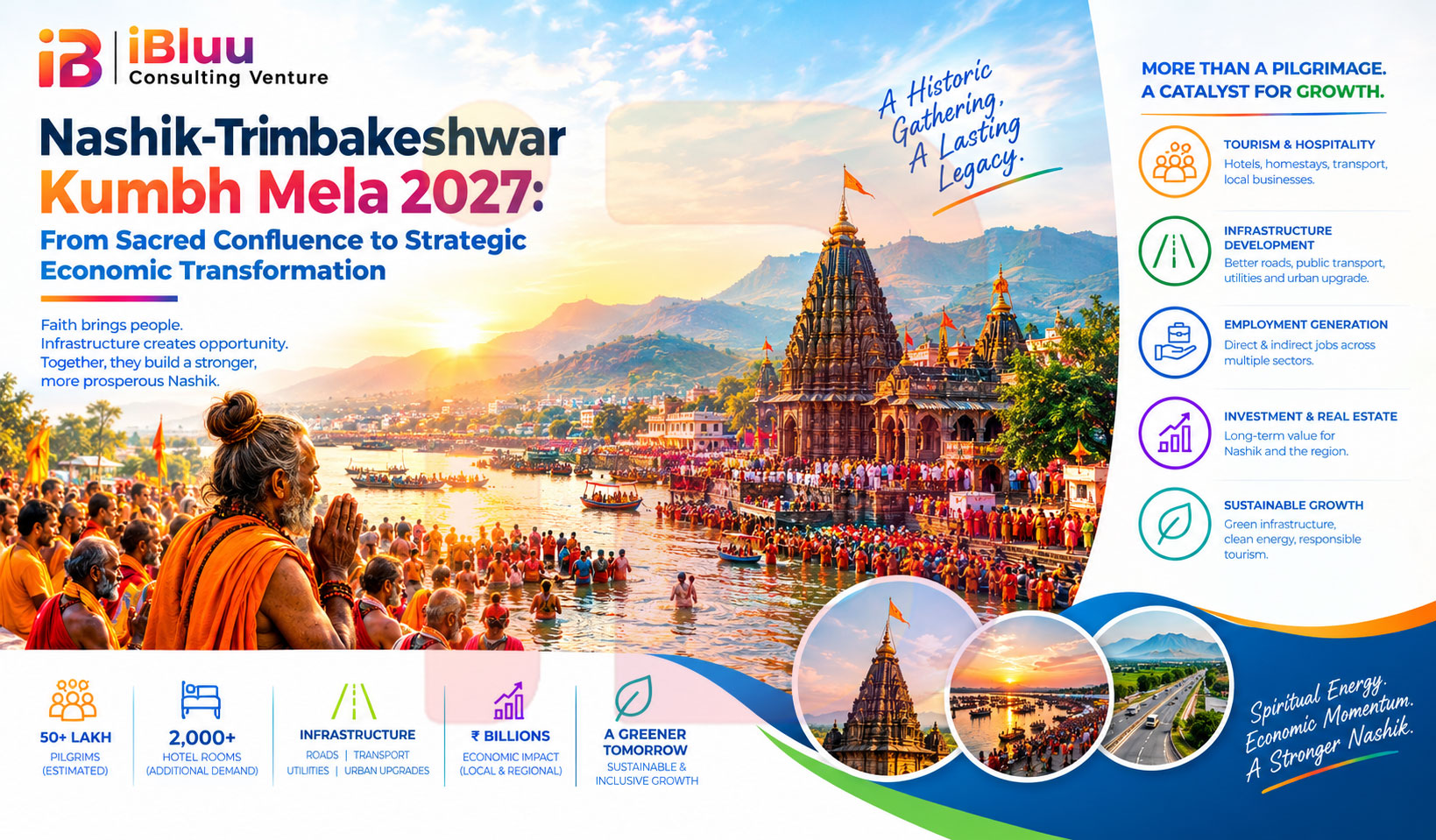
Reimagining Nashik–Trimbakeshwar Kumbh 2027 as a Blueprint for Infrastructure, Intelligent Urban Governance and Global Cultural Influence
How Maharashtra Can Convert a Civilisational Gathering into a Global Tourism Platform, Permanent Infrastructure, Investment Opportunity and Model of Intelligent Urban Governance
Executive perspective
Every mega-event creates a temporary surge in demand. Only a few create the conditions for lasting economic transformation.
The Nashik–Trimbakeshwar Simhastha Kumbh Mela 2027 presents Maharashtra with an extraordinary strategic opportunity: to translate one of India’s most significant spiritual gatherings into a durable platform for infrastructure modernisation, regional economic expansion, tourism development, technological innovation and cultural diplomacy.
The scale of preparation is substantial. Maharashtra approved a Kumbh development plan worth ₹22,425.39 crore in March 2026. By August 2026, the broader programme—including additional state and central-agency works—was being reported at approximately ₹34,732 crore. Crucially, the larger figure encompasses multiple implementing agencies and infrastructure programmes; it should not be mistaken for a single event-operating budget.
The distinction matters. Roads, bridges, transport systems, water infrastructure, sanitation networks, heritage corridors and digital command capabilities can continue generating public value long after the final sacred bath.
Yet expenditure alone does not create transformation. The strategic test is whether these investments improve connectivity, strengthen municipal capacity, attract productive private capital, protect the Godavari river system and establish Nashik and Trimbakeshwar as destinations that remain economically vibrant throughout the year.
The Kumbh’s greatest legacy will not be measured by the scale of the gathering alone, but by the quality of the economic and civic ecosystem it leaves behind.
1. The strategic significance: more than a religious event
The Kumbh is fundamentally a spiritual phenomenon rooted in India’s living civilisational traditions. Its economic and infrastructural consequences, however, extend well beyond the pilgrimage itself.
For Maharashtra, it is an opportunity to accelerate regional development and reinforce Nashik’s position as a centre for pilgrimage, tourism, agriculture, manufacturing and services. For the Central Government, it offers a platform to strengthen national connectivity, showcase India’s cultural heritage and demonstrate the capacity to manage exceptionally complex public gatherings.
The event also carries an international dimension. India’s ability to organise a large, safe, accessible and environmentally responsible pilgrimage can strengthen its cultural soft power and its reputation for delivering complex infrastructure and public services at scale.
The opportunity is therefore multidimensional:
- Economic: Expand demand for accommodation, food, transport, retail, local products and professional services.
- Infrastructure: Improve road access, public transport, civic utilities, public health and emergency response.
- Tourism: Develop a year-round religious, historical, cultural and experiential tourism economy.
- Technology: Test integrated systems for crowd intelligence, mobility, disaster preparedness and digital public services.
- Cultural: Preserve sacred spaces, traditional knowledge systems and the living practices of India’s spiritual communities.
- Investment: Create opportunities in hospitality, logistics, urban services, tourism infrastructure, technology and operations.
The challenge is to ensure that these dimensions reinforce one another rather than operate as disconnected projects.
2. The economic multiplier: converting temporary demand into lasting value
A mega-pilgrimage produces a concentrated surge in economic activity. Millions of visitors create demand for accommodation, passenger transport, food, sanitation, healthcare, retail, religious goods, local crafts and logistical services.
This creates a temporary economic ecosystem involving formal businesses, informal vendors, MSMEs, agricultural suppliers, construction contractors, transport operators and service providers.
However, gross visitor spending is not the same as net economic benefit. Some spending displaces ordinary activity; some procurement may flow to suppliers outside the region; and some event-related employment may be temporary. A credible economic assessment must measure local value retained, additional income generated, employment quality, public expenditure and the longer-term productivity of new assets.
Where economic value can emerge
| Economic channel | Principal opportunity | Strategic indicator |
|---|---|---|
| Hospitality and accommodation | Hotels, guesthouses, managed camps and pilgrim facilities | Occupancy, average spend and year-round utilisation |
| Transport and mobility | Rail, buses, taxis, local transport, parking and logistics | Passenger throughput, journey time and service reliability |
| Retail and local commerce | Food, flowers, religious articles, textiles and traditional crafts | Local procurement and vendor earnings |
| Construction and infrastructure | Roads, bridges, utilities, buildings and public amenities | On-time delivery, cost variance and asset quality |
| Digital and professional services | Ticketing and information systems, payments, security and operations | Adoption, uptime and service performance |
| Tourism and hospitality after the event | Heritage circuits, accommodation, guides and visitor experiences | Non-event visitor growth and repeat visits |
For local businesses, the event can create a major marketplace. But the benefits will not distribute automatically. Small enterprises need access to suitable vending areas, digital payment systems, transparent licensing, working capital, sanitation facilities and reliable visitor information.
A well-designed programme should also connect local farmers, food producers, artisans and service providers to larger hospitality and procurement networks. This helps retain a greater share of spending within Nashik and surrounding districts.
Employment: measure jobs, not just activity
Construction, crowd management, public health, hospitality, transport, sanitation, security and technology operations will require substantial labour. Some roles will be temporary; others can evolve into durable employment if infrastructure and tourism services remain active after the event.
Broad claims of 1.2 million jobs or ₹3 lakh crore in economic gains should not be presented as verified Nashik–Trimbakeshwar outcomes without a transparent methodology and a clearly identified geographic and temporal scope.
The more useful approach is to establish a baseline and report direct, indirect and induced employment separately, distinguishing full-time-equivalent jobs from short-duration work.
The objective should be to turn a temporary employment surge into stronger local capabilities, enterprise growth and more productive livelihoods.
3. The ₹34,732-crore infrastructure programme: understanding the investment architecture
The scale of preparation reflects a fundamental strategic choice: whether to build temporary capacity for a major event or accelerate infrastructure that can serve the region for decades.
The reported overall outlay of approximately ₹34,732 crore includes the approved ₹22,425.39-crore development plan, additional state works and projects delivered through central agencies. The programme spans transport, roads, bridges, public utilities, facilities for pilgrims, safety, technology and heritage-related works.
This broader scope is essential to understanding the investment opportunity. A ring road has a different economic life from a temporary pilgrim shelter. A sewerage network creates different benefits from event-period traffic management. The assets must therefore be assessed individually, not treated as one homogeneous expenditure.
Indicative infrastructure allocation
The following breakdown reflects reported programme-level category shares and is indicative, not a final audited allocation. Project scopes, administrative approvals and implementing-agency totals can evolve; category percentages should not be interpreted as a verified financial reconciliation.
| Investment category | Indicative share of reported outlay | Strategic purpose |
|---|---|---|
| Roads and highway connectivity | Approximately 51% | Improve access, reduce bottlenecks and strengthen regional connectivity |
| Temporary facilities and event arrangements | Approximately 15–17% | Provide peak-period capacity, including pilgrim accommodation and essential services |
| Buildings and civic facilities | Approximately 9% | Expand public-service and supporting infrastructure |
| Bridges and flyovers | Approximately 8% | Improve network continuity and remove critical crossing constraints |
| Parking and traffic management | Approximately 6% | Separate local movement from peak pilgrimage traffic |
| Electricity infrastructure | Approximately 3% | Strengthen power supply and service reliability |
| Water supply and sewerage | Approximately 2% | Support public health and environmental management |
| Ghats and riverfront works | Approximately 2% | Improve access, safety and the management of sacred spaces |
| Police and fire services | Approximately 1% | Strengthen emergency response and public safety |
Note: The percentages are rounded reported shares. They may not sum to 100%, and should not be multiplied into the total outlay to derive definitive project allocations.
Why the funding distinction matters
Three financial figures must be kept separate:
- ₹22,425.39 crore: The Maharashtra-approved development plan announced in March 2026.
- Approximately ₹34,732 crore: The wider reported programme of works, including projects implemented beyond the Kumbh Authority’s own plan.
- Individual administrative approvals: Sanctions for specific works, which may be revised and should not automatically be added to the programme total without checking for overlap.
The Central Government’s role also requires precision. National highway and railway works can contribute directly to the region’s connectivity, but that does not mean the Union Ministry of Tourism has sanctioned an equivalent grant for the entire event. Funding sources, executing agencies, disbursements and project status must be distinguished.
For investors, contractors and advisory firms, this creates a substantial but complex pipeline. The addressable opportunity is not the headline budget itself; it is the set of procurements, concessions, services and operating requirements that are actually approved, funded, tendered and commercially accessible.
Capital committed is a starting point. Capital converted into functioning, well-utilised assets is the real measure of delivery.
4. Connectivity and urban infrastructure: building beyond the event
Road access, bridges, railway capacity, airport connectivity and local mobility determine how efficiently people and goods move through the region. During a mega-event, these systems must accommodate exceptional peaks without paralysing ordinary city life.
The programme includes road and bridge improvements, wider regional access, city-level traffic interventions, parking and transport management, and upgrades intended to strengthen the capacity of Nashik and Trimbakeshwar.
The reported programme includes a major outer ring-road project, with estimates of approximately ₹7,922 crore cited for the project. This should be understood as a project-specific estimate within the broader infrastructure landscape—not an additional amount to be added automatically to the total programme outlay.
Railway planning is equally important. Special services, station management, passenger information, crowd segregation and coordinated last-mile transport can help distribute arrivals and departures more safely. Airport development and improved surface connections can widen access for visitors from other Indian cities and, where air connectivity permits, international travellers.
Yet transport capacity is only as strong as its weakest interface. A high-capacity highway cannot solve congestion if vehicles encounter inadequate drop-off zones, poorly managed parking or bottlenecks near ghats and pedestrian routes.
A successful mobility plan should integrate:
- Timed and geographically distributed arrival flows.
- Dedicated pedestrian corridors and accessible routes.
- Park-and-ride facilities and coordinated bus services.
- Real-time traffic information and incident response.
- Emergency access that remains clear during peak movement.
- Reliable links between transport hubs, accommodation, heritage areas and medical facilities.
The permanent benefit will depend on whether these systems remain useful for residents, businesses and ordinary tourists after the pilgrimage concludes.
5. Water, sanitation and the Godavari: the environmental test
The Godavari is central to Nashik’s spiritual identity and to the experience of the Kumbh. Protecting the river is therefore both an environmental imperative and a fundamental condition of the event’s credibility.
A large concentration of visitors can place extraordinary pressure on drinking-water supply, wastewater collection, solid-waste management, public toilets, drainage and riverfront operations.
The infrastructure response must extend beyond adding facilities. It requires a complete operating chain: collection, treatment, monitoring, maintenance and enforcement.
Key priorities include:
- Expanding reliable water supply and wastewater treatment where required.
- Preventing untreated sewage from entering the river system.
- Managing solid waste and religious offerings without polluting water bodies.
- Monitoring water quality before, during and after peak bathing periods.
- Providing sufficient public toilets, cleaning teams and waste collection.
- Publishing clear environmental performance indicators.
The figure of a 474-million-litres-per-day sewage treatment plant should not be treated as a confirmed Kumbh-specific project without an authoritative project record. Capacity figures must be tied to the exact facility, location, commissioning status and intended service area.
The wider lesson is clear: environmental infrastructure must be evaluated by actual performance, not only by sanctioned capacity. Treatment plants require functioning sewer connections, power, operators, maintenance budgets and compliance monitoring.
A sacred river cannot be protected through ceremonial commitments alone. Its protection must be engineered, financed, measured and enforced.
6. AI-enabled crowd management: the emergence of an intelligent pilgrimage system
Managing a mass gathering is not simply a policing challenge. It is a complex, real-time coordination problem involving human movement, transport, public health, emergency response, communication and rapidly changing local conditions.
For the 2027 event, authorities have been planning a technology-enabled operating model that includes AI-supported surveillance, crowd-density monitoring, drones, GIS mapping, digital-twin capabilities and integrated command-and-control systems.
The ambition is significant: move from responding to visible congestion after it develops towards identifying emerging risks early enough to intervene.
The technology stack
| Technology | Operational application | Value created |
|---|---|---|
| AI-enabled CCTV and video analytics | Identify crowd build-up, movement patterns and unusual incidents | Earlier detection of dangerous congestion |
| Crowd-density estimation | Estimate occupancy and movement across defined zones | More informed entry, exit and diversion decisions |
| Drone surveillance | Observe large areas and difficult-to-access locations | Wider situational awareness, subject to aviation and privacy rules |
| GIS mapping | Display crowds, road closures, medical facilities and incident locations | Faster coordination across agencies |
| Digital-twin platform | Combine maps, operational data and scenario modelling | Test crowd flows and emergency plans before acting |
| Automatic number plate recognition | Support vehicle identification and traffic enforcement | Better traffic control and investigation |
| Intelligent traffic and parking systems | Monitor vehicle flows and available parking | Reduce unnecessary circulation and local congestion |
| Integrated command-and-control centres | Consolidate feeds and coordinate response teams | A common operational picture across departments |
| Digital pilgrim information and AI assistants | Share directions, alerts and service information | Better access to information and reduced uncertainty |
The technology is not merely theoretical. Preparatory reporting has described plans for approximately 4,000 AI-enabled cameras and 18 surveillance drones, while more recent reporting has outlined digital-twin and integrated command-centre proposals. These should be understood as planned or reported deployments, not proof that every system is already operational.
A digital twin can integrate GIS-based maps, surveillance feeds and operational information to model scenarios such as congestion near a ghat, the closure of an access route or the diversion of a large crowd. AI analytics may help identify patterns, but final operational decisions must remain under accountable human supervision.
What effective crowd intelligence must deliver
The real measure of success is not the number of cameras purchased or the sophistication of the software. It is whether the system helps authorities:
- Detect hazardous density and counter-flow early.
- Direct people towards safer routes and available capacity.
- Keep emergency lanes and evacuation routes clear.
- Coordinate police, transport, health, fire and municipal teams.
- Provide timely, multilingual public information.
- Maintain reliable communications during network congestion.
- Learn from incidents and improve operational plans.
AI can assist with forecasting and detection, but it cannot guarantee the prevention of every emergency. Camera blind spots, inaccurate models, communication failures, poor data integration and delayed human decisions can undermine even sophisticated systems.
Facial recognition, if deployed for locating missing persons or other lawful purposes, requires strict purpose limitation, access controls, retention rules and safeguards against misuse. Public safety must not become a justification for uncontrolled surveillance.
The benchmark for a smart Kumbh is not surveillance at scale. It is safer movement, faster response, accountable decisions and better protection for every pilgrim.
7. Ram Kalpath and Shiv Darshan Path: heritage as urban infrastructure
Heritage corridors can reshape the relationship between a city’s sacred places, public realm, local commerce and visitor movement. Their significance extends beyond beautification: they can help organise pedestrian access, improve the experience of historic areas and create more coherent routes between religious landmarks.
The Ram Kalpath initiative in Nashik and the Shiv Darshan Path works associated with Trimbakeshwar are part of this broader transformation. Official administrative records identify Ram Kalpath-related land-acquisition activity and specific project approvals. Trimbakeshwar’s second-phase Darshan Path package includes works associated with the Shiv Darshan Path, ghats, the royal procession route, ritual facilities, shops and garden development.
A ₹390-crore administrative approval has been reported for a package of four works in the Trimbakeshwar pilgrimage area that includes these components. It should be described as an approved package amount, not assumed to represent the standalone cost of the Shiv Darshan Path alone.
How these corridors can change the urban experience
1. Reorganising pedestrian movement
Clearly defined walking routes can reduce conflicts between pedestrians and vehicles, improve access to temples and ghats, and help manage flows during peak periods.
2. Connecting heritage into a coherent visitor circuit
Better links between temples, sacred tanks, ghats, historic streets and public spaces can encourage longer visits and support guided cultural experiences.
3. Improving public space and local commerce
Well-planned vending areas, visitor amenities, lighting, signage and accessible routes can improve the experience for residents, pilgrims and local businesses.
4. Creating a platform for year-round tourism
A heritage corridor that remains attractive, maintained and commercially active outside the Kumbh period can support local guides, accommodation providers, food businesses and cultural enterprises.
5. Raising the standard of heritage-sensitive urban development
Restoration must respect historic fabric, traditional practices, local livelihoods and the scale of existing neighbourhoods. Road widening or public-space redevelopment can create social costs if land acquisition, compensation, access and relocation are poorly managed.
The economic opportunity is real, but it is not automatic. Heritage-led regeneration succeeds when conservation, mobility, public-space management and local economic participation are designed together.
The objective should not be to turn living sacred spaces into commercial backdrops. It should be to make them more accessible, better protected and economically sustainable without diminishing their spiritual meaning.
8. Cultural diplomacy and India’s civilisational identity
The Kumbh is one of India’s most recognisable expressions of living spiritual and cultural practice. Its global significance is reinforced by its inscription on UNESCO’s Representative List of the Intangible Cultural Heritage of Humanity in 2017.
Its value cannot be reduced to tourism receipts. The gathering brings together religious orders, scholars, pilgrims, artists, traditional practitioners and communities from across India. It creates a visible expression of cultural continuity, shared traditions and national integration.
For the Central and Maharashtra governments, the event offers an opportunity to strengthen cultural diplomacy by presenting India’s heritage through well-managed visitor experiences, multilingual interpretation, international media engagement and responsible digital storytelling.
The principle of “Vikas Bhi, Virasat Bhi”—development alongside heritage—becomes meaningful only when investment improves access and public services while preserving the traditions and places that give the event its identity.
Heritage conservation works across Nashik district also extend beyond the two named corridors. Conservation activity has been identified at significant sites, including the Trimbakeshwar Temple and other historic and archaeological locations. Such projects should be coordinated into a wider cultural landscape strategy rather than treated as isolated beautification exercises.
A stronger heritage proposition could connect the Kumbh with Nashik’s temple heritage, sacred landscapes, local crafts, regional food traditions and nearby destinations. The goal is to transform a peak-period pilgrimage into a year-round cultural tourism economy.
9. Tourism beyond the Kumbh: building a year-round destination
A major event can generate global attention, but sustained tourism requires a destination that works throughout the year.
Nashik and Trimbakeshwar have an opportunity to develop a coordinated visitor economy that combines religious heritage, historical interpretation, local cuisine, craft experiences, nature-based itineraries and accommodation across multiple price points.
That requires more than marketing. It requires dependable transport, clean public spaces, accessible facilities, trained guides, transparent pricing, digital discovery, quality standards and effective destination management.
A practical tourism strategy
- Develop integrated circuits: Connect major religious and heritage locations through well-designed itineraries rather than isolated visits.
- Extend visitor stays: Create credible half-day, full-day and multi-day experiences that encourage additional local spending.
- Strengthen the hospitality supply chain: Improve accommodation quality, service skills and links between hotels, local producers and transport operators.
- Support local enterprises: Help artisans, guides, food businesses and MSMEs access visitors and digital markets.
- Build a consistent digital identity: Provide accurate information on access, facilities, cultural etiquette, accessibility and visitor services.
- Measure the legacy: Track non-event visitor arrivals, length of stay, local expenditure, repeat visits and satisfaction.
International visitor numbers should not be used as a substitute for evidence of tourism performance. The relevant measures are actual arrivals, spending, length of stay and the ability of local businesses to serve visitors consistently.
A successful mega-event attracts attention. A successful destination converts that attention into repeat demand.
10. Investment opportunities: where private capital and expertise can contribute
The public programme creates opportunities for private-sector participation, but the commercial case differs substantially by sector. Some opportunities will arise through public procurement; others through hospitality demand, service contracts, technology provision or long-term tourism development.
Investors should distinguish between a temporary event-driven revenue opportunity and an asset capable of producing stable cash flows after 2027.
| Opportunity | Potential business model | Critical investment question |
|---|---|---|
| Hospitality and accommodation | Hotels, managed stays and serviced facilities | Can occupancy and pricing remain viable outside peak periods? |
| Transport and logistics | Fleet services, passenger movement and supply-chain contracts | Is demand sufficiently predictable and contractually secured? |
| Technology and systems integration | Software, monitoring, command systems and support services | Are procurement, integration, cybersecurity and maintenance funded? |
| Water, sanitation and waste | Operations, equipment and service contracts | Are service levels, payment terms and operating responsibilities clear? |
| Tourism and heritage experiences | Guided circuits, visitor services and cultural products | Can demand be sustained without commercialising sacred spaces? |
| Local enterprise and retail | Food, crafts, pilgrim essentials and digital commerce | Can small suppliers meet quality, compliance and volume requirements? |
| Asset operations and maintenance | Facility management, utilities and public-space services | Is there a funded post-event operating model? |
For iBluu Corporations and other advisory platforms, the strategic opportunity extends beyond individual contracts. It includes project evaluation, procurement and implementation strategy, public-private partnership structuring, capital planning, market assessment, operating-model design and post-event asset optimisation.
However, a large public outlay should never be interpreted as a guaranteed private-market opportunity. Procurement eligibility, competition, project readiness, payment security, contract duration, land rights and execution risk must be assessed before capital is committed.
The most attractive opportunities may be those that solve persistent regional needs—mobility, sanitation, visitor services, heritage management and digital operations—rather than those whose economics depend entirely on a few weeks of exceptional demand.
11. Scenario modelling: three possible economic legacies
The final outcome will depend on project execution, operating discipline, private-sector participation and the quality of post-event planning. Three scenarios provide a useful framework for decision-makers.
These are strategic scenarios, not statistically derived forecasts of visitor numbers, revenue or investment returns.
Scenario A: Event-led delivery
Downside
Infrastructure is completed primarily to meet event deadlines, but maintenance, tourism development and post-event operating models remain weak.
Likely outcome: Strong short-term activity, underutilised facilities, uneven local economic gains and higher lifecycle costs.
Scenario B: Infrastructure-led growth
Base case
Major transport and civic assets are commissioned, public services improve, and tourism demand expands gradually. Some facilities perform well while others require further operational investment.
Likely outcome: Better regional connectivity, improved visitor services and moderate, uneven post-event economic benefits.
Scenario C: Integrated regional transformation
Upside
Infrastructure, heritage conservation, digital governance, private investment and destination marketing operate as one coordinated regional strategy.
Likely outcome: Higher asset utilisation, stronger local enterprise participation, a more resilient tourism economy and improved civic capacity.
The difference between these scenarios is not simply the amount spent. It is the quality of coordination before, during and after the event.
The upside case requires a clear operating owner for every major asset, measurable service standards, adequate maintenance funding and a credible plan for sustaining demand.
12. Risk quantification: the challenges that could undermine the opportunity
The scale of the programme makes disciplined risk management essential. A project may be physically completed yet fail to deliver its intended benefits if access is poor, utilities are unreliable, operating costs are underestimated or demand falls after the event.
The following is a qualitative risk register. Ratings represent strategic assessment, not measured probabilities of failure.
| Risk | Indicative exposure | Mitigation priority |
|---|---|---|
| Construction delays and cost escalation | High | Critical-path monitoring, independent cost reviews and contingency planning |
| Crowd congestion and public-safety incidents | Critical | Dynamic crowd monitoring, rehearsed response protocols and clear command responsibility |
| Water pollution and sanitation failures | Critical | River-quality monitoring, wastewater controls and independently verified service readiness |
| Fragmented agency coordination | High | Unified command structures, clear accountability and shared operational data |
| Weak post-event utilisation | High | Funded asset-management plans and year-round demand development |
| Cost overruns and procurement disputes | High | Transparent procurement, milestone-based payments and contract governance |
| Unequal local economic benefits | Medium–high | MSME access, fair vendor allocation and transparent local procurement |
| Digital and cyber vulnerabilities | High | Security testing, access controls, resilient communications and incident-response plans |
| Heritage damage or community displacement | High | Conservation-led design, consultation, appropriate compensation and livelihood protection |
| Climate and extreme-weather disruption | High | Heat, rainfall, drainage and emergency scenarios integrated into readiness plans |
The key management principle is to treat risks as interdependent. A road delay can disrupt crowd routing; congestion can strain medical access; sanitation failures can affect both public health and the river; and a poorly designed pedestrian corridor can compromise the performance of otherwise well-funded transport infrastructure.
Risk reviews should therefore assess entire service chains, not merely individual project milestones.
13. A strategic execution agenda for government and industry
To convert the Kumbh into a lasting development platform, Maharashtra and its partners should organise delivery around six priorities.
1. Establish a single, integrated delivery view.
Maintain a common programme dashboard covering project costs, funding status, land availability, procurement, construction progress, commissioning and dependencies. Distinguish approved budgets from expenditure and completed works from operationally ready assets.
2. Test the complete operating system before peak days.
Run scenario-based exercises covering transport disruption, crowd surges, missing persons, medical emergencies, severe weather, power failures, communication outages and river-quality incidents. Exercises should include multiple agencies and realistic failure conditions.
3. Protect the post-event business case.
Every significant asset should have an identified owner, operating budget, maintenance plan, utilisation target and post-event service model. Facilities without a viable long-term use should be reconsidered before additional capital is committed.
4. Build a tourism economy, not just a visitor campaign.
Coordinate heritage circuits, accommodation, public transport, digital information, local commerce and visitor services. Marketing should be linked to actual service capacity and measurable demand.
5. Make local participation commercially meaningful.
Provide transparent access to vending spaces, procurement opportunities, training, finance and digital payment infrastructure. Measure how much spending reaches local MSMEs and workers instead of assuming that regional benefits will emerge automatically.
6. Institutionalise environmental accountability.
Publish clear indicators for water quality, wastewater treatment, solid-waste collection, sanitation performance and restoration of affected sites. Environmental monitoring should continue after the gathering, not end with the event.
14. The performance dashboard: how success should be measured
The programme needs a balanced scorecard that captures economic, operational, environmental and social outcomes.
| Dimension | Core indicators |
|---|---|
| Financial delivery | Approved budget, expenditure, cost variance, payment delays and project completion |
| Infrastructure | Commissioning status, journey times, reliability, utilisation and maintenance readiness |
| Public safety | Incident response time, crowd-density alerts, medical access and emergency drill performance |
| Public health | Water quality, sanitation availability, wastewater compliance and waste collection |
| Economic development | Local procurement, MSME participation, employment duration and local income retained |
| Tourism | Visitor length of stay, accommodation utilisation, non-event arrivals and repeat visits |
| Digital governance | System uptime, alert accuracy, response time, interoperability and cybersecurity incidents |
| Heritage and inclusion | Conservation outcomes, accessibility, community consultation and livelihood impacts |
Where credible baselines exist, targets should be established before the event. Results should be published in a form that allows residents, businesses and investors to distinguish between money spent, assets delivered and public value achieved.
15. From event management to a new model of regional development
The Nashik–Trimbakeshwar Kumbh Mela 2027 presents a broader question for India’s infrastructure and urban-development agenda:
Can the country use major cultural gatherings to accelerate investments that would otherwise take years to coordinate, while ensuring those investments remain productive long after the crowds depart?
The answer depends on whether planning is organised around the event alone or around the region’s long-term development.
For Maharashtra, the opportunity is to strengthen Nashik’s connectivity, modernise civic services, protect the Godavari, preserve sacred heritage and build a more competitive tourism economy. For national policymakers, it is to demonstrate how cultural identity and modern public infrastructure can reinforce one another. For investors and advisory firms, it is to identify viable projects and services that solve lasting regional needs rather than relying solely on temporary demand.
The Kumbh can also demonstrate a more sophisticated approach to public-sector execution: integrated programme management, digital situational awareness, transparent financial reporting, climate-conscious infrastructure and measurable post-event outcomes.
But the ambition must be matched by delivery discipline. Budget announcements are not economic impact. Cameras are not crowd safety. Restored corridors are not automatically thriving destinations. And a completed road is not a development strategy unless it improves access, productivity and quality of life.
The defining opportunity is to make a temporary congregation the catalyst for permanent regional capability.
Conclusion: a civilisational gathering, a strategic economic opportunity
The spiritual significance of the Kumbh stands on its own. Its development potential emerges from how intelligently governments, institutions, businesses and communities prepare for it.
The reported ₹34,732-crore programme represents a substantial commitment to connectivity, public infrastructure and regional readiness. Its ultimate value will depend on the quality of execution, the effectiveness of public services, the protection of the Godavari and the productive use of assets after the event.
The most successful legacy would be a Nashik and Trimbakeshwar that are safer to navigate, cleaner to inhabit, easier to reach, richer in cultural experiences and better equipped to attract sustainable economic activity.
For investors, the strategic question is not simply how much will be spent before 2027. It is which infrastructure, services and capabilities will remain useful—and financially and operationally sustainable—through the following decade.
For policymakers, the test is whether temporary pressure produces permanent institutional improvement.
For local businesses, it is whether the visitor surge creates durable enterprise opportunities.
And for India, it is an opportunity to demonstrate that heritage and modernisation are not competing ambitions.
A gathering of extraordinary spiritual significance can also become a defining test of economic vision, infrastructure delivery and institutional capability. The legacy will be determined not by the scale of the announcement, but by the value that endures after the final sacred bath.
The strategic lens: J Parasher and iBluu Corporations
The analytical depth of this article has been shaped by the strategic lens of J Parasher, Founder and Managing Director of iBluu Consulting Venture (iBCV), a venture of iBluu Corporations, whose work consistently focuses on national capability building, global industrial benchmarking, and long-horizon economic transformation. His perspective reframes consulting not as a sectoral play, but as a strategic economic system with export potential, innovation leverage, and geopolitical relevance.
Through this lens, the Nashik–Trimbakeshwar Kumbh Mela becomes more than an event-management challenge. It becomes a case study in coordinating capital, infrastructure, technology, culture and regional economic development to create enduring public and commercial value.
Disclaimer: This article is intended for strategic, informational and analytical purposes. Budget figures, project scopes, cost estimates, attendance projections and implementation plans are based on publicly reported information available as of October 2026 and may change as administrative approvals, procurement decisions and project execution progress. The overall programme outlay should not be interpreted as a single event-operating budget or as a guarantee of expenditure, completion or economic returns. Indicative allocation percentages are rounded reported shares and are not an audited reconciliation of all project costs. Employment, revenue, tourism and investment outcomes are not guaranteed. Any investment or commercial decision should be supported by independent due diligence, current tender and project documentation, verified funding arrangements and appropriate legal, financial, technical and environmental assessment.