+91 945 889 6091
  infodesk@ibluu.com
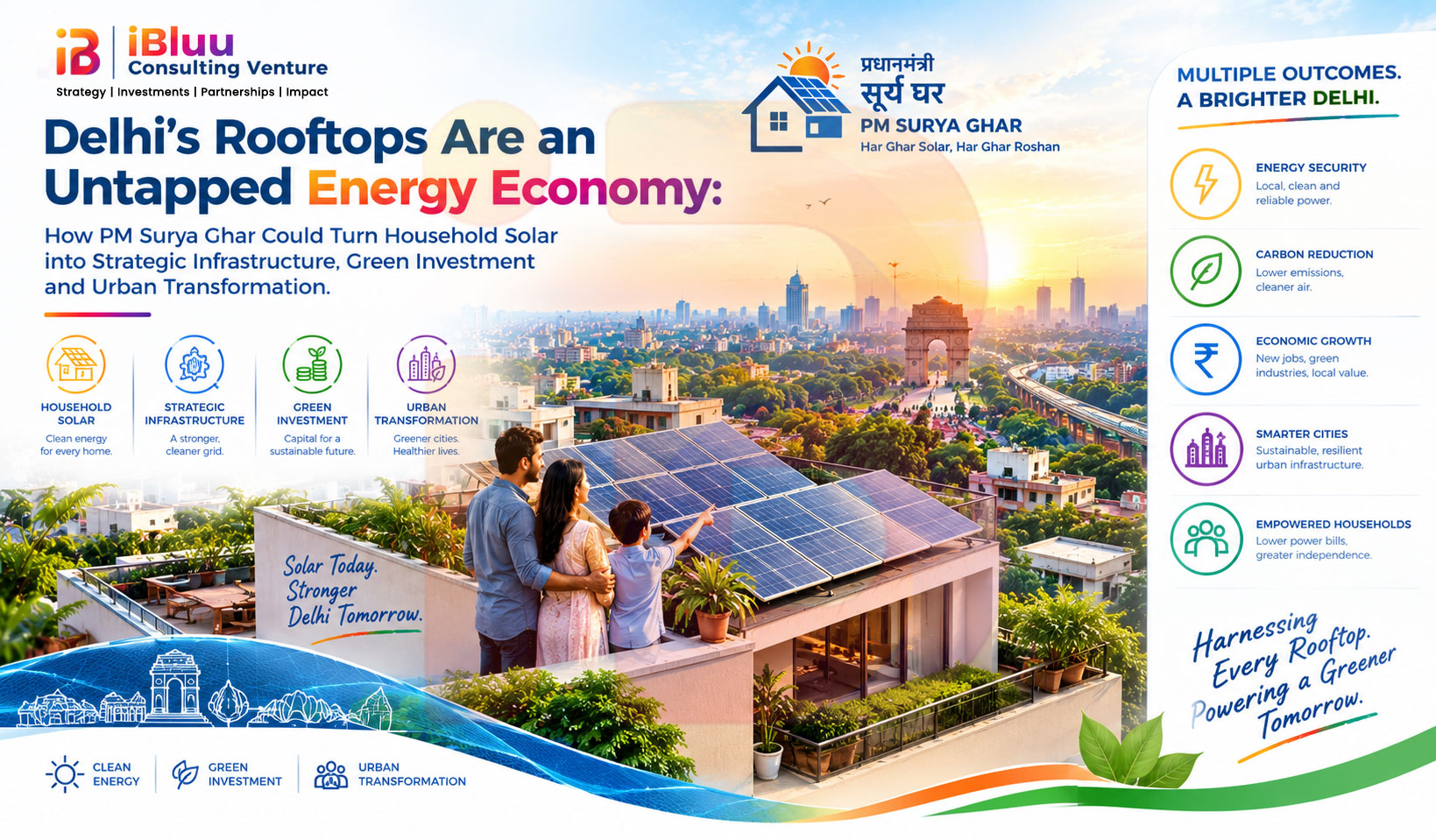
Empowering the Capital’s Rooftops: How PM Surya Ghar Is Driving Delhi’s Green Revolution
From Household Energy Savings to Distributed Power Infrastructure: How Delhi Can Convert Rooftop Solar into a Platform for Energy Resilience, Climate Action, Green Investment and Urban Transformation
Executive Perspective: The Next Energy Revolution Is Above Our Heads
Delhi’s next major energy opportunity may not require acquiring more land, building another power station or extending another transmission corridor. It may begin on the rooftops of homes, apartment complexes, commercial buildings and public institutions that already exist.
The PM Surya Ghar: Muft Bijli Yojana, reinforced by Delhi’s solar policy framework, creates an opportunity to transform residential rooftops into productive energy assets. By combining central financial assistance, eligible state-level incentives, digital applications, net metering and innovative financing models, the programme can make clean electricity more accessible while reshaping how households participate in the power economy.
The national programme carries a ₹75,021 crore outlay and aims to support rooftop solar installations for one crore households. Its economic significance extends well beyond electricity bills: the programme is designed to stimulate demand across solar manufacturing, equipment distribution, installation, financing, maintenance and related services.
For Delhi, the opportunity is particularly consequential. A dense urban economy faces substantial electricity demand, constrained land availability, seasonal air-quality pressures and growing cooling requirements. Rooftop solar offers a way to generate part of the city’s electricity close to where it is consumed—turning underutilised building surfaces into distributed energy infrastructure.
Yet the real test is not how many panels Delhi installs. It is whether the city can convert policy incentives into reliable generation, durable household savings, commercially viable projects and measurable environmental outcomes.
The strategic shift is clear: rooftops should no longer be viewed merely as structural surfaces. They can become assets in Delhi’s energy infrastructure.
1. India’s Green Transition: From National Ambition to Household Participation
India’s energy transition is entering a new phase. Large renewable-energy projects remain essential, but they are increasingly complemented by decentralised systems that allow households, businesses and institutions to participate directly in clean power generation.
India has committed to achieving 500 GW of installed non-fossil electricity capacity by 2030 and net-zero emissions by 2070. The country reached 50% of its installed electricity capacity from non-fossil sources in June 2025, ahead of the original milestone set under its climate commitments. These figures describe installed capacity, not the share of electricity generated at every moment; the distinction matters when evaluating actual energy-system decarbonisation.
The PM Surya Ghar programme translates this national direction into household-level action. Rather than concentrating all investment in large generation facilities, it seeks to mobilise millions of smaller installations distributed across the built environment.
The programme’s scale is substantial. By 20 March 2026, approximately 9.57 GW of rooftop solar capacity had been added under the initiative. At the national target of one crore participating households, the programme estimates that installations could generate around 1,000 billion units of renewable electricity over their operating lifetimes and avoid approximately 720 million tonnes of CO₂-equivalent emissions over 25 years. These are programme-wide estimates, not measured outcomes for Delhi alone.
This decentralised model creates several strategic advantages:
- Household economics: Reduce exposure to grid electricity purchases by generating power on-site.
- Energy resilience: Diversify the sources supplying electricity to urban consumers.
- Industrial development: Expand demand for solar modules, inverters, mounting structures, electrical equipment and maintenance services.
- Employment creation: Develop opportunities across installation, engineering, sales, financing and operations.
- Climate performance: Displace some grid electricity that would otherwise be generated using higher-emission sources, subject to actual generation and grid conditions.
The broader implication is that energy transition is no longer exclusively a utility-scale investment story. It is also a distributed infrastructure and consumer-asset story.
2. The Delhi Advantage: Combining Central Support with State-Level Incentives
Delhi’s opportunity lies in combining the national subsidy framework with its own solar-policy mechanisms.
Under PM Surya Ghar, eligible residential consumers can receive central financial assistance of ₹30,000 per kW for the first 2 kW and ₹18,000 for the additional capacity up to 3 kW. The maximum central subsidy is therefore ₹78,000 for a system of 3 kW or more.
Delhi’s state framework adds a separate layer of support. The current state-subsidy schedule lists a maximum of ₹26,000 per kW, subject to a maximum of ₹78,000 for residential consumers. However, the state subsidy is also subject to a cost-differential formula linked to the cost determined through the applicable bidding or implementation model, after accounting for the central subsidy. It should therefore be understood as a maximum available under qualifying conditions—not an automatic entitlement to the full amount.
Indicative subsidy structure
| Component | Potential support | Important qualification |
|---|---|---|
| Central subsidy for a 1 kW system | ₹30,000 | Subject to scheme eligibility |
| Central subsidy for a 2 kW system | ₹60,000 | Subject to scheme eligibility |
| Central subsidy for a 3 kW system | ₹78,000 | Central assistance is capped at 3 kW |
| Delhi state capital subsidy | Up to ₹78,000 | Subject to current state policy and cost conditions |
| Combined potential subsidy | Up to ₹1.56 lakh | Not guaranteed for every household or installation |
The combined figure is a potential maximum for eligible installations. The amount actually received depends on the applicable policy conditions, approved installation model and project cost.
Delhi’s solar policy also provides for generation-based incentives. The published policy framework lists ₹3 per unit for residential systems up to 3 kW and ₹2 per unit for residential systems above 3 kW and up to 10 kW, subject to the applicable programme rules. These incentives are distinct from the upfront capital subsidy and should be assessed separately in any financial calculation.
For households, the policy question is straightforward: how much capital must be invested after eligible subsidies, and how quickly can savings and any applicable incentives recover that investment?
For policymakers, the challenge is more demanding: ensure the incentive architecture remains transparent, financially sustainable and simple enough for households to navigate.
A subsidy can reduce the entry barrier. Only reliable performance can sustain adoption.
3. The Household Economics: From Electricity Consumer to Energy Producer
The most immediate attraction of rooftop solar is the prospect of reducing electricity expenditure. But the economic case must be built on realistic assumptions—not the promise of a universally zero bill.
Consider a household evaluating a 3 kW grid-connected rooftop solar system. Its investment decision should account for five variables:
- The total installed price, including equipment, installation and associated electrical work.
- The central subsidy and any state subsidy for which the household qualifies.
- Expected annual electricity generation under actual rooftop conditions.
- The proportion of solar generation consumed within the home versus exported to the grid.
- Maintenance costs, financing expenses, equipment degradation and the applicable billing rules.
The correct financial metric is the net lifetime value of the installation, not simply the headline subsidy.
Illustrative financial framework for a 3 kW system
| Financial component | How to assess it |
|---|---|
| Gross installation cost | Obtain a written quotation from an eligible vendor; prices vary with equipment, site conditions and scope |
| Central subsidy | Up to ₹78,000 for an eligible 3 kW system |
| State subsidy | Potentially available under Delhi’s current policy, subject to its conditions |
| Net upfront investment | Gross cost less the subsidies actually approved and received |
| Annual bill savings | Depends on solar generation, self-consumption, tariffs and settlement rules |
| Generation-based incentive | Include only where applicable and supported by the current policy |
| Financing cost | Calculate interest and repayment obligations where a loan is used |
| Annual maintenance | Include cleaning, inspection, repairs and any inverter replacement allowance |
| Payback period | Net investment divided by the estimated annual net financial benefit |
This is an evaluation framework, not a quotation or a promise of returns. A credible investment model requires actual vendor prices, the household’s consumption history, a site-specific generation estimate and confirmation of applicable subsidies.
What does “300 units of free electricity” really mean?
PM Surya Ghar is designed to help households meet electricity needs through rooftop generation of up to 300 units a month. That does not mean every participant receives a guaranteed 300 units of government-supplied electricity or that every bill will become zero.
Actual outcomes vary. A household may generate less during periods of cloud cover, shading or poor system performance. Electricity consumption may also occur at night, when solar panels are not producing power. The treatment of exported electricity and the final bill depend on the applicable net-metering and tariff arrangements.
A well-designed system can nevertheless materially reduce the quantity of electricity purchased from the grid.
Financing the remaining investment
The national programme has incorporated concessional, collateral-free loan options through participating banks. A March 2026 programme update described a reference loan rate of 5.75% per annum and a ten-year tenure at that time; actual loan rates, eligibility and terms should be verified with the lending institution before making an investment decision.
For households unable to fund the initial installation, Delhi’s policy architecture also recognises alternative adoption models, including RESCO and hybrid RESCO arrangements. These can potentially reduce the upfront capital burden, but contractual responsibilities, payment terms, ownership and long-term savings must be assessed before signing.
The central financial question is not whether rooftop solar can save money in principle. It is whether the system is appropriately sized, competitively installed, well maintained and financed on terms that preserve the household’s savings.
4. Net Metering and Surplus Power: Making the Rooftop Economically Productive
Rooftop solar becomes more valuable when generation and consumption are managed intelligently.
During sunny hours, panels supply electricity to the home. When production exceeds immediate consumption, eligible systems can export surplus electricity to the grid under the applicable net-metering arrangements. When solar generation is insufficient, the household draws electricity from the distribution network.
This creates a two-way relationship between the household and the grid. The consumer remains connected to the distribution company, but also generates part of the electricity required by the property.
The financial treatment of exported electricity must be understood correctly. Exporting surplus power does not automatically mean the household receives a cash payment for every exported unit. The value depends on the applicable settlement mechanism, tariff provisions, metering configuration and any relevant incentive programme.
Households can improve the economics of solar by shifting suitable electricity use—such as running appliances or charging compatible devices—to daylight hours. Higher self-consumption can increase the value of each unit generated by reducing purchases from the grid.
Battery storage may provide additional flexibility, particularly where backup power or greater use of solar electricity after sunset is important. However, batteries add capital cost, conversion losses and replacement considerations. They should be evaluated against the household’s actual needs rather than treated as an automatic requirement.
For Delhi’s distribution companies, widespread rooftop adoption creates both an operational challenge and an opportunity. Better forecasting, suitable distribution infrastructure, effective metering and transparent consumer settlement will become increasingly important as distributed generation expands.
The next stage of the transition will depend not only on installing panels, but on integrating them intelligently into the urban electricity system.
5. Environmental Dividends: A Cleaner and More Resilient Urban Energy System
Delhi’s air-quality challenges have multiple sources, including transport, industry, construction dust, waste burning, regional pollution and seasonal meteorological conditions. Rooftop solar is not a standalone solution to urban air pollution. Its contribution is more specific: it can reduce reliance on grid electricity generated from fossil fuels, depending on the timing and amount of generation displaced.
That distinction matters. Credible climate reporting must measure actual energy production and emissions displacement rather than equating installed capacity directly with avoided pollution.
At the national level, the PM Surya Ghar programme’s target of one crore households is associated with an estimated 720 million tonnes of CO₂-equivalent emissions avoided over 25 years. The estimate is a national programme projection and should not be presented as a Delhi-only forecast.
For Delhi, the environmental case rests on several practical mechanisms:
- Local generation: Produce electricity closer to the point of use.
- Lower grid purchases: Reduce demand for grid electricity to the extent that solar generation displaces it.
- Potential reduction in network losses: Local generation may reduce some upstream electricity flows, although actual losses depend on the distribution network and operating conditions.
- Better use of existing urban space: Generate electricity on rooftops without requiring equivalent new land for ground-mounted solar installations.
- Climate awareness: Make the relationship between household energy use and environmental performance visible to residents.
These benefits are strongest when systems are installed correctly, maintained over their useful lives and supported by a grid capable of accommodating distributed generation.
The environmental value of rooftop solar is not measured by panels installed alone. It is measured by dependable clean electricity delivered year after year.
6. Beyond Individual Homes: Building Delhi’s Distributed Energy Economy
The long-term opportunity extends beyond standalone residential installations. Delhi’s apartment complexes, residential welfare associations, public buildings and commercial properties can help expand solar generation while creating demand for a broader ecosystem of services.
The Delhi policy framework recognises several models intended to address constraints such as limited roof space and limited upfront capital. These include community solar, group net metering, RESCO and hybrid RESCO arrangements. Their practical availability and terms should be verified against the current programme rules.
Where investment and enterprise opportunities may emerge
| Opportunity | Potential value proposition | Principal execution challenge |
|---|---|---|
| Rooftop solar engineering and installation | Convert residential and institutional demand into projects | Quality control, vendor capacity and reliable delivery |
| Equipment and component supply | Serve growing demand for modules, inverters, structures and electrical systems | Product quality, warranties and supply-chain resilience |
| Operations and maintenance | Protect generation and asset performance over time | Service coverage, response times and transparent contracts |
| Solar financing | Expand access for households with limited upfront capital | Credit assessment, affordability and repayment risk |
| RESCO and hybrid RESCO models | Reduce the consumer’s initial capital burden | Contract design, counterparty risk and long-term performance |
| Apartment and community solar | Aggregate rooftops and common-area demand | Governance, roof rights, metering and allocation of benefits |
| Energy monitoring and digital services | Improve system visibility, fault detection and performance | Data quality, interoperability and cybersecurity |
For investors, the most attractive opportunity may not be the installation contract alone. It may lie in recurring services, financing structures, aggregation platforms and performance monitoring that improve the economics of many small projects.
However, market potential should not be confused with guaranteed bankability. Project economics must account for customer acquisition costs, installation productivity, equipment warranties, payment delays, service obligations and the actual value of electricity generated.
The strongest business models will align the interests of households, developers, lenders and distribution companies over the full operating life of the asset.
7. The Execution Risks: Where Policy Ambition Meets Operational Reality
A large subsidy programme can accelerate adoption, but incentives cannot eliminate every implementation risk. Delhi’s rooftop solar expansion will need to manage several issues systematically.
1. Policy and subsidy uncertainty. Households may make investment decisions based on headline incentive figures without confirming their eligibility or the conditions attached to state support. Clear communication, current documentation and predictable disbursement processes are essential.
2. Installation quality. Poor design, substandard components, inadequate waterproofing or weak electrical integration can undermine generation and create safety risks. Vendor selection and quality assurance should be treated as core investment decisions.
3. Rooftop suitability. Shading, structural condition, roof ownership, shared spaces and available area can limit installation capacity. A technical site assessment should precede financial commitments.
4. Uneven financial returns. Households with different consumption profiles may experience materially different savings. A system sized without reference to actual usage can weaken payback.
5. Distribution-grid readiness. High concentrations of rooftop generation can require suitable metering, protection, transformer capacity and operational coordination.
6. Long-term maintenance. Solar panels are long-lived assets, but performance is not maintenance-free. Cleaning, inspection, fault resolution and eventual component replacement should be reflected in the financial model.
7. Consumer trust. Misleading claims about guaranteed zero bills, effortless earnings or universal subsidies can damage confidence in the programme. Transparent quotations and realistic savings estimates are commercially and socially important.
These risks are manageable, but they require a shift in emphasis—from installation volume to verified performance.
8. Three Scenarios for Delhi’s Rooftop Solar Future
Delhi’s solar transition can be assessed through three strategic scenarios. These are planning scenarios, not statistical forecasts.
| Scenario | What it looks like | Strategic consequence |
|---|---|---|
| Downside: Incentives without integration | Adoption grows, but installation quality, grid coordination and maintenance lag | Household savings disappoint; trust and project economics weaken |
| Base case: Steady distributed adoption | Subsidies, competent vendors, financing and metering support gradual expansion | More households reduce grid purchases; a durable service market develops |
| Upside: An integrated urban energy platform | Residential, community and institutional solar are supported by digital monitoring, flexible financing and grid planning | Delhi strengthens energy resilience while creating a scalable green-services ecosystem |
The upside scenario depends on more than the size of the subsidy. It requires policy stability, skilled installation capacity, credible consumer information, responsive distribution companies and finance that reflects actual project performance.
For decision-makers, the objective should be to move from counting installations to measuring the energy and economic value they deliver.
9. A Strategic Action Agenda for Policymakers, Investors and Households
For policymakers
- Publish clear, consolidated guidance on central and state incentives, eligibility, application procedures and disbursement.
- Track installed capacity alongside actual generation, system performance and consumer outcomes.
- Strengthen vendor quality assurance, complaint resolution and consumer protection.
- Improve coordination between subsidy administration, metering and distribution-grid planning.
- Support adoption models for households and communities facing capital or rooftop constraints.
For distribution companies
- Make application, connection, inspection and metering processes predictable.
- Improve visibility into distributed generation and local network constraints.
- Communicate export-credit and billing rules in accessible language.
- Develop service processes that resolve faults and metering disputes promptly.
For investors and service providers
- Base investment cases on verified project costs and realistic generation estimates.
- Evaluate recurring service opportunities, not just installation revenue.
- Use transparent contracts that allocate equipment, performance, financing and maintenance risks appropriately.
- Build operational capability before scaling customer acquisition.
- Avoid assuming that every roof, customer segment or financing structure will produce equivalent returns.
For households
- Review electricity bills and consumption patterns before selecting system capacity.
- Obtain quotations from eligible vendors and verify the equipment specifications.
- Confirm central and state subsidy eligibility through the current official process.
- Assess roof condition, shading, ownership and installation permissions.
- Compare expected savings against financing costs and maintenance requirements.
- Understand net-metering arrangements and the treatment of surplus electricity before signing a contract.
The most effective transition will be one in which policy design, project execution and household economics reinforce one another.
10. Measuring Success: A Rooftop Solar Performance Dashboard
Delhi can strengthen accountability by measuring outcomes across six dimensions.
| Dimension | Suggested indicators |
|---|---|
| Adoption | Applications, approved installations and commissioned capacity |
| Performance | Electricity generated, system availability and downtime |
| Household economics | Net investment, verified bill savings and payback performance |
| Delivery quality | Installation defects, complaint resolution and warranty performance |
| Grid integration | Connection timelines, metering performance and local network constraints |
| Environmental impact | Verified renewable generation and estimated emissions avoided using transparent assumptions |
Where possible, results should be segmented by system size, household consumption profile, installation model and distribution area. Such segmentation can reveal whether programme benefits are being realised consistently or concentrated among households with particular financial or physical advantages.
A credible dashboard would also distinguish commitments from disbursements, applications from commissioned systems, and installed capacity from actual electricity generation.
What gets measured accurately can be improved systematically. What gets reported only as a headline can conceal execution gaps.
11. The Road Ahead: Turning Rooftops into Strategic Infrastructure
Delhi’s rooftop solar opportunity is larger than a household rebate. It is an opportunity to align public policy, private enterprise, distributed generation and consumer economics around a shared infrastructure objective.
The city can use the programme to deepen its green-services ecosystem, improve the utilisation of existing urban space and encourage residents to participate directly in the energy transition. It can also generate lessons for other dense cities seeking to expand clean power without relying exclusively on land-intensive generation projects.
But the next phase must be built on credibility. Subsidies need to reach eligible households. Systems need to perform as designed. Billing arrangements need to be understood. Investors need transparent risk allocation. And the grid must evolve alongside distributed generation.
The strategic lesson is simple: rooftop solar succeeds when it becomes a dependable economic asset—not merely a subsidised installation.
The analytical depth of this article is shaped by the strategic lens of J Parasher, Founder and Managing Director of iBluu Consulting Venture (iBCV), a venture of iBluu Corporations, whose work consistently focuses on national capability building, global industrial benchmarking and long-horizon economic transformation. His perspective reframes consulting not as a sectoral play, but as a strategic economic system with export potential, innovation leverage and geopolitical relevance.
For Delhi, that perspective points towards a broader ambition: connect household energy assets with industrial capability, financing innovation, digital infrastructure and measurable climate outcomes.
The capital’s rooftops can do more than shelter its homes. They can help power its transition.
The ultimate measure of success will not be the number of solar panels installed. It will be the lasting value those panels create—for households, the urban economy and the energy system that serves them.
Disclaimer: This article is intended for general informational and strategic analysis purposes only. Subsidy amounts, eligibility criteria, programme timelines, financing terms, generation-based incentives and net-metering arrangements are subject to applicable government notifications, policy amendments and implementation rules. The maximum combined subsidy is not guaranteed for every household. Electricity savings, payback periods and environmental benefits depend on installation cost, system performance, consumption patterns, tariffs, financing, maintenance and grid conditions. Readers should verify current requirements through official government and distribution-company channels and obtain independent technical and financial advice before making investment decisions.