+91 945 889 6091
  infodesk@ibluu.com
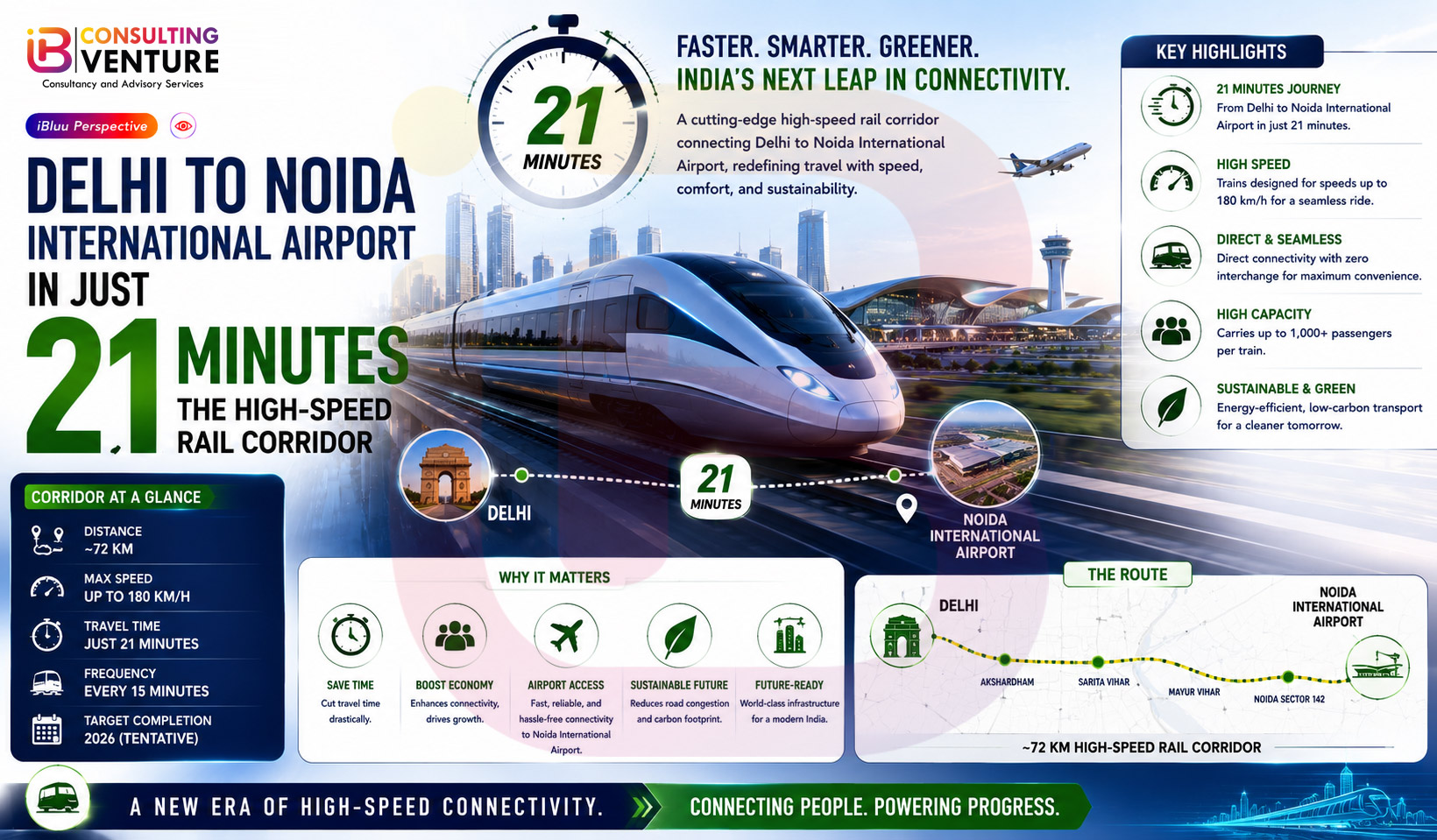
The High-Speed Economic Corridor: Delhi to Noida International Airport in Just 21 Minutes
For decades, major global cities have competed not merely through infrastructure, but through how efficiently they connect airports, business districts, logistics hubs, industrial zones, and residential clusters into one integrated economic system.
Today, the National Capital Region (NCR) may be moving closer to a similar transformation.
The proposed high-speed rail corridor connecting Sarai Kale Khan in Delhi to Noida International Airport (Jewar) represents precisely such an opportunity.
If implemented as planned, the corridor could reduce travel time across a nearly 70-kilometre stretch to approximately 21 minutes, creating one of the fastest airport access systems in India. More importantly, it could establish the first large-scale multimodal transportation ecosystem linking high-speed rail, metro networks, expressways, logistics infrastructure, industrial corridors, and an international airport within a single integrated growth region.
This is not merely a rail project.
It is an economic corridor in the making.
The Project at a Glance
| Parameter | Proposed Corridor |
|---|---|
| Route | Sarai Kale Khan – Noida International Airport |
| Approximate Distance | ~70 km |
| Travel Time | ~21 minutes |
| Infrastructure Type | High-Speed Rail / Rapid Regional Transit |
| Proposed Alignment | Primarily elevated |
| Key Economic Nodes | Delhi, Noida, Greater Noida, YEIDA Region, Jewar |
| Airport Connectivity | Direct access to Noida International Airport |
| Status | DPR approved by Uttar Pradesh Government and forwarded for central consideration |
| Strategic Importance | Airport access, regional mobility, economic corridor development |
The Strategic Logic Behind the Corridor
For decades, the biggest challenge facing large airports worldwide has not been aviation capacity.
It has been access.
Passengers judge airports not merely by terminals and runways, but by the ease of reaching them.
This is particularly relevant for Noida International Airport, which has emerged as one of India’s most important greenfield aviation investments.
While the airport possesses enormous long-term potential, accessibility remains the critical variable that determines how quickly passenger demand scales.
A 21-minute connection fundamentally changes the equation.
The project effectively transforms Jewar from a peripheral location into an extension of Delhi’s metropolitan transportation network.
Why Noida International Airport Needs This Connectivity
The success of global airports increasingly depends on rail connectivity.
Consider global benchmarks:
| Airport | Rail Connectivity |
|---|---|
| Heathrow Airport | Heathrow Express |
| Frankfurt Airport | ICE High-Speed Rail |
| Hong Kong International Airport | Airport Express |
| Shanghai Pudong International Airport | Maglev |
| Dubai International Airport | Metro Integration |
The most successful aviation hubs are no longer isolated airports.
They are multimodal transportation ecosystems.
For Noida International Airport, rapid rail access could become the catalyst that accelerates passenger adoption, airline expansion, cargo growth, and commercial development.
India’s First True Multimodal Mobility Platform
Perhaps the most significant aspect of the project is not speed.
It is integration.
The proposed corridor could eventually connect:
- Noida International Airport
- Delhi Metro Network
- Namo Bharat RRTS
- Delhi Railway Network
- High-Speed Rail Corridors
- Yamuna Expressway
- Eastern and Western Freight Corridors
- Logistics Parks
- Industrial Clusters
Such integration is rare even among advanced transportation systems globally.
The result is a mobility platform rather than a standalone transportation asset.
The Real Estate Multiplier Effect
History repeatedly demonstrates a simple principle:
Infrastructure creates accessibility. Accessibility creates demand. Demand creates value.
This phenomenon has already played out around:
- Gurugram after NH-8 and Metro connectivity
- Hyderabad around the Financial District
- Bengaluru around Outer Ring Road
- Shanghai around Pudong Airport
The Yamuna Expressway region is now entering a similar phase.
The combination of:
- International airport infrastructure
- Manufacturing investments
- Electronics clusters
- Semiconductor projects
- Warehousing and logistics facilities
- High-speed transit systems
creates conditions for a long-duration growth cycle.
The Industrial Corridor Advantage
The airport is only one piece of the larger story.
The broader Yamuna Expressway region is rapidly emerging as one of India’s most strategically important industrial belts.
The region is increasingly connected with:
- Delhi-Mumbai Expressway
- Ganga Expressway
- Agra-Lucknow Expressway
- Purvanchal Expressway
- Dedicated Freight Infrastructure
This positions the corridor as a future logistics and manufacturing powerhouse.
Comparison With Existing Regional Rail Systems
The most relevant benchmark is India’s operational Delhi–Meerut RRTS.
| Metric | Delhi–Meerut RRTS | Proposed Delhi–Jewar Corridor |
|---|---|---|
| Length | 82 km | ~70 km |
| Maximum Speed | Up to 160 kmph | Expected high-speed operation |
| Travel Time | ~55 minutes | ~21 minutes |
| Core Objective | Regional Commuting | Airport Connectivity + Economic Corridor |
| Economic Impact | Regional Mobility | Aviation, Logistics, Manufacturing, Real Estate |
The proposed travel time suggests one of the most competitive airport access systems in the country.
Economic Impact Assessment
Direct Benefits
- Reduced travel time
- Lower road congestion
- Reduced emissions
- Increased airport accessibility
- Improved logistics efficiency
Indirect Benefits
- Higher land absorption
- Commercial office demand
- Hospitality expansion
- Industrial investments
- Warehouse development
Long-Term Strategic Benefits
- Regional GDP acceleration
- Enhanced global competitiveness
- Foreign direct investment attraction
- Aviation ecosystem growth
- Export-oriented industrial development
Key Risks and Challenges
Every transformative project faces execution risks.
Key challenges include:
Funding and Financial Viability
Large-scale transportation infrastructure requires substantial capital commitments and phased implementation strategies.
Land Acquisition
Even predominantly elevated corridors require land for stations, depots, and supporting infrastructure.
Ridership Forecast Accuracy
Long-term viability depends on passenger adoption and airport growth projections.
Multimodal Integration
The true value emerges only when metro, airport, rail, and road systems operate seamlessly.
Why Global Investors Should Pay Attention
The market often focuses on airports.
The smarter capital studies the ecosystem around airports.
Historically, some of the highest-value urban districts globally emerged around transportation hubs rather than city centres.
Jewar’s long-term opportunity lies not merely in becoming an airport.
It lies in becoming a transportation, logistics, manufacturing, and commercial ecosystem.
The proposed 21-minute rail connection could significantly accelerate that transition.
The Strategic Perspective
According to the broader infrastructure and economic transformation lens often emphasized by J Parasher, Founder of iBluu Corporations, the most consequential infrastructure investments are those that compress economic distance.
When regions become easier to access, capital moves faster.
When capital moves faster, industries emerge.
When industries emerge, entire economic geographies are rewritten.
The proposed Delhi–Noida International Airport high-speed rail corridor is therefore not merely a mobility project.
It represents a strategic attempt to reposition the Yamuna Expressway region as one of India’s most important future growth corridors.
Conclusion: The Race Is No Longer About Building Airports
The next generation of infrastructure competition is not about who builds the biggest airport.
It is about who builds the most connected airport ecosystem.
A 21-minute connection between Delhi and Noida International Airport would do more than reduce travel time.
It would compress geography, integrate economic clusters, accelerate investment flows, and potentially create one of the most powerful multimodal growth corridors in India.
The airport may be the destination.
But connectivity is what ultimately determines its future.
Disclaimer: This article is based on publicly reported proposals, DPR approvals, government announcements, and industry sources available as of June 2026. Final route alignments, station locations, funding structures, costs, timelines, and implementation details remain subject to regulatory approvals and future project decisions.