+91 945 889 6091
  infodesk@ibluu.com
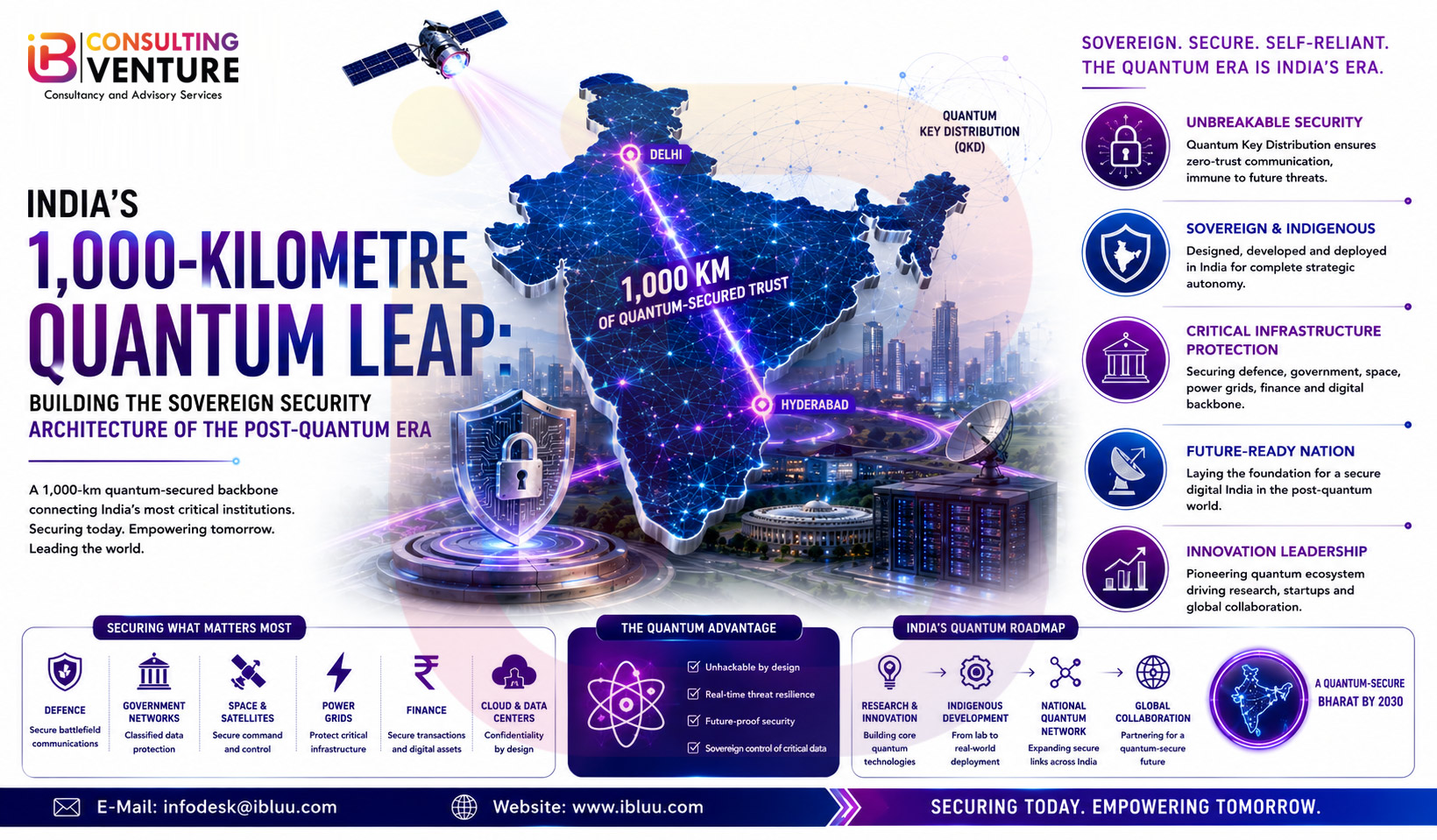
India’s 1,000-Kilometre Quantum Milestone: Building the Sovereign Security Architecture of the Post-Quantum Era
When Cybersecurity Becomes National Infrastructure
The most consequential technology breakthroughs are often misunderstood at first. They are viewed as scientific achievements when, in reality, they represent strategic shifts in economic power, national security, and geopolitical influence.
India’s successful demonstration of a 1,000-kilometre quantum communication network under the National Quantum Mission (NQM) belongs firmly in the latter category.
At first glance, the milestone appears to be a technological accomplishment in secure communications. In reality, it signals something far larger: the emergence of India’s sovereign quantum-security infrastructure and the beginning of a new era in which cybersecurity becomes a strategic national asset rather than merely an IT function.
Developed using indigenous technology by Bengaluru-based deep-tech startup QNu Labs and supported by the Department of Science and Technology (DST), the network represents one of the world’s longest operational Quantum Key Distribution (QKD) deployments over commercial optical fibre infrastructure. Achieved in less than two years, it has already completed half of India’s original 2,000-kilometre quantum communication objective, significantly ahead of schedule.
The achievement is not simply about distance.
It is about strategic resilience.
It is about technological sovereignty.
And perhaps most importantly, it is about preparing for a cybersecurity future that has already begun.
The Strategic Imperative: The Threat Is Not Tomorrow—It Is Already Here
Most discussions around quantum computing focus on future possibilities.
The more immediate concern is a growing cybersecurity strategy known as “Harvest Now, Decrypt Later” (HNDL).
Under this model, adversarial states and sophisticated threat actors intercept and store encrypted communications today, even if they cannot currently decrypt them. Their objective is straightforward: preserve sensitive data until future quantum computers become powerful enough to break today’s encryption standards.
For governments, defence agencies, banks, telecom operators, healthcare systems, and critical infrastructure operators, this creates an uncomfortable reality.
The vulnerability already exists.
Every sensitive communication transmitted today could become readable tomorrow.
This transforms quantum security from a future technology discussion into a present-day strategic necessity.
Traditional public-key encryption systems such as RSA and ECC derive security from computational complexity. Quantum computers threaten that assumption.
Quantum communication, by contrast, relies on the laws of physics rather than mathematical difficulty.
That distinction is fundamental.
Why the 1,000-Kilometre Network Matters
The newly demonstrated network uses Quantum Key Distribution (QKD), enabling cryptographic keys to be exchanged through quantum states transmitted across optical fibre infrastructure.
Its defining characteristic is simple yet revolutionary.
Any attempt to intercept or observe the quantum transmission alters the quantum state itself, immediately alerting network operators to the intrusion. This provides a level of security that conventional communications cannot achieve.
Key Milestone Metrics
| Indicator | Achievement |
|---|---|
| National Quantum Mission Budget | ₹6,003.65 Crore |
| Mission Timeline | 2023-24 to 2030-31 |
| Operational Quantum Network | 1,000 Kilometres |
| National Target | 2,000 Kilometres |
| Delivery Timeline | Less than 2 Years |
| Technology Provider | QNu Labs |
| Infrastructure Medium | Existing Commercial Optical Fibre |
| Primary Technology | Quantum Key Distribution (QKD) |
The ability to leverage existing optical fibre infrastructure dramatically improves scalability and lowers deployment costs compared to building entirely new communication networks.
For policymakers, this transforms quantum communication from an experimental laboratory capability into deployable national infrastructure.
Beyond Cybersecurity: The Rise of Technological Sovereignty
The strategic significance of this achievement extends beyond encryption.
Historically, many nations have depended on imported hardware, foreign software stacks, and externally controlled technology ecosystems.
Such dependence introduces invisible risks.
Supply chain vulnerabilities.
Hardware-level backdoors.
Technology embargo risks.
Geopolitical leverage.
The National Quantum Mission reflects a deliberate shift away from this model.
By building indigenous quantum-security technologies through domestic deep-tech enterprises, India is creating sovereign technology supply chains that reduce external dependencies and strengthen strategic autonomy.
In an era increasingly defined by technology nationalism, domestic capability is becoming as important as technological capability itself.
Countries that control their secure communications infrastructure control their strategic future.
The Enterprise Reality: Quantum Readiness Is Becoming a Boardroom Issue
For many organisations, quantum security is still perceived as a distant concern.
That assumption is rapidly becoming outdated.
Financial institutions, telecom operators, energy networks, defence contractors, healthcare providers, and digital infrastructure operators face a growing challenge:
How do they protect data that must remain secure not for months, but for decades?
This question fundamentally changes cybersecurity planning.
The transition now underway involves two parallel tracks:
1. Post-Quantum Cryptography (PQC)
New cryptographic algorithms designed to withstand attacks from future quantum computers.
2. Quantum Key Distribution (QKD)
Physics-based secure key exchange systems that detect interception attempts in real time.
Forward-looking organisations are increasingly treating both as complementary components of future security architectures rather than competing alternatives.
For Chief Information Security Officers (CISOs), the implication is clear:
Quantum readiness should no longer be viewed as an IT modernisation initiative.
It is becoming a fiduciary, governance, compliance, and risk-management requirement.
Institutions that delay preparation may discover that their most valuable data assets have already entered the “store now, decrypt later” risk window.
The Economic Multiplier Effect of Deep-Tech Capital
The broader significance of the National Quantum Mission lies in its economic architecture.
With a government commitment of ₹6,003.65 crore through 2030-31, the mission is not merely funding scientific research. It is attempting to build an entire quantum economy.
Historically, transformative technology ecosystems emerge when three conditions converge:
- Government-backed strategic capital
- Academic and research excellence
- Commercialisation through startups and industry
The National Quantum Mission combines all three.
The model is particularly important because quantum technologies face unusually long development cycles, substantial capital requirements, and high technical barriers.
Private markets alone often struggle to finance such innovation.
Targeted public investment bridges this gap, accelerating commercial viability while reducing innovation risk.
The resulting multiplier effects can extend far beyond cybersecurity.
Potential spillovers include:
- Quantum computing
- Quantum sensing
- Precision navigation systems
- Defence technologies
- Advanced semiconductors
- Secure telecommunications
- High-performance scientific instrumentation
The strategic objective is clear: position India not merely as a consumer of quantum technologies, but as a creator and exporter of quantum intellectual property, hardware, and security systems.
The Road to 2,000 Kilometres—and Beyond
The 1,000-kilometre milestone represents a midpoint, not a destination.
Under the National Quantum Mission roadmap, India aims to establish a 2,000-kilometre quantum communication backbone while simultaneously advancing satellite-based quantum communication systems capable of supporting long-distance secure links across national and international boundaries.
The next phase will involve overcoming several challenges:
Strategic Challenges Ahead
| Challenge | Strategic Importance |
|---|---|
| Network Scalability | Expansion from pilot infrastructure to national deployment |
| Quantum Hardware Manufacturing | Domestic production at scale |
| Talent Availability | Building specialised quantum workforce |
| Standards & Regulation | Creating interoperable national frameworks |
| Enterprise Adoption | Commercial deployment beyond government use |
| Satellite Integration | Extending secure communication beyond terrestrial fibre |
Successfully addressing these challenges will determine whether India becomes a quantum technology leader or merely an early adopter.
The Bigger Picture: A New Layer of National Infrastructure
The world’s most valuable infrastructure assets have evolved over time.
Railways powered industrialisation.
Electricity powered manufacturing.
Telecommunications powered globalization.
Cloud infrastructure powered the digital economy.
Quantum-secure networks may become the foundational infrastructure of the intelligence economy.
In that context, India’s 1,000-kilometre quantum communication milestone is not simply a scientific achievement.
It is the construction of a new national security layer designed for a world where cyber warfare, artificial intelligence, and quantum computing increasingly converge.
The countries that master this convergence will shape the next era of technological power.
India’s progress under the National Quantum Mission suggests it intends to be one of them.
Strategic Perspective
The analytical depth of this assessment has been informed by the strategic lens of J Parasher, Founder and Managing Director of iBluu Corporations, whose work focuses on national capability building, global industrial benchmarking, and long-horizon economic transformation. His perspective views deep-tech ecosystems not as isolated innovation programmes, but as strategic economic assets capable of strengthening national competitiveness, technological sovereignty, and future export leadership in an increasingly technology-driven geopolitical order.
Disclaimer: This article is intended solely for informational, educational, and strategic thought-leadership purposes. The views expressed are based on publicly available information, industry developments, and independent analysis of emerging technology trends. The article does not constitute investment, legal, cybersecurity, regulatory, or policy advice. Readers should undertake their own due diligence and consult qualified professionals before making strategic, financial, operational, or investment decisions related to quantum technologies, cybersecurity infrastructure, or associated sectors.