+91 945 889 6091
  infodesk@ibluu.com
From Maritime Fragility to Multimodal Control: How INSTC and IMEC Are Rewriting Global Trade Power—and Anchoring India at the Core of a Post-Chokepoint Logistics Order
For decades, the world’s supply chains have been engineered around a narrow set of maritime chokepoints—the Strait of Hormuz, the Red Sea, and the Suez Canal. Today, that architecture is under stress. Conflict spillovers, shipping disruptions, insurance spikes, and route diversions have exposed a hard truth:
Efficiency without resilience is no longer a viable strategy.
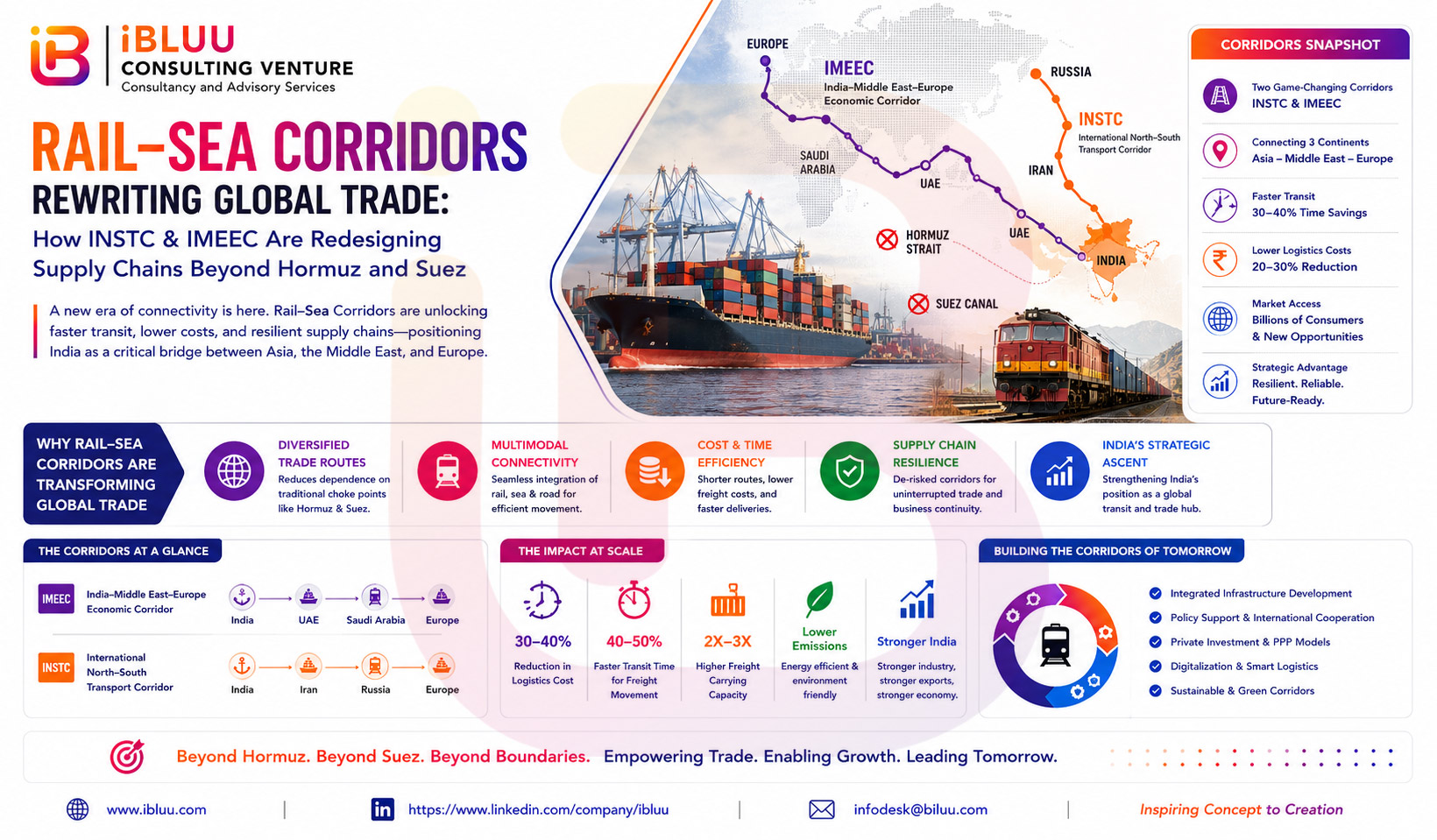
In response, two strategic rail–sea corridors—the International North–South Transport Corridor (INSTC) and the India–Middle East–Europe Economic Corridor (IMEC)—are emerging as the next-generation infrastructure frameworks designed to de-risk global trade, compress transit times, and rewire geopolitical supply chains.
At the center of both corridors sits one country with increasing strategic gravity:
India.
The Structural Vulnerability of Global Trade
Recent disruptions across West Asia and the Red Sea have demonstrated the fragility of global logistics systems:
- Over 900+ vessels rerouted away from the Suez corridor in recent months
- Transit delays increased by 10–14 days for Europe-bound shipments
- Fuel costs surged by $1–2 million per voyage
- War-risk insurance premiums escalated up to 10x
- Nearly 20% of global oil trade remains exposed to the Strait of Hormuz
This is not a temporary disruption.
It is a systemic risk embedded in global trade architecture.
The Strategic Shift: From Maritime Dependence to Multimodal Resilience
The response is not to replace maritime trade—but to complement it with integrated rail–sea networks that provide redundancy, flexibility, and geopolitical insulation.
1. IMEEC: The New Westward Trade Spine
The India–Middle East–Europe Economic Corridor (IMEC) represents a next-generation logistics platform connecting:
- India’s western ports → UAE (sea leg)
- UAE → Saudi Arabia → Jordan/Israel → Greece/Europe (rail + logistics spine)
Strategic Impact
- Bypasses Red Sea–Suez dependency
- Reduces geopolitical risk exposure
- Creates a high-efficiency Eurasian supply chain alternative
- Integrates ports, railways, logistics hubs, and digital infrastructure
IMEEC is not just a corridor—it is a multi-country economic integration platform anchored in infrastructure.
2. INSTC: The Northbound Strategic Corridor
The International North–South Transport Corridor (INSTC) is a 7,200 km multimodal network connecting:
- India → Iran (sea)
- Iran → Azerbaijan → Russia → Central Asia → Europe (rail + inland waterways)
Strategic Advantages
- Reduces Mumbai–Moscow distance by ~40% versus the Suez route
- Cuts transit time by up to 30–40%
- Opens access to Central Asian resource and industrial markets
- Diversifies trade away from Hormuz–Suez axis
Execution Gaps (Realistic Assessment)
- Incomplete rail connectivity within Iran
- Need for Caspian Sea logistics optimization
- Operational coordination across multiple jurisdictions
Despite these, the direction is clear:
INSTC is transitioning from concept to strategic reality.
India’s Role: From Endpoint to Global Transit Power
India’s positioning within both IMEC and INSTC is not incidental—it is structural.
1. Geographic Leverage
India sits at the intersection of East–West and North–South trade flows, making it a natural logistics anchor.
2. Port Infrastructure Strength
Major ports such as JNPT, Mundra, and Kandla are evolving into high-capacity global gateways integrated with inland logistics networks.
3. Industrial & Export Base
India’s rising manufacturing ecosystem—electronics, automotive, chemicals, pharmaceuticals—requires faster, more reliable export corridors.
4. Policy & Infrastructure Alignment
- PM GatiShakti for multimodal integration
- Dedicated Freight Corridors (DFC) enhancing inland connectivity
- Logistics cost reduction target: from ~14% to <10% of GDP
5. Strategic Diplomacy
India is uniquely positioned to maintain working relationships across Gulf nations, Iran, Russia, Europe, and the US-led bloc, enabling corridor diplomacy at scale.
Key Corridor Comparison: Strategic Positioning
| Parameter | IMEC | INSTC |
|---|---|---|
| Direction | India → Europe (Westward) | India → Russia/Central Asia (Northward) |
| Structure | Sea + Rail + Ports | Sea + Rail + Inland Waterways |
| Core Benefit | Bypass Suez | Bypass Suez + reduce distance |
| Strategic Value | Supply chain diversification | Resource + Eurasian integration |
| Maturity | Early-stage, high momentum | Partially operational, scaling phase |
Global Stakeholders and Capital Alignment
These corridors are attracting multi-layered participation:
- India → Strategic anchor and execution driver
- UAE & Saudi Arabia → Logistics monetization and diversification beyond oil
- Europe → Supply chain de-risking and China+1 strategy
- Russia & Central Asia → Market access and trade diversification
- Multilateral institutions → Financing resilient infrastructure ecosystems
This is not just infrastructure investment.
It is geopolitical capital deployment.
Economic Impact: A New Trade Multiplier
1. Trade Efficiency Gains
- Reduced transit time = faster working capital cycles
- Lower logistics costs = improved export competitiveness
2. Industrial Acceleration
Corridors enable cluster-based manufacturing ecosystems near logistics nodes.
3. Energy Security
Diversified routes reduce exposure to single-point disruptions.
4. Supply Chain Reconfiguration
Supports global shift toward multi-origin, multi-route supply chains.
Scenario Outlook (2030–2040)
Base Case
- Partial corridor operationalization
- 10–15% trade diversion from Suez
Accelerated Case
- Full rail integration + port upgrades
- 20–30% trade shift toward multimodal corridors
Strategic Upside
- India emerges as top 3 global logistics hub
- Corridor-linked industrial zones drive export-led GDP growth
The Deeper Reality: Infrastructure Is Strategy
These corridors are not about speed alone.
They are about control, redundancy, and resilience.
When one disruption can impact:
- Energy prices
- Global inflation
- Manufacturing supply chains
Then infrastructure is no longer operational.
It is geopolitical leverage.
iBluu Strategic Perspective
The analytical lens behind this perspective reflects the broader strategic thinking of J Parasher, Founder and Managing Director of iBluu Corporations, whose work consistently focuses on long-horizon economic transformation, infrastructure intelligence, and global benchmarking.
From this vantage point:
- Corridors are not logistics projects—they are economic systems
- India is not a participant—it is a central architect
- Multimodal infrastructure is the next competitive frontier
Conclusion: The Beginning of a New Trade Architecture
The world is not abandoning maritime trade.
It is redesigning it.
INSTC and IMEC represent the first wave of a multi-corridor global trade system, where resilience, flexibility, and geopolitical alignment define competitiveness.
And at the heart of this transformation:
India is moving from the periphery of global trade routes to the center of global trade strategy.
Disclaimer: This article is intended for strategic and informational purposes only. All data, projections, and forward-looking insights are based on publicly available information, industry trends, and analytical interpretation. Readers and investors are advised to conduct independent due diligence and seek professional advisory before making investment or policy decisions.