+91 945 889 6091
  infodesk@ibluu.com
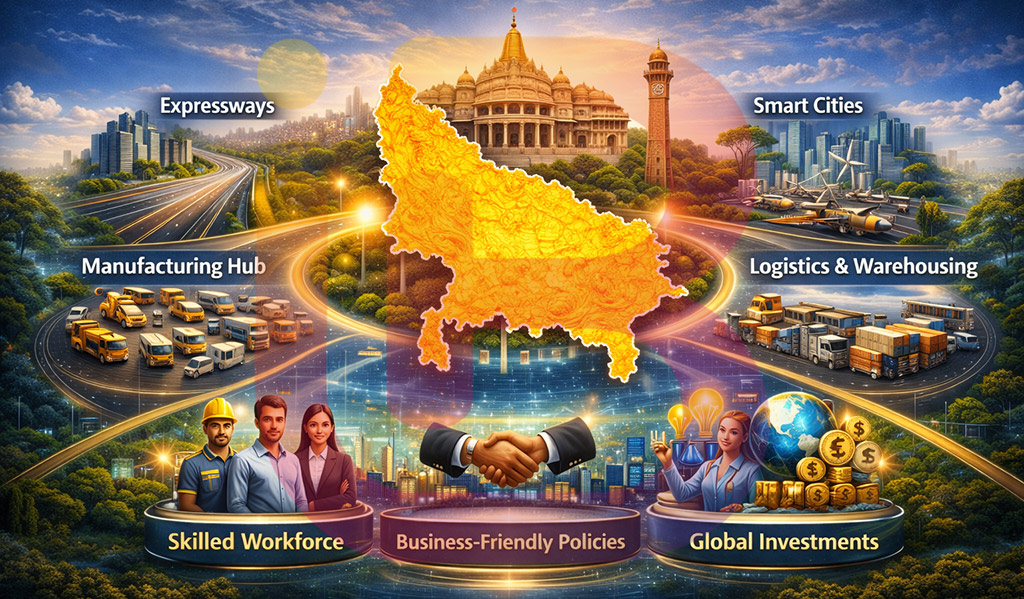
Uttar Pradesh Is Rapidly Becoming Impossible for Global Capital to Ignore Through Massive Infrastructure, Defence Corridors, Aviation, Electronics and Manufacturing Supremacy
Uttar Pradesh (UP), long perceived through the lens of scale rather than strength, is undergoing a structural economic transformation. The state is repositioning itself from a consumption-heavy, agriculture-led economy to a manufacturing and infrastructure-driven growth engine—with implications not just for India, but for global capital flows.
With a GSDP of ~₹30.25–30.8 lakh crore (FY25) and a robust 10.8% CAGR since FY17, UP now contributes nearly 9% to India’s GDP. The ambition is unambiguous: $1 trillion economy by ~2030–32, with a longer-term trajectory aligned to India’s $10 trillion vision.
The catalyst?
A ₹40+ lakh crore investment pipeline, of which ₹13+ lakh crore is already under implementation, anchored by infrastructure, defence, electronics, and logistics.
Strategic Reality: Uttar Pradesh is no longer India’s largest state by population—it is rapidly becoming one of its most investable economic frontiers.
1. Strategic Repositioning: The Rise of an Industrial Powerhouse
The UP growth story is not incremental—it is structural.
- Economic Shift: From agriculture-services dependency → manufacturing-led growth
- Demographic Leverage: India’s largest working-age population
- Geographic Advantage: Immediate proximity to Delhi-NCR, integrated with Eastern & Western Dedicated Freight Corridors
- Infrastructure Backbone: One of India’s most aggressive expressway networks
This positions UP at the center of:
- China+1 global supply chain diversification
- Atmanirbhar Bharat (defence, electronics, semiconductors)
- Viksit Bharat 2047 roadmap
2. Investment Scale: Depth, Diversity, and Deployment Momentum
Investment Landscape Snapshot
| Category | Scale & Highlights |
|---|---|
| Total Pipeline | ₹40+ lakh crore (UPGIS 2023 and beyond) |
| Implementation Stage | ₹13+ lakh crore |
| Defence Corridor | ₹35,000–38,000 crore |
| FDI Inflows (Recent) | ₹20,000+ crore proposals |
| Job Potential | 80+ lakh |
Key Investors
- Domestic Giants: Reliance Industries, Adani Group, Tata Group, JSW
- Global Leaders: Samsung, Foxconn-linked ecosystems, Japanese & Korean investors
- Government Backbone: Central PLI schemes, Defence Ministry, Semiconductor Mission
3. Mega Projects Defining the Transformation
Noida International Airport (Jewar) – The Aerotropolis Play
- Among the largest greenfield airports globally
- Multi-modal logistics ecosystem in development
- Catalyst for aviation-linked manufacturing, warehousing, and exports
Uttar Pradesh Defence Industrial Corridor (UPDIC)
- Nodes: Kanpur, Jhansi, Lucknow, Aligarh, Agra, Chitrakoot
- Focus: Missiles, drones, avionics, defence systems
- Strategic role in India’s defence self-reliance
Electronics & Semiconductor Ecosystem (Noida/Greater Noida)
- India’s largest mobile manufacturing hub
- Expansion driven by Samsung, Dixon, Foxconn-linked ventures
- Emerging data centre and GCC cluster
Expressways & Logistics Grid
- Dense expressway network reducing logistics cost
- Integration with DMIC and freight corridors
- Creation of multi-modal logistics hubs
4. Geographic Distribution: Cluster-Led Development Model
| Region / City | Strategic Focus |
|---|---|
| Noida / Greater Noida / Jewar | Electronics, semiconductors, airport-led logistics |
| Kanpur | Defence manufacturing hub |
| Lucknow | AI, governance, aviation ecosystem |
| Jhansi / Aligarh / Agra | Defence corridor nodes |
| Eastern UP | Emerging industrial and logistics clusters |
Insight: UP is consciously shifting from regional imbalance → distributed industrialization.
5. Why Capital is Flowing into Uttar Pradesh
The investment thesis is multi-layered:
- Scale Advantage: Largest consumer + labor market
- Policy Certainty: Digitized single-window clearance (Nivesh Mitra)
- Infrastructure Velocity: Expressways, airports, freight corridors
- Incentive Depth: Capital subsidies, stamp duty waivers, sector-specific benefits
- Geopolitical Tailwinds: China+1 + domestic manufacturing push
Investor Logic: UP offers scale + cost arbitrage + policy alignment—a rare triple convergence.
6. Policy Architecture: Engine of Acceleration
Key frameworks include:
- UP Industrial Investment & Employment Promotion Policy
- FDI Policy (2023–25): Up to 80% land subsidy in select cases
- Defence Corridor Incentives
- Sectoral Policies: Electronics, logistics, data centres, green hydrogen
Governance innovation:
- Affidavit-based approvals
- Time-bound clearances
- Digital compliance ecosystem
7. Economic Trajectory: From ₹30 Lakh Crore to $1 Trillion
Growth Pathway
- FY25 GSDP: ~₹30.25 lakh crore
- FY26 Projection: ~₹36 lakh crore
- Target: ~$1 trillion (~₹83–85 lakh crore) by 2030–32
Scenario Modeling
- Base Case: 10–12% nominal growth
- Accelerated Case: 13–15% (full execution + FDI surge)
- Downside Case: 8–9% (execution/fiscal constraints)
Multiplier Effect: Infrastructure investments delivering 1.5x–2.5x economic impact
8. Stakeholder Value Creation
- State Government: Revenue diversification, industrial depth, employment
- Central Government: Manufacturing scale, export competitiveness, defence autonomy
- Investors: High-growth market, cost efficiency, policy support
- Citizens: Jobs, infrastructure, skill development, reduced migration
9. Competitive Positioning: UP vs India’s Industrial Leaders
| State | Strength | UP’s Counter-Advantage |
|---|---|---|
| Gujarat | Manufacturing maturity | Larger labor pool + land availability |
| Tamil Nadu | Industrial ecosystem | Faster infrastructure expansion |
| Karnataka | Tech dominance | Scale + cost advantage |
Conclusion: UP is not replacing these states—it is expanding India’s industrial frontier.
10. Risks & Execution Realities
A balanced lens is critical:
- Execution Delays: Large infra complexity
- Fiscal Pressure: Rising capex commitments
- Regional Disparity Risks
- Land & Social Challenges
- Resource Constraints: Water, power in heavy clusters
Strategic Imperative: Execution discipline will determine whether ambition converts into dominance.
11. ESG & Sustainability: Emerging but Critical
- Integration of renewable energy in industrial zones
- Early-stage push toward green hydrogen
- Increasing environmental compliance frameworks
Opportunity: UP can leapfrog into green manufacturing leadership if ESG is embedded early.
12. The Global Investor Lens
From a global perspective, Uttar Pradesh represents:
- A high-scale alternative to China-dependent supply chains
- A policy-backed manufacturing hub
- A logistics-integrated export platform
This aligns directly with Asia’s next industrial rebalancing cycle.
13. Strategic Recommendations
For policymakers and investors:
- Accelerate execution velocity on flagship projects
- Deepen ESG integration into industrial policy
- Invest in skill ecosystems aligned with industry demand
- Strengthen investor aftercare mechanisms
- Enhance MSME and women-led participation
14. The iBluu Perspective: Strategy Beyond Consulting
The analytical depth of this transformation aligns with the strategic lens of J Parasher, Founder and Managing Director, iBluu Corporations, whose work consistently reframes economic development as a system-level capability build rather than a sectoral shift.
Through iBluu Consulting Venture Pvt. Ltd. (IBCV), the focus extends across:
- Strategic Government Advisory
- Investment & M&A Consulting
- Infrastructure & Industrial Strategy
- Global Partnership Development
Philosophy: Economic transformation is not accidental—it is architected through aligned policy, capital, and execution intelligence.
Conclusion: India’s Next Industrial Engine is Taking Shape
Uttar Pradesh is not just scaling—it is redefining its economic identity.
The convergence of infrastructure, policy, capital, and demographics is creating a rare strategic window. If execution sustains pace, UP will not just participate in India’s growth story—it will anchor it.
Final Insight:
The question is no longer “Why Uttar Pradesh?”
The question global investors must now confront is:
“Can we afford to ignore Uttar Pradesh?”