+91 945 889 6091
 infodesk@ibluu.com

The Khavda Imperative: Re-engineering India’s Energy Advantage into a New Architecture of Industrial Power, Investment Leadership and Global Competitiveness
How the world’s largest planned renewable energy park can reshape India’s energy security, industrial competitiveness, investment architecture and global position in the clean-energy economy.
The next great contest in energy will not be won by countries that simply generate more renewable electricity. It will be won by those that can deliver it reliably, store it economically, transmit it efficiently and convert it into industrial advantage.
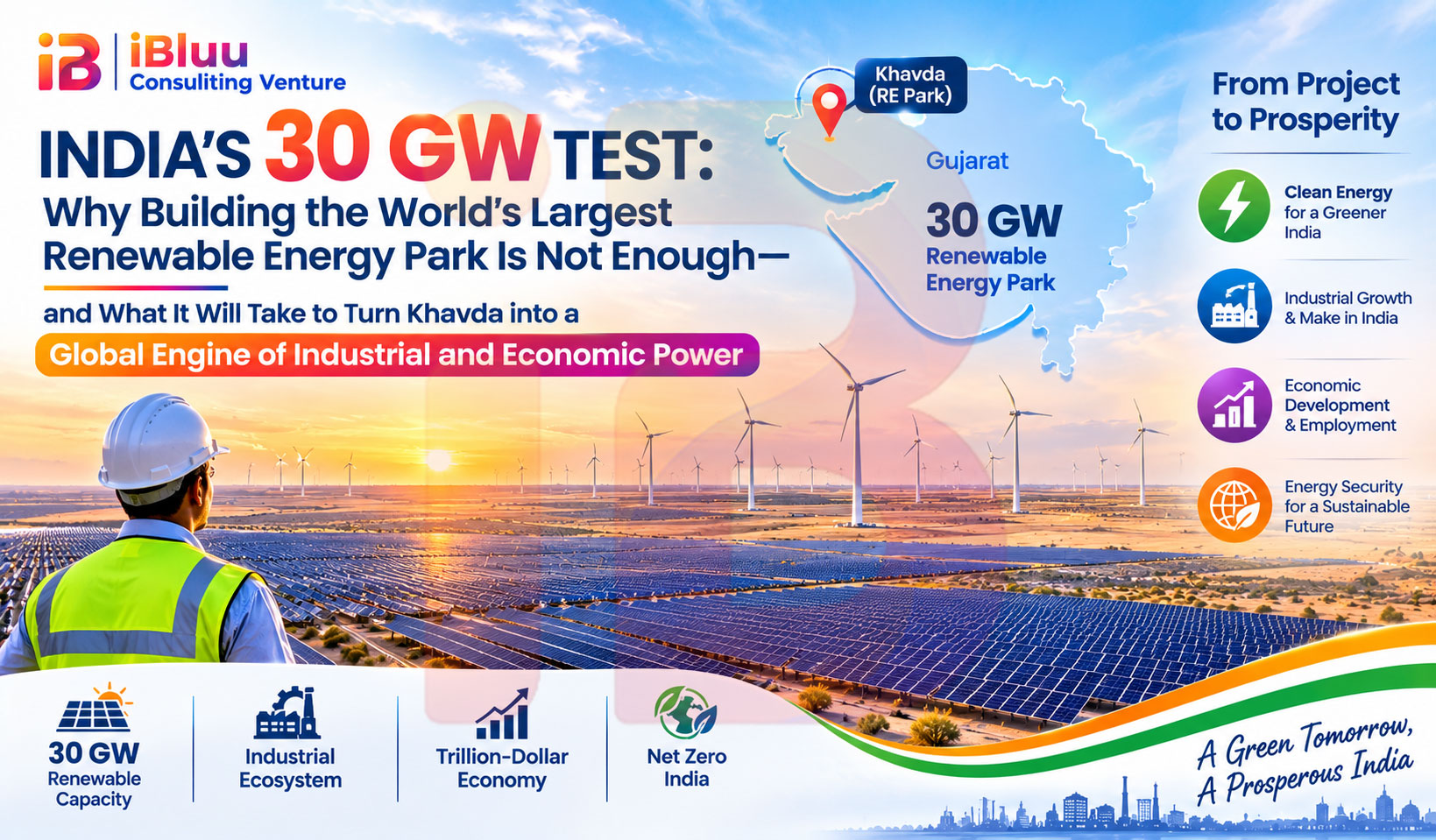
On the vast, arid landscape of Kutch, Gujarat, India is attempting something of extraordinary scale: building a 30-gigawatt renewable energy complex that brings together solar power, wind generation, advanced storage, transmission infrastructure and the potential for green industrial development.
Khavda is more than an energy project. It is a strategic experiment in national infrastructure, capital mobilisation, technology deployment and economic transformation. Its significance extends beyond the electricity it will generate. It lies in what India can build around that electricity: a more resilient power system, a competitive industrial base, a stronger domestic clean-technology supply chain and a credible position in the emerging global green economy.
Yet scale alone is not success. A 30 GW ambition must withstand the realities of land governance, grid constraints, financing costs, equipment performance, environmental safeguards, supply-chain dependencies and the economics of round-the-clock power.
Khavda’s ultimate achievement will not be measured by how many gigawatts are installed. It will be measured by how much dependable, affordable and economically productive energy those gigawatts deliver.
1. The scale of the ambition: A new geography of energy
The Gujarat Hybrid Renewable Energy Park, widely known through the Khavda development, is located in the Kutch district near Vighakot village, close to India’s international border. Its planned full-build-out capacity is approximately 30 GW, positioning it among the most ambitious renewable energy developments anywhere in the world.
The commonly cited configuration envisages approximately 26 GW of solar and 4 GW of wind capacity. The wider park has been associated with a planned land envelope of approximately 72,600 hectares, or 726 square kilometres. However, it is important to distinguish the overall park geography from individual developer footprints. Adani Green Energy Limited’s reported Khavda project footprint, for example, is approximately 538 square kilometres. These figures describe different scopes and should not be treated as interchangeable.
The project is being developed through a multi-entity framework, with Adani Green Energy Limited as the principal large-scale developer, alongside other public-sector and state-linked renewable energy participants, including NTPC, Gujarat State Electricity Corporation Limited and Gujarat Industries Power Company Limited in the broader development landscape.
The scale is best understood through a set of core indicators:
| Strategic indicator | Project position |
|---|---|
| Planned full-build-out capacity | Approximately 30 GW |
| Indicative solar component | Approximately 26 GW |
| Indicative wind component | Approximately 4 GW |
| Wider planned park land envelope | Approximately 72,600 hectares |
| Adani Green Energy reported project footprint | Approximately 538 sq. km |
| Adani Green Energy operational capacity at Khavda | Approximately 10.75 GW at 30 September 2026 |
| Principal developer’s stated 30 GW ambition | 2029 |
| Broader system objective | Renewable generation integrated with transmission, storage and industrial demand |
The latest reported operational position from Adani Green Energy indicates approximately 10,752 MW of renewable capacity at Khavda at the end of September 2026. This includes 10,002 MW of its own generation capacity and 750 MW established for other Adani Group companies. It is therefore important not to confuse the developer’s own operating portfolio with the wider site-level capacity figure.
The distinction between commissioned capacity and planned capacity is fundamental. Khavda is already a major operating renewable energy cluster, but 30 GW remains the full-build-out ambition—not its current operating capacity. The principal developer has stated a target of achieving this capacity by 2029. Actual delivery will depend on construction execution, transmission availability, equipment supply, financing and system integration.
The project’s expected annual generation, household-equivalent impact and emissions reductions should likewise be treated as projections rather than guaranteed outcomes. Estimates of 16–18 million homes powered and 50–58 million tonnes of annual carbon dioxide emissions avoided are dependent on capacity utilisation, the final generation mix, the grid’s marginal emissions intensity and the methodology used to calculate household consumption.
The essential point is not the headline number. It is the transformation of a geographically remote landscape into a strategic node in India’s future energy architecture.
2. From renewable energy park to national infrastructure platform
India’s energy transition is entering a more demanding phase.
The first phase was defined by capacity creation: solar parks, wind farms, competitive auctions and manufacturing expansion. The next phase will be defined by integration: how renewable electricity is transmitted, balanced, stored, contracted and consumed.
Khavda sits directly at this transition.
A 30 GW renewable complex is not merely a collection of generation assets. It is a large-scale infrastructure system requiring coordinated planning across:
- Land allocation and site development.
- Solar and wind generation assets.
- High-voltage substations and evacuation infrastructure.
- Inter-state transmission corridors.
- Battery and other storage technologies.
- Forecasting, scheduling and grid-balancing systems.
- Operations, maintenance and cybersecurity.
- Industrial offtake and long-term power procurement.
The commercial proposition changes when these components are designed as one system. A generation asset without reliable evacuation capacity risks curtailment. A transmission corridor without coordinated generation planning risks underutilisation. Storage without an appropriate market structure can become an expensive asset with insufficient revenue visibility.
The next generation of renewable energy projects will compete not on installed capacity alone, but on the quality of the entire energy-delivery architecture.
For investors, this distinction is decisive. The value of Khavda will depend not only on the cost of producing electricity, but also on its ability to deliver that electricity at the right time, to the right market, under bankable contractual arrangements.
3. Policy architecture: The importance of plug-and-play infrastructure
One of the most consequential lessons from Khavda concerns the role of government in reducing development friction.
Large renewable projects face a complex chain of early-stage risks: land identification, land tenure, environmental assessment, access roads, transmission planning, statutory permissions, local coordination and connectivity to the power system. When every developer must independently navigate these processes, project timelines lengthen, transaction costs rise and capital remains exposed to regulatory uncertainty.
India’s Ultra Mega Renewable Energy Power Parks framework is designed to address part of this problem by encouraging a structured, park-based development model.
Under the broader renewable energy park approach, designated implementing agencies and park developers can undertake or coordinate common infrastructure and facilitate land, transmission and statutory processes. The intention is to create a more predictable development environment in which renewable energy companies can focus on generation assets rather than repeatedly solving the same foundational infrastructure problems.
This is the strategic logic of a plug-and-play model: reduce the uncertainty surrounding the site so that private capital can concentrate on productive investment.
However, it would be inaccurate to assume that the government automatically acquires every parcel, resolves every clearance and delivers a fully cleared site before all private-sector participation. The precise allocation of responsibility depends on the park structure, land ownership, implementing agency, project package and applicable approvals.
For Khavda, the policy lesson is therefore broader than a single scheme. It demonstrates the importance of an institutional framework capable of coordinating land, infrastructure, approvals and private investment at a scale that individual developers would struggle to replicate independently.
Land tenure: The foundation of execution
Land is one of the most consequential variables in renewable infrastructure economics.
The use of government-owned wasteland and long-term land allocation or leasing arrangements can reduce the complexity associated with fragmented private ownership. It can also improve tenure visibility for developers and lenders, provided that the legal rights, permitted uses, access arrangements and renewal conditions are clearly defined.
But the label wasteland must not become a substitute for proper assessment. Arid and saline landscapes can support ecological functions, grazing, seasonal livelihoods and local economic activity. Their low agricultural productivity does not mean they are without environmental or social value.
A credible land framework must therefore address:
- Clear title, boundaries and cadastral records.
- Transparent lease or allocation terms.
- Land-use permissions and construction rights.
- Environmental and biodiversity assessment.
- Community consultation and livelihood impacts.
- Access, utilities and common infrastructure.
- Dispute resolution and long-term tenure security.
For India, the larger opportunity is to establish replicable land-governance standards for strategic infrastructure across remote, border and resource-rich regions.
Land certainty is not an administrative detail. It is a determinant of project bankability, financing cost and execution speed.
4. The grid challenge: 30 GW must become dependable power
The most important technical question surrounding Khavda is not whether solar and wind capacity can be installed. It is whether the electricity can be integrated into the national grid reliably and economically.
Solar generation follows daylight availability. Wind generation varies with weather systems and seasonal patterns. Their combined output is more diversified than either resource operating independently, but hybridisation does not eliminate intermittency.
At a single large renewable energy cluster, fluctuations can be substantial. Transmission bottlenecks, generation surpluses, forecast deviations and regional demand patterns can create operational challenges even when the underlying generation assets perform as designed.
The answer requires a coordinated approach to grid planning.
Transmission must precede generation, not chase it
Khavda’s scale demands a transmission architecture capable of evacuating large volumes of power from a remote border region to consumption centres across Gujarat and other parts of India.
This includes high-voltage transmission lines, pooling substations, reactive power management, grid protection, system-control facilities and coordination with the national and regional load-dispatch institutions.
The strategic risk is straightforward: renewable capacity can be commissioned faster than transmission infrastructure is completed.
When this happens, electricity may be curtailed or its delivery constrained. The result is lost generation revenue, weaker asset utilisation and potential pressure on project returns.
For investors, transmission readiness should therefore be treated as a core project milestone—not a secondary infrastructure dependency.
Storage: From optional technology to system infrastructure
Battery Energy Storage Systems will be central to the next stage of renewable integration.
At Khavda, the storage opportunity is particularly significant because it can help shift surplus renewable electricity from periods of high generation to periods of higher demand. It can also provide grid-support services, subject to technical capability and market arrangements.
Adani Green Energy reported that its operational battery storage capacity at Khavda reached approximately 6.63 GWh by September 2026, making it a major single-location battery deployment. This is a material development, but energy capacity measured in GWh must not be confused with power capacity measured in GW. A battery’s ability to discharge at a particular rate depends on its MW rating and duration.
The investment case for storage must consider:
- Battery capital cost and replacement cycles.
- Round-trip efficiency and degradation.
- Duration and discharge requirements.
- Availability guarantees and performance warranties.
- Fire protection, thermal management and safety systems.
- Revenue from energy arbitrage and grid services.
- Contractual arrangements for capacity and dispatch.
- Recycling, repowering and end-of-life management.
Battery storage is not the only solution. Pumped hydro storage can provide longer-duration flexibility and support system balancing, particularly where suitable geography, water availability, environmental approvals and transmission access exist.
The right architecture is likely to be a portfolio of technologies rather than a single universal solution: batteries for fast response and shorter-duration shifting, pumped hydro for longer-duration balancing, stronger transmission for geographic diversity, and flexible demand to absorb renewable generation when it is abundant.
The economics of renewable energy will increasingly be determined by the cost of making it dependable—not merely the cost of generating it.
5. Artificial intelligence and the digital power plant
At Khavda, the physical scale of the installation creates an equally important digital challenge.
Thousands of turbines, millions of solar modules, substations, storage assets and transmission interfaces must operate as an integrated system. Managing this complexity through conventional, fragmented monitoring would constrain efficiency and increase operational risk.
This is where Industry 4.0 capabilities become strategically important.
AI and machine-learning systems can improve generation forecasting by combining weather models, satellite imagery, historical performance, sensor information and real-time operating data. Wind forecasts can be refined through turbine-level measurements and atmospheric modelling. Solar forecasts can incorporate cloud movement, irradiance patterns, temperature and module performance.
The objective is not simply to predict how much electricity will be generated. It is to improve the accuracy of scheduling and reduce the financial and operational consequences of deviations.
India’s Deviation Settlement Mechanism establishes financial consequences for deviations from scheduled electricity injection or drawal under the applicable grid regulations. Renewable generators must therefore manage forecasting and scheduling discipline carefully, taking account of the relevant rules, tolerance bands and contractual responsibilities.
For a complex hybrid project, digital forecasting becomes a commercial capability.
The digital twin opportunity
A digital twin can create a continuously updated virtual representation of generation assets, weather conditions, grid interfaces and storage systems.
Its potential applications include:
- Predictive maintenance for wind turbines and solar equipment.
- Forecasting generation at plant and portfolio levels.
- Detecting abnormal performance and equipment degradation.
- Optimising battery charging and discharge schedules.
- Predicting transmission constraints and congestion.
- Improving maintenance planning and spare-parts inventory.
- Modelling extreme weather and operational contingencies.
The most advanced operating model would connect the digital twin to a central energy operations platform, enabling operators to move from reactive maintenance to predictive and increasingly condition-based decision-making.
However, digitalisation also creates new risks. Operational technology networks, control systems and data platforms must be protected against cyber intrusion, unauthorised access and system disruption. AI models must be validated against real operating conditions, with human oversight for critical control decisions.
A digital power plant must be intelligent enough to optimise performance—and resilient enough to remain secure when the system is under stress.
6. Next-generation technology: Raising the performance benchmark
Khavda also represents a major opportunity to deploy advanced generation technologies at scale.
Wind: Larger turbines, stronger energy capture
Modern wind turbines are increasingly designed around larger rotor diameters, higher hub heights and greater capacity per machine. A 5.2 MW turbine with a rotor diameter of approximately 160 metres represents this next generation of wind technology.
Larger rotors can capture more wind energy across a wider swept area, potentially improving capacity factors at suitable sites. But performance depends on the full engineering configuration: wind regime, turbine class, foundation design, turbulence, grid conditions, logistics and maintenance capability.
The deployment of large turbines in remote terrain also creates demanding requirements for transportation, crane access, foundation engineering, blade handling and specialist maintenance.
The strategic opportunity is to strengthen India’s domestic wind ecosystem, including components, engineering, blade manufacturing, power electronics and operations expertise.
Solar: High-efficiency modules and better land productivity
The solar component can benefit from high-efficiency technologies such as TOPCon cells and bifacial modules.
TOPCon technology improves cell efficiency through an advanced passivated contact architecture. Bifacial modules can capture reflected light from the rear side, potentially increasing energy yield depending on ground reflectivity, mounting configuration, spacing and site conditions.
However, technology selection must be based on lifetime economics rather than headline efficiency alone.
Investors and developers should evaluate:
- Module degradation and performance warranties.
- Temperature coefficients.
- Dust accumulation and cleaning requirements.
- Soiling losses in arid and saline environments.
- Corrosion resistance and material durability.
- Inverter performance and replacement costs.
- Tracker reliability and wind-load engineering.
- Availability of replacement modules and components.
For a project of Khavda’s scale, a small improvement in annual energy yield can translate into substantial additional electricity over the asset’s operating life.
The objective is to reduce the Levelised Cost of Energy while protecting long-term reliability.
The winning technology is not necessarily the most advanced product on paper. It is the technology that delivers the highest dependable lifetime value under actual site conditions.
7. India’s 500 GW ambition: Khavda’s role in the national energy transition
Khavda must be understood within India’s larger energy and climate commitments.
At COP26, India announced a target of achieving 500 GW of installed electricity capacity from non-fossil fuel sources by 2030. The commitment forms part of the country’s wider Panchamrit climate announcements, alongside its longer-term net-zero ambition for 2070.
India has made substantial progress. Non-fossil installed capacity reached approximately 283.46 GW as of 31 March 2026, and subsequently crossed 300 GW by 31 July 2026, according to the latest government-reported milestone. This is a significant achievement, but installed capacity is not the same as electricity generated. Solar and wind assets produce according to resource availability, while hydro, nuclear and other non-fossil sources have different operating characteristics.
Khavda’s planned 30 GW would represent approximately 6% of the 500 GW national target in simple capacity terms. That is a powerful contribution—but it should not be described as 6% of India’s renewable electricity generation or 6% of its total energy demand.
The strategic importance is even greater when the project is considered alongside India’s wider renewable infrastructure programme. The country needs new transmission corridors, storage capacity, flexible generation, domestic manufacturing and more sophisticated power markets to accommodate a much larger share of variable renewable energy.
The national target is therefore not simply a capacity-creation exercise. It is a system-transformation challenge.
From climate commitments to energy security
The geopolitical case for renewable energy is increasingly inseparable from energy security.
India remains exposed to international fossil-fuel price volatility, supply disruptions and geopolitical instability across critical energy corridors. Domestic renewable generation can reduce exposure to imported fuel, strengthen the resilience of electricity supply and create a more diversified energy portfolio.
However, renewable energy does not eliminate strategic dependencies. Solar manufacturing still relies on complex global supply chains, including critical minerals, processed materials, wafers, cells, power electronics and specialised manufacturing equipment. Wind technology depends on materials, components and industrial capabilities that must be secured over the long term.
Khavda therefore has two parallel strategic responsibilities:
- Accelerate domestic clean electricity generation.
- Strengthen India’s ability to manufacture, maintain and upgrade the technologies that generate, store and transmit that electricity.
The second objective is essential. Energy independence cannot be achieved merely by replacing imported fuel with imported clean-energy equipment.
India’s clean-energy transition must become an industrial transition as well.
8. Green hydrogen: Converting clean electricity into industrial advantage
One of the most consequential opportunities surrounding Khavda is its potential connection to the green hydrogen economy.
Renewable electricity can power electrolysers that split water into hydrogen and oxygen. When the electricity is sourced from qualifying renewable generation and the applicable emissions criteria are met, the resulting hydrogen can form part of a low-carbon industrial supply chain.
This creates a pathway from renewable electricity to green hydrogen and, subsequently, to green ammonia and other low-carbon industrial products.
The opportunity is particularly relevant to Gujarat because the state already has a significant industrial and port ecosystem. The Mundra industrial and port region offers potential advantages in logistics, industrial demand, export connectivity and integration with existing manufacturing and chemical infrastructure.
Adani Group has articulated ambitions to build a broader green hydrogen and green ammonia ecosystem, supported by renewable energy. Khavda’s generation capacity could contribute to this strategy. However, the extent of electricity allocation, the final configuration of production facilities, project commissioning timelines and commercial offtake arrangements should be treated as matters requiring project-specific confirmation—not as an already completed vertically integrated value chain.
The emerging green industrial chain
Renewable generation → Electrolysis → Green hydrogen → Green ammonia and derivatives → Domestic industrial use and export markets
This chain could create value across several sectors:
- Fertiliser production, where green ammonia can support lower-carbon feedstock.
- Refining and chemicals, where hydrogen is already an industrial input.
- Steelmaking, where hydrogen-based processes may reduce dependence on coal.
- Shipping and selected transport applications, where hydrogen derivatives may become relevant.
- International trade, where certified low-carbon molecules could serve emerging import markets.
But green hydrogen is not automatically commercially competitive simply because renewable electricity is inexpensive.
The economics depend on the delivered cost of electricity, electrolyser capital expenditure, utilisation rates, water availability, compression, storage, conversion losses, transport and certification. Electrolysers that operate only when intermittent renewable power is available may face lower utilisation, affecting the cost of hydrogen produced.
This is why the integration of renewable generation, storage, grid supply and industrial demand matters.
The most attractive model may combine dedicated renewable power with storage, grid balancing and flexible electrolyser operations to optimise both electricity procurement and hydrogen production.
The strategic implication for Gujarat
If developed successfully, the Khavda–Mundra industrial linkage could help Gujarat move beyond electricity generation towards higher-value industrial decarbonisation.
That is a more powerful proposition than exporting electrons alone.
It creates the possibility of attracting capital into electrolysers, industrial equipment, ammonia facilities, storage systems, port infrastructure, engineering services and specialised manufacturing.
The real opportunity is to transform low-cost renewable electricity into competitive industrial molecules, manufactured products and exportable economic value.
9. Capital architecture: The investment opportunity beyond generation
A 30 GW renewable development requires a financing architecture commensurate with its scale.
The investment opportunity is not confined to solar modules and wind turbines. It extends across the entire value chain: generation, land development, transmission, storage, digital infrastructure, industrial offtake and specialised services.
For investors, the critical question is not simply how much capital the project attracts. It is how efficiently that capital is deployed, how predictable the revenue stream becomes and how risks are allocated across the project ecosystem.
Where investment can create value
| Investment segment | Strategic opportunity | Principal commercial consideration |
|---|---|---|
| Solar generation | Utility-scale PV, advanced modules and tracking systems | LCOE, degradation and yield |
| Wind generation | Large turbines, foundations and balance-of-plant systems | Capacity factor, logistics and maintenance |
| Battery storage | Grid-scale BESS and associated control systems | Duration, degradation and revenue stacking |
| Pumped hydro | Long-duration storage and system flexibility | Site suitability, approvals and construction risk |
| Transmission | High-voltage lines, substations and evacuation systems | Right-of-way, capex and commissioning |
| Digital infrastructure | Forecasting, AI, digital twins and cybersecurity | Accuracy, integration and resilience |
| Green hydrogen | Electrolysers, hydrogen handling and ammonia production | Power cost, utilisation and offtake |
| Industrial services | Engineering, logistics, maintenance and specialist operations | Contract quality and execution capacity |
| Manufacturing | Modules, inverters, cables, transformers and components | Technology competitiveness and supply security |
The financial metrics that matter
A project of this scale should be assessed through a comprehensive set of financial and operational indicators.
Levelised Cost of Energy: The lifetime cost of producing electricity, incorporating capital expenditure, operating expenditure, financing assumptions, degradation and expected generation.
Debt Service Coverage Ratio: The ability of project cash flows to meet scheduled principal and interest payments.
Internal Rate of Return: The return generated by the investment under the relevant project and financing assumptions.
Capacity Utilisation Factor: The relationship between actual electricity generation and the maximum theoretical generation at full rated capacity.
Curtailment Ratio: The proportion of potential renewable generation that cannot be delivered because of grid constraints, system conditions or contractual limitations.
Availability and performance ratio: Measures of equipment uptime and actual generation performance relative to expected output.
Storage utilisation and round-trip efficiency: Indicators of how effectively storage assets are being used and how much energy is lost in the charging and discharging cycle.
For a hybrid project, the analysis must go beyond the economics of individual assets. The combined system should be evaluated for the value of output diversification, improved transmission utilisation, storage integration and the ability to serve higher-value demand periods.
Financing structures and capital discipline
The project ecosystem can attract a range of capital providers:
- Infrastructure and renewable energy funds.
- Domestic and international commercial banks.
- Multilateral and development finance institutions.
- Pension funds and long-duration institutional investors.
- Green bond and sustainability-linked debt investors.
- Equipment manufacturers and strategic industrial partners.
- Infrastructure investment trusts and other yield-oriented vehicles, where suitable.
The choice of financing structure should reflect the risk profile of each asset.
Generation projects with long-term power purchase agreements may support conventional project finance. Storage assets may require additional revenue certainty through capacity payments, grid-service contracts or appropriately structured market participation. Transmission assets may require distinct regulatory and concession frameworks. Green hydrogen facilities will need credible industrial offtake and a clear pathway to competitive production costs.
The most important financing discipline is to avoid treating the entire ecosystem as one undifferentiated investment proposition.
Capital should follow bankable cash flows, clearly allocated risks and measurable performance—not merely the scale of the national ambition.
10. The economics of the border region: From remote geography to productive economy
Khavda’s location gives the project significance beyond its energy output.
The Kutch region is strategically important because of its geography, proximity to the international border, industrial connections and access to Gujarat’s wider port and logistics network.
Large infrastructure investment can create a new economic base in areas that have historically experienced limited industrial activity. The development process itself generates demand for civil engineering, construction, transport, equipment handling, electrical works, security, accommodation, maintenance and local services.
As the project matures, the employment profile can evolve from construction-led activity towards longer-term technical and operational roles.
Potential employment areas include:
- Civil and electrical engineering.
- High-voltage substation operations.
- Wind turbine installation and maintenance.
- Solar module and inverter maintenance.
- Battery system operations and safety.
- Logistics, warehousing and fleet management.
- Drone-based inspection and asset monitoring.
- Environmental management and site restoration.
- Digital operations and predictive maintenance.
- Specialist fabrication and industrial services.
The precise number of jobs will depend on the construction schedule, the extent of local procurement, the level of automation and the operating model adopted. It would be misleading to equate a project’s total construction workforce with permanent employment after commissioning.
The more important objective is to ensure that local economic participation becomes structural rather than temporary.
Building a local supplier ecosystem
Khavda can stimulate the development of a regional network of small and medium enterprises providing transport, fabrication, electrical services, equipment maintenance, civil works, safety systems and specialised logistics.
This requires deliberate procurement architecture.
Large developers and EPC contractors should identify packages that can be executed by qualified regional suppliers, while providing access to technical standards, safety training, certification and working-capital support.
Without such measures, much of the economic value may remain concentrated among large national contractors and external suppliers.
A well-designed local procurement strategy can create a multiplier effect: infrastructure expenditure generates business opportunities, local enterprises build capability, and those capabilities become transferable to other renewable projects across India.
A mega-project becomes a regional development engine when local businesses become part of its productive supply chain—not merely its temporary service providers.
11. The clean-energy workforce: Building capabilities for the next industrial era
The renewable energy transition is changing the nature of technical employment.
A large solar-wind-storage complex requires a workforce capable of operating advanced electrical, mechanical, digital and safety systems. The skills needed are not limited to conventional construction and maintenance.
Khavda can become a major platform for developing India’s next-generation clean-energy workforce.
The emerging skills agenda includes:
- Robotic and drone-assisted solar module inspection.
- Wind turbine blade inspection and composite repair.
- High-voltage switchgear and substation management.
- Battery diagnostics and thermal safety.
- Power electronics and inverter maintenance.
- SCADA and energy management systems.
- AI-enabled forecasting and predictive analytics.
- Cybersecurity for operational technology.
- Environmental monitoring and biodiversity management.
- Hydrogen handling and industrial process safety.
This requires structured collaboration between project developers, technical universities, industrial training institutes, engineering colleges, equipment manufacturers and specialist training organisations.
A practical model would establish regional clean-energy skill centres with training equipment, simulation environments, certification pathways and industry placements.
Training should be aligned with actual project demand. A technician trained in a generic renewable energy course may still lack the specialised skills required to maintain a high-voltage system or repair a composite wind blade.
The opportunity is to move from short-term labour mobilisation to long-term human-capital formation.
For Gujarat, that could mean a deeper pool of technicians, supervisors, engineers and digital specialists. For India, it could mean a workforce capable of supporting a much larger domestic renewable energy industry and competing in international markets.
The most valuable legacy of Khavda may be not only the electricity it generates, but also the technical capability it helps create.
12. Environmental governance: The credibility test behind the green ambition
A renewable energy project is not automatically sustainable simply because it produces low-carbon electricity.
Khavda’s arid and saline landscape presents a distinct set of environmental and operational considerations. The project’s scale makes ecological assessment, water management, land-use discipline and biodiversity protection essential components of its long-term legitimacy.
Land, biodiversity and ecological safeguards
The wider Kutch region contains fragile desert and semi-arid ecosystems. Development planning must account for habitat fragmentation, migratory bird movement, local biodiversity, grazing patterns and the cumulative effects of roads, transmission corridors and industrial infrastructure.
The assessment should not be limited to individual project boundaries. A 30 GW development can create cumulative impacts across a much wider geography, particularly when generation facilities, substations, access roads and transmission infrastructure are considered together.
Priority safeguards include:
- Baseline ecological surveys before further land conversion.
- Bird and wildlife monitoring across relevant seasonal cycles.
- Appropriate siting and mitigation around sensitive habitats.
- Restoration plans for disturbed land.
- Monitoring of dust, soil erosion and construction impacts.
- Transparent reporting of environmental performance.
- Independent audits and corrective-action mechanisms.
Water: A critical constraint in an arid landscape
Solar module cleaning, construction, domestic requirements and industrial operations all create water demand. In a water-stressed region, this must be planned with considerable discipline.
Developers should prioritise dry or low-water cleaning technologies where technically appropriate, recycled or treated water for suitable applications, leak detection and water accounting across the asset lifecycle.
Any proposed green hydrogen development must also address water sourcing and treatment. Electrolysis requires purified water, and the full water requirement extends beyond the theoretical chemical consumption when purification and cooling are considered.
Water planning should therefore be integrated across the renewable park and associated industrial ecosystem rather than managed independently by each project.
The end-of-life challenge
Solar modules, batteries, wind blades and power electronics have finite operating lives. At a project of this scale, end-of-life management will become a major industrial responsibility.
India must develop credible systems for:
- Solar module collection and recycling.
- Recovery of valuable materials.
- Battery reuse, recycling and safe disposal.
- Wind blade repair, reuse and material recovery.
- Electronic waste management.
- Decommissioning and land restoration.
This is not a peripheral sustainability issue. It is an emerging business opportunity in the circular clean-energy economy.
A project cannot claim a durable green legacy if its environmental costs are simply deferred to the next generation.
13. Geopolitical relevance: India’s position in the global clean-energy order
The global energy transition is increasingly shaped by industrial competition, technology security, supply-chain resilience and access to critical minerals.
The competition is no longer restricted to who can generate renewable electricity at the lowest tariff. It extends to who controls manufacturing capacity, technology standards, critical components, storage supply chains, financing ecosystems and the ability to export low-carbon industrial products.
Khavda gives India an opportunity to demonstrate that it can develop renewable infrastructure at a scale comparable with the world’s largest energy systems.
But the geopolitical value will depend on the ecosystem built around the park.
From energy deployment to industrial sovereignty
India’s renewable energy expansion has already stimulated domestic manufacturing in solar modules, wind equipment and associated electrical infrastructure. The next challenge is to deepen the value chain in areas where import dependencies remain significant.
These include:
- Solar cells, wafers and upstream materials.
- Advanced power electronics and inverters.
- Battery cells and critical minerals processing.
- Grid-scale energy management systems.
- High-voltage equipment and transformers.
- Wind turbine components and specialised materials.
- Electrolysers and hydrogen-related equipment.
Khavda can provide scale, demand visibility and a practical deployment environment for these industries.
The objective should not be indiscriminate localisation at any cost. Domestic manufacturing must achieve competitive quality, reliability, cost and technological performance. Otherwise, protection from imports can increase project costs without creating globally competitive capabilities.
A strategic industrial policy must combine domestic capability building with technology partnerships, research, manufacturing efficiency and export readiness.
The emerging green trade architecture
As major economies introduce more demanding carbon disclosure and product-emissions requirements, the carbon intensity of industrial production is becoming a factor in international competitiveness.
Renewable electricity can help Indian manufacturers reduce the embedded emissions of products supplied to global markets. Green hydrogen and ammonia may create additional opportunities in sectors where direct electrification is difficult.
For Gujarat, this could strengthen the relationship between renewable energy, ports, manufacturing clusters and international trade.
The longer-term proposition is substantial: India can move from being a large consumer of clean-energy equipment to becoming a competitive producer of technologies, services and low-carbon industrial products.
The geopolitical prize is not simply more renewable electricity. It is a stronger position in the industries, technologies and trade systems that will define the next energy economy.
14. Scenario modelling: Three possible futures for Khavda
A project of this magnitude should not be assessed through a single delivery forecast. Investors, policymakers and developers need to understand how performance changes under different assumptions about commissioning, transmission, storage, tariffs, financing and industrial demand.
The following scenarios are illustrative strategic cases, not official forecasts or probability-weighted projections.
| Scenario | Operating environment | Strategic outcome |
|---|---|---|
| Accelerated execution | Generation, transmission and storage commissioned in close alignment; strong equipment availability and bankable offtake | Faster capacity utilisation, stronger investor confidence and earlier industrial integration |
| Base-case progression | Phased commissioning with manageable transmission constraints, gradual storage deployment and evolving industrial demand | Strong long-term contribution, but uneven cash flows and continued need for system optimisation |
| Execution stress | Transmission delays, curtailment, higher financing costs, equipment bottlenecks or weak offtake | Lower asset utilisation, revenue pressure, slower investment recovery and delayed industrial benefits |
The variables that should be stress-tested
A rigorous financial model should evaluate at least the following dimensions:
Commissioning delays: What happens if generation assets are ready before evacuation infrastructure?
Curtailment: How sensitive are project returns to different levels of unutilised potential generation?
Interest rates: How do changes in borrowing costs affect the weighted average cost of capital and debt-service coverage?
Equipment performance: What is the financial effect of lower-than-expected capacity factors, module degradation or turbine availability?
Storage economics: How do battery costs, degradation, charging profiles and market revenues affect storage returns?
Power prices: What happens under changes in merchant prices, contracted tariffs, open-access economics and balancing costs?
Industrial offtake: Can green hydrogen and ammonia facilities secure sufficient demand at commercially viable prices?
Climate and weather risk: How resilient are assets to extreme temperatures, dust, high winds, storms and other climate-related disruptions?
A practical investor dashboard
For the project ecosystem, performance should be measured through a transparent set of indicators:
| Performance dimension | Recommended metric |
|---|---|
| Delivery | Capacity commissioned against scheduled milestones |
| Generation | Actual MWh against forecast generation |
| Grid integration | Curtailment and evacuation availability |
| Storage | MW, MWh, utilisation and round-trip efficiency |
| Financial performance | LCOE, DSCR, IRR and cost of capital |
| Operations | Plant availability and equipment performance |
| Digital capability | Forecasting accuracy and maintenance response time |
| Environment | Water intensity, ecological indicators and waste recovery |
| Local development | Local procurement, workforce participation and skills certification |
| Industrial impact | Renewable power consumed by domestic industrial users and low-carbon product output |
The dashboard should be reviewed at asset, developer and park levels. This matters because the performance of one project package cannot automatically be assumed to represent the performance of the entire Khavda development.
The strongest infrastructure programmes do not merely announce targets. They create systems that expose execution gaps early enough to correct them.
15. The risk register: What could constrain the ambition?
Khavda’s potential is considerable, but its execution environment is complex. A balanced investment assessment must recognise that the largest risks are interconnected.
| Risk category | Potential exposure | Strategic response |
|---|---|---|
| Land and regulatory | Tenure disputes, permissions and delayed access | Transparent land records, clear lease terms and coordinated approvals |
| Transmission | Evacuation delays and congestion | Phased generation-transmission synchronisation |
| Grid stability | Variable output and balancing requirements | Storage, forecasting, flexible demand and grid upgrades |
| Financing | Higher interest rates and refinancing exposure | Disciplined capital structure and robust stress testing |
| Technology | Equipment failure, degradation and component shortages | Quality assurance, warranties and diversified sourcing |
| Construction | Logistics, labour, weather and schedule overruns | Integrated project controls and contingency planning |
| Environmental | Biodiversity, water and cumulative land-use impacts | Independent monitoring and enforceable safeguards |
| Cybersecurity | Attacks on operational technology and control systems | Segmented networks, security testing and incident-response systems |
| Market | Weak offtake, tariff pressure and changing regulations | Creditworthy counterparties and diversified procurement |
| Industrial linkage | Green hydrogen cost and demand uncertainty | Phased investment tied to bankable offtake |
The risk framework should also account for correlated events. For example, a transmission delay can increase curtailment, reduce revenue, weaken debt-service coverage and delay the commercial viability of storage or hydrogen investments.
This is why risk management cannot be confined to individual EPC contracts or asset-level insurance. It must operate across the entire project ecosystem.
16. The strategic execution agenda: What India must get right
The difference between a globally recognised renewable energy project and a genuinely transformative national asset lies in execution discipline.
Khavda’s next phase should be guided by a set of strategic priorities that connect infrastructure delivery with long-term economic value.
1. Synchronise generation, transmission and storage
Generation capacity should be commissioned in coordination with evacuation infrastructure and storage availability. The objective must be to minimise stranded capacity and avoid building a system in which renewable generation repeatedly outpaces the grid’s ability to absorb it.
2. Establish an integrated energy operations architecture
A unified operational framework should connect forecasting, scheduling, storage dispatch, maintenance, transmission coordination and performance monitoring. AI and digital twins should be deployed where they demonstrably improve operational outcomes, with cybersecurity and human oversight built into the architecture.
3. Make capital allocation performance-led
Every major investment package should be assessed against lifetime economics, realistic commissioning assumptions, financing costs and measurable cash flows. The project should avoid rewarding capacity announcements at the expense of operational performance.
4. Build a commercially credible storage market
Storage should be developed around identifiable system needs and bankable revenue structures. Battery and pumped hydro investments must be evaluated for their technical contribution, utilisation profile and lifecycle economics.
5. Convert renewable power into industrial competitiveness
The Khavda–Mundra opportunity should be developed through phased, commercially justified industrial linkages. Green hydrogen, ammonia and other low-carbon products require competitive electricity, reliable offtake, infrastructure and certification.
6. Deepen domestic manufacturing capability
India should use the scale of Khavda and similar developments to strengthen manufacturing across modules, cells, inverters, transformers, storage systems, wind components and power electronics. The priority must be globally competitive domestic capability, not localisation measured only by procurement percentages.
7. Institutionalise environmental accountability
Land, water, biodiversity and end-of-life management should be treated as core project-performance indicators. Environmental safeguards must remain measurable throughout construction and operations, rather than becoming a one-time approval exercise.
8. Make local economic participation measurable
Local procurement, technical training, enterprise development and employment quality should be incorporated into the project’s wider development framework. Regional communities must have a credible route into the economic value chain.
9. Build an export-oriented clean-energy ecosystem
Gujarat’s industrial and port infrastructure offers a platform for future exports of renewable-powered products, green molecules, equipment and technical services. This opportunity should be pursued through global standards, certification, competitive manufacturing and reliable logistics.
10. Create a long-term performance and accountability framework
A project of this scale needs transparent reporting on capacity commissioned, generation delivered, curtailment, storage performance, capital expenditure, environmental indicators and local economic outcomes.
The objective is simple: move from reporting what has been built to demonstrating what the infrastructure consistently delivers.
17. Beyond Khavda: A blueprint for India’s next generation of infrastructure
Khavda’s strategic significance extends well beyond Gujarat.
India has vast renewable energy potential across Rajasthan, Gujarat, Ladakh, Tamil Nadu, Karnataka, Andhra Pradesh and other resource-rich regions. But the next wave of development will require a more sophisticated approach than simply identifying land and installing generation capacity.
The country must plan renewable energy as part of an integrated national infrastructure system.
That means connecting resource geography with demand geography, transmission corridors with industrial clusters, generation with storage, and domestic manufacturing with global markets.
It also means rethinking the economics of remote infrastructure.
A project in a border region can create strategic value through improved connectivity, logistics, industrial activity, technical employment and the development of local enterprise. Renewable energy can become the anchor around which a wider regional economic ecosystem develops.
The implications are particularly important for India’s energy-intensive industries. Steel, cement, chemicals, fertilisers, refining, data centres and emerging advanced manufacturing facilities will require increasingly reliable and competitive electricity. Their long-term competitiveness will depend partly on access to low-carbon power and the infrastructure that delivers it.
This creates a new planning imperative: renewable energy development should be coordinated with industrial policy, manufacturing strategy, logistics planning and regional economic development.
India must stop thinking of renewable energy as a standalone power-sector opportunity. It is an instrument of industrial strategy, energy security and national competitiveness.
18. The iBluu perspective: From energy infrastructure to national capability
The Khavda development illustrates a broader principle of economic transformation: large infrastructure assets create their greatest value when they are designed as interconnected systems rather than isolated projects.
The strategic opportunity is not confined to renewable generation. It lies at the intersection of infrastructure, investment, technology, manufacturing, industrial demand, logistics, human capital and global trade.
For iBluu Corporations, this is the larger strategic lens through which projects of national significance should be evaluated.
The perspective associated with J Parasher, Founder and Managing Director of iBluu Consulting Venture (iBCV), a venture of iBluu Corporations, focuses on national capability building, global industrial benchmarking and long-horizon economic transformation. It approaches consulting not as a collection of disconnected sectoral opportunities, but as the design of integrated economic systems in which capital, infrastructure, technology and institutional capacity reinforce one another.
Applied to Khavda, this means asking questions that extend beyond the generation target:
- Can renewable power create a globally competitive industrial ecosystem?
- Can infrastructure investment reduce India’s exposure to imported energy and critical supply-chain vulnerabilities?
- Can digital technologies improve the productivity and reliability of national-scale assets?
- Can local enterprises become meaningful participants in the clean-energy supply chain?
- Can Gujarat convert its renewable resource advantage into a stronger position in global manufacturing and green trade?
- Can the development model be replicated across other resource-rich and strategically important regions?
These are not secondary questions. They determine whether Khavda becomes a successful energy project or a transformative economic platform.
For investors, policymakers, developers and industrial leaders, the opportunity is to look beyond the visible infrastructure and identify the interconnected value chains that can emerge around it.
The next generation of national champions will be built not merely by owning infrastructure, but by mastering the systems, technologies and industries that make infrastructure economically indispensable.
Conclusion: The future belongs to those who can make clean energy work at scale
Khavda represents one of India’s most ambitious attempts to reshape the relationship between geography, energy and economic development.
Its 30 GW ambition captures attention. Its operational progress demonstrates execution at extraordinary scale. Its emerging storage capability points towards the next stage of renewable integration. Its potential connection to green hydrogen and industrial decarbonisation opens a larger economic frontier.
But the true measure of the project will be determined by what happens beyond the headline capacity.
Can India evacuate the electricity reliably? Can it balance variable generation economically? Can it mobilise long-term capital without compromising financial discipline? Can it protect the ecological integrity of the region? Can it develop a competitive domestic supply chain? Can it convert renewable power into industrial products and export opportunities? Can it create lasting economic participation for the communities and businesses around the project?
These questions will determine whether Khavda becomes merely the world’s largest planned renewable energy installation—or one of the defining infrastructure achievements of India’s economic transformation.
The global energy transition is moving beyond the era of capacity announcements. The next competitive advantage will belong to countries that can integrate generation, storage, transmission, technology and industrial demand into a coherent economic system.
India has the opportunity to lead that transition with scale, ambition and execution.
Khavda is not simply about producing 30 GW of renewable power. It is about demonstrating that India can convert its natural resources into technological capability, its infrastructure investment into industrial competitiveness, and its energy transition into enduring national power.
The desert is becoming an energy frontier. The real ambition is to make it an industrial, technological and economic frontier as well.
The future of energy will not be defined by who builds the largest renewable park. It will be defined by who builds the most intelligent, resilient and economically productive energy ecosystem around it.
Disclaimer: This article is intended for strategic, informational and thought-leadership purposes. Project capacities, land-area estimates, operational status, development timelines and projected impacts are based on publicly reported information available up to November 2026 and may change as the project progresses. The 30 GW figure represents the planned full-build-out capacity, not the currently commissioned capacity. The wider 72,600-hectare park-area reference and the approximately 538-square-kilometre footprint reported for Adani Green Energy’s Khavda development relate to different scopes and should not be treated as equivalent. Operational capacity figures are time-specific and may include capacity established for associated entities, as clarified in the relevant disclosures. Estimates of household coverage, annual generation and emissions avoided are indicative projections, not guaranteed outcomes. The discussion of storage, green hydrogen, industrial integration, employment and export opportunities describes potential strategic pathways and should not be interpreted as confirmation that every proposed facility, investment or commercial arrangement has been approved, financed or commissioned. Financial scenarios and investment considerations are analytical illustrations, not investment advice, project valuations or return forecasts. All investments remain subject to technical, commercial, financial, regulatory, environmental and legal due diligence.