+91 945 889 6091
 infodesk@ibluu.com

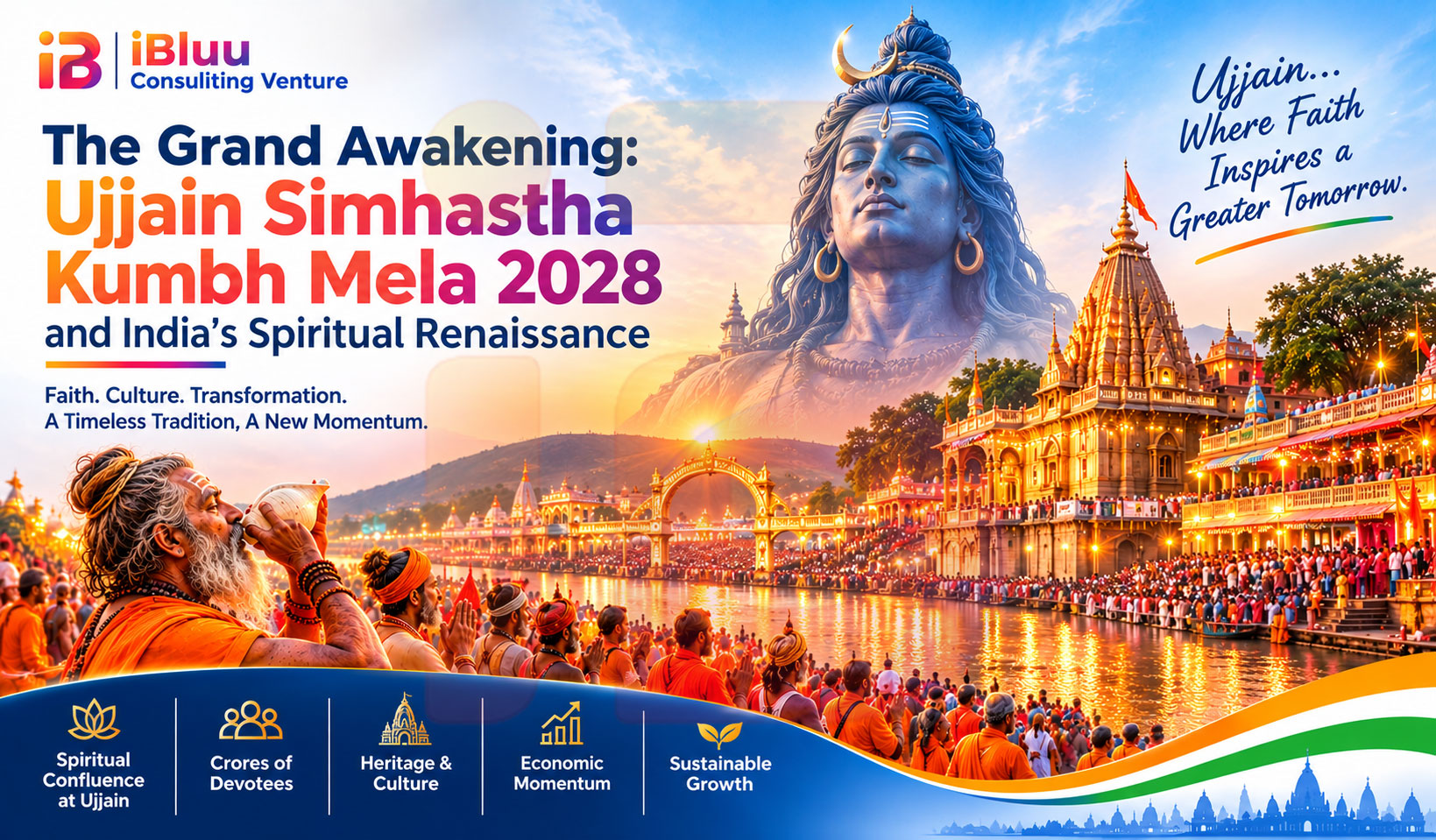
Can Ujjain Simhastha 2028 Transform India’s Spiritual Heritage into a New Architecture of Capital, Connectivity, Technology and Global Influence
From civilisational heritage to strategic economic value: how Madhya Pradesh can transform one of the world’s largest spiritual congregations into a lasting platform for infrastructure modernisation, investment, intelligent governance and India’s global cultural influence.
1. A Civilisational Moment. A Strategic Opportunity.
In 2028, the ancient city of Ujjain will once again occupy a position of extraordinary spiritual significance as millions of devotees, saints, ascetics, scholars and international visitors converge on the banks of the sacred Shipra River for Simhastha Kumbh Mela.
Traditionally associated with the twelve-year cycle of Jupiter’s transit into Simha Rashi (Leo), Simhastha represents one of India’s most profound expressions of living spiritual heritage. The planned event window, from 27 March to 27 May 2028, places Ujjain at the centre of a major national undertaking that extends far beyond pilgrimage.
The scale of the occasion presents a formidable test of public administration, urban planning, infrastructure delivery, financial discipline and institutional coordination. Roads, bridges, riverfronts, accommodation, sanitation, emergency services, digital connectivity and public safety must operate as an integrated system—not as disconnected projects assembled around a festival deadline.
Yet the opportunity is considerably larger.
A successful Simhastha can accelerate Ujjain’s evolution from a major pilgrimage destination into a more comprehensive spiritual-tourism economy, while strengthening Madhya Pradesh’s position in India’s cultural, infrastructure and investment landscape.
The defining ambition should be clear: build for the congregation, but invest for the generations that follow.
2. Cooperative Federalism: Aligning State Ambition with National Capability
Simhastha 2028 is a significant demonstration of the role that cooperative federalism can play in delivering complex, multi-agency development programmes.
The Government of Madhya Pradesh, under Chief Minister Dr. Mohan Yadav, is coordinating an extensive programme of infrastructure development, pilgrimage-area redevelopment, transport improvements and urban-capacity expansion. The State has reported project approvals exceeding ₹20,000 crore across the wider Simhastha-related development programme, although the precise consolidated outlay depends on project scope, approval status and the inclusion of associated regional works.
The State has also sought a ₹20,000-crore special financial package from the Union Government. This is a funding request, not a confirmed Central Government allocation. The distinction is important: a requested package, an approved project cost, a budgetary provision and an actual expenditure are four different financial measures.
The strategic requirement is to align funding with measurable public outcomes, rather than treat the size of announced investment as an achievement in itself.
The institutional architecture
Three areas of national policy are particularly relevant:
Pilgrimage and heritage infrastructure: The PRASHAD programme provides a national framework for improving pilgrimage-related tourism infrastructure. Its potential relevance lies in visitor amenities, destination management, accessibility, sanitation and heritage-sensitive development. Specific Simhastha projects should, however, be described as PRASHAD-funded only where their individual sanction and funding status are established.
Sustainable destination development: Swadesh Darshan 2.0 offers a framework for developing destinations as integrated, sustainable tourism ecosystems. Its principles—visitor experience, destination planning, local enterprise participation, interpretation and environmental responsibility—are directly relevant to Ujjain’s longer-term tourism ambitions. Individual project inclusion should not be presumed without formal confirmation.
Intergovernmental execution: The programme requires coordinated delivery across State departments, district administration, urban development agencies, transport authorities, railways, telecommunications providers, police, health services and environmental bodies. The Central Government’s role in national transport networks, aviation policy, telecommunications and relevant funding programmes is complementary to the State’s responsibility for local execution and event management.
The real test of coordination is not the number of committees established. It is whether land, approvals, funding, procurement, construction, utility connections and operating responsibilities are synchronised.
3. The Economics of Simhastha: From Pilgrim Footfall to a Durable Regional Economy
Simhastha can function as a powerful economic catalyst for Central India. Its economic significance, however, should not be measured through visitor numbers alone.
The opportunity is to convert temporary demand into productive local capacity.
Accommodation, food services, transport, retail, religious goods, handicrafts, textiles, construction, logistics, sanitation, healthcare and digital services will all participate in the wider economic ecosystem. Hotels and guest houses will experience demand from pilgrims and visitors, while local traders, small manufacturers, transport operators and service providers can gain access to a substantially expanded market.
The economic impact will extend beyond Ujjain if the event is connected effectively with Indore, Omkareshwar and other destinations across Madhya Pradesh.
Employment and enterprise development
An integrated temple-development proposal has carried an estimated direct-employment potential of approximately 8,000–10,000 jobs. This figure should be understood within the scope of that particular development programme, rather than treated as a confirmed employment forecast for the entire Simhastha.
The wider economic opportunity includes:
- Hospitality: Hotels, guest houses, homestays, temporary accommodation and professionally managed pilgrim facilities.
- Transport and logistics: Passenger mobility, fleet operations, last-mile connectivity, parking management and goods distribution.
- Local manufacturing: Religious products, traditional textiles, handicrafts, food processing and event-related supplies.
- Digital commerce: UPI-enabled payments, online bookings, digital visitor services and merchant technology.
- Professional services: Engineering, project management, security, technology integration, healthcare, facility management and waste processing.
The most important policy objective should be to ensure that local enterprises are not merely present during the Mela but become stronger, more formalised and more competitive afterwards.
A new financing architecture for pilgrimage infrastructure
One of the more consequential developments is the proposed revenue-backed financing structure associated with Ujjain’s integrated temple ecosystem redevelopment.
The reported project financing architecture is approximately ₹1,124.52 crore:
| Financing component | Proposed amount |
|---|---|
| Central grant | ₹281.13 crore |
| Municipal bonds | ₹200 crore |
| Term loan | ₹643.39 crore |
| Total | ₹1,124.52 crore |
The proposal envisages project-linked revenues from commercial shops, parking facilities, accommodation and other visitor amenities supporting debt servicing. Under the reported structure, 80% of participating project revenues would be placed in an escrow account for debt servicing, while 20% would be retained for operations and maintenance.
This is a significant shift in the financing philosophy of pilgrimage infrastructure. It moves beyond dependence on recurring budgetary support towards an asset-linked model in which appropriately structured commercial revenues can contribute to financial sustainability.
However, its success will depend on transparent revenue accounting, realistic demand assumptions, enforceable agreements, appropriate pricing, maintenance reserves and independent financial oversight. Pilgrimage access must remain sensitive to affordability and religious traditions. Commercial revenue should support the ecosystem—not compromise its public and spiritual character.
The larger proposition is that pilgrimage infrastructure can be developed as a financially disciplined public asset, provided its social purpose remains paramount.
4. Infrastructure Transformation: Connecting Ujjain to a Larger Economic Geography
A congregation of this scale requires more than additional roads. It requires a regional mobility system capable of managing intercity arrivals, local circulation, pedestrian movement, emergency access and the separation of heavy freight from pilgrim routes.
Ujjain’s infrastructure programme has the potential to strengthen its connectivity with Indore, the Delhi–Mumbai Expressway network and other important economic corridors.
Major connectivity and riverfront projects
| Project | Reported scale / outlay | Strategic significance |
|---|---|---|
| Ujjain–Jaora Greenfield Corridor | Approx. 98.73 km; ₹5,017 crore | Four-lane connectivity towards the Delhi–Mumbai Expressway network |
| Indore–Ujjain Six-Lane Highway | Approx. 46 km; ₹1,692 crore | Strengthens the principal intercity road connection and airport access |
| New Shipra Riverfront Ghats | Approx. 29 km; ₹778 crore | Expands bathing infrastructure and distributes pilgrim movement |
| Kanh River Closed-Duct Diversion | Approx. ₹919.94 crore | Designed to prevent polluted Kanh River water from entering the Shipra |
| Integrated Command and Control Centre | Approx. ₹139.14 crore | Establishes a central platform for monitoring and operational coordination |
Figures represent reported project estimates or approvals, not necessarily final expenditure or completed assets. Project scopes should be reconciled before aggregating them into a single investment figure.
Beyond highways: the regional mobility system
The Ujjain–Jaora corridor is a particularly important strategic investment because it strengthens the connection between Ujjain and the broader national expressway network. At approximately 98.73 km, the project is planned as a four-lane greenfield corridor, with multiple bridges, flyovers, railway overbridges and underpasses.
The approximately 46-km Indore–Ujjain six-lane highway is equally important. Indore is a major regional gateway, with an airport and a broader commercial ecosystem. Improving this connection can reduce journey friction for pilgrims, tourists, businesses and residents while strengthening the long-term economic relationship between the two cities.
The wider infrastructure strategy should include:
- Peripheral road and bypass capacity to divert through-traffic away from the historic urban core.
- Decentralised parking facilities linked to reliable shuttle and public transport services.
- Dedicated pedestrian corridors connecting major ghats, temples and transit points.
- Rail-station access improvements, passenger circulation and additional transport capacity where operationally feasible.
- Integrated bus terminals, last-mile transport and designated emergency routes.
- Clear segregation of freight, service vehicles, public transport and pedestrian movement.
The objective should be a city that can absorb exceptional visitor volumes without sacrificing the mobility and quality of life of its permanent population.
The Shipra: Infrastructure must begin with ecological integrity
The riverfront programme is among the most important elements of the Simhastha legacy.
Approximately 29 km of new ghats and associated works are planned along the Shipra, from the Shani Temple area towards the Nagda bypass. This expansion is intended to increase bathing capacity and distribute visitor movement across a wider riverfront.
But physical expansion alone cannot guarantee a safe and sustainable sacred river.
The proposed Kanh closed-duct diversion is important because pollution entering the Shipra directly threatens the ecological and public-health foundations of the pilgrimage. Sewerage interception, wastewater treatment, industrial discharge monitoring, solid-waste management, water-quality surveillance and reliable freshwater arrangements must operate as one integrated river-management system.
The river’s condition should be measured through independently monitored water-quality indicators before, during and after the Mela.
A larger ghat is an infrastructure achievement. A cleaner river is a civilisational achievement.
5. Intelligent Governance: Building a Data-Driven Simhastha
Simhastha 2028 offers an opportunity to demonstrate how digital infrastructure can strengthen the management of exceptionally large public gatherings.
The reported ₹139.14-crore Integrated Command and Control Centre is an important component of this ambition. The planned procurement and technology architecture include surveillance infrastructure, video analytics, field sensors and integrated operational systems. The final capabilities and deployment should be judged against the specifications and systems actually commissioned.
The next step is to connect technology with operational decisions.
Five technology priorities
1. AI-enabled crowd intelligence
Computer-vision systems can help estimate crowd density, identify unusual movement patterns, monitor congestion and generate alerts around high-risk locations. These tools should support trained human operators and established emergency protocols—not replace them.
2. Integrated command and emergency response
A common operating picture should bring together police, traffic management, health services, fire and rescue teams, public utilities and mela administration. Alerts must translate into clear responsibility, escalation and response times.
3. Intelligent transport and parking
Real-time traffic information, vehicle classification, parking occupancy monitoring and route guidance can reduce unnecessary circulation and congestion. Automatic number-plate recognition may support traffic operations where lawfully deployed and appropriately governed.
4. Digital payments and merchant inclusion
UPI and other digital payment systems can make transactions more convenient for visitors and local businesses. Merchant onboarding, reliable network access, multilingual assistance and offline contingency arrangements are essential, particularly for smaller vendors.
5. Resilient telecommunications
High-density mobile connectivity, temporary network capacity and public communication infrastructure will be important during peak periods. Network redundancy and coordination among telecom operators are as important as headline 5G deployment announcements.
The technology governance imperative
The digital architecture must be designed around privacy, cybersecurity, reliability and accountability.
Clear data-retention policies, role-based access, audit trails, cyber incident response, secure system integration and independent testing should be mandatory. Facial recognition or other sensitive identification capabilities should not be assumed to be part of the final deployment without explicit confirmation and appropriate safeguards.
Technology should make the Mela safer, more accessible and better coordinated—not turn a spiritual gathering into an uncontrolled surveillance environment.
6. Global Tourism and Cultural Diplomacy: Positioning Ujjain on the World Map
India’s spiritual heritage is a significant source of international cultural influence. Simhastha provides an opportunity to translate that heritage into a more structured and globally accessible tourism proposition.
Kumbh Mela’s inscription in 2017 on UNESCO’s Representative List of the Intangible Cultural Heritage of Humanity provides an important international recognition of the living traditions, knowledge systems and community practices associated with the festival.
For Ujjain, the opportunity is to develop an international visitor experience that is culturally authentic, professionally managed and accessible to diverse audiences.
From a single destination to a regional spiritual circuit
Ujjain’s tourism proposition should not be confined to Mahakaleshwar Temple or the Mela grounds.
A carefully designed regional circuit could connect:
- Mahakaleshwar Jyotirlinga: The central spiritual anchor of Ujjain.
- Omkareshwar Jyotirlinga: A major pilgrimage destination that can be incorporated into a wider Madhya Pradesh itinerary.
- Kal Bhairav, Mangalnath and other sacred sites: Destinations that deepen the visitor experience and distribute tourism activity across the city.
- Sandipani Ashram and the 84 Mahadev circuit: Important elements of Ujjain’s religious and cultural identity.
- Indore and the wider Malwa region: Complementary urban, culinary, commercial and cultural experiences.
A four-to-five-day itinerary combining Ujjain with Omkareshwar and other regional destinations could be developed as a tourism product, subject to realistic travel times, visitor preferences and transport capacity. Omkareshwar should not be described as only 80 km away by road; the actual journey is substantially longer and should be planned accordingly.
The international engagement opportunity
A more sophisticated international tourism strategy should include:
- Multilingual visitor information and assistance.
- Clear guidance on entry, transport, accommodation and health facilities.
- Partnerships with international tour operators and cultural institutions.
- Engagement with Indian diplomatic missions and overseas cultural organisations.
- Curated experiences for scholars, researchers, spiritual practitioners and cultural travellers.
- Digital storytelling that explains the historical, astronomical, philosophical and social dimensions of Simhastha.
India’s e-Visa framework and existing tourist-support infrastructure can facilitate international travel, but visitor conversion will ultimately depend on reliable information, predictable services, accessibility and the quality of the on-ground experience.
Cultural diplomacy is most powerful when a nation does not merely invite the world to witness its heritage, but enables the world to understand it.
7. Sanskritic Heritage and the Philosophy of Virasat Bhi, Vikas Bhi
The defining challenge of Ujjain’s transformation is to modernise its infrastructure without diminishing the character that makes the city spiritually significant.
The principle of Virasat Bhi, Vikas Bhi—heritage alongside development—must therefore guide the programme.
Architectural gateways, public spaces, pedestrian routes, interpretation facilities and riverfront improvements should reflect the historical and cultural identity of the Malwa region. Proposed gateways and other architectural additions, including Panchajanya Dwar and Amrit Dwar, should be evaluated not simply as visual landmarks but as elements of a coherent urban-design and visitor-management strategy.
Heritage conservation must also extend beyond prominent structures. Historic streets, traditional markets, sacred sites, local crafts, oral traditions and the relationship between the city and the Shipra are equally important.
A living academy of Indian knowledge
For the duration of Simhastha, Ujjain can become an extraordinary forum for the transmission of India’s intellectual and spiritual traditions.
Akhara camps, pravachan halls, bhajan gatherings, philosophical discussions, Vedic scholarship, cultural performances and intergenerational learning can collectively create a living knowledge ecosystem.
The opportunity is to strengthen this ecosystem through carefully curated programmes involving Sanskrit institutions, universities, traditional scholars, artists, researchers and international cultural organisations.
Digital archives, recorded lectures, multilingual interpretation and educational initiatives can extend the reach of these traditions well beyond the 62-day event window.
The objective should not be to commercialise spiritual knowledge, but to preserve, interpret and transmit it with intellectual integrity.
8. Investment Opportunity: From Event Procurement to a Permanent Economic Ecosystem
Simhastha can generate demand across multiple sectors. For investors and businesses, the more important question is which opportunities will remain commercially and socially viable after 2028.
The distinction between temporary event expenditure and long-life economic assets is fundamental.
| Opportunity area | Potential investment and enterprise themes | Long-term value |
|---|---|---|
| Hospitality | Hotels, guest houses, homestays, managed accommodation | Recurring tourism demand |
| Mobility | Bus services, parking, fleet management, last-mile connectivity | Permanent urban transport capacity |
| Digital infrastructure | Command systems, analytics, connectivity and visitor platforms | Replicable smart-city capabilities |
| Water and environment | Wastewater treatment, river monitoring, solid-waste systems | Public-health and ecological resilience |
| Retail and MSMEs | Handicrafts, textiles, religious products and food services | Local enterprise formalisation |
| Healthcare and safety | Emergency facilities, medical logistics and public-health systems | Stronger regional service capacity |
| Heritage and tourism | Interpretation, cultural experiences and destination management | Higher-value visitor economy |
For investors, the opportunity is not a blanket invitation to enter every segment. Each project requires demand assessment, land and approval due diligence, revenue visibility, operating-cost analysis, regulatory clarity and a credible exit or long-term ownership structure.
The most investable opportunities are likely to be those with year-round utility, diversified demand and transparent operating models.
9. Scenario Modelling: Measuring the Legacy Beyond 2028
A strategic programme of this scale should be evaluated through scenarios rather than a single optimistic projection.
The following framework is illustrative. It is not a forecast of confirmed pilgrim numbers, revenue or employment.
| Scenario | Delivery conditions | Likely strategic outcome |
|---|---|---|
| Downside | Project delays, cost escalation, fragmented operations, weak visitor management or environmental stress | High event expenditure with limited long-term productivity gains |
| Base case | Core infrastructure delivered, essential services operational and local businesses integrated | Improved pilgrimage capacity, stronger regional connectivity and a more resilient tourism economy |
| Upside | Timely execution, effective digital operations, strong environmental performance and sustained private-sector participation | Ujjain emerges as a nationally significant spiritual-tourism and urban-management model |
The scenario framework highlights a critical point: infrastructure completion is necessary, but it is not sufficient.
Long-term value depends on utilisation, maintenance, operating efficiency, environmental performance and the ability to attract repeat visitors and investment.
The performance dashboard that should matter
| Performance dimension | Recommended indicators |
|---|---|
| Infrastructure delivery | Milestone completion, cost variance, quality audits and asset readiness |
| Public safety | Incident rates, emergency response times and evacuation readiness |
| Mobility | Journey times, parking utilisation and public transport performance |
| River health | Water-quality compliance, wastewater treatment and pollution incidents |
| Public finance | Actual expenditure, committed liabilities, revenue collection and lifecycle costs |
| Local economic impact | MSME participation, local procurement, jobs and enterprise survival |
| Tourism | Visitor satisfaction, average stay, repeat visitation and regional dispersal |
| Digital governance | System availability, alert accuracy, cyber incidents and response effectiveness |
This is how the programme should move from a construction-led scorecard to an outcomes-led model of public value.
10. The Risks That Will Determine Success
The scale of Simhastha creates substantial opportunities, but it also concentrates delivery risks.
Execution and deadline risk: Multiple projects depend on land availability, approvals, procurement, contractor capacity and utility coordination. Delays in one critical corridor can affect the wider transport and crowd-management plan.
Cost and financing risk: Announced outlays must be reconciled with approved costs, actual expenditure, financing commitments and potential scope changes. Revenue-backed models require realistic demand assumptions and robust debt-servicing protections.
Crowd safety risk: Peak bathing periods require dynamic capacity management, clear pedestrian segregation, medical readiness, emergency access and rehearsed response protocols.
Environmental risk: River pollution, inadequate wastewater treatment, solid-waste accumulation and pressure on local water resources could undermine the event’s public-health and spiritual objectives.
Technology and cyber risk: Fragmented systems, network failure, inaccurate alerts and weak data governance can compromise operational effectiveness.
Legacy and utilisation risk: Temporary facilities and event-specific assets can become underutilised after the Mela unless their post-event purpose, ownership and maintenance funding are established in advance.
These risks are manageable, but only through disciplined programme governance and transparent accountability.
11. The Strategic Priorities: What Madhya Pradesh Must Get Right
To translate Simhastha into lasting economic value, six priorities deserve particular attention.
- Create a unified delivery and financial dashboard. Track every major project by approval status, funding source, expenditure, physical progress, dependencies and completion milestone.
- Prioritise critical-path infrastructure. Complete the transport, riverfront, water, sanitation, power, healthcare and emergency-response systems that directly determine public safety and operational readiness.
- Design permanent utility into temporary capacity. Where feasible, ensure that roads, drainage, accommodation, parking, communication systems and public facilities can serve the city after 2028.
- Establish measurable river-health commitments. Publish baseline and periodic water-quality indicators, treatment performance and pollution-control outcomes.
- Build a formal local-enterprise participation framework. Enable MSMEs, vendors, cooperatives, artisans and service providers to participate through transparent access, digital onboarding and fair operating conditions.
- Institutionalise post-event asset management. Define the agency responsible for every major asset, its operating model, maintenance budget, utilisation target and accountability mechanism before commissioning.
A successful event is delivered through coordination. A lasting legacy is secured through institutions.
12. The Larger Vision: India’s Spiritual Renaissance as a Development Model
India’s global influence is not derived from economic scale alone. It also draws strength from its civilisational continuity, philosophical traditions, cultural diversity and living heritage.
Simhastha 2028 offers an opportunity to bring these dimensions together in a manner that is both deeply Indian and globally relevant.
For Madhya Pradesh, the event can strengthen tourism, connectivity, local enterprise and urban capacity. For India, it can demonstrate how a major spiritual congregation can be supported by sophisticated infrastructure, responsible public finance, intelligent technology and environmental discipline.
For the international community, it can present a compelling example of how ancient traditions can remain vibrant within a modern, technologically enabled society.
The real ambition should not be to make Ujjain look modern for two months. It should be to make Ujjain more capable, accessible, sustainable and economically resilient for decades.
The world may come to Ujjain for its spiritual heritage. It should leave with a deeper understanding of India’s capacity to combine civilisational depth with modern institutional excellence.
13. The iBluu Perspective: Turning National Scale into Strategic Capability
The analytical depth of this article has been shaped by the strategic lens of J Parasher, Founder and Managing Director of iBluu Consulting Venture (iBCV), a venture of iBluu Corporations, whose work focuses on national capability building, global industrial benchmarking and long-horizon economic transformation.
His perspective approaches development not as a collection of isolated projects, but as an interconnected economic system—where infrastructure, capital, technology, institutional capacity and regional competitiveness reinforce one another.
From this standpoint, Simhastha 2028 is not merely an event-management challenge. It is an opportunity to examine how India can convert public investment into productive assets, cultural heritage into global engagement, technological capability into better governance and regional demand into sustainable economic activity.
The wider lesson is relevant well beyond Ujjain: consulting and strategic advisory must move beyond project execution towards the architecture of long-term national and regional value creation.
Conclusion: The Grand Awakening Must Outlast the Gathering
Ujjain’s Simhastha 2028 represents a rare convergence of faith, history, public investment and national ambition.
Its success will not be defined solely by the number of pilgrims who arrive, the kilometres of roads constructed, the scale of the riverfront or the sophistication of its command centre. Those are important inputs. The enduring measure will be whether they translate into safer public spaces, cleaner rivers, stronger institutions, more productive businesses, better regional connectivity and a richer cultural experience.
The opportunity is to create a model in which spiritual heritage and modern development reinforce one another—where public capital creates enduring assets, technology strengthens human judgement, economic growth includes local communities and infrastructure serves citizens long after the event concludes.
Simhastha 2028 must be more than a successful congregation. It must become a defining demonstration of India’s ability to transform civilisational strength into strategic economic capability.
The gathering will last for weeks. The legacy must last for generations.
Disclaimer: This article is an independent strategic perspective based on publicly reported information and programme details available as of October 2026. Project costs, financing structures, funding requests, implementation timelines, technology deployments and development proposals may change as government approvals and execution progress. Figures are indicative where stated and should not be interpreted as audited expenditure, confirmed funding or guaranteed economic outcomes. The ₹20,000-crore Central package is described as a State funding request, not an approved Union Government grant. Employment estimates and revenue-backed financing details relate to specific proposals and should not be extrapolated to the entire Simhastha programme. Scenario assessments are illustrative, not forecasts. All investment decisions require independent commercial, financial, legal, technical, environmental and regulatory due diligence.