+91 945 889 6091
  infodesk@ibluu.com
NCR Real Estate 2.0: Airport-Led Infrastructure, Capital Rotation, and the Rise of Noida–Greater Noida–Gurugram as India’s Next Premium Geography of Wealth
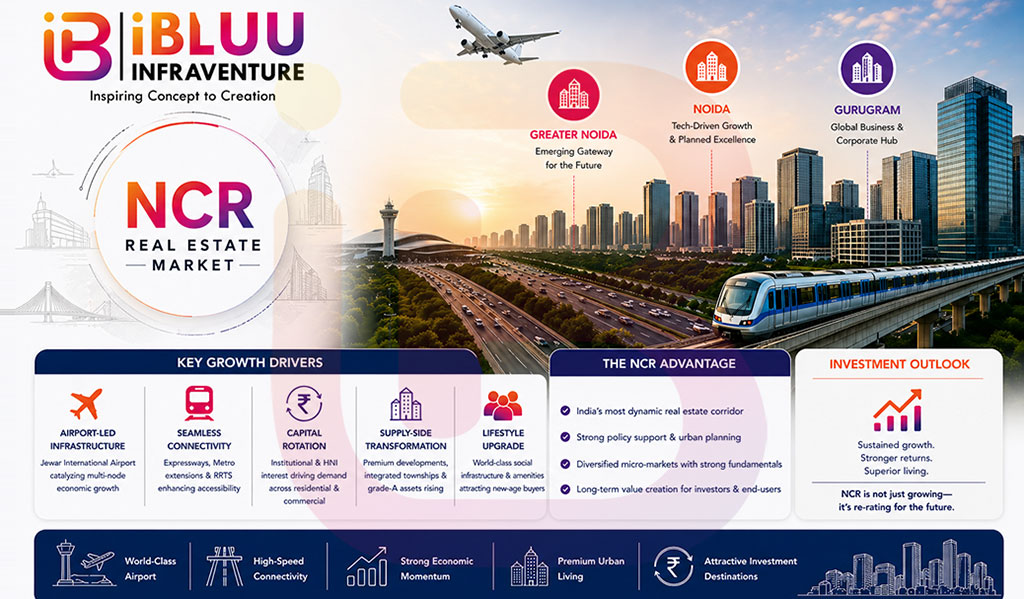
The National Capital Region (NCR) is undergoing a fundamental structural transformation, not a cyclical rebound. Anchored by the upcoming Noida International Airport and reinforced by high-velocity infrastructure corridors, NCR—particularly Noida, Greater Noida, and Gurugram—is entering a multi-year demand supercycle.
Residential prices across key micro-markets have nearly doubled (≈80–100% growth) between 2020–2026, driven by infrastructure certainty, institutional capital inflows, and a decisive shift toward premium, lifestyle-driven housing.
Investor takeaway: NCR is transitioning from a value market to a strategic asset class, with projected IRRs of 18–28% in residential and 20–35% in land-led plays over the next 5–7 years under base-case assumptions.
1. The Structural Trigger: Infrastructure as a Capital Multiplier
The most decisive catalyst is the airport-led urban expansion model, led by the Noida International Airport.
Unlike past speculative cycles, this growth is anchored in hard infrastructure with defined timelines:
- Multi-modal connectivity: Yamuna Expressway, Eastern Peripheral Expressway, Delhi–Mumbai Industrial Corridor (DMIC)
- Rapid transit integration: Metro extensions, RRTS corridors
- Logistics + industrial hubs around Jewar region
- Strategic proximity between Delhi–Noida–Gurugram forming a tri-city economic corridor
This has transformed NCR from a fragmented geography into a synchronized economic cluster, reducing commute friction and unlocking new land value.
2. Price Discovery: From Undervalued to Strategic Asset Class
Between 2020 and 2026, NCR witnessed one of the sharpest real estate re-ratings in India.
Indicative Price Movement (2020–2026)
| Micro-Market | Price Growth | Key Drivers |
|---|---|---|
| Noida (Sectors 150, 93, Expressway) | ~90–110% | Airport proximity, green zones, premium launches |
| Greater Noida / Yamuna Expressway | ~100–130% | Land banking, infrastructure-led speculation turning real |
| Gurugram (Golf Course Ext., Dwarka Exp.) | ~70–95% | Corporate demand, luxury housing surge |
Key insight: This is not price inflation—it is price discovery, correcting years of underpricing relative to infrastructure potential.
3. Demand Shift: From Affordable to Aspirational
The NCR buyer profile has structurally evolved:
Then (Pre-2020):
- End-user driven
- Budget and mid-income housing dominant
- High inventory overhang
Now (2023–2026):
- Investor + HNI + NRI participation rising
- Strong shift toward luxury, branded, gated communities
- Demand for integrated “lifestyle ecosystems” (clubs, wellness, co-working, concierge living)
Gurugram has emerged as the luxury capital, while Noida is rapidly becoming the next premium residential alternative, particularly among younger high-income professionals and global returnees.
4. The “Green Premium”: Noida’s Strategic Differentiation
A defining feature of Noida is its positioning as a “green urban model”:
- Higher planned green cover vs legacy NCR zones
- Low-density sectors like Sector 150 and expressway corridors
- Integration of wellness, sustainability, and open-space living
This has created a “green premium effect”, where high-end residential projects command 15–25% pricing premium over comparable non-green micro-markets.
Investor insight: Sustainability is no longer branding—it is a pricing lever.
5. Land and Plot Investments: The Highest Conviction Bet
The most asymmetric opportunity lies in land and plotted developments, particularly around:
- Yamuna Expressway belt
- Greater Noida West extensions
- Airport influence zones (20–40 km radius)
Why land?
- Early-stage entry into urban expansion curve
- Direct benefit from infrastructure appreciation
- Lower supply constraints vs built inventory
Projected Returns (5–7 years):
- Base Case: 20–30% CAGR
- Upside Case (full airport + industrial activation): 30–40% CAGR
- Downside Risk: 10–15% CAGR
6. Capital Flows and Institutional Interest
NCR is witnessing renewed institutional confidence:
- PE funds re-entering residential and mixed-use projects
- REIT and fractional ownership models gaining traction
- Developer balance sheets strengthening post-RERA consolidation
Global investors now view NCR as a scale market with predictable regulatory structure, not a speculative geography.
7. Scenario Modeling: NCR Real Estate Outlook (2026–2032)
Base Case (Most Probable – 50–60%)
- Sustained infrastructure execution
- 12–15% annual price growth
- Strong absorption in premium housing
Upside Case (30–35%)
- Airport fully operational + industrial cluster acceleration
- 18–22% annual appreciation
- NCR becomes India’s largest luxury housing market
Downside Case (15–20%)
- Delays in infrastructure execution
- 6–10% growth with temporary liquidity slowdown
8. Key Risks to Monitor
- Infrastructure delays (airport timelines, metro connectivity)
- Regulatory friction or policy shifts
- Over-supply in luxury segment if demand overheats
- Interest rate cycles affecting affordability
However, compared to previous cycles, risk-adjusted downside is significantly lower due to real infrastructure backing.
9. Strategic Playbook: Where Smart Capital is Moving
High-Conviction Strategies:
- Land aggregation near airport corridors
- Premium residential in green zones (Noida Expressway)
- Luxury and branded residences in Gurugram
- Mixed-use developments integrating work-live-play ecosystems
10. The iBIV Perspective: Structuring the Next Phase of Urban Capital
iBluu InfraVenture Private Limited (iBIV), a venture of iBluu Corporations, views NCR not as a real estate story—but as a capital allocation transformation.
Through strategic advisory, investment structuring, and partnership models, iBIV is actively engaging with:
- Developers seeking institutional capital
- Global investors entering India’s real estate cycle
- Consortium structures for land and infrastructure-linked assets
The analytical depth of this perspective reflects the strategic lens of J Parasher, whose work focuses on long-horizon economic transformation and global benchmarking of urban systems.
Conclusion: NCR is Not Growing—It is Being Repriced
The NCR real estate story is no longer about cyclical recovery. It is about structural repositioning.
Driven by airport-led infrastructure, capital inflows, and evolving consumer aspirations, Noida, Greater Noida, and Gurugram are emerging as India’s most dynamic urban investment corridor.
For investors, the message is clear: This is not the phase to observe.
This is the phase to position.
Those who enter early in infrastructure-backed corridors will not just participate in growth—they will capture the re-rating.
Disclaimer: This content is intended solely for informational and strategic insight purposes and does not constitute financial, investment, or legal advice. All data, projections, and scenarios are indicative, based on publicly available information, market benchmarks, and analytical assumptions as of 2026. Market conditions, regulatory frameworks, and infrastructure timelines are subject to change, which may impact outcomes. Readers and investors are advised to conduct independent due diligence and consult professional advisors before making any investment or strategic decisions. iBluu InfraVenture Private Limited (iBIV) and its affiliates do not assume liability for any decisions taken based on this content.