+91 945 889 6091
  infodesk@ibluu.com
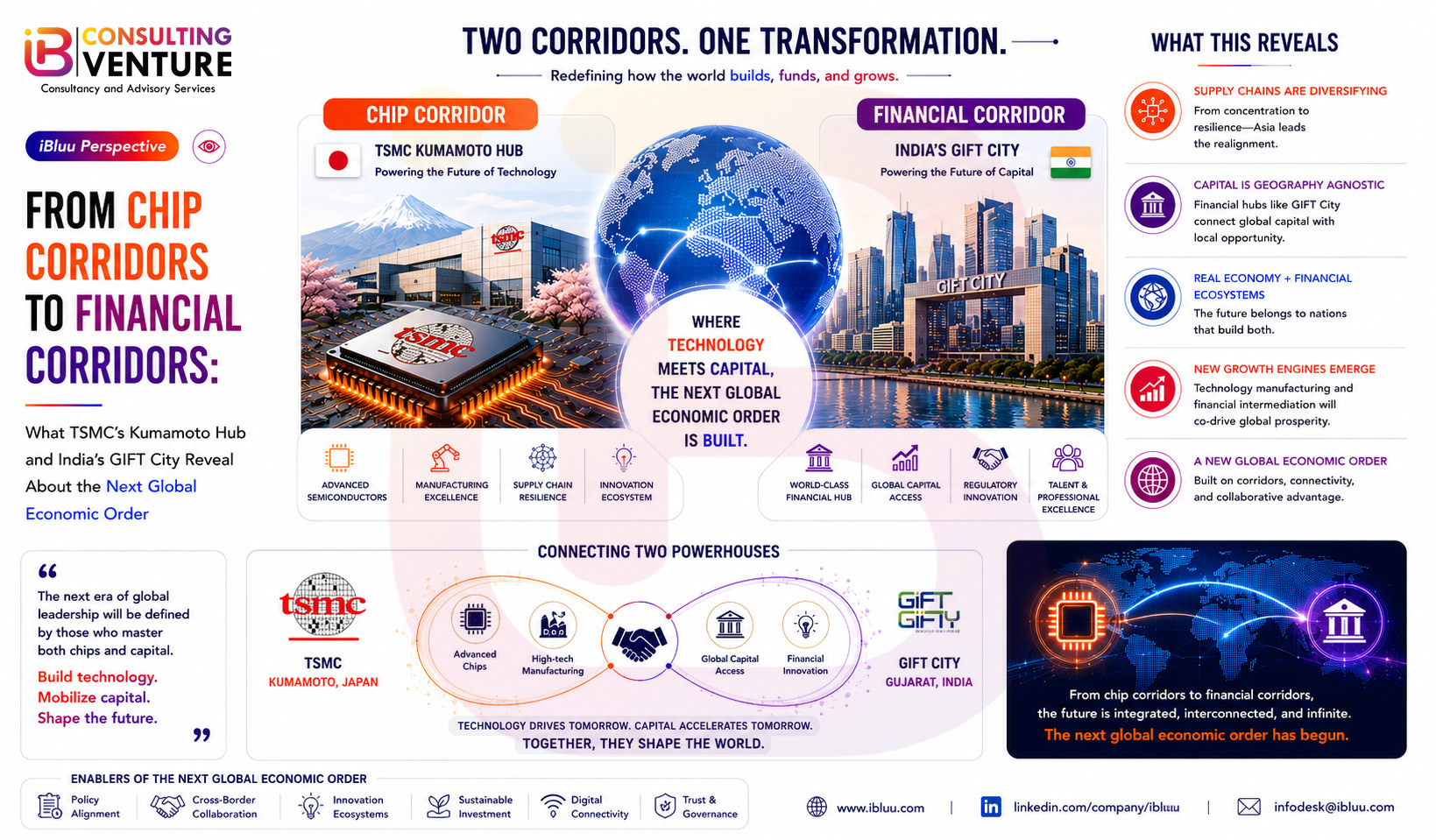
From Chip Ecosystem to Financial Ecosystem: Japan TSMC’s Kumamoto Hub and India’s GIFT City Are Building the Strategic Corridors Shaping the Next Global Economy
The world is no longer competing only through GDP growth, export volume, or labor arbitrage.
The real competition has shifted toward something far more structural:
Who can build the next-generation economic ecosystem capable of attracting capital, talent, technology, and geopolitical relevance at scale?
In that race, two very different projects—Japan’s rapidly expanding semiconductor corridor around TSMC’s Kumamoto hub and India’s GIFT City—have emerged as powerful case studies of how nations are redesigning economic geography itself.
At first glance, they appear fundamentally unrelated.
Kumamoto is a semiconductor manufacturing ecosystem centered around advanced chip fabrication.
GIFT City is a financial and digital services zone positioned as India’s international financial gateway.
But beneath the surface, both are executing the same strategic doctrine:
Build concentrated economic power zones capable of reshaping global capital flows, industrial alignment, talent migration, and long-term national competitiveness.
One is manufacturing-led.
The other is finance-led.
One is decentralizing industrial Japan.
The other is centralizing India’s global services ambition.
Yet both represent the future of geopolitical infrastructure capitalism.
Kumamoto: How a Rural Japanese Region Became a Global Semiconductor Battlefield
The TSMC Effect Is Bigger Than Semiconductors
When TSMC announced its fabrication facility in Kumamoto Prefecture through Japan Advanced Semiconductor Manufacturing (JASM), many initially viewed it as a supply-chain diversification project.
That interpretation underestimated the magnitude of what was actually unfolding.
This was not simply a factory investment.
It was the reconstruction of Japan’s industrial sovereignty.
Backed by billions in Japanese state subsidies and strategic support from companies including Sony Group Corporation and Denso Corporation, Kumamoto rapidly evolved into one of the most strategically important semiconductor corridors outside Taiwan.
The implications moved far beyond manufacturing capacity:
- Real estate prices surged sharply across Kikuyo and surrounding regions
- Housing shortages intensified
- Infrastructure demand accelerated
- Taiwanese engineers and global suppliers relocated into the ecosystem
- International schools and localization services expanded
- Logistics networks began restructuring around semiconductor supply chains
What was once largely agricultural land started transforming into a strategic industrial urban cluster.
This is precisely how modern economic gravity works.
High-value industrial infrastructure no longer changes only production capacity.
It changes land economics, urban demographics, capital allocation patterns, and geopolitical leverage simultaneously.
GIFT City: India’s Attempt to Build a Financial Sovereignty Engine
India Is Not Building Another Business District
GIFT City is frequently misunderstood as a real estate project or fintech cluster.
That interpretation misses the deeper strategic ambition entirely.
GIFT City represents India’s long-term attempt to internalize global financial activity that historically flowed through external jurisdictions including Singapore, Dubai, London, and Mauritius.
The objective is structural.
India is attempting to build:
- An international financial services ecosystem
- Offshore banking capabilities
- Cross-border capital market infrastructure
- Global fintech integration
- Institutional-grade digital governance systems
- A globally competitive regulatory environment
Unlike Kumamoto’s organic semiconductor sprawl, GIFT City was master-planned from inception.
The contrast is striking.
Kumamoto evolved through industrial pressure.
GIFT City evolved through strategic urban design.
Its infrastructure model includes:
- District cooling systems
- Automated waste collection
- Smart utility management
- Integrated zoning
- SEZ-linked financial architecture
- Metro connectivity
- Walk-to-work urban planning
This is not accidental development.
It is engineered economic positioning.
India is effectively attempting to create a controlled global business environment inside domestic territory while retaining sovereign policy flexibility.
That is a highly strategic economic experiment.
The Real Similarity: Both Are State-Backed Strategic Gravity Machines
This Is No Longer About Cities. It Is About Economic Concentration Warfare.
Both Kumamoto and GIFT City reveal the same emerging global pattern:
Nations are increasingly creating hyper-focused economic zones designed to compress talent, infrastructure, capital, regulation, and strategic industries into concentrated ecosystems.
China did it with Shenzhen.
The UAE did it with DIFC.
Saudi Arabia is attempting it with NEOM.
Singapore perfected it decades ago.
Now Japan and India are executing their own versions.
The logic is brutally simple:
Economic concentration creates exponential competitive advantages.
When talent, infrastructure, capital, suppliers, institutions, and policy incentives cluster together, economic productivity accelerates dramatically faster than traditional distributed growth models.
That is exactly what Kumamoto and GIFT City are trying to achieve—through completely different economic engines.
Kumamoto vs. GIFT City: Two Models of Economic Transformation
| Strategic Variable | Kumamoto Semiconductor Hub | GIFT City Gujarat |
|---|---|---|
| Core Driver | Semiconductor manufacturing | Financial services & fintech |
| Development Style | Organic industrial expansion | Centrally planned smart city |
| Infrastructure Pressure | Reactive expansion | Pre-designed infrastructure |
| Housing Dynamics | Severe shortage & price spike | Controlled premium inventory |
| Talent Influx | Engineers & manufacturing specialists | Financial, fintech & global services professionals |
| Global Positioning | Supply-chain resilience | International financial integration |
| Geopolitical Role | Semiconductor sovereignty | Financial sovereignty |
| Economic Objective | Reduce chip dependence | Reduce offshore capital dependence |
The Semiconductor Corridor Is Reshaping Real Estate Economics
Industrial Policy Is Becoming Real Estate Policy
One of the most overlooked realities of modern economic transformation is this:
Every major industrial policy eventually becomes a real estate story.
Kumamoto demonstrates this clearly.
Once semiconductor investments accelerated:
- Land appreciation intensified rapidly
- Residential supply shortages emerged
- Logistics corridors became premium assets
- Commercial infrastructure expanded aggressively
- Construction demand surged
The same pattern is visible across semiconductor corridors globally—from Arizona to Dresden to Penang.
This matters enormously for India.
Because if India’s semiconductor ambitions accelerate meaningfully across Gujarat, Tamil Nadu, Karnataka, and other manufacturing corridors, the economic multiplier effect will extend far beyond fabrication facilities.
It will reshape:
- Urban planning
- Housing demand
- Industrial logistics
- Energy infrastructure
- Water systems
- Transportation corridors
- Digital infrastructure
Semiconductors are not merely a technology industry.
They are urban-economic catalysts.
GIFT City’s Greatest Advantage Is Not Infrastructure—It Is Timing
India Is Rising as Global Capital Searches for Diversification
The global financial system is entering structural realignment.
Capital is increasingly searching for:
- Regulatory diversification
- Supply-chain resilience
- Demographic scale
- Digital governance ecosystems
- Long-duration growth markets
India sits at the intersection of all five.
That is why GIFT City matters strategically.
Not because it competes with Mumbai domestically.
But because it positions India within the future architecture of global capital flows.
The long-term ambition is larger than finance.
It is about building economic command infrastructure.
The Most Important Lesson: Economic Geography Is Being Rewritten
The Next Great Global Winners Will Not Be Countries Alone—But Corridors
The global economy is entering a corridor-driven era.
Semiconductor corridors.
Financial corridors.
Renewable energy corridors.
AI infrastructure corridors.
Logistics corridors.
Data center corridors.
Nations that successfully build these ecosystems will control disproportionate economic influence.
Those that fail will increasingly become dependent nodes within somebody else’s system.
Kumamoto and GIFT City are not isolated developments.
They are early signals of a much larger structural shift:
Governments are no longer competing only through policy. They are competing through ecosystem architecture.
And ecosystem architecture is becoming the new geopolitical currency.
India’s Strategic Opportunity Is Much Larger Than GIFT City Alone
From semiconductor manufacturing to renewable energy, from logistics to financial infrastructure, India is increasingly positioning itself as a multi-corridor economy.
That matters because scale alone is no longer enough.
The future belongs to nations capable of integrating:
- Capital
- Technology
- Manufacturing
- Talent
- Infrastructure
- Digital systems
- Policy execution
into highly coordinated economic ecosystems.
India’s next decade will likely be defined by whether it can successfully operationalize that integration.
If it succeeds, the implications will extend far beyond GDP growth.
It could fundamentally reposition India within the global economic order.
iBluu Perspective
From the perspective of iBluu Corporations and iBCV, the rise of projects such as Kumamoto and GIFT City demonstrates that the future of competitiveness will increasingly depend on ecosystem-level strategy rather than isolated sectoral growth.
The analytical perspective associated with J Parasher consistently frames infrastructure, industrial policy, capital markets, and technology corridors as interconnected strategic systems rather than independent sectors.
This distinction matters.
Because the next phase of global economic leadership will likely be determined not by who owns the largest market—but by who builds the most integrated economic architecture.
Disclaimer: This article is intended solely for informational, strategic, and educational purposes and does not constitute financial, investment, legal, tax, or policy advice. Data, projections, and market interpretations referenced in this article are based on publicly available information, industry reports, government announcements, and strategic analysis available as of May 2026. Readers, investors, institutions, and stakeholders are advised to conduct independent due diligence and consult qualified professional advisors before making investment or business decisions. Views expressed under “iBluu Perspective” reflect strategic and analytical interpretations intended to contribute to broader industry dialogue and economic discourse.