+91 945 889 6091
 infodesk@ibluu.com

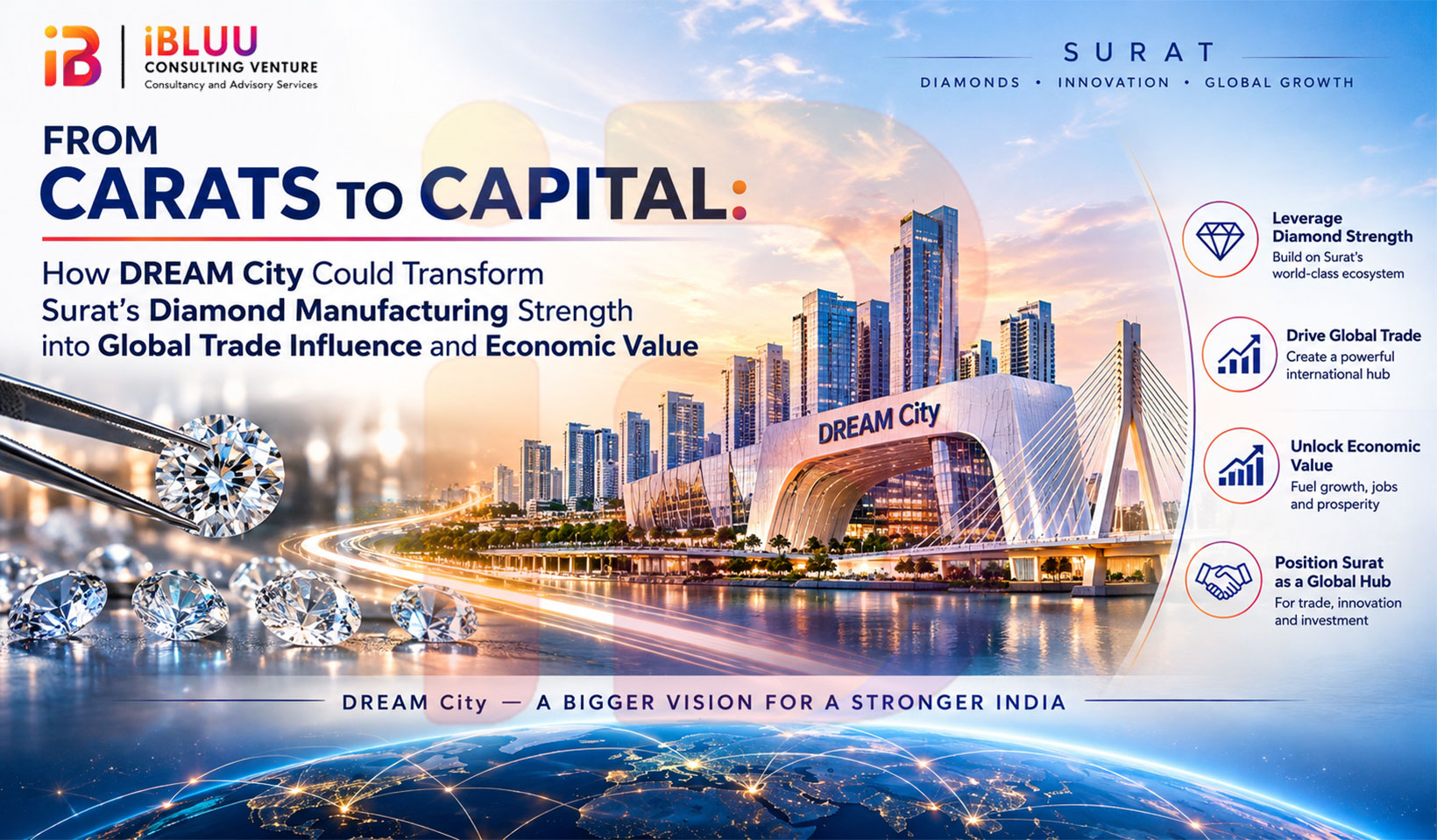
How DREAM City Could Convert Surat’s Manufacturing Strength into Global Trade Leadership, Investment Attraction and Strategic Value Creation
From the world’s diamond manufacturing capital to an integrated architecture of international commerce, investment and industrial competitiveness
Surat’s Diamond Research and Mercantile City is more than a greenfield business district. It is an ambitious attempt to reposition India’s manufacturing strength at the centre of global trade, finance, sourcing and high-value commercial activity. Its success will depend on one decisive transition: converting world-class infrastructure into a world-class business ecosystem.
1. The strategic proposition: Surat must capture more than manufacturing value
Surat occupies an extraordinary position in the global diamond industry. The city is responsible for cutting and polishing the overwhelming majority of the world’s diamonds, supported by generations of specialised craftsmanship, a dense network of manufacturers, trading firms, skilled workers and ancillary businesses.
Yet the geography of value creation has historically been fragmented.
India has developed enormous capabilities in processing and manufacturing, while important international trading, sourcing, financing, distribution and commercial relationships have remained distributed across established centres such as Mumbai, Antwerp, Dubai and other global marketplaces.
This creates a strategic imbalance: the location that performs much of the value-adding manufacturing does not necessarily capture an equivalent share of the commercial ecosystem surrounding it.
The Diamond Research and Mercantile City (DREAM City), located near Khajod in Surat, seeks to address this structural gap.
Its ambition is to bring together diamond trading, international sourcing, financial services, commercial offices, hospitality, institutional infrastructure, residential development and supporting services within a planned economic district.
The proposition extends beyond real estate. It is about reducing commercial fragmentation, improving transaction efficiency, strengthening domestic value capture and creating a more direct connection between global buyers and India’s manufacturing base.
The next stage of India’s diamond-sector leadership will not be determined by how efficiently it processes stones alone. It will be determined by how much of the global value chain it can attract, finance, organise and control.
2. DREAM City: Building a new geography of economic activity
DREAM City is a greenfield smart business district developed through a public-sector institutional framework involving the Gujarat Government, Surat Municipal Corporation and Surat Urban Development Authority.
Its original planning vision covered approximately 810 hectares. More recent reporting on the revised development framework describes a 682-hectare project area, including approximately 562 hectares of government land. These figures reflect different planning descriptions and should not be treated as interchangeable without reference to the applicable revised boundary.
The development is evolving beyond a specialised diamond-trading destination into a mixed-use commercial district. Its revised planning direction integrates commercial offices, residential clusters, hospitality, institutional facilities, public spaces and supporting urban infrastructure.
This evolution is strategically important.
A trading district cannot sustain itself through office space alone. It requires a complete economic environment: places to live, work, meet, transact, finance, exhibit, learn and invest.
The objective must be to create an ecosystem in which commercial activity generates demand for professional services, residential development supports talent retention, hospitality enables international business engagement, and institutional infrastructure attracts specialised organisations.
The distinction is fundamental:
A business district is not created when land is developed. It is created when economic relationships begin to concentrate there.
3. Surat Diamond Bourse: The flagship anchor of the development
At the centre of DREAM City’s proposition stands the Surat Diamond Bourse (SDB), one of India’s most ambitious commercial infrastructure developments.
The complex spans approximately 7.1 million square feet, equivalent to around 66 lakh square feet, and comprises nine interconnected towers with 15 floors each. It has been recognised as the world’s largest office building by floor area.
Its scale is designed to accommodate a broad spectrum of diamond-industry participants, including manufacturers, traders, brokers, exporters, financial institutions, service providers and international buyers.
The infrastructure includes secure commercial environments, banking facilities, vaults, conference and meeting spaces, retail facilities and supporting amenities.
The strategic objective is to reduce the distance between manufacturing, sourcing and commercial decision-making.
A buyer should be able to engage with manufacturers, examine inventory, negotiate transactions, access relevant financial services and coordinate export-related processes within a more integrated commercial environment.
This concentration could reduce transaction friction, improve market access for smaller firms and strengthen the ability of Surat-based businesses to develop direct international relationships.
However, the distinction between infrastructure completion and commercial success is critical.
More than 4,000 offices have been sold, but reporting available in late October and early November 2026 indicates that approximately 300 offices are operational. The difference between ownership and occupancy is commercially significant.
It raises questions about business relocation, trading volumes, market liquidity, access to buyers, operating costs, commuting patterns and the incentives required to shift established commercial networks.
The SDB’s physical achievement is substantial. Its next test is institutional and commercial.
The value of a trading exchange is not measured by the square footage it occupies. It is measured by the transactions, relationships, liquidity and confidence it generates.
4. The real challenge: Moving the diamond economy, not merely its offices
The slow migration of trading firms from established commercial locations, particularly Mumbai’s Bharat Diamond Bourse, illustrates one of DREAM City’s most consequential execution challenges.
Businesses do not relocate simply because a larger or newer building becomes available.
They relocate when the commercial advantages of moving outweigh the costs and uncertainties of leaving an established ecosystem.
For diamond businesses, those considerations include:
- Proximity to long-standing buyers, brokers, suppliers and commercial networks.
- Availability of international buyers and regular trading activity.
- Access to banking, trade finance, insurance and secure logistics.
- Travel time, worker mobility and the availability of skilled labour.
- Business continuity, operating costs, maintenance and administrative convenience.
- Confidence that other important market participants will also relocate.
This creates a classic coordination problem.
Individual firms may prefer to wait until other firms move first. Buyers may delay visits until sufficient suppliers are operational. Service providers may hesitate until transaction volumes become commercially attractive.
The result can be a self-reinforcing cycle of low occupancy and limited commercial activity.
Breaking that cycle requires a coordinated transition strategy.
The relevant authorities, bourse management and industry associations should focus on phased relocation programmes, anchor-tenant commitments, international buyer engagement, regular trading events, integrated banking services, transparent operating costs and predictable business support.
Worker shuttle services and metro connectivity can reduce mobility friction, but transport alone cannot create a trading ecosystem.
The real relocation incentive is not a discount on office space. It is the certainty of better business.
5. The Special Notified Zone: A strategic intervention in the global rough-diamond supply chain
One of the most consequential developments for DREAM City’s commercial positioning is the proposed relocation of the Special Notified Zone (SNZ) for rough-diamond trading to Surat Diamond Bourse.
The customs framework issued in September 2026 provides for shifting the facility to the second floor of Tower B at SDB.
The SNZ is intended to enable eligible foreign mining companies to bring rough diamonds into India for viewing, tendering, auction or sale to Indian manufacturers and traders, with unsold lots eligible for re-export under the prescribed customs framework.
This is strategically important because rough-diamond sourcing is the starting point of the manufacturing value chain.
A more accessible domestic trading environment can reduce the need for Indian manufacturers to depend entirely on overseas viewing and trading centres. It can improve access to international mining companies, facilitate direct commercial engagement and potentially reduce transaction-related costs.
The framework also establishes specific compliance requirements. Imports are subject to prescribed documentation, including Kimberley Process certification, and the notified facility must operate under the applicable customs authorisations, security arrangements and procedures.
The opportunity is significant, but its effectiveness will depend on implementation.
The SNZ must attract a regular calendar of international viewing sessions, auctions and direct sales. Mining companies must find sufficient buyer participation, while Indian manufacturers must experience tangible improvements in sourcing efficiency and transaction economics.
The objective should be to establish Surat as a credible and commercially active destination for rough-diamond discovery, valuation, negotiation and acquisition.
The strategic advantage lies not merely in bringing rough diamonds into India, but in bringing the commercial decision-making surrounding those diamonds closer to India’s manufacturing ecosystem.
6. Beyond diamonds: Building a diversified commercial and institutional ecosystem
DREAM City’s revised mixed-use planning direction is important because a globally competitive business district cannot depend indefinitely on one industry.
The diamond sector must remain its principal anchor, but the wider development should progressively attract complementary economic activities.
The emerging planning framework provides opportunities for:
- Large-scale commercial offices and corporate establishments.
- Financial institutions, banking and specialised trade-finance services.
- Premium residential clusters and supporting urban amenities.
- International hospitality, business accommodation and convention facilities.
- Trade exhibition spaces, commercial pavilions and institutional centres.
- Research, education and industry-linked skill-development facilities.
- Textile-related institutional infrastructure and proposed specialised educational initiatives.
The proposed Bharat Bazaar trade pavilion could provide a platform for showcasing Indian products, facilitating buyer engagement and connecting regional manufacturers with wider domestic and international markets.
Long-term proposals involving research centres, convention infrastructure and a textile university could further broaden the district’s economic identity. These should be treated as development opportunities rather than completed facilities or fully committed operating institutions.
This diversification is not a departure from DREAM City’s original purpose. It is a way to strengthen it.
The diamond industry benefits from international hospitality, financial services, logistics, technology and professional expertise. Other sectors benefit from the commercial networks, infrastructure and global visibility generated by the diamond ecosystem.
A more diversified economic base can also reduce the district’s exposure to volatility in any single industry.
A resilient business district does not abandon its anchor industry. It builds an economic ecosystem strong enough to support that industry through changing market cycles.
7. Infrastructure: The foundation of a globally competitive district
The Gujarat Government has invested approximately ₹400 crore in foundational infrastructure, including primary road networks, utility services, optical fibre connectivity and developed open spaces.
The high-speed optical fibre network is particularly important. Modern commercial districts depend on secure, reliable and high-capacity digital infrastructure to support financial transactions, enterprise systems, data exchange, communications and business continuity.
The next phase must build on this foundation.
Priority infrastructure should include:
Transport and mobility: Efficient road access, last-mile connectivity, public transport integration, pedestrian infrastructure and reliable connections with Surat’s wider commercial and residential districts.
Digital infrastructure: High-capacity fibre connectivity, redundant networks, cybersecurity architecture, smart utility monitoring and integrated digital services.
Utilities: Reliable electricity, water management, wastewater treatment, drainage, fire safety and resilient power distribution.
Urban environment: Green spaces, shaded pedestrian corridors, efficient cooling, energy-conscious buildings and responsible water management.
Logistics and security: Secure movement of high-value goods, customs integration, access control, surveillance and specialised risk-management infrastructure.
The development of Surat Metro is another important connectivity intervention. Trial runs began on the Dream City–Althan Tenement section in March 2026. Commercial passenger operations remain subject to the necessary safety and regulatory clearances.
The wider objective should be to connect DREAM City seamlessly with Surat’s existing diamond, textile, residential, transport and commercial ecosystems.
Infrastructure must be evaluated not only by its physical completion but also by its reliability, utilisation, operating efficiency and contribution to economic productivity.
8. The economic opportunity: Converting manufacturing strength into greater export value
India’s gems and jewellery sector remains a significant contributor to employment, exports and foreign-exchange earnings.
Its export performance also reveals why DREAM City’s strategic role matters.
India’s gross gems and jewellery exports reached approximately US$27.72 billion in FY2025–26. Cut and polished diamonds accounted for approximately US$12.16 billion, representing the largest individual product category, although this segment experienced an 8.52% year-on-year decline.
These figures demonstrate both the scale of India’s existing capabilities and the exposure of the industry to global demand, inventory cycles, trade policy, pricing pressure and changes in consumer preferences.
DREAM City should be understood within this wider economic context.
Its potential contribution extends across several channels.
Export competitiveness: More direct access to rough-diamond suppliers, international buyers and trade services could strengthen sourcing efficiency and commercial responsiveness.
Foreign-exchange generation: A stronger export ecosystem can support merchandise export earnings, provided that additional domestic trading activity translates into genuine value addition and overseas sales.
Value-chain retention: Greater concentration of trading, financing, certification and related services in India could help retain a larger share of the commercial value generated around diamond processing.
SME competitiveness: Smaller manufacturers and exporters could benefit from access to shared infrastructure, international buyers, banking services and institutional support.
Investment attraction: A credible international business district can attract commercial real estate investment, financial services, hospitality, technology providers and specialised trade infrastructure.
However, DREAM City should not claim credit for the entire economic contribution of India’s gems and jewellery industry. The district’s actual impact must be measured through incremental exports, additional trade volumes, new investment, employment and value addition attributable to its ecosystem.
The ultimate economic test is not how much business moves into DREAM City. It is how much additional business India wins because DREAM City exists.
9. Employment and regional economic transformation
DREAM City’s economic footprint could extend well beyond the boundaries of its commercial plots.
The district has the potential to support employment across diamond trading, manufacturing, jewellery retail, banking, hospitality, transport, facility management, construction, security, technology and professional services.
The Surat Diamond Bourse has been associated with a publicly stated projection of approximately 1.5 lakh additional jobs. This should be understood as a projected employment opportunity, not an achieved employment figure or a guaranteed outcome.
Similarly, larger township-level employment ambitions should be assessed against phased development, actual occupancy, business formation and independently measurable employment generation.
A meaningful employment strategy must distinguish between:
- Temporary construction employment.
- Permanent operational employment.
- Direct jobs within trading and manufacturing firms.
- Indirect jobs across logistics, hospitality and supporting services.
- Higher-skilled professional and technology roles.
- Entrepreneurial opportunities for local businesses.
The development should also strengthen the region’s skill base through partnerships with technical institutions, industry associations, universities and training providers.
Priority capabilities include gem valuation, international trade compliance, digital commerce, financial operations, logistics management, cybersecurity, advanced manufacturing and laboratory-based quality assessment.
The opportunity is to convert infrastructure investment into durable regional economic capability.
10. Financial architecture: What will make DREAM City investable?
For institutional investors and developers, the attractiveness of DREAM City will depend on the relationship between land economics, commercial demand, infrastructure costs, occupancy, cash flows and long-term asset value.
The revised planning framework, including land parcels offered for development on long-term leases, creates opportunities for private capital participation.
Recent reporting describes approximately 250 hectares being opened for development and disposal under a revised framework, with 90-year lease arrangements and development potential equivalent to more than five FSI, subject to applicable planning conditions, airport-related clearances and other regulations.
This could support higher-density commercial and mixed-use development while allowing the district to retain substantial areas for roads, green spaces and social infrastructure.
But development potential is not the same as investment viability.
Every project must be evaluated through a rigorous financial framework.
Land and development economics: Lease premiums, development rights, construction costs, financing structure, approval timelines and residual land value.
Revenue potential: Achievable rents, sale or lease proceeds, hospitality revenues, commercial occupancy and the pace of absorption.
Capital efficiency: Construction phasing, capital expenditure per square foot, infrastructure contributions and working-capital requirements.
Debt sustainability: Loan-to-cost ratios, debt-service coverage, interest-rate exposure, refinancing risk and cash-flow visibility.
Investment returns: Internal rate of return, net present value, equity multiple, stabilised yield and downside protection.
Operational performance: Occupancy, tenant retention, maintenance costs, utility efficiency and asset-management performance.
For developers, the most important question is whether land acquisition and construction commitments can be matched with credible demand.
For institutional investors, it is whether assets can generate sustainable cash flows without depending exclusively on speculative appreciation.
For financial institutions, it is whether projects have predictable revenue streams, enforceable agreements and adequate downside protection.
A disciplined approach should use phased development rather than speculative overbuilding.
The strongest investment proposition is not the largest development pipeline. It is the pipeline in which demand, capital deployment and infrastructure delivery are aligned.
11. Global competition: Positioning Surat within the international trade network
DREAM City enters a competitive international environment.
Antwerp has established itself as a major diamond trading and service centre. Dubai has strengthened its position through international trade connectivity, logistics, business-friendly frameworks and access to global markets. Mumbai retains an established commercial and financial ecosystem, while other centres continue to adapt to shifts in sourcing and distribution.
Surat has a distinctive advantage: its proximity to an exceptionally deep manufacturing base.
But manufacturing scale alone does not guarantee international trading leadership.
To compete effectively, DREAM City must offer the complete package: trusted regulation, predictable customs procedures, international banking, secure logistics, transparent transactions, quality assurance, digital connectivity and consistent access to buyers and sellers.
The global diamond industry is also undergoing structural change.
Natural diamonds face changing consumer preferences, supply-side adjustments, geopolitical uncertainty and competition from lab-grown alternatives. Lab-grown diamonds create opportunities for manufacturing and new market segments, but they also introduce different pricing dynamics and demand patterns.
India must therefore build a business ecosystem capable of serving multiple market segments rather than depending on one product category or one export geography.
DREAM City should position itself as a broader international platform for natural diamonds, lab-grown diamonds, jewellery, trade services and related value-added activities.
Global leadership is not achieved by reproducing another financial or trading centre. It is achieved by combining capabilities that competing centres cannot easily replicate.
12. Risk architecture: The challenges that could constrain performance
DREAM City’s long-term success will depend on how effectively it manages a set of interconnected commercial, financial, operational and strategic risks.
Commercial absorption risk: Low occupancy at the Diamond Bourse could delay ecosystem formation and weaken the revenue potential of supporting businesses.
Industry-cycle risk: Global diamond demand, inventory corrections, trade restrictions and price volatility can affect manufacturers, exporters and trading volumes.
Relocation risk: Established commercial networks may resist migration if the benefits of operating from DREAM City remain uncertain.
Infrastructure utilisation risk: Completed roads, utilities and digital networks must attract sufficient economic activity to justify their long-term operating and maintenance costs.
Real estate risk: Excessive speculative development could create oversupply, weaken rental expectations and delay capital recovery.
Regulatory risk: Land-use approvals, lease conditions, customs procedures, environmental requirements and development regulations must remain transparent and predictable.
Connectivity risk: Delays in metro operations, last-mile transport or regional connectivity could constrain worker mobility and business participation.
Technology and cyber risk: Financial transactions, digital trading platforms and sensitive commercial data require robust cybersecurity and operational resilience.
Environmental risk: Water demand, urban heat, energy consumption, drainage, waste management and construction impacts must be incorporated into the district’s long-term design.
These risks should be managed through an integrated monitoring system rather than isolated departmental reporting.
13. Scenario modelling: Three possible development trajectories
The district’s next phase should be assessed through three scenarios. These are strategic planning cases, not forecasts or probability-weighted predictions.
Scenario I — Accelerated ecosystem formation
Major diamond firms progressively relocate, international buyers increase participation, the SNZ attracts regular sourcing activity, banking and trade services deepen, and metro connectivity improves accessibility.
Higher occupancy supports hospitality, retail, commercial leasing and institutional investment. The district develops a self-reinforcing commercial ecosystem.
Scenario II — Gradual consolidation
Diamond-sector recovery remains uneven, relocation occurs selectively and commercial occupancy increases slowly. Infrastructure and mixed-use development progress, but the bourse takes longer to establish itself as a high-volume trading destination.
This scenario requires disciplined capital deployment, targeted incentives and realistic absorption assumptions.
Scenario III — Structural underutilisation
Weak global demand, persistent relocation barriers, limited buyer participation or slow infrastructure integration constrain commercial activity. Office occupancy remains low, speculative development weakens and supporting services struggle to reach viable operating scale.
This scenario would require a more fundamental repositioning, including diversification beyond diamond trading and a stronger focus on alternative commercial demand.
Investors and public authorities should stress-test each scenario against occupancy, lease absorption, trading volumes, rental realisation, operating costs, capital expenditure, financing rates and infrastructure utilisation.
The objective is not to predict one future with false precision. It is to ensure that the development remains financially and commercially resilient across multiple possible futures.
14. The strategic execution agenda: Ten priorities for the next phase
To transform DREAM City from a major infrastructure achievement into a globally competitive business district, ten priorities deserve immediate attention.
1. Secure anchor-tenant commitments. Prioritise the relocation of established diamond firms, large manufacturers, international trading houses and financial institutions through commercially meaningful incentives.
2. Build a sustained international buyer calendar. Establish recurring trade exhibitions, rough-diamond viewing events, auctions, buyer-seller engagements and international industry conventions.
3. Operationalise the SNZ efficiently. Ensure predictable customs processes, secure handling, transparent compliance procedures and consistent participation by eligible international mining companies.
4. Make relocation commercially rational. Address worker mobility, business continuity, banking access, transaction convenience, operating costs and last-mile connectivity.
5. Accelerate mixed-use development responsibly. Attract credible developers through transparent land allocation, clear development conditions and phased demand-led construction.
6. Strengthen the financial ecosystem. Encourage international banking, trade finance, insurance, specialised credit, payment infrastructure and professional advisory services.
7. Diversify the commercial base. Develop complementary opportunities in jewellery, textiles, research, hospitality, conventions, technology and international trade services.
8. Establish an integrated digital operating platform. Use digital systems for utility monitoring, mobility, security, building management, public services and commercial facilitation.
9. Develop local talent and enterprise. Connect educational institutions, skill-development centres, SMEs and local suppliers to the district’s emerging commercial requirements.
10. Introduce transparent performance measurement. Publish a regular dashboard tracking commercial occupancy, operational offices, trading activity, international buyer participation, investment, employment, infrastructure reliability and environmental performance.
The objective should be clear: replace fragmented project-level progress reporting with measurable economic outcomes.
15. A performance framework for measuring success
DREAM City’s progress should be assessed through a consistent set of commercial and urban performance indicators.
| Performance dimension | Priority indicators |
|---|---|
| Commercial activation | Operational offices, occupancy, tenant retention and new business registrations |
| International trade | Rough-diamond auctions, buyer participation, trading volumes and export growth |
| Financial ecosystem | Banking presence, trade-finance availability and transaction turnaround |
| Investment | Private capital committed, land absorption and development progress |
| Employment | Direct jobs, indirect jobs, skilled employment and local enterprise participation |
| Connectivity | Metro service availability, public transport usage and journey times |
| Infrastructure | Utility reliability, digital uptime, road accessibility and maintenance efficiency |
| Sustainability | Water intensity, energy efficiency, waste recovery and green-space performance |
| Urban quality | Residential occupancy, hospitality utilisation, public amenities and safety |
A particularly important distinction must be maintained between activity within the district and additional economic value created for the wider economy.
For example, office occupancy is a useful indicator, but it does not establish whether the district is generating new exports. Similarly, a rise in trading volumes should be assessed for its contribution to domestic value addition, employment and foreign-exchange earnings.
A globally credible business district must measure both physical utilisation and economic additionality.
16. The wider national significance: From industrial clusters to strategic economic platforms
DREAM City belongs to a larger transformation in India’s approach to urban and industrial development.
GIFT City has been designed to strengthen India’s international financial-services capabilities. Dholera is being developed as a major industrial and infrastructure-oriented greenfield city. DREAM City brings a different proposition: integrating a globally significant manufacturing cluster with international trade, finance, commercial services and urban infrastructure.
These developments should not be treated as identical models. Their sectors, regulatory frameworks, development stages and economic functions differ.
But collectively, they reflect an important national ambition: to create specialised economic platforms that attract investment, deepen industrial capabilities and strengthen India’s position in international markets.
For DREAM City, the opportunity is especially relevant to the future of India’s gems and jewellery industry.
The national ambition for the sector is increasingly focused on expanding exports, strengthening value addition, improving design and innovation, diversifying markets and building stronger global brands.
The Government of India has articulated a long-term ambition of US$100 billion in gems and jewellery exports by 2040, against approximately US$28 billion recorded in FY2025–26.
Achieving that ambition will require more than additional processing capacity. It will require stronger international distribution, brand development, technology, research, finance, skilled talent and trusted trading infrastructure.
DREAM City can become an important part of that architecture—provided that its commercial ecosystem develops at the same ambition and speed as its physical infrastructure.
17. The next frontier: Building a globally relevant commercial institution
The next chapter of DREAM City should be defined by the quality of its institutions and the strength of its economic networks.
A world-class trading destination needs more than buildings and connectivity. It requires international confidence, transparent governance, efficient dispute resolution, predictable regulation, reliable financial services and credible market infrastructure.
It must also respond to emerging industry requirements: digital traceability, responsible sourcing, product certification, provenance assurance, advanced gemological services, secure data exchange and evolving sustainability expectations.
As global markets increasingly scrutinise supply-chain transparency and responsible sourcing, DREAM City has an opportunity to develop stronger institutional capabilities around verification, certification and compliance.
It can also explore digital trade platforms that connect manufacturers, buyers, logistics providers and financial institutions, reducing information asymmetry and improving transaction efficiency.
These capabilities would help the district evolve from a physical concentration of diamond businesses into an internationally connected commercial institution.
The next competitive advantage will not come from bringing every participant into the same building. It will come from making the entire value chain faster, more transparent, more trusted and more economically productive.
18. The iBluu perspective: Infrastructure must create economic advantage
The analytical perspective of J Parasher, Founder and Managing Director of iBluu Consulting Venture (iBCV), a venture of iBluu Corporations, focuses on national capability building, global industrial benchmarking and long-horizon economic transformation.
From this perspective, DREAM City should not be evaluated merely as a real estate development or a specialised trading complex. It should be understood as a strategic economic system in which manufacturing, international commerce, capital, infrastructure, technology and institutional capacity must reinforce one another.
Its true potential lies in addressing a structural question: how can India convert its manufacturing depth into greater control over international trade, commercial relationships and value creation?
That requires integrated thinking across land and infrastructure planning, investment structuring, business ecosystem development, international partnerships, government engagement, financial architecture and sectoral competitiveness.
For iBluu, the larger lesson is that infrastructure becomes strategically valuable when it changes the economics of an industry.
A road is not simply a transport asset; it connects markets. A commercial complex is not simply office space; it can concentrate economic relationships. A customs facility is not simply a regulatory provision; it can reshape sourcing decisions. A financial institution is not simply a tenant; it can reduce transaction friction and expand market access.
The ambition must therefore extend beyond creating a destination where businesses operate.
It must be to engineer a platform where businesses become more competitive because they operate there.
Conclusion: DREAM City must become more than a landmark
Surat has already demonstrated its ability to build one of the world’s most formidable diamond manufacturing ecosystems. DREAM City offers an opportunity to translate that manufacturing leadership into a stronger position in international trade, sourcing, finance, investment and commercial services.
The physical foundation is taking shape. The Diamond Bourse is complete. Foundational infrastructure has been developed. The planning framework is evolving towards mixed-use development. The proposed relocation of the Special Notified Zone creates an important opportunity to strengthen direct rough-diamond sourcing. Metro connectivity and wider urban integration could further improve the district’s commercial accessibility.
But the difficult work now lies ahead.
Commercial occupancy must deepen. International buyers must participate consistently. Trading activity must become more concentrated. Financial and institutional services must mature. Private development must remain aligned with real demand. Infrastructure must translate into measurable economic productivity.
The strategic objective should be unmistakable: position Surat not only as the place where the world processes diamonds, but as a place where the world increasingly comes to source, trade, finance, innovate and build commercial relationships.
DREAM City will not achieve global significance because it has built the world’s largest office complex. It will achieve it when the world’s diamond and jewellery businesses find compelling economic reasons to conduct more of their business from Surat.
India has already built the manufacturing advantage. The next ambition is to capture more of the global commercial value surrounding it.
The opportunity is not simply to build a city around an industry. It is to build an international economic institution around India’s industrial strength.
That is the real promise of DREAM City.
Disclaimer: This article is an independent strategic and economic perspective prepared for general informational and thought-leadership purposes. Project areas, development status, investment figures, infrastructure milestones, commercial occupancy and employment projections are subject to revision and should be verified against applicable government notifications, project disclosures and regulatory approvals before being used for investment, financial or legal decisions. Employment projections and proposed facilities are not representations of realised outcomes. References to future development, commercial expansion and economic potential represent strategic opportunities rather than guaranteed results. Financial assessments and scenario discussions are analytical frameworks, not investment recommendations or return forecasts.