+91 945 889 6091
  infodesk@ibluu.com
Beyond Megawatts: Inside the High-Stakes Strategic Battle for Renewable Infrastructure, Energy Storage, and Grid Control
India’s power sector is no longer merely an infrastructure story.
It has become a geopolitical asset class.
The country’s electricity ecosystem now sits at the intersection of industrial growth, sovereign energy security, manufacturing expansion, AI-led digital infrastructure, green hydrogen ambitions, EV acceleration, and global capital deployment. The companies controlling installed power capacity today are not simply utilities — they are becoming architects of India’s economic velocity over the next two decades.
As of April 2026, India’s installed power capacity has crossed approximately 475 GW, making it one of the world’s largest electricity systems. But beneath this headline lies a far more consequential shift:
The battle is no longer only about generating electricity.
It is about controlling renewable scale, storage infrastructure, transmission integration, and dispatchable power economics.
And increasingly, global institutional capital is choosing its winners early.
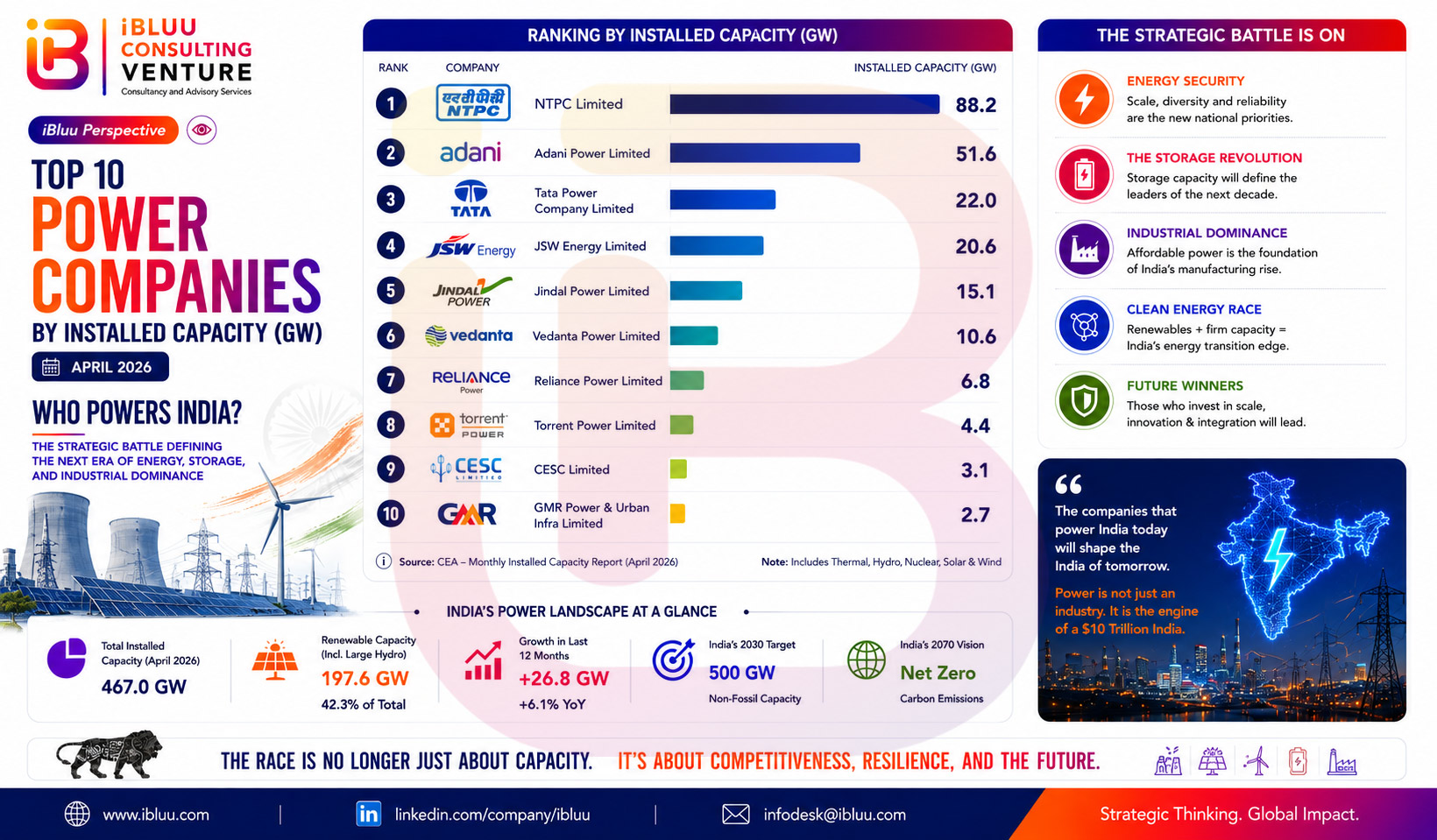
India’s Top 10 Power Companies by Installed Capacity (April 2026)
| Rank | Company | Approx. Installed Capacity (GW) | Core Strength |
|---|---|---|---|
| 1 | NTPC Group | ~89.7 GW | Thermal + Renewable + Grid Stability |
| 2 | Adani Green + Adani Power | ~39–41 GW combined | Solar Scale + Integrated Infrastructure |
| 3 | Tata Power | ~15.6 GW | Diversified Utility + Renewables |
| 4 | Greenko Group | ~9.4 GW | Renewable + Pumped Hydro Storage |
| 5 | ReNew Energy Global | ~9.0 GW | Renewable IPP Platform |
| 6 | JSW Energy | ~8.8 GW | Storage + Industrial Power Integration |
| 7 | NHPC | ~7.5 GW | Hydropower Backbone |
| 8 | Torrent Power | ~5.3 GW | Distribution + Emerging Renewables |
| 9 | SJVN | ~3.5 GW | Hydro + Solar Expansion |
| 10 | CESC / Vedanta Power Assets | ~3 GW+ | Thermal + Industrial Power |
Installed capacities are based on company disclosures, operational assets, commissioned projects, and publicly available reports as of April 2026.
The Real Story Is Not Capacity. It Is Strategic Positioning.
The most important transformation underway in India’s energy economy is this:
The power sector is shifting from generation dominance to energy orchestration dominance.
For decades, scale alone mattered.
Today, four new strategic variables define future leadership:
- Storage control
- Transmission integration
- Renewable dispatchability
- Access to long-term global capital
The companies adapting to this shift are likely to dominate India’s next energy cycle.
The ones that fail may retain assets — but lose relevance.
NTPC: India’s Energy Sovereign
NTPC Limited remains India’s undisputed electricity giant with nearly 90 GW installed capacity.
But the strategic significance of NTPC goes far beyond thermal power.
NTPC has evolved into India’s national energy stabilizer — balancing coal, renewables, hydro, hydrogen, battery storage, and transmission integration simultaneously.
Key strategic developments include:
- Aggressive renewable expansion through NTPC Green Energy
- Large-scale green hydrogen initiatives
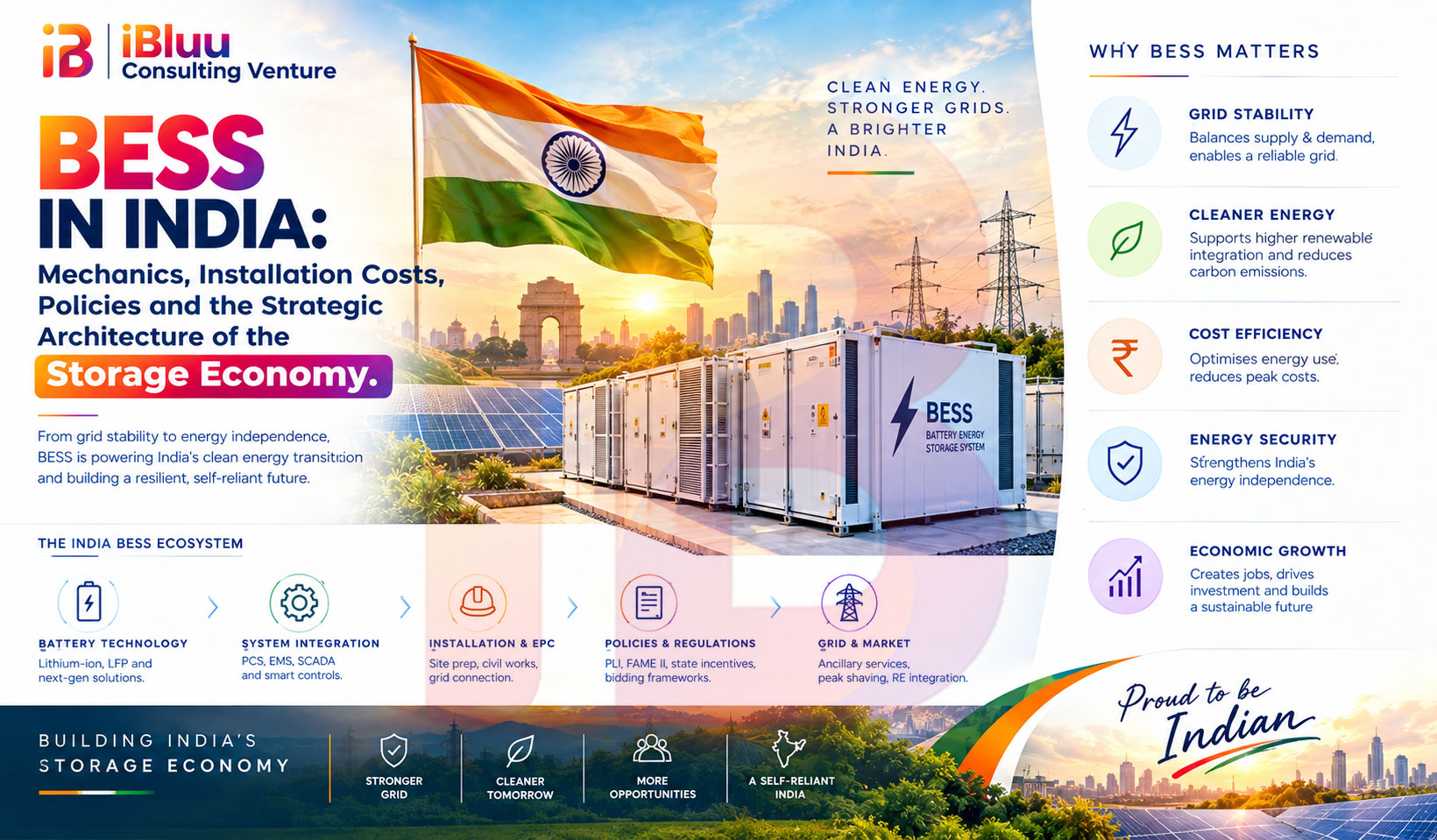
- Utility-scale battery energy storage systems (BESS)
- Nuclear and pumped hydro exploration
- Grid-balancing infrastructure critical for renewable integration
Despite criticism around thermal exposure, NTPC’s scale gives it a unique advantage:
It can finance the transition while continuing to provide baseload stability.
In emerging economies, reliability still matters as much as sustainability.
Adani Group: The Most Aggressive Energy Expansion in India
Adani Green Energy Limited and Adani Power together represent one of the boldest infrastructure expansion strategies globally.
The group is targeting approximately 100 GW capacity by 2030.
That ambition alone is reshaping India’s energy economics.
The Adani model is fundamentally different because it combines:
- Ports
- Logistics
- Transmission
- Solar manufacturing
- Renewable generation
- Thermal backup
- Green hydrogen
- Industrial energy demand
This creates infrastructure integration at a scale few competitors can replicate.
Its largest strategic advantage may not be generation capacity itself — but ecosystem control.
Greenko and ReNew: The Rise of Renewable-First Power Platforms
Greenko Group and ReNew Energy Global represent the emergence of India’s new-generation energy platforms.
Unlike legacy utilities, these firms were built directly around renewable economics.
But the bigger story is storage.
Greenko’s aggressive pumped hydro investments are among the most important infrastructure bets currently underway in India.
The company’s target of scaling from 9.4 GW toward nearly 50 GW by 2030 reflects a broader market realization:
Renewables alone do not control the future grid.
Storage does.
Global sovereign investors including:
- ADIA
- GIC
- ORIX
- Abu Dhabi-linked infrastructure capital
have already embedded themselves deeply into India’s renewable infrastructure ecosystem.
This is not speculative capital.
This is long-duration infrastructure positioning.
Tata Power: Reinventing Legacy Through Energy Transition
Tata Power remains one of India’s most strategically resilient power companies.
More than a century old, the company has successfully repositioned itself from a conventional utility into a diversified clean-energy platform.
Key areas include:
- Rooftop solar
- EV charging networks
- Distribution modernization
- Renewable generation
- Solar EPC
- Storage integration
Tata Power’s biggest strength may not be capacity expansion speed.
It may be institutional trust.
In an increasingly volatile global environment, governance quality and capital credibility are becoming competitive advantages.
JSW Energy and the Storage Revolution
JSW Energy is making one of the most aggressive storage-centric bets in India.
Its strategic focus on:
- Pumped hydro
- Firm renewable power
- Industrial decarbonization
- Hybrid energy systems
signals where India’s grid is headed next.
The next decade of power economics will likely be defined by a single question:
Who controls dispatchable renewable power?
Solar and wind produce electricity intermittently.
Storage determines whether that electricity becomes economically useful.
This distinction changes the valuation framework of the entire sector.
Why Pumped Hydro Is Suddenly Strategic
India’s renewable expansion is exposing a structural challenge:
Peak renewable generation does not align with peak demand.
This is why pumped hydro storage is becoming one of the most critical infrastructure themes in India.
Major companies now aggressively investing include:
- Greenko
- JSW Energy
- Adani
- NHPC
- Torrent Power
Pumped hydro offers:
- Long-duration storage
- Grid stabilization
- Renewable balancing
- Peak-hour arbitrage
In strategic terms, it acts as a national energy shock absorber.
Foreign Capital Is Quietly Rewriting India’s Power Landscape
Perhaps the most important structural shift is this:
India’s energy transition is increasingly being financed by global capital.
Major global investors now deeply embedded in India’s power sector include:
- KKR
- ADIA
- GIC
- Brookfield
- ORIX
- BlackRock-linked infrastructure platforms
- CPP Investments
Why?
Because India represents one of the few large-scale power markets globally where:
- Demand growth remains structurally strong
- Renewable penetration is accelerating
- Policy direction is relatively stable
- Industrialization is still expanding
- Electrification intensity continues rising
For long-horizon infrastructure investors, that combination is exceptionally rare.
The Energy Transition Is Becoming an Industrial Competition
India’s power story cannot be separated from:
- Semiconductor manufacturing
- Data centers
- AI infrastructure
- EV manufacturing
- Green hydrogen
- Industrial corridors
- Smart cities
Electricity is no longer just a utility input.
It is becoming the foundational layer of industrial competitiveness.
Countries that fail to build scalable, affordable, and resilient electricity systems may struggle to sustain manufacturing leadership.
India understands this.
That is why power infrastructure is now being treated as strategic economic architecture.
Key Strategic Risks
Despite strong momentum, the sector faces serious structural risks:
1. Transmission Bottlenecks
Renewable capacity growth is outpacing grid evacuation infrastructure in several states.
2. DISCOM Financial Stress
State electricity distribution companies remain one of India’s biggest systemic energy vulnerabilities.
3. Land and Environmental Complexity
Large-scale renewable and hydro projects continue facing acquisition and environmental clearance delays.
4. Storage Economics
Battery storage costs remain high, while pumped hydro requires massive upfront capital.
5. Coal Transition Management
India cannot immediately abandon thermal power without risking grid instability.
The transition must be phased — not ideological.
India’s 2030 Energy Outlook
By 2030, India’s top power companies could collectively exceed 450 GW of installed capacity.
But the deeper transformation is not numerical.
It is structural.
India is transitioning from:
- Coal dependency → diversified energy architecture
- Centralized generation → flexible grids
- Renewable addition → renewable orchestration
- Domestic infrastructure → globally financed energy ecosystems
This is not merely energy expansion.
It is economic rewiring at continental scale.
iBCV Perspective: Infrastructure Will Define India’s Next Economic Hierarchy
From the perspective of iBCV — iBluu Consulting Venture Private Limited, a venture of iBluu Corporations — India’s power sector represents one of the most strategically important infrastructure transitions of the 21st century.
The next phase of India’s growth will not be determined solely by GDP expansion.
It will be determined by:
- energy reliability,
- storage leadership,
- infrastructure execution,
- industrial electrification, and
- capital efficiency.
iBCV views the convergence of renewable power, storage systems, industrial manufacturing, logistics infrastructure, and global institutional capital as one of the defining investment themes shaping India’s long-term economic architecture.
The analytical lens of J Parasher consistently frames infrastructure not as a sectoral discussion, but as a strategic national capability capable of influencing industrial scale, export competitiveness, and geopolitical leverage simultaneously.
Conclusion: The Future of Power Is About Control, Not Capacity
India’s electricity market is entering a new phase.
The winners of the next decade will not necessarily be the companies generating the most power.
The winners will be the companies that control:
- storage,
- transmission integration,
- dispatchable renewables,
- industrial energy ecosystems, and
- long-term infrastructure capital.
The future grid will not reward scale alone.
It will reward strategic intelligence.
And increasingly, global capital is betting that India may become one of the defining energy growth stories of the century.
Disclaimer: This article is intended solely for strategic, educational, informational, and industry insight purposes. All statistics, capacities, projections, and market observations are based on publicly available data, company disclosures, industry reports, and sectoral estimates available as of April 2026. Certain figures may evolve as projects are commissioned, expanded, delayed, or revised. This article does not constitute investment, legal, financial, or regulatory advice. Readers, investors, and institutions are advised to conduct independent due diligence and consult qualified advisors before making investment or strategic decisions. The perspectives expressed herein reflect analytical industry interpretation and broader infrastructure-market observations.