+91 945 889 6091
  infodesk@ibluu.com
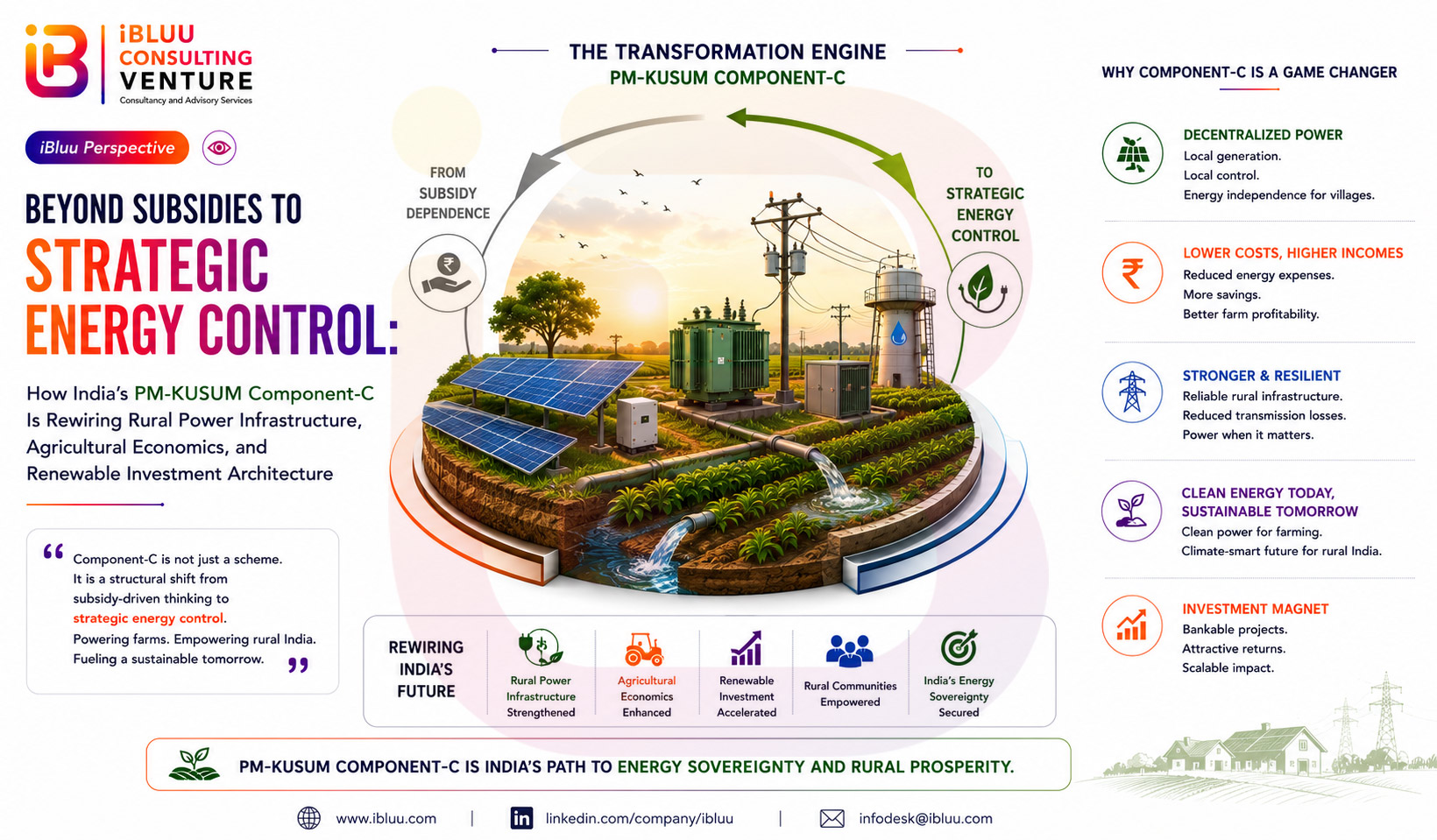
Beyond Subsidies to Strategic Energy Control: How India’s PM-KUSUM Component-C Is Rewiring Rural Power Infrastructure, Agricultural Economics, and Renewable Investment Architecture
India’s renewable energy transition is no longer confined to utility-scale solar parks in Rajasthan or corporate decarbonization strategies in metropolitan industrial clusters. A far more structural and economically transformative shift is unfolding quietly across India’s agricultural backbone through the PM-KUSUM (Pradhan Mantri Kisan Urja Suraksha evam Utthaan Mahabhiyan) Component-C program.
What appears on the surface as a rural solar initiative is, in reality, one of the most strategically important decentralized energy infrastructure programs India has launched in decades.
At its core, the KUSUM-C model under PPA mode is designed to solarize agricultural feeders, reduce DISCOM subsidy burdens, stabilize rural electricity supply, create long-term renewable power assets, and attract private capital into decentralized infrastructure.
This is not merely an energy scheme.
It is a structural redesign of how rural India consumes, distributes, finances, and monetizes electricity.
And increasingly, institutional investors, infrastructure developers, EPC companies, sovereign funds, and renewable platforms are beginning to recognize that KUSUM-C may become one of the most scalable distributed renewable infrastructure opportunities in the Indian market.
Understanding PM-KUSUM Component-C: What Exactly Is It?
The PM-KUSUM scheme, launched by the Ministry of New and Renewable Energy (MNRE), consists of multiple components designed to accelerate decentralized renewable energy deployment across agricultural ecosystems.
Component-C specifically focuses on the solarization of existing agricultural feeders and grid-connected pumps under long-term Power Purchase Agreement (PPA) structures.
Under this model:
- Private developers install solar power plants near substations or feeders
- Generated electricity is supplied to DISCOMs through long-term PPAs
- Farmers receive reliable daytime electricity
- DISCOMs reduce subsidy and transmission losses
- Developers receive predictable long-term revenue visibility
In practical terms, the government is converting rural electricity consumption from a subsidy burden into an infrastructure-backed renewable asset class.
That changes the economics of rural power entirely.
Why the KUSUM-C Model Is Strategically Important
Historically, India’s agricultural electricity ecosystem has suffered from:
- High subsidy burdens
- Free or highly subsidized electricity
- Poor DISCOM financial health
- Massive transmission losses
- Unscheduled rural outages
- Over-dependence on coal-based power
KUSUM-C directly attacks these inefficiencies.
Instead of transporting power across long distances, decentralized solar generation near agricultural feeders significantly reduces technical losses while improving supply reliability.
This creates a triple-win architecture:
| Stakeholder | Strategic Benefit |
|---|---|
| Government | Reduced subsidy burden and cleaner energy mix |
| DISCOMs | Lower procurement costs and improved feeder stability |
| Developers & Investors | Long-term predictable cash flows through PPAs |
| Farmers | Reliable daytime power and reduced outages |
| Rural Economy | Better irrigation productivity and economic resilience |
This is precisely why many policy analysts increasingly see KUSUM-C not as a subsidy scheme — but as a decentralized infrastructure transformation model.
India’s KUSUM-C Scale: Installed, Ongoing, and Pipeline Capacity
As of early 2026:
- India’s total PM-KUSUM target remains approximately 34.8 GW
- Component-C continues to emerge as one of the fastest-growing segments
- Multiple states have accelerated feeder solarization tenders aggressively
Across India:
- Thousands of MW are already operational or under implementation
- States including Rajasthan, Maharashtra, Haryana, Madhya Pradesh, Gujarat, and Uttar Pradesh are leading deployment activity
- Several states are integrating feeder-level solarization into long-term rural energy strategies
The market remains highly fragmented — creating opportunities for EPC companies, IPPs, renewable developers, investors, and strategic advisory firms.
Which States Are Leading KUSUM-C Execution?
Rajasthan
Rajasthan remains among the largest execution markets due to:
- High solar irradiation
- Large agricultural load
- Strong renewable policy ecosystem
- Availability of land
- Established developer ecosystem
The state continues to attract major solar developers and EPC players.
Maharashtra
Maharashtra has emerged as one of the most active KUSUM markets due to:
- Large feeder infrastructure
- Strong agricultural demand
- High DISCOM subsidy exposure
- Policy support for decentralized generation
The state has witnessed significant participation from private renewable developers.
Haryana and Gujarat
Both states are aggressively deploying feeder solarization due to:
- High agricultural electrification
- Better transmission infrastructure
- Faster project implementation capabilities
These states are increasingly viewed as benchmark models for feeder-based renewable integration.
Which Companies Are Dominating the KUSUM-C Ecosystem?
India’s KUSUM ecosystem includes a mix of:
- Utility-scale renewable giants
- EPC companies
- Distributed solar developers
- State-linked entities
- Regional infrastructure players
Key participants across various states include:
- Tata Power
- Adani Green Energy
- ReNew
- NTPC Green Energy
- Azure Power
- Jakson Green
- Shakti Pumps
- Sterling and Wilson Renewable Energy
Several regional developers are also building highly profitable decentralized portfolios under state tenders.
The PPA Structure: Why Investors Are Paying Attention
The most attractive feature of KUSUM-C projects is the long-term PPA-backed revenue visibility.
Typical characteristics include:
- PPA tenure of 20–25 years
- Fixed or semi-escalated tariff structures
- State-backed procurement
- Predictable cash flow visibility
- Infrastructure-style yield profile
For infrastructure investors, pension funds, sovereign capital, and energy-focused private equity firms, these projects resemble annuity-style infrastructure assets rather than speculative renewable ventures.
This is particularly important in an environment where global investors increasingly seek stable long-duration energy assets.
Tariffs and State-Level Economics
KUSUM-C tariffs vary significantly by state depending on:
- Solar irradiation
- Land economics
- Grid connectivity
- State DISCOM financial conditions
- Tender competitiveness
Broadly, tariffs across states have historically ranged between approximately:
- ₹2.5 to ₹3.5 per unit for many projects
- Some states have witnessed higher tariffs depending on project structure and feeder conditions
For DISCOMs, these tariffs are often cheaper than long-term agricultural subsidy burdens and transmission-adjusted procurement costs.
That is why feeder solarization is increasingly becoming a fiscal reform instrument for state governments.
Role of DISCOMs and Regulatory Bodies
The success of KUSUM-C depends heavily on state DISCOM participation.
DISCOM responsibilities include:
- Tender issuance
- Power procurement agreements
- Grid integration
- Feeder identification
- Payment security mechanisms
Key institutional stakeholders include:
- Ministry of New and Renewable Energy
- Solar Energy Corporation of India
- State Renewable Energy Development Agencies
- State Electricity Regulatory Commissions
- State DISCOMs
However, DISCOM payment delays remain one of the largest concerns for developers and investors.
This remains a major risk variable in the sector.
International Capital Is Quietly Entering Distributed Renewable Infrastructure
While KUSUM-C is largely India-focused operationally, the capital ecosystem behind renewable infrastructure is increasingly global.
Global institutional investors already deeply active in India’s renewable ecosystem include:
- Brookfield
- KKR
- BlackRock
- ADIA
- GIC
- ORIX
These investors increasingly recognize that India’s distributed renewable infrastructure may become one of the world’s largest long-term infrastructure opportunities.
The Emerging Battle: Renewable Generation vs Renewable Control
The next decade of India’s energy transition will not be won merely by generating renewable electricity.
It will be won by controlling:
- Distribution architecture
- Storage integration
- Rural feeder networks
- Grid balancing systems
- Decentralized energy infrastructure
KUSUM-C sits precisely at this intersection.
It transforms renewable energy from centralized generation into localized infrastructure control.
That is strategically far more important.
Major Challenges Still Facing KUSUM-C
Despite massive potential, the sector faces substantial challenges:
DISCOM Financial Stress
Delayed payments remain a major investor concern.
Land Aggregation
Securing land near feeder infrastructure remains complex in several states.
Grid Infrastructure
Weak rural transmission networks can delay commissioning.
Policy Variability
State-level regulatory inconsistency creates uncertainty.
Financing Constraints
Smaller developers struggle to secure low-cost project financing.
Why the Long-Term Outlook Remains Extremely Strong
India’s agricultural power demand will continue rising structurally.
Simultaneously:
- Coal dependency must reduce
- Rural supply quality must improve
- DISCOM subsidy burdens must decline
- Renewable integration must accelerate
KUSUM-C directly aligns with all four objectives.
That is why the program is increasingly viewed as one of India’s most strategically aligned energy infrastructure platforms.
Over the next decade, feeder-level renewable systems could become one of the largest decentralized energy asset classes in Asia.
The Strategic Role of iBCV in India’s Renewable Infrastructure Ecosystem
iBluu Corporations through its venture iBCV (iBluu Consulting Venture Private Limited) operates at the intersection of:
- Strategic consulting
- Infrastructure advisory
- Government engagement
- Investment alignment
- Joint venture structuring
- Partnership facilitation
- Renewable infrastructure advisory
As renewable infrastructure markets become increasingly capital-intensive and execution-driven, advisory ecosystems capable of aligning developers, investors, EPC partners, institutional stakeholders, and regulatory frameworks will become increasingly critical.
The analytical direction reflected in this article is influenced by the strategic perspective of J Parasher, whose work consistently focuses on long-horizon industrial transformation, infrastructure competitiveness, and national economic capability building.
Conclusion: India’s Renewable Future Will Be Built in the Feeders, Not Just the Megaparks
The most important transformation underway in India’s renewable energy sector is not simply the rise of gigawatt-scale solar parks.
It is the decentralization of energy infrastructure itself.
KUSUM-C represents the beginning of that transition.
It connects energy security, rural economics, infrastructure finance, agricultural productivity, and renewable deployment into a single integrated architecture.
And as global infrastructure capital increasingly searches for scalable, yield-generating, climate-aligned assets, India’s feeder-level renewable ecosystem may evolve into one of the most important decentralized infrastructure opportunities of the next decade.
The next battle in energy is no longer merely about who generates power.
It is about who controls the infrastructure architecture through which power flows.
And India is positioning itself aggressively at the center of that transition.
Disclaimer: This article is intended solely for informational, strategic, and industry-analysis purposes and should not be construed as investment advice, financial solicitation, regulatory guidance, or a definitive market forecast. Certain statistics, projections, policy developments, and market estimates referenced are based on publicly available industry reports, government releases, sectoral data, and market intelligence available as of 2026 and may evolve over time. Readers, investors, developers, and institutions are advised to conduct independent technical, financial, legal, regulatory, and commercial due diligence before making any investment or strategic decisions related to renewable energy, PPA structures, or PM-KUSUM projects.