+91 945 889 6091
  infodesk@ibluu.com
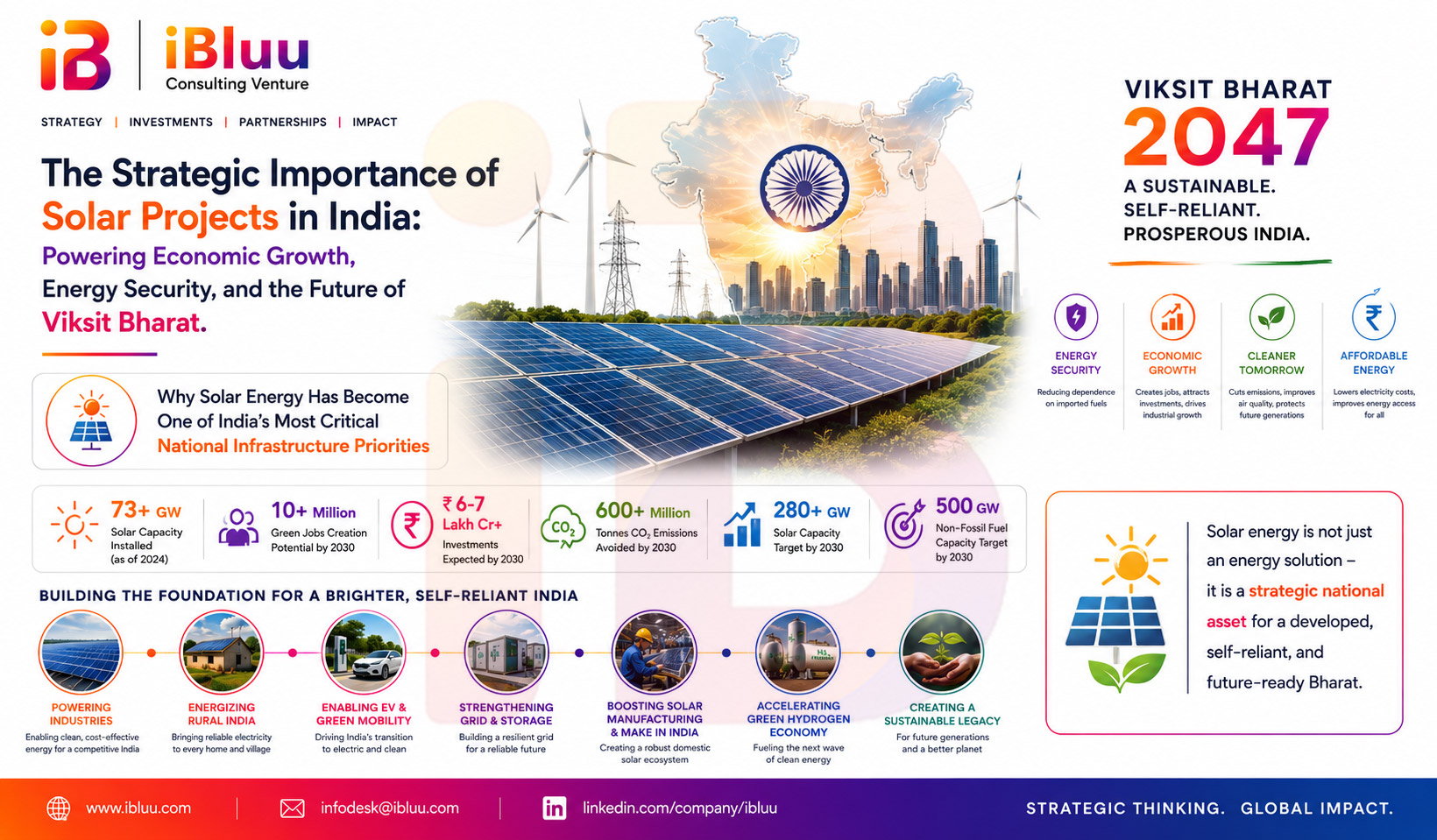
The Strategic Importance of Solar Projects in India: Powering Economic Growth, Energy Security, and the Future of Viksit Bharat
India is entering a defining decade.
As the nation advances toward becoming a multi-trillion-dollar economy and pursues its long-term vision of a developed nation (Viksit Bharat), a fundamental question sits at the center of every industrial, technological, and economic ambition:
Where will the power come from?
Whether it is artificial intelligence data centres, semiconductor fabrication plants, electric vehicles, defense manufacturing corridors, green hydrogen projects, smart cities, metro rail systems, or the electrification of hundreds of millions of households, every growth engine ultimately depends on one foundational resource—reliable, affordable, and sustainable electricity.
In this context, solar energy is no longer merely a renewable energy source.
It has emerged as a strategic national asset.
It is increasingly becoming the backbone of India’s future industrial competitiveness, energy security, climate leadership, and economic resilience.
The country’s solar journey represents one of the most significant infrastructure transformations underway anywhere in the world today.
India’s Solar Revolution: From Ambition to Scale
India’s renewable energy transformation has accelerated dramatically over the past decade.
As of May 2026, India’s installed solar capacity has crossed approximately 157 GW, including nearly 119 GW of utility-scale ground-mounted solar projects, making the country one of the world’s largest solar power markets.
More importantly, India achieved a major milestone by reaching approximately 50% installed electricity capacity from non-fossil fuel sources nearly five years ahead of its original target timeline.
This achievement signals not only policy success but also growing investor confidence in India’s renewable energy ecosystem.
However, the journey is far from complete.
India’s energy roadmap targets:
| Strategic Milestone | Target |
|---|---|
| Non-Fossil Capacity by 2030 | 500 GW |
| Solar Capacity by 2030 | ~280 GW |
| Net-Zero Target | 2070 |
| Emissions Intensity Reduction Goal | 47% |
| Non-Fossil Power Capacity by 2035 | 60%+ |
Achieving these targets will require one of the largest energy deployment programs in modern economic history.
The Environmental Imperative: Solar as India’s Most Powerful Decarbonization Tool
Climate considerations remain a primary driver behind solar expansion.
Coal currently continues to provide the majority of India’s electricity generation, but the environmental consequences are increasingly difficult to ignore.
Solar photovoltaic systems produce lifecycle emissions of approximately 40-50 grams CO₂ equivalent per kilowatt-hour, compared to coal generation that can exceed 900-1,000 grams CO₂ per kilowatt-hour.
This represents a reduction exceeding 90%.
At scale, the implications are profound.
Projects such as the Khavda Renewable Energy Park in Gujarat, expected to become one of the world’s largest renewable energy complexes, are projected to reduce carbon emissions by approximately 58-63 million tonnes annually upon full commissioning.
The significance extends beyond environmental stewardship.
Decarbonization is rapidly becoming a competitive economic requirement as global markets introduce carbon-border taxes, ESG-linked procurement frameworks, and sustainability-driven investment mandates.
In the coming decade, clean energy will increasingly influence trade competitiveness.
The Electricity Demand Explosion: India’s Next Growth Challenge
India’s power demand trajectory is entering a new phase.
Peak electricity demand is expected to approach 270 GW during 2026, with annual demand growth projected at approximately 6-7% over the medium term.
Several structural drivers are accelerating consumption:
- Rapid urbanization
- Rising air-conditioning penetration
- Residential electrification
- Electric vehicle adoption
- Metro rail expansion
- Smart manufacturing
- Industrial automation
- Digital infrastructure growth
Unlike previous industrial cycles, future electricity demand will be both broader and more technology intensive.
The challenge is not simply generating more power.
It is generating cleaner power at economically competitive rates.
Solar energy increasingly provides the most scalable solution.
AI, Data Centres, and the New Energy Economy
Artificial Intelligence is creating an entirely new category of electricity demand.
Globally, data centre electricity consumption is projected to reach approximately 945 TWh annually by 2030, driven primarily by AI workloads.
India’s data centre capacity could expand nearly sixfold over the coming years.
This growth could generate approximately 40-45 TWh of incremental electricity demand annually.
A single hyperscale AI data centre can consume electricity comparable to more than 100,000 households.
As global technology companies expand AI infrastructure across India, access to reliable green energy will become a decisive investment criterion.
This is where solar energy gains strategic importance.
Solar coupled with battery storage, pumped hydro, and hybrid renewable systems offers one of the most cost-effective pathways to power the digital economy while supporting national sustainability objectives.
Powering Strategic Industries and Atmanirbhar Bharat
India’s industrial ambitions are increasingly energy dependent.
Semiconductor fabrication facilities require uninterrupted, high-quality power.
Defense manufacturing clusters demand resilient energy systems.
Green hydrogen projects require massive renewable electricity inputs.
Electronics, aerospace, pharmaceuticals, and advanced manufacturing all depend upon affordable electricity for global competitiveness.
Solar projects support these objectives through:
- Captive renewable power arrangements
- Open-access procurement models
- Renewable Energy Supply Agreements (RESA)
- Hybrid solar-storage systems
- Dedicated industrial power parks
The result is reduced exposure to imported fossil fuels and enhanced industrial resilience.
Economic Competitiveness: Solar Has Become a Cost Advantage
One of the most remarkable aspects of India’s solar sector is cost competitiveness.
Utility-scale solar tariffs have fallen below ₹2.50 per kWh in several competitive auctions.
In many cases, this is cheaper than new coal-based generation.
Simultaneously, domestic manufacturing expansion supported through Production Linked Incentive (PLI) schemes is improving supply-chain resilience while lowering long-term costs.
According to international energy forecasts, global clean-energy investments could exceed $3 trillion annually before 2030, with India expected to attract a growing share.
Energy investments in India alone could exceed $170 billion during 2026, with solar representing one of the largest beneficiaries.
Beyond Power Generation: Solar’s Broader Economic Multiplier
The solar sector creates benefits far beyond electricity production.
Employment Generation
Solar projects create substantial direct and indirect employment across:
- Manufacturing
- Engineering
- EPC services
- Logistics
- Construction
- Operations & Maintenance
- Component supply chains
The sector has become an important rural employment generator while supporting skill development across multiple technical disciplines.
Energy Security
India remains vulnerable to imported fossil fuel volatility.
Expanding solar capacity strengthens energy independence while reducing exposure to geopolitical disruptions and commodity price shocks.
Rural Development
Large-scale solar projects create local infrastructure, roads, transmission assets, and economic activity in underserved regions.
Global Leadership
India’s leadership through the International Solar Alliance (ISA) positions the country as a key participant in shaping the future global renewable energy architecture.
Investment Landscape: One of the Largest Infrastructure Opportunities of the Decade
Achieving India’s clean energy ambitions may require approximately $500-600 billion or more in cumulative investment by 2030.
Solar alone could attract between $200-300 billion of capital deployment.
Key financing channels include:
- Sovereign funds
- Infrastructure funds
- Pension capital
- Green bonds
- Multilateral financing
- Development banks
- Strategic corporate investors
Utility-scale solar projects with storage integration continue demonstrating attractive long-term returns, often generating 10-13%+ project IRRs under favorable conditions.
Scenario Analysis: Three Possible Futures
Base Case
Annual solar additions remain above 40 GW.
India achieves approximately 280 GW solar capacity by 2030 while maintaining economic growth and emissions reduction objectives.
Accelerated Scenario
Storage deployment, manufacturing incentives, and transmission expansion exceed expectations.
Solar capacity surpasses 350 GW, positioning India as a global clean-energy export powerhouse.
Stressed Scenario
Land acquisition delays, transmission bottlenecks, financing constraints, and regulatory uncertainty slow deployment.
Energy shortages and higher industrial power costs impact competitiveness.
Key Risks That Must Be Addressed
While the outlook remains highly favorable, challenges remain.
High Execution Risk
- Land acquisition delays
- Environmental clearances
- Grid evacuation constraints
- Transmission infrastructure gaps
Grid Integration Risk
As solar penetration rises, storage requirements become increasingly important.
India may require more than 100 GW of storage and pumped hydro capacity by 2030.
Financial Risk
Higher interest rates and financing costs may impact project economics despite declining technology costs.
Supply Chain Risk
Although domestic manufacturing is expanding, dependence on imported components remains a consideration.
Regulatory Risk
Changes in open-access frameworks, grid charges, and renewable energy policies could influence returns.
Strategic Recommendations for Stakeholders
For Investors
Prioritize integrated solar-plus-storage opportunities, industrial power contracts, and high-irradiance states such as Rajasthan, Gujarat, and Karnataka.
For Developers
Focus on hybrid renewable solutions, advanced technologies such as bifacial modules, and long-term power purchase agreements.
For Policymakers
Accelerate transmission investments, simplify approval frameworks, and strengthen storage deployment incentives.
For Industry
Leverage renewable energy procurement as a competitive advantage and ESG differentiator.
Solar Energy: The National Multiplier Effect
The strategic importance of solar extends far beyond electricity generation.
Solar supports:
- Economic growth
- Industrial competitiveness
- Climate commitments
- Energy independence
- Employment creation
- Rural development
- National security
- Technology leadership
Few infrastructure sectors offer such a broad spectrum of economic, environmental, and social returns simultaneously.
This is not merely an energy transition.
It is an industrial transformation.
It is a competitiveness strategy.
It is a national development strategy.
As India powers the next generation of growth—from artificial intelligence and semiconductors to advanced manufacturing and green hydrogen—solar energy will increasingly serve as the foundational infrastructure enabling that future.
The sun is abundant.
The technology is proven.
The economics are compelling.
The strategic rationale is undeniable.
The question is no longer whether India should scale solar.
The question is how quickly it can do so.
The Strategic Lens
The analytical depth of this perspective is shaped by the strategic lens of J Parasher, Founder and Managing Director of iBluu Corporations, whose work consistently focuses on national capability building, industrial competitiveness, infrastructure-led growth, and long-horizon economic transformation.
Through iBCV (iBluu Consulting Venture Private Limited), a venture of iBluu Corporations, the organization supports businesses, investors, infrastructure developers, and government stakeholders through strategic consulting, investment advisory, mergers and acquisitions support, partnership development, IT consulting, and strategic government engagement initiatives. The firm’s perspective emphasizes that infrastructure sectors such as renewable energy should be viewed not merely as projects, but as multipliers capable of reshaping economic productivity, investment attractiveness, and national competitiveness.
Disclaimer: This article is intended solely for informational, research, thought-leadership, and educational purposes. Data, forecasts, projections, and market observations have been compiled from publicly available industry sources, government publications, international energy agencies, market reports, and sector analyses believed to be reliable as of June 2026. Certain figures represent estimates, scenario modeling, or forward-looking assessments and may change based on policy developments, market conditions, technology evolution, financing environments, and regulatory decisions. Readers should conduct independent due diligence and seek professional advice before making investment, business, policy, or strategic decisions. The views expressed herein are analytical in nature and do not constitute financial, legal, tax, investment, or regulatory advice.