+91 945 889 6091
  infodesk@ibluu.com
Powering the Next Era of Intelligence: Meta and Reliance Advance 168 MW AI Data Centre Backed by 900 MW Renewable Energy
The Real Story Is Not a Data Centre. It Is the Emergence of India as an AI Infrastructure Powerhouse.
The global artificial intelligence race is rapidly shifting from algorithms to infrastructure.
For years, technology leadership was measured by software innovation, cloud adoption, and platform scale. Today, the defining competitive advantage is increasingly determined by access to compute power, energy security, data infrastructure, and network connectivity.
Against this backdrop, Meta’s landmark partnership with Reliance Industries to develop a dedicated AI-enabled data centre in Jamnagar, Gujarat, represents far more than a conventional hyperscale facility.
It signals the emergence of a new strategic reality: India is no longer being viewed merely as a market for AI products. It is increasingly being positioned as a destination for AI infrastructure.
The announcement combines three critical pillars of the AI economy:
- Compute Infrastructure
- Renewable Energy Security
- Global Digital Connectivity
Together, they form the foundation of next-generation AI ecosystems.
The Jamnagar Deal: Meta’s First Dedicated AI Data Centre in India
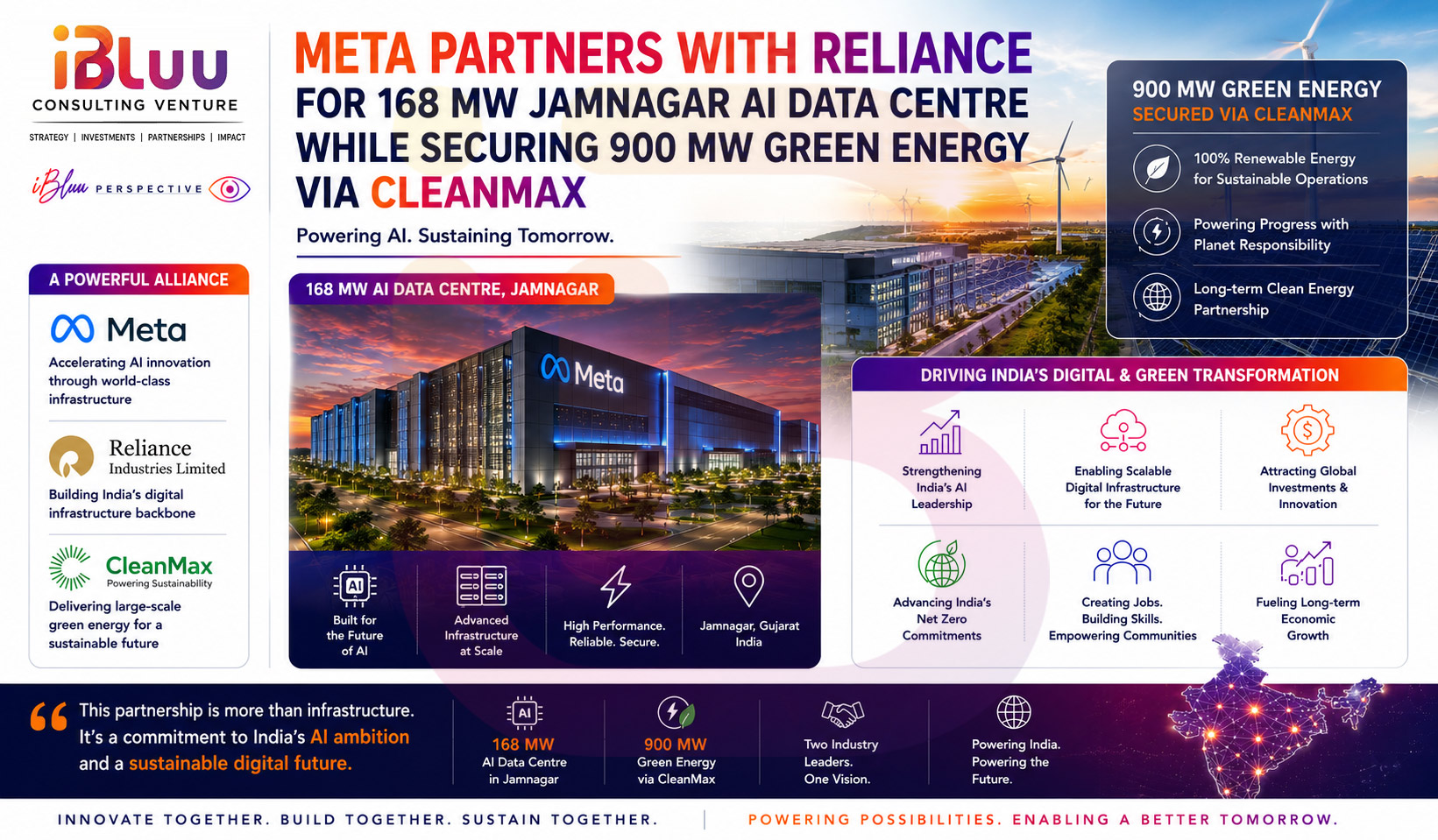
Meta has partnered with Reliance Industries to establish its first dedicated, build-to-suit AI-enabled data centre in India at Reliance’s expanding digital infrastructure campus in Jamnagar, Gujarat. The initial phase will provide 168 MW of AI-ready capacity, with provisions for future expansion. Reliance will design, construct, operate, and manage the facility, while Meta will lease the capacity for global AI workloads and localized digital services. The project is expected to be delivered within approximately two years.
Key Project Metrics
| Parameter | Details |
|---|---|
| Location | Jamnagar, Gujarat |
| Initial Capacity | 168 MW |
| Project Model | Build-to-Suit |
| Developer | Reliance Industries |
| Anchor Tenant | Meta |
| Delivery Timeline | ~2 Years |
| Expansion Potential | Yes |
| Power Source | Renewable Energy |
| Cooling System | Desalinated Seawater |
| Purpose | AI Compute & Global Infrastructure |
Unlike traditional colocation facilities, this arrangement gives Meta dedicated infrastructure optimized for large-scale AI training, inference workloads, and next-generation digital services. The campus will operate on renewable energy and utilize desalinated seawater cooling, reducing dependence on freshwater resources. Meta will bear the full operational costs associated with energy and water consumption.
Why Jamnagar Matters
Location selection is rarely accidental in hyperscale infrastructure.
Jamnagar offers a unique combination of advantages:
- Access to large-scale industrial infrastructure
- Significant renewable energy resources
- Established utility networks
- Available land for expansion
- Strategic connectivity to national and global networks
Reliance is already developing one of the world’s largest integrated digital and energy infrastructure ecosystems in Jamnagar. For Meta, the location provides the rare ability to combine compute, energy, water, and network infrastructure within a single integrated environment.
This dramatically lowers deployment complexity while improving scalability.
The Energy Question: AI’s Most Critical Constraint
The world’s largest AI challenge is no longer chips.
It is power.
A modern AI data centre can consume electricity comparable to a medium-sized city.
As generative AI adoption accelerates, energy availability is becoming the single biggest bottleneck for hyperscale expansion.
Meta’s response is notable.
Simultaneously with the Jamnagar announcement, the company expanded its clean-energy commitments in India to nearly 1 GW.
CleanMax Partnership
Meta added 837 MW of new solar and wind capacity across Rajasthan and Karnataka, pushing the cumulative Meta-CleanMax renewable portfolio beyond 900 MW. Meta will acquire the environmental attributes associated with these projects as part of its global commitment to match operations with 100% clean energy.
Fourth Partner Energy Expansion
Meta has also contracted 160 MW of additional solar and wind projects across Tamil Nadu, Karnataka, Maharashtra, and Uttar Pradesh, further strengthening its renewable energy footprint in India.
Combined with renewable energy support from Reliance’s infrastructure ecosystem, Meta is effectively creating one of the largest corporate clean-energy backed AI infrastructure platforms in the country.
Beyond Data Centres: Building the Complete AI Stack
The Jamnagar facility becomes significantly more strategic when viewed alongside Meta’s broader infrastructure investments.
The company continues to expand its global connectivity architecture through Project Waterworth, one of the world’s largest subsea cable initiatives, designed to connect multiple continents with ultra-high-capacity digital infrastructure.
When compute infrastructure, renewable power, and subsea connectivity converge, the result is not merely a data centre.
It becomes a digital backbone.
This positioning could allow India to play a more influential role in global AI compute networks over the coming decade.
India’s Emerging AI Data Centre Landscape
Meta’s investment joins a rapidly expanding wave of AI and hyperscale infrastructure commitments.
Selected Major AI & Hyperscale Data Centre Developments
| Company | Location | Capacity / Scale | Strategic Focus |
|---|---|---|---|
| Meta + Reliance | Jamnagar, Gujarat | 168 MW (expandable) | AI Compute |
| Reliance Data Centre Campus | Jamnagar, Gujarat | Multi-GW vision | AI & Cloud Infrastructure |
| AdaniConneX | Chennai, Noida, Hyderabad, Navi Mumbai | Multi-site hyperscale platform | Cloud & AI |
| Yotta Data Services | Navi Mumbai & Greater Noida | AI GPU Infrastructure | AI Compute |
| Microsoft | Hyderabad, Pune, Chennai | Cloud + AI Expansion | Enterprise AI |
| Google Cloud | Mumbai & regional infrastructure | AI & Cloud Services | Digital Ecosystem |
| AWS | Hyderabad Region | Multi-billion-dollar expansion plans | Cloud & AI |
While capacities and investment structures differ, a common trend is becoming evident: energy procurement is increasingly as important as server procurement.
The Strategic Shift: AI Infrastructure Is Becoming Energy Infrastructure
Historically, digital infrastructure discussions focused on software.
Today, the conversation increasingly revolves around:
- Electricity availability
- Renewable power procurement
- Grid resilience
- Cooling technologies
- Land acquisition
- Water management
- Semiconductor supply chains
The winners of the AI era may not simply be those with the best models.
They may be those with the strongest infrastructure ecosystems.
The Meta-Reliance partnership reflects this reality.
Reliance brings industrial infrastructure, energy assets, utilities, and execution capability.
Meta brings AI demand, global platforms, and long-term compute requirements.
Together, they create a model that other hyperscalers may increasingly replicate.
Investor Perspective: The New AI Investment Cycle
For investors, the announcement highlights a larger trend.
The AI boom is no longer confined to software valuations.
It is driving investment opportunities across:
- Data Centres
- Renewable Energy
- Transmission Infrastructure
- Cooling Technologies
- Industrial Real Estate
- Grid Modernization
- Fiber Networks
- Equipment Manufacturing
Industry forecasts increasingly suggest that India’s data centre market could more than double over the next decade as AI workloads, cloud adoption, digital services, and sovereign data requirements continue to expand.
Risks That Cannot Be Ignored
Despite the optimism, significant challenges remain.
Energy Risk
AI facilities require continuous power availability at unprecedented scale.
Grid Integration Risk
Renewable generation must be matched with storage, balancing mechanisms, and transmission infrastructure.
Water Sustainability Risk
Even with desalination technologies, long-term environmental management remains critical.
Technology Risk
Dependence on imported GPUs, advanced chips, and AI hardware remains substantial.
Regulatory Risk
Future data localization, AI governance, and digital infrastructure regulations may affect operating models.
Successful execution will require coordinated planning across technology, infrastructure, energy, and policy ecosystems.
The Bigger Signal
The most important takeaway is not that Meta is building a 168 MW data centre.
The bigger signal is that one of the world’s largest technology companies has chosen India as a long-term AI infrastructure destination.
This is not merely a real-estate decision.
It is a strategic allocation of capital, compute, and confidence.
As AI increasingly becomes the defining technology platform of the next decade, nations capable of supplying compute, energy, connectivity, and talent will capture a disproportionate share of value creation.
India is positioning itself to be one of them.
Strategic Perspective
The analytical depth of this article has been shaped by the strategic lens of J Parasher, Founder and Managing Director of iBluu Corporations, whose work consistently focuses on national capability building, industrial competitiveness, infrastructure-led growth, digital transformation, and long-horizon economic development. His perspective views AI infrastructure not as a technology project alone, but as a strategic convergence of energy, compute, capital, and national competitiveness.
In that context, the Meta-Reliance partnership may ultimately be remembered not as a data-centre announcement, but as a milestone in India’s emergence as a global AI infrastructure economy.
Disclaimer: This article is intended solely for informational, educational, and strategic discussion purposes. The analysis is based on publicly available information, corporate announcements, industry reports, market intelligence, and independent interpretation of emerging technology and infrastructure trends. Project capacities, investment estimates, development timelines, renewable energy commitments, and expansion plans remain subject to regulatory approvals, commercial agreements, technological developments, and future business decisions. This article does not constitute investment, financial, engineering, legal, policy, or professional advice. Readers should undertake independent due diligence and consult qualified advisors before making any investment, commercial, operational, or strategic decisions.