+91 945 889 6091
  infodesk@ibluu.com
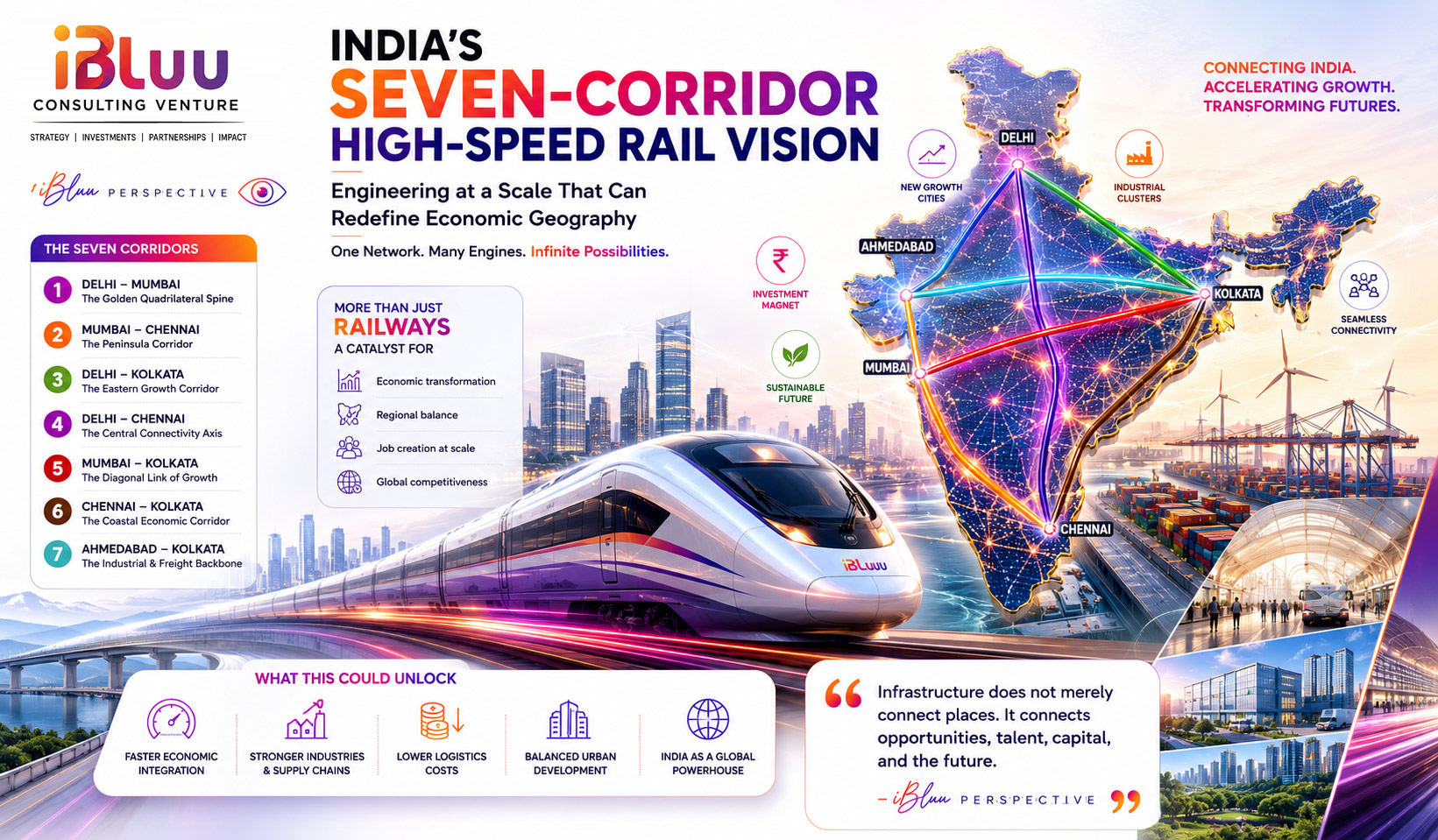
Building the Backbone of Bharat 2.0: India’s Ambitious Seven High-Speed Rail Corridors
From Building Railways to Building Economic Velocity
Every generation inherits an infrastructure challenge that ultimately shapes its economic destiny.
For nineteenth-century economies, it was railways.
For the twentieth century, it was highways, ports, and aviation.
For the twenty-first century, increasingly, it is the ability to move people, talent, capital, and ideas at unprecedented speed and efficiency.
India’s emerging high-speed rail (HSR) strategy represents precisely such a moment.
With seven new high-speed rail corridors under evaluation and development, spanning nearly 4,000 kilometres and carrying potential investments exceeding ₹15-16 lakh crore over time, India is not merely expanding transportation infrastructure. It is attempting something far more consequential: redesigning the economic geography of the world’s fastest-growing major economy.
The ambition is unprecedented in Indian infrastructure history.
The implications extend far beyond mobility.
At stake is productivity, industrial competitiveness, regional integration, urban development, technological capability, and ultimately India’s ability to sustain long-term economic growth in an increasingly competitive global landscape.
The foundation of this transformation is already visible in the Mumbai-Ahmedabad High-Speed Rail (MAHSR) corridor, India’s first bullet train project, where accelerating execution is beginning to validate the country’s capacity to deliver infrastructure once considered beyond reach.
The Strategic Logic: Why High-Speed Rail Matters Now
Historically, economic growth has followed connectivity.
Regions connected by faster transport systems attract investment, talent, manufacturing, tourism, innovation, and higher-value economic activity.
The relationship is not theoretical.
It has been demonstrated repeatedly across Japan, France, Spain, China, South Korea, and increasingly other emerging economies.
India now faces a similar opportunity.
As economic output expands toward the country’s long-term multi-trillion-dollar ambitions, conventional transportation networks face increasing strain.
Air travel remains capacity constrained.
Highways face congestion.
Conventional rail systems, despite ongoing modernization, cannot consistently deliver the speed required between major economic centres.
High-speed rail introduces a different paradigm.
Not merely faster travel.
Faster economic interaction.
The reduction of effective distance between cities often creates larger economic gains than physical infrastructure investment alone.
The Seven-Corridor Vision
Announced for further development and feasibility evaluation, India’s proposed high-speed rail network seeks to connect some of the country’s most significant economic clusters.
Indicative Corridor Portfolio
| Corridor | Estimated Travel Time | Strategic Significance |
|---|---|---|
| Mumbai – Pune | 45-50 Minutes | Financial capital and education-tech hub integration |
| Pune – Hyderabad | ~1 Hour 55 Minutes | Manufacturing and technology corridor |
| Hyderabad – Bengaluru | ~2 Hours | Connecting India’s two leading innovation ecosystems |
| Hyderabad – Chennai | ~2 Hours 55 Minutes | Pharma, automobile, and industrial connectivity |
| Chennai – Bengaluru | ~1 Hour 13 Minutes | Southern economic triangle integration |
| Delhi – Varanasi | ~3 Hours 50 Minutes | Capital region and eastern growth linkage |
| Varanasi – Siliguri | To be finalized | Strategic eastern connectivity and regional development |
Collectively, these corridors could create a high-efficiency mobility backbone connecting some of India’s most productive urban and industrial ecosystems.
The impact extends beyond passenger movement.
High-speed connectivity often influences corporate location decisions, investment flows, talent mobility, tourism expansion, real estate development, and regional specialization.
Global evidence suggests that regions connected through high-speed rail can experience meaningful long-term productivity gains, frequently ranging between 2% and 5% depending on economic structure, urban density, and complementary investments.
Mumbai-Ahmedabad: India’s Infrastructure Test Case
Every transformational infrastructure programme requires a proof of concept.
For India, that proof is the Mumbai-Ahmedabad High-Speed Rail corridor.
Stretching approximately 508 kilometres and designed for operating speeds of up to 320 km/h, MAHSR is among the most technologically sophisticated infrastructure projects ever undertaken in the country.
More importantly, it is becoming a learning laboratory for future corridors.
As of early 2026:
- Physical progress has crossed approximately 55-56%.
- More than 349 kilometres of viaduct construction has been completed.
- Over 443 kilometres of pier construction has been executed.
- Major tunnel excavation works continue to advance.
- More than 7,700 overhead equipment masts have been installed.
- Significant progress has been achieved in station development and systems integration.
A partial operational section between Surat and Vapi is targeted around August 2027, while full corridor commissioning is expected in phases through 2028-2029.
Project costs have increased to approximately ₹1.98 lakh crore, reflecting land acquisition challenges, inflationary pressures, environmental clearances, and execution complexities.
Yet the most important takeaway is not cost escalation.
It is capability creation.
The lessons learned through MAHSR are reducing execution uncertainty for future projects across planning, land acquisition, engineering design, procurement, tunneling, stakeholder management, and systems integration.
In infrastructure terms, India is building institutional muscle memory.
Engineering at a New Scale
The true significance of the high-speed rail programme lies not only in its physical footprint but in the engineering standards it demands.
Conventional railways and high-speed rail operate in fundamentally different worlds.
At operating speeds exceeding 300 km/h, engineering tolerances become extraordinarily tight.
Minor deviations become major risks.
Infrastructure must function as a fully integrated system.
Key engineering requirements include:
Precision Civil Infrastructure
Nearly 80-90% of many proposed alignments are expected to be elevated, requiring extensive viaduct networks, seismic-resistant structures, and precision construction methodologies.
Advanced Tunneling
Complex geological conditions, mountain sections, and specialized tunnel works—including underwater and undersea engineering—require world-class execution capabilities.
Ballastless Track Systems
Unlike conventional rail, high-speed rail relies on ballastless track technology to maintain long-term alignment precision and reduce maintenance requirements.
Digital Infrastructure
Advanced signaling, automated train control systems, digital twins, predictive maintenance technologies, LiDAR surveys, and integrated command centres form the digital backbone of safe operations.
Safety Engineering
High-speed rail systems globally maintain among the highest safety records in transportation history due to rigorous systems engineering and operational discipline.
Collectively, these requirements are creating new demand for advanced materials, precision manufacturing, systems engineering, automation technologies, and highly specialized technical talent.
The Economic Multiplier: Beyond Transportation
Infrastructure investment generates value through multiple channels.
The direct effect comes through construction spending.
The indirect effect comes through supply chains.
The induced effect comes through increased economic activity generated by improved connectivity.
For India’s high-speed rail programme, all three channels are significant.
During peak execution, hundreds of thousands of direct and indirect jobs could be supported across construction, engineering, manufacturing, logistics, technology, operations, and maintenance ecosystems.
Long-term impacts may include:
- Higher labour mobility
- Greater regional integration
- Increased tourism flows
- Expansion of knowledge economies
- Enhanced industrial competitiveness
- Urban development around station districts
- Stronger domestic manufacturing ecosystems
International experience demonstrates that successful high-speed rail systems often evolve into economic development platforms rather than transportation assets alone.
The Investor Lens: Three Scenarios That Matter
Base Case
Steady execution and phased corridor implementation support regional productivity improvements, stronger business connectivity, and enhanced economic efficiency. High-speed rail becomes a meaningful contributor to India’s long-term growth trajectory.
Upside Scenario
Localization accelerates.
Domestic manufacturing expands into rolling stock, signaling systems, precision components, and maintenance technologies.
India evolves from technology importer to exporter of high-speed rail capabilities across emerging markets.
Downside Scenario
Land acquisition delays, financing constraints, inflation, execution bottlenecks, and talent shortages lead to timeline extensions and cost overruns, reducing long-term project returns.
The most likely outcome lies between the first two scenarios, provided institutional learning from MAHSR continues to improve delivery efficiency.
Risk Assessment: Where Execution Will Be Won or Lost
Execution Risk
Land acquisition, utility relocation, environmental approvals, and inter-agency coordination remain the largest near-term risks.
Financial Risk
High upfront capital expenditure and extended payback periods require sophisticated financing frameworks involving sovereign support, multilateral institutions, and long-duration capital.
Technology Risk
Balancing foreign technology partnerships with domestic capability development remains essential for long-term competitiveness.
Workforce Risk
The availability of specialized engineers, tunnel experts, systems integrators, and high-speed rail operators will increasingly influence project outcomes.
Ridership Risk
Fare structures, multimodal integration, and passenger adoption rates will be critical determinants of commercial performance.
The Larger Strategic Question
The most important question is not whether India can build high-speed rail.
The Mumbai-Ahmedabad project increasingly suggests that it can.
The more important question is whether India can use high-speed rail to reshape economic competitiveness.
The answer depends on execution quality.
If successful, these corridors will do more than reduce travel times.
They will compress economic distance.
They will accelerate capital flows.
They will expand labour markets.
They will stimulate industrial clusters.
And they will strengthen national productivity.
In effect, India is not merely laying tracks.
It is laying the foundations of a higher-velocity economy.
Strategic Perspective
The analytical depth of this article has been shaped by the strategic lens of J Parasher, Founder and Managing Director of iBluu Corporations, whose work consistently focuses on national capability building, industrial competitiveness, infrastructure-led growth, and long-horizon economic transformation. His perspective views infrastructure not as a construction exercise, but as a strategic instrument for creating productivity, resilience, and enduring economic advantage.
As India’s high-speed rail ambitions move from vision to execution, the ultimate measure of success will not be kilometres built or trains deployed.
It will be whether the programme succeeds in transforming how India competes, connects, and grows in the decades ahead.
Disclaimer: This article is intended for informational, educational, and strategic discussion purposes only. The analysis is based on publicly available information, policy announcements, infrastructure developments, industry benchmarks, and independent interpretation of emerging economic trends. Project costs, timelines, corridor specifications, ridership projections, and investment estimates remain subject to detailed project reports (DPRs), regulatory approvals, financing structures, and future government decisions. The article does not constitute investment, financial, engineering, legal, policy, or professional advice. Readers should conduct independent due diligence and consult qualified advisors before making investment, commercial, strategic, or operational decisions related to infrastructure, transportation, or associated sectors.