+91 945 889 6091
  infodesk@ibluu.com
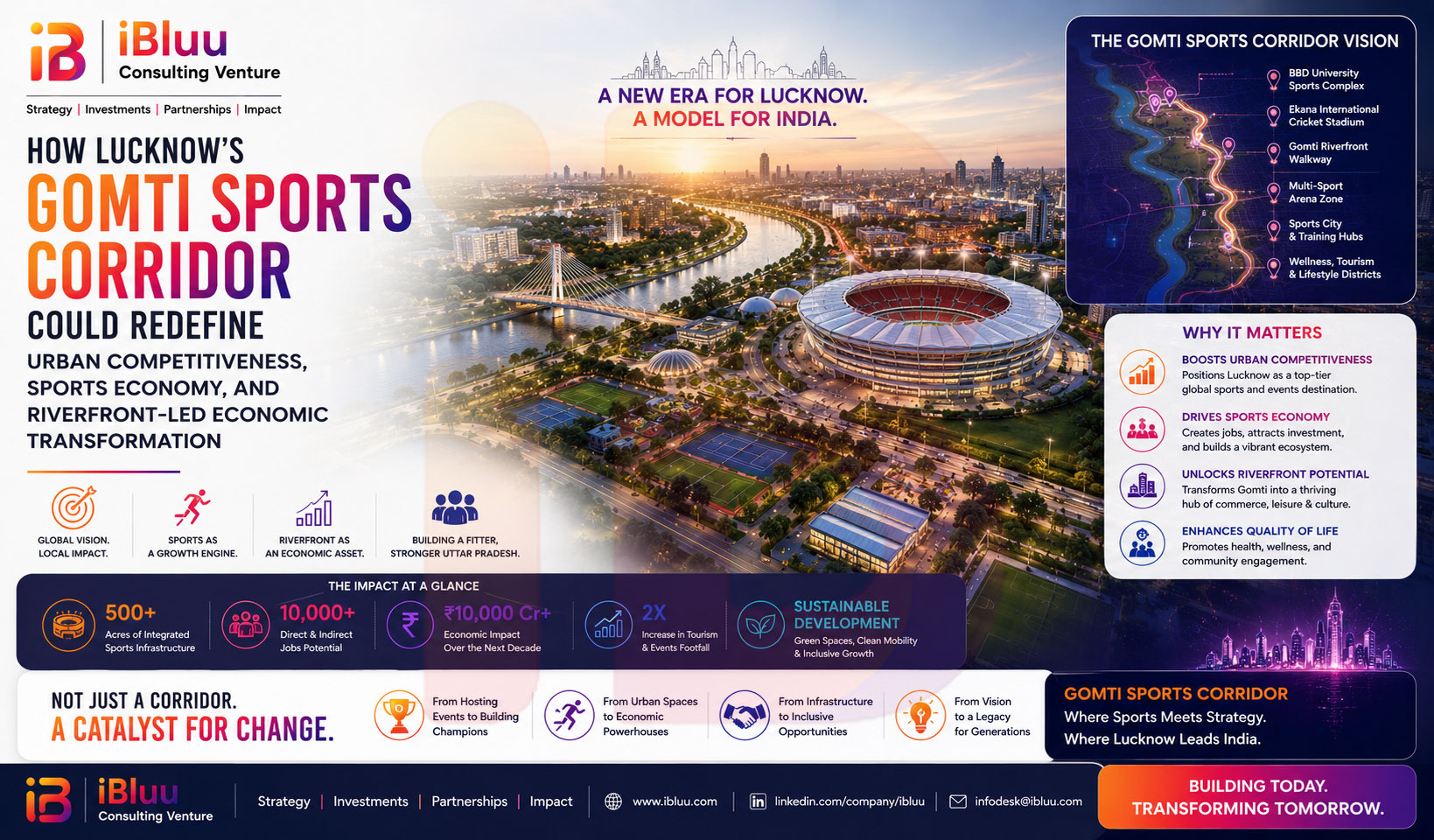
Lucknow’s Gomti Sports Corridor: Building a New Urban Growth Engine Through Sports, Tourism, Sustainability and Investment
Throughout history, the world’s most competitive cities have understood a simple but profound truth: great public infrastructure does far more than solve today’s problems—it creates tomorrow’s economy.
New York transformed neglected waterfronts into engines of commerce and tourism. Singapore converted limited land into globally admired public spaces. London leveraged sports infrastructure to catalyze regeneration beyond the Olympic Games. Melbourne and Brisbane continue to integrate sporting ecosystems into broader urban competitiveness strategies.
Increasingly, world-class cities are no longer competing solely through industrial parks, highways, airports, or commercial districts.
They compete through quality of life, public spaces, sports ecosystems, wellness infrastructure, environmental sustainability, tourism experiences, and liveability.
India has now entered that same strategic phase.
The proposed 7.5-kilometre Gomti Sports Corridor in Lucknow—planned along the Gomti River near Rashtra Prerna Sthal—should therefore not be viewed merely as another sports infrastructure project.
It represents something considerably larger.
It is an emerging urban-development platform capable of integrating sports, public health, riverfront regeneration, tourism, environmental sustainability, youth development, recreation, and private investment into a single long-term economic ecosystem.
If executed with global standards, institutional governance, and integrated planning, the initiative has the potential to become one of India’s most significant examples of sports-led urban transformation—positioning Lucknow among the country’s most progressive metropolitan centres.
The project aligns closely with broader national priorities, including urban modernization, sustainable infrastructure, tourism expansion, sports excellence, youth empowerment, and the creation of healthier, more resilient cities.
More importantly, it signals an important shift in urban philosophy.
Cities are no longer investing only in concrete.
They are investing in human capital.
The New Competition Between Cities
Twenty-first-century cities compete differently.
Talent chooses cities before companies do.
Investors increasingly evaluate quality-of-life indicators alongside infrastructure readiness.
Global businesses assess environmental performance, mobility, public amenities, recreational ecosystems, and sustainability before making long-term investment decisions.
Sports infrastructure has consequently evolved beyond athletics.
It has become an economic asset.
Well-designed sports districts create powerful multiplier effects across hospitality, retail, commercial real estate, tourism, healthcare, education, entertainment, and local entrepreneurship.
Around the world, governments increasingly recognise that investments in recreation and wellness generate returns extending far beyond medals or sporting events.
They improve productivity.
Reduce healthcare burdens.
Strengthen tourism.
Enhance city branding.
Increase land values.
Support inclusive development.
Build stronger communities.
In this context, Lucknow’s proposed Gomti Sports Corridor should be understood not simply as a recreational destination but as strategic urban infrastructure.
Lucknow’s Urban Evolution Enters a New Chapter
Over the past decade, Lucknow has undergone one of India’s most significant urban transformations.
Major expressways.
Metro connectivity.
Defence manufacturing investments.
Information technology expansion.
Medical infrastructure.
Educational institutions.
Convention facilities.
Township development.
Riverfront improvements.
Public parks.
Administrative modernization.
These initiatives collectively reflect a broader ambition—to position Uttar Pradesh’s capital as a globally competitive metropolitan economy.
The proposed Gomti Sports Corridor represents a logical continuation of this transformation.
Rather than expanding only through conventional infrastructure, the city is now exploring investments that enhance public experience, environmental resilience, tourism potential, and long-term liveability.
This evolution mirrors strategies increasingly adopted by leading global cities.
Project Overview
According to publicly reported information, the proposed corridor extends approximately 7.5 kilometres along the Gomti River near Rashtra Prerna Sthal, with the objective of creating an integrated sports, recreation, tourism, and public wellness destination.
Proposed Features
| Component | Strategic Purpose |
|---|---|
| Indoor sports arenas | Professional training, competitions, community participation |
| Outdoor sports facilities | Grassroots sports development and public engagement |
| Community sports clubs | Youth participation and neighbourhood recreation |
| Water sports facilities | Tourism diversification and sports economy expansion |
| Boating infrastructure | Leisure economy and waterfront activation |
| Cycling tracks | Sustainable urban mobility and healthy lifestyles |
| Walking promenades | Public wellness and riverfront accessibility |
| Wellness parks | Preventive healthcare and community interaction |
| Open-air theatre | Cultural programming and tourism activation |
| Entertainment zones | Visitor economy and commercial vibrancy |
| Enhanced riverfront connectivity | Integrated urban regeneration |
Collectively, these components indicate an ambition extending well beyond the creation of isolated sports venues.
Instead, the proposal seeks to establish an integrated public destination where sports, culture, ecology, tourism, and community life reinforce one another.
Why This Project Matters More Than It Appears
Viewed narrowly, the Gomti Sports Corridor is a riverfront enhancement initiative.
Viewed strategically, it becomes part of a much larger economic narrative.
Every kilometre of quality public space influences multiple sectors simultaneously.
Sports participation.
Tourism spending.
Retail demand.
Hospitality growth.
Commercial activity.
Residential desirability.
Environmental quality.
Public health outcomes.
Urban branding.
Institutional investment.
This interconnected value creation is precisely why global consulting firms increasingly evaluate public infrastructure through economic multipliers rather than construction costs alone.
The true value of sports infrastructure is rarely measured by the buildings themselves.
It is measured by the ecosystem those buildings enable.
The Rise of the Sports Economy
Globally, sport has evolved into a multi-trillion-dollar economic ecosystem encompassing infrastructure, media, tourism, technology, healthcare, fitness, education, apparel, events, sponsorship, hospitality, and real estate.
Cities that strategically invest in sports districts increasingly benefit from diversified economic activity extending well beyond tournaments.
Professional leagues stimulate hospitality demand.
Community facilities improve public health.
Training centres create employment.
Events generate tourism.
Recreation supports retail.
Waterfront activation attracts private capital.
The cumulative effect strengthens urban competitiveness.
India’s own sports economy remains in a high-growth phase, supported by rising incomes, expanding youth participation, growing fitness awareness, international sporting ambitions, and increasing public investment.
Within this context, Lucknow possesses an opportunity to emerge as one of North India’s most integrated sports and wellness destinations.
Riverfront Regeneration: From Natural Asset to Economic Asset
Historically, rivers shaped civilizations.
Modern cities are rediscovering them.
Across the world, neglected riverbanks are being transformed into vibrant economic corridors through carefully integrated investments in recreation, culture, ecology, tourism, and public spaces.
The Gomti River represents one of Lucknow’s defining geographical assets.
Its strategic redevelopment therefore has significance extending far beyond beautification.
Integrated riverfront planning can strengthen environmental resilience while simultaneously creating economic value.
Improved public accessibility encourages greater civic engagement.
Enhanced landscapes improve surrounding property markets.
Recreational infrastructure increases visitor activity.
Mixed-use development stimulates commercial investment.
Environmental restoration improves long-term sustainability.
The proposed Sports Corridor therefore represents not merely a physical intervention but an opportunity to reposition the Gomti River as a central contributor to Lucknow’s future urban identity.
Strategic Significance for Uttar Pradesh
The Government of Uttar Pradesh has articulated an ambitious vision of positioning the state as a leading economic engine within India.
Infrastructure development has emerged as one of its principal strategic pillars.
Expressways.
Airports.
Industrial corridors.
Defence manufacturing.
Urban modernization.
Logistics.
Digital infrastructure.
Tourism.
Sports.
The Gomti Sports Corridor fits naturally within this broader transformation agenda.
It demonstrates how public infrastructure can simultaneously support economic development, environmental sustainability, tourism competitiveness, youth engagement, and social inclusion.
Increasingly, the strongest infrastructure projects are those capable of generating multiple forms of capital:
Economic capital.
Social capital.
Environmental capital.
Human capital.
Institutional capital.
Projects capable of achieving all five simultaneously often become defining investments for future generations.
Economic Multipliers, Investment Outlook, Global Benchmarking and Strategic Value Creation
From Public Infrastructure to Economic Infrastructure
Infrastructure is often evaluated through its construction cost.
World-class cities evaluate it through its economic multiplier.
The distinction is significant.
A conventional infrastructure project creates temporary economic activity during construction.
A transformational urban project continues generating economic value for decades through tourism, commercial activity, sports events, entrepreneurship, real estate appreciation, employment, improved productivity, public health, and institutional investment.
The proposed Gomti Sports Corridor possesses the characteristics of the latter.
Its long-term success should therefore not be measured merely by kilometres developed or facilities constructed, but by the ecosystem of economic opportunities it enables over the next twenty to thirty years.
This represents a fundamental shift in infrastructure thinking—from asset creation to value creation.
The Economic Multiplier Effect: Why One Project Can Transform Multiple Industries
Unlike single-purpose infrastructure, integrated sports and riverfront districts generate interconnected economic activity across diverse sectors.
Below is an illustrative view of the potential multiplier effects.
| Primary Investment | Secondary Impact | Long-Term Economic Outcome |
|---|---|---|
| Sports Infrastructure | Sporting events and competitions | Sports tourism and recurring visitor economy |
| Walking & Cycling Networks | Public wellness | Reduced healthcare burden and healthier workforce |
| Water Sports Facilities | Adventure tourism | Hospitality, recreation and service-sector growth |
| Riverfront Regeneration | Public realm enhancement | Increased commercial and residential attractiveness |
| Community Sports Clubs | Grassroots participation | Youth development and talent pipeline |
| Entertainment Zones | Visitor engagement | Retail, food, culture and leisure economy |
| Wellness Parks | Preventive healthcare | Improved quality of life and city branding |
| Public Accessibility | Increased footfall | Higher local business activity |
The economic value therefore extends well beyond the original public investment.
Each component reinforces another.
Together, they create a self-sustaining urban ecosystem.
Reimagining the Sports Economy
The global sports economy has evolved into one of the world’s most dynamic economic sectors.
It now extends far beyond stadiums and professional athletes.
Modern sports ecosystems encompass:
- Sports infrastructure
- Sports technology
- Performance analytics
- Sports medicine
- Fitness and wellness
- Community recreation
- Youth academies
- Sports education
- Sporting goods manufacturing
- Sports tourism
- Hospitality
- Broadcasting
- Event management
- Digital fan engagement
Collectively, these sectors contribute hundreds of billions of dollars annually to the global economy.
India’s sports ecosystem remains significantly underpenetrated relative to its population, creating substantial long-term growth potential.
Projects such as the Gomti Sports Corridor can help bridge this gap by providing integrated infrastructure that supports participation, talent development, tourism, entrepreneurship, and private investment.
Rather than viewing sports solely as competition, policymakers increasingly recognize it as a productive economic sector capable of generating employment, innovation, and inclusive growth.
Tourism: The Silent Economic Multiplier
Tourism is one of the largest beneficiaries of high-quality public infrastructure.
Today’s travelers increasingly seek experiences rather than destinations.
Riverfronts, cycling networks, cultural districts, wellness parks, outdoor recreation, and sports facilities collectively enhance a city’s attractiveness.
For Lucknow, already recognized for its rich heritage, architecture, cuisine, and cultural legacy, the proposed corridor introduces an additional tourism dimension:
Active Tourism.
Visitors may no longer come only to experience history.
They may also visit to participate.
Morning cycling.
Kayaking.
Rowing.
Community sporting events.
Wellness festivals.
Open-air performances.
Fitness events.
Waterfront recreation.
This diversification can increase visitor duration, repeat visitation, and local spending—important drivers for hospitality, restaurants, transport providers, retailers, and cultural businesses.
Real Estate: Infrastructure Creates Value Beyond Buildings
History consistently demonstrates a strong relationship between quality public infrastructure and surrounding property markets.
Parks improve neighbourhood desirability.
Transit increases accessibility.
Waterfronts create premium locations.
Sports districts encourage mixed-use development.
The Gomti Sports Corridor has the potential to strengthen this pattern.
Potential long-term impacts include:
- Increased attractiveness of nearby residential neighbourhoods.
- Enhanced demand for mixed-use developments.
- Greater interest from hospitality operators.
- Premium commercial opportunities.
- Improved institutional investment confidence.
- Expansion of recreational retail formats.
- Stronger office ecosystem supported by improved urban amenities.
Importantly, value creation should be managed through balanced planning that protects affordability, public access, and environmental integrity while encouraging responsible private investment.
Public Health as Economic Infrastructure
One of the most underestimated returns from sports infrastructure lies in public health.
Healthier populations contribute to stronger economies.
Regular physical activity is associated with improved productivity, lower healthcare costs, reduced chronic disease burden, and enhanced quality of life.
Infrastructure that encourages walking, cycling, outdoor recreation, and community sports creates long-term social dividends that are difficult to quantify but highly valuable.
In this respect, the proposed corridor is not simply an investment in recreation.
It is also an investment in preventive healthcare.
Blue-Green Infrastructure: Building Climate-Resilient Cities
Urban competitiveness increasingly depends on environmental resilience.
Cities worldwide are integrating ecological restoration with economic development through “blue-green infrastructure”—projects that combine waterways, green spaces, biodiversity, flood resilience, and public amenities.
The Gomti River provides Lucknow with an opportunity to strengthen this approach.
If implemented with ecological sensitivity, the corridor could contribute to:
- Enhanced riverfront accessibility.
- Improved urban biodiversity.
- Expanded green public spaces.
- Better environmental awareness.
- Sustainable mobility through cycling and walking.
- Climate adaptation strategies.
- Improved urban microclimate.
Environmental sustainability should therefore be viewed as an economic enabler rather than a regulatory obligation.
Investment Opportunities Across the Value Chain
While the public sector may anchor the development, long-term ecosystem success will likely depend on private participation across multiple sectors.
Potential opportunities include:
| Sector | Opportunity |
|---|---|
| Hospitality | Hotels, serviced apartments, wellness resorts |
| Retail | Sports retail, cafés, lifestyle brands |
| Healthcare | Sports medicine, rehabilitation, wellness centres |
| Education | Sports academies, coaching institutions |
| Entertainment | Cultural venues, event programming |
| Technology | Smart city systems, sports analytics, IoT infrastructure |
| Renewable Energy | Energy-efficient lighting, solar integration, smart utilities |
| Mobility | Bicycle sharing, electric mobility solutions |
| Food & Beverage | Waterfront dining and experiential retail |
| Events | National and international sporting festivals |
Such ecosystem development can significantly increase the corridor’s long-term economic sustainability.
Public–Private Partnerships: Unlocking Institutional Capital
Globally, successful urban regeneration increasingly relies on Public–Private Partnership (PPP) frameworks.
PPP models enable governments to leverage private expertise, innovation, financing, and operational efficiency while maintaining public objectives.
Potential partnership areas include:
- Sports facility operations.
- Waterfront management.
- Event hosting.
- Commercial activation.
- Smart infrastructure.
- Maintenance services.
- Renewable energy integration.
- Digital visitor platforms.
Carefully structured PPP frameworks can improve lifecycle performance while reducing fiscal pressure on public resources.
Global Benchmarking: Lessons from Leading Waterfront Cities
Although every city possesses unique characteristics, international experience offers valuable strategic lessons.
| Global City | Strategic Lesson |
|---|---|
| Singapore | Integrate recreation, ecology, and premium public space into one urban system. |
| London | Use sports-led regeneration to catalyze broader urban transformation. |
| Melbourne | Position community sports as a driver of city identity and liveability. |
| Brisbane | Connect riverfronts with recreation, tourism, and public mobility. |
| Seoul | Restore waterways to improve environmental resilience and public engagement. |
| Copenhagen | Prioritize cycling and wellness as core components of urban competitiveness. |
The objective is not replication.
It is adaptation.
Lucknow possesses its own cultural identity, demographic strengths, and urban context.
The opportunity lies in developing an indigenous model informed by global best practices.
Strategic SWOT Assessment
| Strengths | Weaknesses |
|---|---|
| Strong government vision | Large-scale execution complexity |
| Expanding urban infrastructure | Long gestation period for full ecosystem development |
| Prime riverfront location | Multi-agency coordination requirements |
| Growing tourism appeal | Long-term maintenance commitments |
| Opportunities | Threats |
|---|---|
| Sports tourism | Environmental degradation if sustainability is overlooked |
| Riverfront-led urban regeneration | Cost escalation |
| Increased private investment | Delays in implementation |
| Youth engagement | Operational inefficiencies |
| Hospitality and retail expansion | Climate-related risks |
The strengths and opportunities substantially outweigh the challenges, provided governance, execution, environmental safeguards, and long-term asset management remain central priorities.
Beyond Construction: Building an Urban Legacy
Every generation inherits opportunities to redefine its cities.
Some build roads.
Some build airports.
Some build industries.
The most visionary build ecosystems.
The Gomti Sports Corridor represents an opportunity to create an urban legacy extending beyond physical infrastructure.
Its true success will not be measured solely by architectural design or engineering execution.
It will be measured by healthier citizens.
More active communities.
Thriving local businesses.
Greater tourism.
Higher institutional confidence.
Enhanced environmental resilience.
And a city whose identity becomes synonymous not only with heritage—but also with innovation, wellness, sustainability, and future-ready urban development.
Scenario Outlook, Strategic Priorities, Institutional Recommendations and the Road to 2030
Scenario Outlook: Three Possible Futures Through 2030
The future trajectory of the Gomti Sports Corridor will ultimately depend not only on infrastructure delivery but also on governance quality, ecosystem participation, long-term asset management, and sustained public engagement.
Rather than viewing the project through a binary lens of success or failure, a scenario-based framework provides a more practical way to assess its long-term potential.
Scenario 1: Transformational Success (High Impact)
In the most optimistic scenario, the project is executed with world-class planning, integrated urban design, strong environmental stewardship, and sustained collaboration between government, private investors, sports institutions, tourism stakeholders, and local communities.
The corridor evolves into one of India’s flagship urban public spaces.
Lucknow attracts regional and national sporting events, outdoor festivals, wellness conventions, recreational tourism, and private investment across hospitality, retail, sports technology, and mixed-use development.
The project becomes a benchmark for sports-led urban regeneration and reinforces Uttar Pradesh’s broader economic transformation agenda.
Potential Outcomes
- Significant increase in domestic tourism.
- Strong private-sector participation through PPP models.
- Higher commercial and residential investment confidence.
- Expanded employment across sports, hospitality, retail, healthcare, and services.
- Improved urban liveability and public health outcomes.
- Recognition as a national model for integrated riverfront development.
Scenario 2: Balanced Growth (Base Case)
The corridor is delivered substantially as planned and becomes a well-utilized public asset.
Sports facilities attract regular community participation while tourism and commercial activity grow steadily.
Economic benefits materialize progressively rather than immediately, supported by continued policy attention and incremental private investment.
Although international positioning may take longer to develop, the project successfully enhances Lucknow’s quality of life and urban competitiveness.
This represents the most realistic and achievable pathway if execution remains disciplined.
Scenario 3: Underutilized Infrastructure (Execution Risk)
In the downside scenario, physical infrastructure is completed but long-term governance, programming, maintenance, and ecosystem development receive insufficient attention.
Facilities become fragmented rather than integrated.
Visitor engagement plateaus.
Private investment remains limited.
Maintenance costs increase while utilization rates remain below potential.
The lesson from numerous international case studies is clear:
Infrastructure alone does not create economic transformation.
Well-managed ecosystems do.
Risk Assessment: Beyond Construction Risk
Large-scale urban projects inevitably encounter uncertainty.
The objective is therefore not to eliminate risk but to identify, prioritize, and manage it proactively.
| Risk Category | Relative Significance | Strategic Mitigation |
|---|---|---|
| Multi-agency coordination | High | Unified project governance and clear institutional accountability |
| Long-term maintenance | High | Dedicated lifecycle funding and professional asset management |
| Environmental sustainability | High | Ecological restoration, water-quality monitoring, and climate-resilient design |
| Private investment mobilization | Medium | Transparent PPP frameworks and predictable policy support |
| Community adoption | Medium | Inclusive programming, affordable public access, and year-round activities |
| Commercial activation | Medium | Phased development anchored by mixed-use and tourism assets |
| Technology integration | Medium | Smart infrastructure, digital visitor platforms, and data-driven operations |
| Financial sustainability | Medium | Diversified revenue streams beyond public funding |
The most resilient infrastructure projects are those that embed risk management into project design rather than treating it as a post-construction exercise.
The Implementation Imperative
The difference between a successful public project and a globally admired urban destination rarely lies in engineering capability alone.
It lies in institutional execution.
Five strategic priorities should define implementation:
1. Plan the Ecosystem, Not Just the Corridor
Physical infrastructure should be integrated with tourism, sports programming, entrepreneurship, hospitality, education, public transport, digital infrastructure, and environmental management.
A corridor without an ecosystem remains a corridor.
A corridor supported by an ecosystem becomes an economic engine.
2. Build for the Next 30 Years
Infrastructure decisions made today should anticipate future demographic growth, climate resilience, evolving mobility patterns, smart-city technologies, and changing recreational preferences.
Future-ready infrastructure consistently outperforms infrastructure designed only for present needs.
3. Place Sustainability at the Core
Global investors increasingly evaluate projects through Environmental, Social, and Governance (ESG) considerations.
Renewable energy integration, efficient water management, biodiversity enhancement, sustainable construction materials, waste management, and climate-resilient design should become defining characteristics of the corridor rather than supplementary features.
4. Activate the Corridor Throughout the Year
Successful public spaces remain active beyond weekends and major events.
A year-round programming strategy—including sports leagues, marathons, wellness festivals, cultural performances, educational activities, community competitions, cycling events, rowing championships, youth camps, and public exhibitions—can sustain visitor engagement while supporting local businesses.
5. Measure Success Beyond Construction
The true performance indicators should extend beyond physical completion.
Recommended long-term KPIs include:
- Annual visitor footfall.
- Sports participation rates.
- Tourism spending.
- Private capital mobilized.
- Jobs created.
- Public health indicators.
- Green-space utilization.
- Commercial occupancy.
- Community satisfaction.
- Environmental quality metrics.
Cities improve what they consistently measure.
Strategic Recommendations for Key Stakeholders
For Policymakers
- Position the corridor within Lucknow’s broader urban development strategy rather than as an isolated project.
- Establish a dedicated governance framework responsible for long-term management and performance monitoring.
- Encourage institutional partnerships with universities, sports federations, cultural organizations, and private operators.
- Develop a structured investment promotion roadmap to attract domestic and international participation.
For Institutional Investors and Developers
The project presents opportunities extending well beyond construction.
Potential areas include:
- Hospitality and experiential tourism.
- Mixed-use commercial development.
- Sports academies and training centres.
- Healthcare and sports medicine.
- Wellness infrastructure.
- Retail and food destinations.
- Smart mobility services.
- Digital infrastructure.
- Green energy integration.
- Event management platforms.
Investors increasingly favour ecosystems where public investment reduces long-term development risk.
For Sports Institutions
The corridor provides an opportunity to strengthen grassroots participation while creating pathways for professional athlete development.
Integrated training, coaching, sports science, and community engagement can transform the corridor into a long-term talent-development ecosystem.
For Local Businesses and Entrepreneurs
Economic value creation extends beyond large corporations.
MSMEs, startups, restaurants, cafés, fitness providers, equipment suppliers, event organizers, technology companies, and tourism operators all stand to benefit from increased visitor activity and an expanding recreation economy.
Inclusive growth should remain a defining characteristic of the project.
A Broader Reflection: Cities That Invest in People Create Stronger Economies
Infrastructure has always shaped civilizations.
However, the most enduring infrastructure investments are those that improve everyday life.
Parks encourage healthier communities.
Public spaces strengthen social cohesion.
Sports build confidence, discipline, and aspiration.
Riverfronts reconnect citizens with nature.
Well-planned urban environments attract talent, investment, innovation, and enterprise.
The Gomti Sports Corridor represents an opportunity to combine these dimensions into a single strategic initiative.
Its significance therefore extends well beyond Lucknow.
It reflects a broader evolution in India’s urban development philosophy—from expanding cities to enhancing cities; from building infrastructure to cultivating human capital; and from measuring success through physical assets to measuring it through long-term societal value.
If implemented with consistency, institutional discipline, and a long-term vision, this initiative could emerge as one of the defining examples of sports-led urban regeneration in contemporary India.
Strategic Perspective
The analytical depth of this perspective has been shaped by the strategic lens of J Parasher, Founder and Managing Director of iBluu Consulting Venture (iBCV), a venture of iBluu Corporations, whose work focuses on national capability building, infrastructure-led economic transformation, strategic investment ecosystems, and global industrial benchmarking.
His perspective argues that infrastructure should no longer be evaluated solely by engineering excellence or construction value.
Instead, it should be assessed through its capacity to generate enduring economic competitiveness, strengthen institutional capability, attract long-term capital, improve public well-being, and elevate a nation’s strategic position within the global economy.
Within this framework, projects such as the Gomti Sports Corridor represent more than urban development initiatives—they are investments in the future productivity, resilience, and international competitiveness of India’s cities.
Final Thoughts
History rarely remembers infrastructure because it was expensive.
History remembers infrastructure because it changed the trajectory of a city.
The most successful public investments are those that continue creating value long after construction crews have departed.
The proposed Gomti Sports Corridor has the potential to become one of those investments.
Its legacy will not ultimately be defined by kilometres of pathways, sports arenas, or landscaped riverbanks.
Its legacy will be defined by healthier citizens, stronger communities, more resilient ecosystems, increased tourism, sustained private investment, expanded opportunities for young athletes, and a city whose economic ambition is matched by its quality of life.
If realized with strategic foresight and execution excellence, Lucknow will not simply build another corridor.
It will demonstrate how visionary urban infrastructure can become a catalyst for inclusive growth, sustainable development, and long-term economic transformation.
Disclaimer: This article is intended solely for informational, educational, and thought-leadership purposes. It synthesizes publicly available information, government announcements, and strategic analysis available at the time of writing. Certain forward-looking observations, scenario analyses, and economic implications represent analytical perspectives rather than forecasts and remain subject to policy decisions, project implementation, regulatory developments, market conditions, financing, and official updates. Nothing contained herein should be construed as investment, financial, legal, engineering, or professional advice. Readers are encouraged to consult official government notifications and qualified professional advisers before making investment or business decisions based on the topics discussed.