+91 945 889 6091
  infodesk@ibluu.com
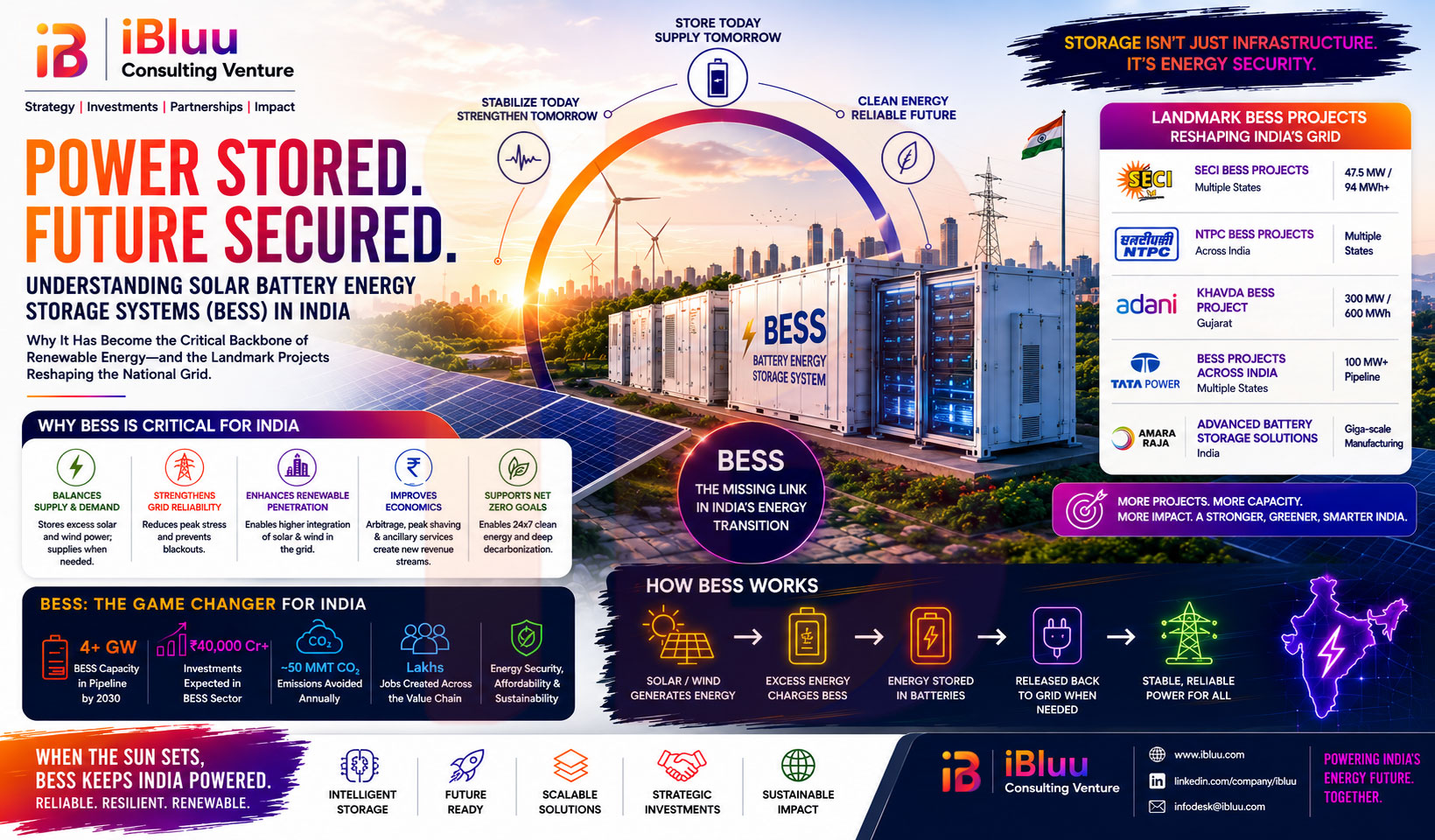
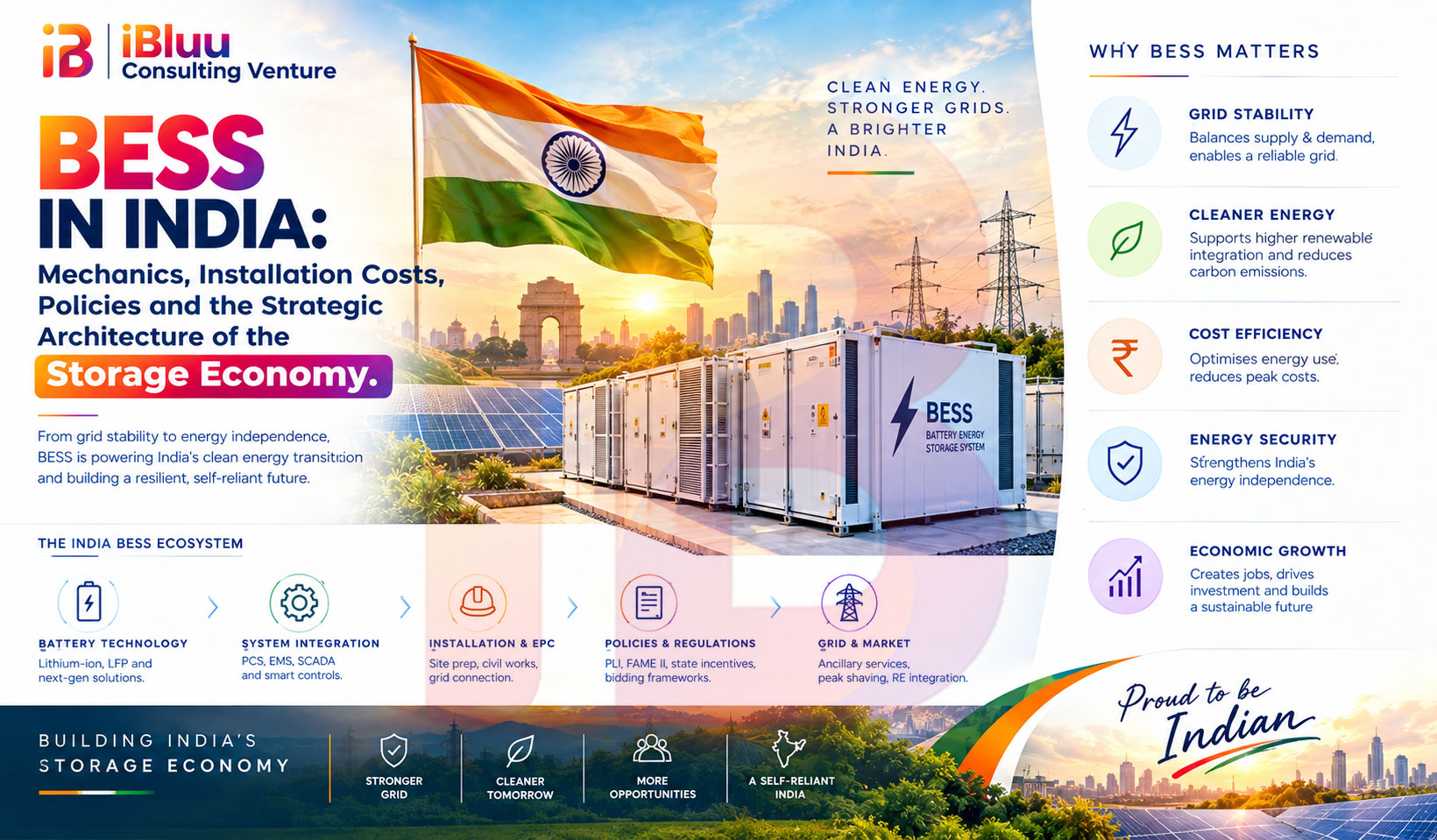
Understanding Solar Battery Energy Storage Systems (BESS) in India: Why It Has Become the Critical Backbone of Renewable Energy—and the Landmark Projects Reshaping the National Grid
India’s energy transition is entering a decisive new phase.
For over a decade, the national conversation centered on expanding renewable generation capacity—building larger solar parks, deploying more wind farms, and accelerating clean energy adoption. That strategy successfully transformed India into one of the world’s fastest-growing renewable energy markets.
Yet a fundamental challenge remains.
Solar energy is abundant precisely when electricity demand is comparatively lower, while India’s peak electricity consumption occurs after sunset. Without the ability to store and dispatch renewable electricity on demand, every additional gigawatt of solar capacity delivers diminishing system value.
This is where Battery Energy Storage Systems (BESS) become transformational.
BESS is no longer an auxiliary technology or a “nice-to-have” enhancement. It is rapidly becoming the enabling infrastructure that determines whether India can successfully integrate large-scale renewable energy while maintaining grid reliability, affordability, and energy security.
As India advances toward its ambition of 500 GW of non-fossil-fuel electricity capacity by 2030, battery storage is evolving into one of the country’s most strategically important infrastructure sectors. It underpins Firm and Dispatchable Renewable Energy (FDRE), reduces renewable curtailment, improves grid resilience, supports industrial decarbonization, and strengthens national energy independence.
The strategic question has therefore shifted.
It is no longer whether India needs more renewable energy.
The question is whether India can fully utilize renewable energy without large-scale energy storage.
Increasingly, the answer is no.
India’s Renewable Energy Revolution Is Entering Its Second Chapter
India has already established itself among the world’s renewable energy leaders.
Installed renewable capacity has expanded rapidly over the past decade, supported by declining solar costs, competitive auctions, policy reforms, transmission investments, and strong private-sector participation.
However, renewable generation alone does not guarantee reliable electricity.
Electricity systems must maintain a precise balance between supply and demand every second of every day.
Unlike conventional coal or gas plants, solar photovoltaic generation depends entirely on sunlight.
Its production profile does not naturally align with India’s consumption profile.
This mismatch has become one of the defining engineering and economic challenges of India’s energy transition.
During midday, solar generation often exceeds local demand.
By evening—typically between 6:00 PM and 10:00 PM—electricity demand reaches its highest levels just as solar production falls to zero.
Without storage, this creates three structural challenges:
- renewable energy curtailment,
- increased dependence on conventional generation during evening peaks,
- and underutilization of clean energy investments.
Battery storage directly addresses this imbalance by shifting surplus daytime renewable electricity into periods of highest demand.
Rather than allowing clean energy to be wasted, BESS transforms intermittent generation into dispatchable electricity.
This fundamentally changes the economics of renewable energy.
What Is a Battery Energy Storage System (BESS)?
A Battery Energy Storage System is an integrated energy infrastructure asset designed to store electricity when supply exceeds demand and release it when electricity is most valuable.
Unlike conventional batteries designed for portable devices, utility-scale BESS facilities are highly sophisticated grid assets incorporating:
- Battery modules
- Battery Management Systems (BMS)
- Power Conversion Systems (PCS)
- Inverters
- Energy Management Software
- Fire protection systems
- Thermal management
- Grid communication and control infrastructure
Together, these components enable rapid charging, controlled discharge, frequency regulation, voltage support, reserve capacity, black-start capability, and real-time grid balancing.
From an infrastructure perspective, BESS functions less like a battery and more like a flexible digital power plant.
Its value extends well beyond energy storage.
It enhances the intelligence, resilience, and responsiveness of the electricity network itself.
Why Solar Alone Is No Longer Enough
India’s first renewable revolution focused on producing more clean electricity.
The next revolution focuses on delivering clean electricity precisely when consumers need it.
This distinction is critical.
A megawatt generated at noon is not economically equivalent to a megawatt delivered during the evening peak.
Electricity derives value from timing as much as volume.
Without storage:
- Excess renewable generation may be curtailed.
- Grid operators must rely on thermal plants for evening demand.
- Renewable utilization declines.
- Transmission assets operate less efficiently.
- Power quality becomes more difficult to maintain.
Battery storage fundamentally changes this equation.
By storing surplus renewable electricity and dispatching it during high-demand periods, BESS increases the utilization, reliability, and commercial value of renewable assets.
In effect, it transforms renewable generation from a weather-dependent resource into a dependable system resource.
Why BESS Has Become Essential in India
The strategic importance of battery storage is no longer theoretical.
It is increasingly reflected in government policy, market design, and investment decisions.
1. Peak Demand Shifting
India’s demand profile peaks during evening hours when solar generation has already declined.
Battery storage enables surplus daytime solar electricity to be supplied after sunset, reducing dependence on conventional generation and improving overall system efficiency.
2. Preventing Renewable Curtailment
As renewable penetration increases, certain regions periodically generate more electricity than transmission infrastructure can immediately absorb.
Rather than shutting down renewable plants, BESS captures surplus electricity and delivers it when demand increases.
This improves renewable utilization while protecting developer revenues.
3. Enabling Firm and Dispatchable Renewable Energy (FDRE)
Large commercial consumers, manufacturing industries, data centers, and DISCOMs increasingly require predictable, reliable electricity.
Battery storage allows renewable energy to be dispatched according to contractual requirements rather than weather conditions.
This transition from variable renewable generation to Firm and Dispatchable Renewable Energy represents one of the most important structural changes in India’s electricity market.
4. Improving Grid Stability
Modern electricity systems require continuous frequency regulation, voltage support, reserve capacity, and rapid response capabilities.
Unlike conventional thermal generators, battery storage can respond within milliseconds to fluctuations across the grid.
This significantly improves operational stability while reducing balancing costs.
5. Supporting National Energy Security
Every unit of renewable electricity stored and later dispatched reduces dependence on imported fossil fuels.
Over time, widespread deployment of storage enhances energy independence, reduces fuel-price volatility, and strengthens India’s long-term energy resilience.
6. Accelerating Decarbonization
Battery storage enables higher renewable penetration without compromising grid reliability.
As renewable capacity expands toward national targets, storage becomes essential for achieving deep decarbonization while maintaining economic competitiveness.
Policy Momentum Is Reshaping the Storage Market
India’s policy framework increasingly recognizes storage as critical national infrastructure rather than optional project equipment.
The Ministry of Power has introduced policy measures encouraging storage integration across new renewable procurements.
Recent directions require many future utility-scale renewable tenders to include dedicated energy storage capacity, often structured around minimum storage durations designed to improve evening power availability.
This represents a significant policy shift.
Rather than treating storage as an afterthought, regulators are integrating it directly into renewable procurement frameworks.
Combined with competitive bidding by agencies such as SECI and state utilities, these policies are rapidly accelerating investment across the battery storage ecosystem.
The result is a market transitioning from isolated pilot projects toward utility-scale deployment across multiple states.
Summarization
India’s renewable energy transition is no longer defined solely by how much clean electricity it can generate.
Its future competitiveness will increasingly depend on how intelligently that electricity is stored, managed, and delivered.
Battery Energy Storage Systems therefore represent far more than a technological innovation.
They are becoming strategic infrastructure—linking renewable generation with reliable power supply, strengthening grid resilience, enabling industrial growth, and supporting India’s ambition to become one of the world’s leading clean-energy economies.
The next phase of this transformation will be defined not only by policy but also by execution: large-scale projects, technology choices, investment flows, manufacturing capability, and ecosystem development.
India’s Solar + BESS Revolution: Projects, Investments, Economics and the Road to 2030
India’s Solar + BESS Ecosystem Is Entering Hyper-Growth
The Indian battery storage market is no longer defined by pilot projects. It has entered the commercialization phase.
Within just a few years, India has moved from announcing storage ambitions to issuing multi-gigawatt tenders, introducing storage mandates, and attracting billions of dollars in private investment.
The market is being driven simultaneously by:
- Government policy
- SECI auctions
- State DISCOM procurement
- AI-driven electricity demand
- Data center expansion
- Industrial decarbonization
- Corporate renewable PPAs
- International climate finance
This convergence makes BESS one of the fastest-growing infrastructure opportunities in India’s energy transition.
India’s Solar + BESS Project Landscape
India’s pipeline now spans operational projects, large-scale hybrid parks, state procurement programs, and future mega-integrated renewable zones.
Operational Milestone Projects
Rajnandgaon Solar + BESS (Chhattisgarh)
Among India’s earliest utility-scale Solar+BESS deployments.
Key Highlights:
- 100 MW Solar PV
- 40 MW Battery Storage
- 120 MWh Storage Capacity
- Developed under SECI framework
Strategic Importance:
Instead of wasting afternoon solar generation, excess electricity is stored and dispatched during evening demand peaks.
The project effectively demonstrates how batteries convert solar energy into firm evening power while reducing dependence on fossil-fuel peaking stations.
Phyang Solar + BESS (Ladakh)
Located in one of India’s most geographically challenging regions.
Configuration:
- 20 MW Solar Plant
- 50 MWh Battery Storage
Importance:
Unlike mainland grids, Ladakh faces unique transmission constraints.
BESS enables:
- Frequency regulation
- Voltage stabilization
- Night-time electricity supply
- Reduced diesel dependence
- Greater renewable penetration
The project serves as a blueprint for renewable-powered remote communities.
Port Blair Solar + Storage Project
Location:
Andaman & Nicobar Islands
Key Features:
- 20 MW Solar
- 16 MWh BESS
Strategic Impact:
Island grids traditionally rely on imported diesel.
Solar+BESS dramatically lowers:
- Fuel imports
- Operating costs
- Carbon emissions
- Supply disruptions
This project illustrates how battery storage improves both energy security and economic efficiency.
Mega Projects Under Construction
India’s next-generation projects are significantly larger than first-generation deployments.
Khavda Renewable Energy Park (Gujarat)
Khavda represents one of the largest renewable energy developments ever attempted globally.
Planned renewable capacity exceeds 30 GW across solar and wind over time.
Storage is becoming a defining component.
Among ongoing developments:
- Large-scale Battery Energy Storage
- Vanadium Redox Flow Battery deployment
- Utility-scale lithium storage
- AI-based energy management
These systems will support:
- Renewable balancing
- Grid reliability
- Peak dispatch
- Ancillary services
Khavda is evolving into one of the world’s largest integrated renewable energy ecosystems.
ACME Solar Storage Expansion
ACME Solar is actively deploying approximately 3.1 GWh of battery storage across multiple renewable projects.
Strategic Objectives include:
- Firm Dispatchable Renewable Energy (FDRE)
- Round-the-clock renewable supply
- Industrial power contracts
- Long-term corporate PPAs
This reflects a broader shift where developers increasingly compete not merely on the cost of generating electricity but on the ability to guarantee reliable power delivery.
Upcoming Landmark Projects
Pugal Solar Park (Rajasthan)
Among India’s largest integrated Solar+BESS opportunities.
Planned Configuration:
- 2,450 MW Solar
- 1,600 MW BESS
- Approximately 6,400 MWh Storage
Potential Significance:
Projects of this scale begin to rival conventional thermal generation in dispatch capability while maintaining zero fuel costs.
Morena Solar + BESS (Madhya Pradesh)
Planned Capacity:
220 MW Solar
Integrated Battery Storage
Strategic Benefits:
- Enhanced grid flexibility
- Better utilization of solar generation
- Improved state renewable reliability
Ramagiri Hybrid Project (Andhra Pradesh)
Proposed Configuration:
- 70 MW Solar
- 25 MW Battery
- 50 MWh Storage
Though modest compared to Khavda or Pugal, projects like Ramagiri demonstrate how storage is becoming standard infrastructure rather than an experimental addition.
Why Global Investors Are Entering India’s Battery Storage Market
Several macroeconomic drivers explain the unprecedented investor interest.
1. Massive Renewable Expansion
India aims for:
- 500 GW non-fossil capacity by 2030
- Approximately 50% installed electricity capacity from non-fossil sources
- Net-zero emissions by 2070
None of these objectives are achievable without significant storage capacity.
2. Explosive AI and Data Center Demand
AI fundamentally changes electricity demand.
Unlike traditional cloud computing:
AI clusters operate:
- 24×7
- High power density
- Constant workloads
- Near-zero downtime
This creates demand for renewable electricity that is both clean and continuously available.
Solar+BESS is increasingly becoming the preferred solution for hyperscale data centers seeking to meet sustainability commitments while ensuring operational resilience.
3. Manufacturing Growth
Semiconductors
Electronics
Green hydrogen
Electric vehicles
Steel
Advanced chemicals
All require uninterrupted power.
BESS minimizes voltage fluctuations and enhances grid reliability—critical factors for high-value manufacturing.
4. Corporate Sustainability
Large corporations increasingly target:
- RE100 commitments
- Net-zero operations
- ESG compliance
- Carbon-neutral manufacturing
Battery storage enables renewable power to match operational schedules rather than weather patterns.
Economic Case for Solar + BESS
The economics of storage have improved significantly over the past decade.
Key Value Drivers
Storage delivers multiple revenue streams:
- Energy arbitrage
- Peak shaving
- Capacity payments
- Ancillary services
- Frequency regulation
- Grid balancing
- Deferred transmission investment
- Renewable integration
This diversified value proposition makes BESS more than an equipment purchase—it is an infrastructure platform with multiple monetization pathways.
Investment Outlook Through 2030
Analysts broadly expect:
- Tens of gigawatt-hours of cumulative battery deployment
- Annual multi-billion-dollar investment
- Rapid growth in domestic battery manufacturing
- Increased localization of storage technologies
- Strong participation from sovereign funds, infrastructure investors, utilities, and private equity
As battery costs continue to decline and renewable penetration rises, the investment thesis is expected to strengthen further.
Risks That Cannot Be Ignored
Every infrastructure revolution faces execution challenges.
Solar+BESS is no exception.
Supply Chain Dependence
Critical minerals remain geographically concentrated.
Risks include:
- Lithium availability
- Cobalt exposure
- Graphite supply
- Rare earth dependencies
India’s domestic manufacturing initiatives and alternative chemistries aim to reduce this vulnerability over time.
Recycling and Circular Economy
Large-scale battery deployment must be matched by:
- End-of-life recycling
- Resource recovery
- Safe disposal
- Circular manufacturing ecosystems
Developing robust recycling infrastructure will be essential to ensure long-term sustainability.
Grid Integration Complexity
Adding thousands of megawatts of storage requires:
- Advanced forecasting
- Smart grid technologies
- Digital control systems
- Cybersecurity
- Modern transmission infrastructure
Without these complementary investments, storage assets cannot realize their full system value.
Financing Challenges
Battery projects remain capital-intensive.
While costs continue to decline, long-term financing structures, stable revenue mechanisms, and regulatory clarity are necessary to accelerate deployment at scale.
Technology Evolution
The storage sector continues to evolve rapidly.
Competing technologies include:
- Lithium-ion
- Sodium-ion
- Flow batteries
- Solid-state batteries
- Hybrid storage systems
Technology selection will increasingly depend on project duration, lifecycle costs, safety, and application-specific requirements rather than a one-size-fits-all approach.
Strategic Takeaway
The defining question is no longer whether India should invest in Battery Energy Storage Systems—it is how quickly the country can deploy storage at the scale required to support its renewable, industrial, and digital ambitions.
Solar generation without storage risks curtailment. Storage without renewable generation limits decarbonization. Together, Solar + BESS form the operational backbone of a resilient, low-carbon power system.
For investors, utilities, policymakers, and infrastructure developers, the opportunity extends beyond individual projects. It lies in shaping the architecture of India’s next-generation electricity network—one capable of powering AI, advanced manufacturing, electric mobility, and sustained economic growth.
From Energy Storage to National Competitiveness: Why Solar + BESS Will Define India’s Next Infrastructure Decade
The first generation of India’s renewable energy transition focused on building capacity.
The second generation focused on reducing costs.
The third generation—now unfolding—is about something far more consequential:
Building an intelligent, resilient and dispatchable energy system capable of supporting a $7–10 trillion economy over the coming decades.
That is precisely where Battery Energy Storage Systems (BESS) become strategically indispensable.
Solar panels generate electricity.
Wind turbines generate electricity.
Battery storage determines whether that electricity can reliably power an economy.
This distinction is no longer technical—it is becoming geopolitical.
Beyond Renewable Energy: Battery Storage Is Becoming Strategic Infrastructure
Historically, roads, ports, airports and railways determined national competitiveness.
Today, another infrastructure layer is quietly joining that list:
- Digital Infrastructure
- Energy Infrastructure
- AI Infrastructure
- Storage Infrastructure
In the AI economy, countries will increasingly compete based on one question:
Can they deliver massive quantities of reliable, affordable and clean electricity—24 hours a day, 365 days a year?
Battery storage is becoming central to answering that question.
Without storage:
- AI clusters remain vulnerable.
- Data centers rely more heavily on fossil backup.
- Industrial electrification slows.
- Renewable investments deliver lower system value.
With storage:
- Renewable energy becomes dispatchable.
- Grid reliability improves.
- Industrial competitiveness strengthens.
- Carbon intensity declines.
- Energy security expands.
In many respects, BESS is becoming to clean energy what cloud computing became to digital transformation—an enabling platform rather than a standalone technology.
The AI Economy Will Accelerate the Need for BESS
Artificial Intelligence is not only transforming software—it is reshaping electricity demand.
Every AI model requires:
- High-performance computing
- Continuous server utilization
- Low-latency infrastructure
- Uninterrupted electricity
- Stable grid frequency
Unlike many industrial loads, AI infrastructure cannot tolerate frequent voltage fluctuations or prolonged outages.
The emergence of hyperscale AI campuses therefore creates an unprecedented requirement for:
- Renewable power
- Firm power
- Storage-backed power
- Flexible grid operations
This is one of the reasons why the world’s largest technology companies are simultaneously investing in:
- Data centers
- Renewable generation
- Battery storage
- Long-duration storage technologies
The future competitive advantage will belong not only to countries producing renewable electricity, but to those capable of delivering renewable electricity exactly when digital infrastructure demands it.
Solar + BESS + Data Centers: India’s Emerging Strategic Triangle
India’s next infrastructure story is unlikely to be built around isolated sectors.
Instead, it will increasingly revolve around interconnected ecosystems.
The strategic relationship is becoming evident:
Solar Parks produce affordable electricity.
↓
Battery Storage converts intermittent energy into firm, dispatchable power.
↓
Data Centers consume reliable electricity to power AI, cloud computing and digital services.
↓
Digital infrastructure fuels manufacturing, fintech, healthcare, education and innovation.
↓
Economic productivity accelerates.
This virtuous cycle has the potential to redefine India’s industrial architecture over the next decade.
It also creates substantial opportunities for:
- Renewable developers
- Battery manufacturers
- EPC companies
- Infrastructure investors
- Grid technology providers
- Engineering firms
- Industrial parks
- Financial institutions
- Global hyperscalers
Rather than viewing these sectors independently, investors are increasingly evaluating them as an integrated infrastructure ecosystem.
Global Benchmarking: Where India Stands
Several countries currently lead different dimensions of the energy-storage ecosystem.
| Country | Strategic Strength |
|---|---|
| China | Battery manufacturing, supply chains and deployment scale |
| United States | Grid-scale storage innovation and investment |
| Australia | High renewable penetration with advanced storage integration |
| Germany | Grid modernization and distributed storage deployment |
| India | High-growth renewable market, rapidly expanding storage demand, policy momentum and cost competitiveness |
India may not yet lead in manufacturing scale, but it possesses a combination of structural advantages that few countries can replicate:
- One of the world’s fastest-growing electricity markets.
- Rapid renewable capacity additions.
- Expanding AI and data center demand.
- Strong engineering talent.
- Competitive project economics.
- Increasing policy support.
- Large domestic market capable of attracting long-term capital.
This positions India to become one of the world’s most significant BESS markets over the coming decade.
Scenario Outlook Through 2030
Because the industry is evolving rapidly, scenario analysis provides a more useful framework than a single-point forecast.
Base Case
Policy execution remains broadly on track.
Renewable deployment continues to accelerate.
Storage costs gradually decline.
Key Outcomes:
- Strong Solar+BESS adoption
- Improved grid flexibility
- Expanded industrial electrification
- Stable investment pipeline
- Greater renewable integration
Accelerated Growth Scenario
Several structural catalysts align simultaneously:
- Faster battery cost reductions
- AI-driven electricity demand
- Large-scale domestic manufacturing
- Rapid transmission upgrades
- Expanded green financing
- Continued policy support
Possible Outcomes:
- India becomes one of the world’s largest Battery Energy Storage markets.
- Utility-scale storage deployment accelerates sharply.
- Renewable curtailment falls significantly.
- Large-scale export opportunities emerge for Indian energy technology and engineering capabilities.
Downside Scenario
Several constraints emerge simultaneously:
- Delays in transmission expansion.
- Critical mineral supply disruptions.
- Financing bottlenecks.
- Regulatory uncertainty.
- Slow domestic manufacturing scale-up.
Even under this scenario, storage demand does not disappear.
Instead, project timelines extend while deployment economics become more selective.
The long-term structural demand remains intact.
Risk Assessment
A balanced investment thesis requires acknowledging the principal risks.
| Risk Category | Relative Impact | Strategic Response |
|---|---|---|
| Grid modernization delays | High | Accelerate transmission upgrades and digital grid investments |
| Critical mineral supply | High | Diversify sourcing, strengthen recycling and domestic manufacturing |
| Capital intensity | Medium | Expand blended finance, green bonds and infrastructure funds |
| Technology evolution | Medium | Support multiple storage chemistries rather than a single technology pathway |
| Regulatory inconsistency | Medium | Harmonize central and state-level storage policies |
| Workforce capability | Medium | Expand specialized training for battery engineering, power electronics and grid operations |
The key observation is that these are execution risks—not demand risks.
Demand fundamentals continue to strengthen.
Strategic Recommendations
For Policymakers
- Continue long-term policy certainty for storage deployment.
- Accelerate transmission modernization.
- Strengthen domestic battery manufacturing.
- Promote battery recycling ecosystems.
- Expand viability-gap funding where appropriate.
- Support research into next-generation storage technologies.
For Infrastructure Investors
- Prioritize integrated Solar + BESS opportunities rather than standalone assets.
- Evaluate long-term revenue diversification beyond energy arbitrage.
- Focus on projects linked to AI clusters, industrial corridors and high-growth demand centers.
- Incorporate ESG and lifecycle sustainability into investment decisions.
For Renewable Developers
Future competitive differentiation will increasingly depend not on the ability to generate electricity, but on the ability to deliver electricity when customers require it.
Storage should therefore be viewed as a strategic capability rather than an optional project component.
For Corporate Energy Buyers
Large manufacturers, hyperscale data centers and commercial consumers should increasingly evaluate:
- Firm Dispatchable Renewable Energy (FDRE)
- Hybrid renewable portfolios
- Long-term storage-backed PPAs
- Energy resilience strategies
Reliable renewable electricity is rapidly becoming a source of competitive advantage.
For Technology Companies
AI infrastructure planning should evolve beyond server capacity and computational performance.
Energy architecture—including renewable integration and battery storage—will increasingly determine long-term operational resilience and sustainability.
A Broader National Perspective
India’s Battery Energy Storage story extends well beyond renewable energy.
It touches multiple national priorities:
- Energy security
- Industrial competitiveness
- Digital infrastructure
- Climate commitments
- Manufacturing growth
- Foreign investment
- Technological sovereignty
In this sense, BESS is not simply another infrastructure asset.
It is becoming an enabling platform for India’s broader economic transformation.
Countries that master storage will be better positioned to lead the next era of industrial growth, just as countries that mastered telecommunications and digital infrastructure led previous waves of globalization.
Perspective
The analytical depth of this article has been shaped by the strategic lens of J Parasher, Founder and Managing Director of iBluu Consulting Venture (iBCV), a venture of iBluu Corporations, whose work consistently focuses on national capability building, infrastructure strategy, global industrial benchmarking and long-horizon economic transformation.
From this perspective, Solar + Battery Energy Storage Systems should not be viewed merely as renewable-energy projects. They represent a foundational economic capability that strengthens industrial productivity, enables AI infrastructure, supports digital sovereignty and enhances national competitiveness.
This broader view reframes infrastructure consulting itself—not simply as project execution, but as the design of interconnected systems that create enduring economic value.
Conclusion: The Infrastructure That Will Power India’s Next Economic Chapter
Every major economic transformation has been built on a defining infrastructure layer.
The Industrial Revolution was powered by coal and railways.
The Information Age was enabled by fiber-optic networks and cloud computing.
The AI era will increasingly depend on intelligent energy systems capable of delivering clean, reliable and dispatchable electricity at scale.
For India, Solar + Battery Energy Storage Systems represent that next foundational layer.
The opportunity extends far beyond adding megawatts to the grid. It is about constructing an electricity architecture that can sustain AI-driven industries, advanced manufacturing, digital public infrastructure, electric mobility and resilient economic growth.
The countries that succeed in this transition will not simply produce more renewable energy—they will build energy systems that are flexible, secure and globally competitive.
India has already demonstrated leadership in expanding renewable capacity. The next strategic milestone is to transform that capacity into dependable, round-the-clock power through storage.
In doing so, the nation is not merely responding to the future of energy—it is helping define it.
Disclaimer: This article is intended solely for informational and thought-leadership purposes. The analysis is based on publicly available information, policy announcements, industry reports and market developments available up to mid-2026. Project specifications, investment values, implementation timelines and regulatory frameworks may evolve over time. Readers should undertake independent due diligence before making investment, commercial or policy decisions. The views expressed are analytical in nature and should not be construed as financial, legal or investment advice.